.jpg.900f6d1bc80a5a156f3ba09ea0e4b3d7.jpg)

Jason Ross
-
Posts
8,154 -
Joined
-
Last visited
-
Days Won
74
Content Type
Profiles
Joomla Posts 1
Chicago Cubs Videos
Chicago Cubs Free Agent & Trade Rumors, Notes, & Tidbits
2026 Chicago Cubs Top Prospects Ranking
News
2023 Chicago Cubs Draft Picks
Guides & Resources
2024 Chicago Cubs Draft Picks
The Chicago Cubs Players Project
2025 Chicago Cubs Draft Pick Tracker
2026 Chicago Cubs Draft Tracker: Picks & Bonuses
Blogs
Events
Forums
Store
Gallery
Everything posted by Jason Ross
-
He will likely be traded like Arias was for some sort of low compensation (cash/PTBNL). I doubt many teams put much value in Canario as a trade target, and the Cubs seemingly haven't put much effort into forcing a spot for him either, so this feels like a fairly likely outcome. As for the bench, I would assume Workman has the inside track considering he's a "keep him or lose him" type. He's also LHH which gives the Cubs a different look. Brujan is probably his biggest competition and probably has a good chance to beat him out if the Cubs are not cool with a Berti/Tucker CF backup situation.
-
This felt pretty likely. The Cubs never seemed to overly love Canario and couldn't figure out what to do with him. For his sake I hope someone like the A's or the White Sox or another OF'er needy team grabs him.
-
That's really interesting from an evaluation standpoint. Publicly accessed models such as DRS and OAA certainly paint him as far from radioactive in the field. He doesn't get great OAA range rates, but seems to make up for it with his arm. I'd assume the Cubs have different defensive weights that look more heavily at his range? On one hand you'd want to question their modeling - but the Cubs have had a real importance on analytics (moving their scouting closer to data than human) and they've made defense an important cog in their play style over the last few years - so you also have some "appeal to authority". At this point I'm just spitballing and their evaluation being so different from DRS/OAA is something that seems intriguing.
-
I think it's less the actual, worldly consequences and more comes down to Tom's vanity. He's always come off as someone who cares a decent amount how he's perceived. He's made sure to hide behind others when things go wrong. He's made sure we all sympathize with his biblical losses. He hides from negative consequences at Cubs Con. I do wonder if public pressure, if every major reporter calling him cheap will eat at him. It really may not. I don't know Tom. But he certainly gives off some vibes that he cares how people view him which can you give you small hope that public pressure may do something.
-
I almost think making the playoffs might help push it. "You made it because of Tucker and you let him walk" will only intensify the cheapness.
-
I do wonder if this pressure will help the Cubs as an organization decide to push a little extra for Tucker. Ricketts has seemed pretty steadfast in how the Cubs have operated in terms of money, but he's also proven more than once that he's vain when it comes to how he's perceived in the media. He's made sure to skip events like Cubs Convention when the Cubs aren't good, the way Hoyer felt the need to have to thank him for his financial contributions makes me feel like he really enjoys the public praise, as well. Enough pressure from Rosenthal, Olney, Passan and crew on the media side could help here. I think worse case, it can only help in that front. (Note - Not saying he'd fully open the pocket books, but Ricketts does come off as someone who cares how he looks)
-
Speaking of projections, ZiPS has Turner as a 112 wrC+ hitter and worth 1.0 fWAR. Conversely they have Grichuk as a 95 wRC+ and a 0.0 fWAR valuation.
-
Part of the problem here is in roster fit. Randall Grichuk doesn't really fulfill a need. He does hit lefties well, but looking at his profile he does nothing that Seiya Suzuki will (probably) be asked to do. For example, Grichuk has been a pretty bad center fielder as of late - and as he hits his mid-30's, this feels like it checks out more and more. He's a -16 DRS over his last 1600 innings in CF. So he's mostly confined to RF and LF - which Suzuki could play. As well, he's been pretty bad against RHP most years. Yes, he did have a 115 wRC+ last year, but this feels like an outlier. His SLG was way up against RHP . years prior he had wRC+ of 88 (2023), 62 (2022), and an 82 (2021). Justin Turner does something the Cubs dont have - they don't have anyone who hits right handed and plays 1b. You could say Tucker could swing into 1b (he's had nominal playing time there since 2019) and he's good against LHP, but for pitchers who have splits, it's sometimes good to have the RHH 1b option as well. Turner's old, and we shouldn't count on him to be amazing, but he's off a season with a 117 wRC+ and while you can argue Grichuk is better against LHP very effectively, Turner is likely going to have more opportunity and is a better roster fit because he's still more than capable against RHP. Grichuk will probably be a pumpkin there. Turner also has little competition as a RHH 1b - there isn't even a prospect that fulfills that role. Kevin Alcantara or Alexander Canario (though I have reservations on both for different reasons) could realistically be a RHH OF'er sometime during 2025 - the Cubs don't have that at 1b outside of maybe popup prospect Johnny Long. Owen Caissie hits LHH and would probably need some RHH protection at the very least. In that regards, we should look at fWAR in less of a pedantic way. Since fWAR is a cumulative statistic, one in which usage matters, the Cubs probably have more use for Turner. Turner can play DH and 1b, and will play more, giving him more of ability to accrue fWAR with the Cubs. It may be that Grichuk ends up posting better WAR numbers, but how the Arizona Diamondbacks can find time for him will differ from the Cubs and with bench players, their usage and utility matters. The Cubs likely believe they will get more milage out of Turner, and while there's risk employing a 40 year old bat-first player, I'm not that disinclined to see their reasoning for a 1b/DH over the corner OF'er.
-
Spring Training Moves/Transactions Thread
Jason Ross replied to Outshined_One's topic in Chicago Cubs Talk
Then you release him. He's on a one year, $6m deal and the Cubs are under the LT still by leaps and bounds. -
Spring Training Moves/Transactions Thread
Jason Ross replied to Outshined_One's topic in Chicago Cubs Talk
In terms of playing time, I'm assuming that the goal is to have Turner get around 250 PA's or a bit less. He got 114 PA's against LHP last year and that's probably going to be on the high end of how many he picks up in Chicago. I don't think the Cubs envision him picking up more than 150, against RHP on the year. He probably will not be used as a primary starting player, regardless of any single injury - it would probably require more of a rash of injuries for him to get that kind of action. Instead, I suspect he'll be used more as a RHH to fill in at 1b/DH against tough lefties and to spell someone in the lineup from time to time. -
Spring Training Moves/Transactions Thread
Jason Ross replied to Outshined_One's topic in Chicago Cubs Talk
Turner offers something the team just didn't really have - someone who is RHH and can play 1b. I suspect any long term injury to Busch or Suzuki will see the Cubs promote Caissie as a LHH compliment to Turner, but Turner gives a RHH handcuff. Chance at 40 he's just cooked - this happens with this age where they just show up done. But likely one year deal, and he was good enough last year to make you think he's got another 105-110 wRC+ in the tank in 150-200 curated PAs. -
Details to come.

-
I hadn't seen it posted elsewhere, but the Cubs agreed to an MiLB deal with Chris Flexen. I'd assume it's MiLB depth for the first bit of the season with Assad and Birdsell down. And while I haven't seen it reported, feels like the kind of deal that has one of those "use me or lose me" dates by, say,. Mid-May which would allow the Cubs coverage if they needed it, but allow Flexen to go elsewhere when the Cubs don't need him so much any more.
-
Considering Horton got to camp as one of the earliest participants, I wouldn't expect he's going to miss April in Iowa. Instead, I suspect the Cubs will use him as a starter in limited innings. Id guess he only goes 2 IP for his first starts and settles in as a 3 IP guy shortly after for a bit. I doubt we see him go 4 or more for a little bit, but they won't keep him in Arizona for three months if he's already throwing and seems healthy and okay right now.
-
Dustin Pedroia is my best 1 for 1 comp. I think Pedroia's walk totals will be higher than Shaw's (even with Shaw jumping to the double digit range, I think that'll come down a bit against better pitching...but maybe?). Pedroia will probably be the better defender, but I think maybe Shaw will surprise there (every time I hear someone talk about his defense it's in a positive light) though Shaw probably adds base running value. But yeah, I think your "best case outcome" for Shaw is something around a four win guy many years, with a 120 wRC+, 15-20 home runs, 15+ steals and defensive value that is fine to slightly better than fine. Will he peak at 7 wins? If everything comes together and he puts an OAA darling of a season together? Wouldn't be insane, but I wouldn't count on it. There's a bit to go, so that's best case scenario - and most people fall short of that.
-
I think its alright to be a little skeptical of the power - he does generate power through a leg kick and he isn't particularly large. And while I don't want to comp Shaw directly to Altuve, but Altuve has managed to put up a career of hitting over 20 home runs and ISO's north of. 200 despite being 3 inches shorter and also using a large leg kick. Not all short kings are Altuve, and he's had some Crawford box help, but I wouldn't ignore that based on that, either. Zack Neto is a good example of someone who managed to lose the leg kick and still find the power. I bring that up because Shaw has consistently posted ISO's north of .200 through the minors using a big leg kick and being a short king. If there's a concern it's more the pull-rate, but every time he goes up a level he just keeps crushing baseballs. So I'm willing to allow Shaw to keep doing his thing before my skepticism moves into anything more than a yellow flag. Sometimes dudes just do things uniquely. Shaw does enough well that I'm willing to think "this might just be someone who does things funny lookin'"
-
Chicago Cubs 2025 Offseason Top-20 Prospects: No. 1 Matt Shaw
Jason Ross posted an article in Minor Leagues
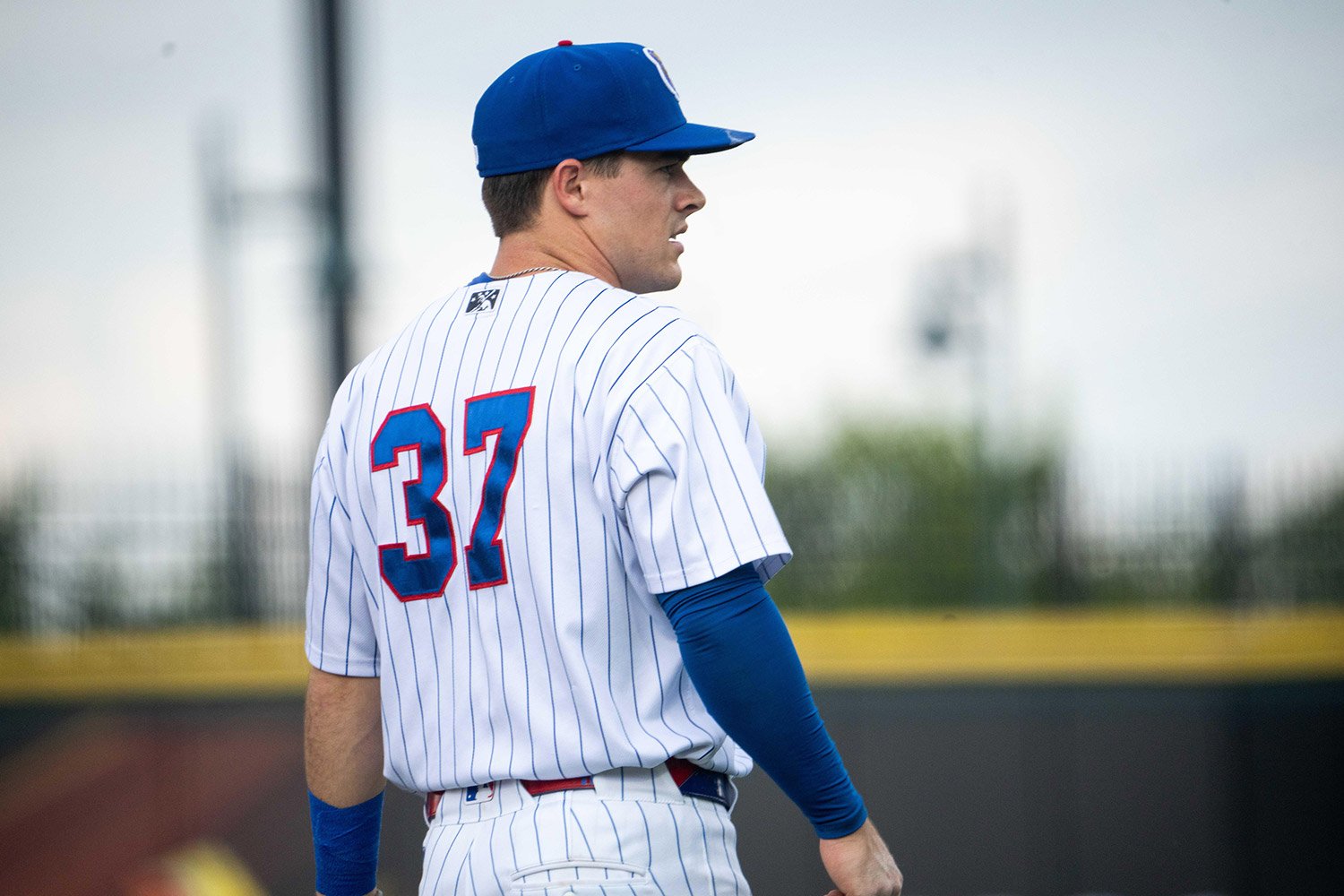 Today, we continue our review of the Top 20 Chicago Cubs prospects (as voted on by the readers of NSBB). Before you read about Matt Shaw, don't miss our previous Top 20 Cubs Prospect articles, including our look at some honorable mentions, the Cubs' Top Prospects #20-16 and the Top Prospects #15-11. #20 - Pedro Ramirez, INF #19 - Luis Vazquez, INF #18 - Michael Arias, RP #17 - Alfonsin Rosario - OF #16 - Drew Gray, SP #15 - Jonathon Long, 1B #14 - Fernando Cruz, SS #13 - Derniche Valdez, SS #12 - Alexander Canario, OF #11 - Cristian Hernandez, SS #10 - Brandon Birdsell, SP #9 - Jaxon Wiggins, SP #8 - Jefferson Rojas #7 - James Triantos #6 - Cam Smith #5 - Kevin Alcantara, OF #4 - Moises Ballesteros, C/1B/DH #3 - Owen Caissie, OF #2 - Cade Horton, SP 2024 Season Review - Matt Shaw, 2B/3B Matt Shaw entered the 2024 season with all sorts of helium. After blowing through A-ball and even holding his own in Double-A during the season's twilight, expectations for the former Terrapin were sky-high. It would be all but fair to say that despite the expectations, the infielder met most/all of them and may have managed to exceed them, as well. One of the big knocks on the diminutive infielder entering the 2024 season was his penchant for being aggressive and probably too aggressive. While his hit tool allows Shaw to make contact often, this is exploitable at higher levels as pitchers will look to take an aggressive swinger and force them to make weak contact by having them make contact on chase pitches. This was a point of emphasis for the Cubs and their top prospect, and it paid off throughout the year, as Shaw didn't just double his walk rate but nearly tripled it (sitting at mid-4% in both South Bend and his first stint in Tennessee in 2023), by walking 12% of the time throughout the season. There were a few learning curves, however, as initially, Shaw had some kinks to work out. Despite posting a pretty nice 120 wRC+ through his first 103 PAs, there was a lack of power displayed, with a lackluster .354 SLG and an ISO that had fallen under .150. This was only a temporary dip, though, as after that power outage, there was an adjustment, and Shaw would go on to see his SLG jump over .500 with an ISO over .200 the rest of the way. This would earn a promotion to Iowa in early August. Once again, Shaw saw initial struggles as he adapted to his new home in Triple-A, struggling out of the gate to a pedestrian 100 wRC+ through his first month. The walk rates remained good, but like the early portion of the 2024 year in Double-A, the power was not following suit. The light kicked on for the Cubs' #1 prospect on August 29th, and Shaw finished with a sparkling 166 wRC+, spanning almost 100 PAs. Shaw wasn't done after Triple-A, as he was involved in the Premier 12, an international tournament that sees a wide array of players taking part, which includes some of the best prospects and professionals (from non-MLB leagues). Showing that his final month in Triple-A was no fluke, Matt would go bonkers all tournament, leading the league in batting average, RBI, hits, OBP, triples, and total bases. For context, Matt Shaw put up better numbers than Seiya Suzuki had the year before coming to the States. Season Outlook and Scouting Report - ETA: Opening Day 2025 In December, the Cubs acquired Kyle Tucker for Isaac Paredes (their starting third baseman at the time) and Cam Smith (who we ranked our 6th-best prospect and the second-best third baseman in the system), clearing the way for Matt Shaw to take over. With all the moving parts, the one constant seems to be - the Chicago Cubs believe their 2023 first-round pick is ready, and ready right now. But just how good will he be right away? A few things should give us a little pause - the first being that if we looked league-wide in 2024, some of the best prospects on the planet (Jackson Chourio and Jackson Holliday are just two to name) struggled initially for large swaths of time. To expect Shaw, who's generally considered a tier below them, to hit the ground running when they couldn't is probably an unfair expectation. Instead, expect a season in which he struggles, makes adjustments, and bounces between adjusting and thriving the rest of the way. Beyond that, a few things should be noted, but I think they fall short of being entirely "red flag" territory (at least, to this point). Shaw does use a pretty pronounced leg kick, which helps generate power through his small frame. This could be exploited at higher levels with even more advanced pitching - MLB pitchers will hit you like you've never been hit before. Also, Shaw does not pull the ball a ton, and this probably has something to do with his setup - it's a definite "toe-in" start, which means it'll just be a bit harder to pull the ball. Why do I stop short of worrying too much; all of these remain squarely in the "hypothetical" category; Shaw has shown aptitude in catching up to velocity and fastballs at a very high level and generally excelled offensively in 2024 regardless of level. Thus far, pitchers have yet to find a way to exploit either his leg kick (as he's posted well above Triple-A contact levels) and his SLG/ISO remain well above league average despite not being a massive-pull hitter. He also shows above-average exit velocity on two-strike counts in which he limits the leg kick, so there seems to be power potential there, regardless. And while the leg kick and the toe-in make him look funny, he wouldn't be the first MLB hitter to do things in a unique way. So, how good do I think Matt Shaw is? Frankly, I think he's very good. He makes contact (a lot). He's got above-average power despite his frame. He's shown an ability and aptitude to change things about his approach. He's worked very hard defensively, and reports on his work at third are strong. He's athletic enough that he's going to add value on the bases. And I'll appeal to authority a bit - but the team who drafted him has seemingly made him unavailable in trade talks and forced open a spot for him on the MLB roster in a way they haven't done for others. I don't think his rookie season will be flawless, and there will be growing pains...but I'm pretty convinced we've got a good one on our hands. What do you think of Matt Shaw? Do you think he's a good bet in 2025? What are your expectations for the rookie? Let us know in the comments below!
 -
It was always going to be Matt Shaw at the top. With trades opening up possibilities on the infield, it's a near lock we'll see the prospect in Chicago. What should we expect from Shaw in 2025? Image courtesy of © Cody Scanlan/The Register / USA TODAY NETWORK It was always going to be Matt Shaw at the top. With trades opening up possibilities on the infield, it's a near lock we'll see the prospect in Chicago. What should we expect from Shaw in 2025? Today, we continue our review of the Top 20 Chicago Cubs prospects (as voted on by the readers of NSBB). Before you read about Matt Shaw, don't miss our previous Top 20 Cubs Prospect articles, including our look at some honorable mentions, the Cubs' Top Prospects #20-16 and the Top Prospects #15-11. #20 - Pedro Ramirez, INF #19 - Luis Vazquez, INF #18 - Michael Arias, RP #17 - Alfonsin Rosario - OF #16 - Drew Gray, SP #15 - Jonathon Long, 1B #14 - Fernando Cruz, SS #13 - Derniche Valdez, SS #12 - Alexander Canario, OF #11 - Cristian Hernandez, SS #10 - Brandon Birdsell, SP #9 - Jaxon Wiggins, SP #8 - Jefferson Rojas #7 - James Triantos #6 - Cam Smith #5 - Kevin Alcantara, OF #4 - Moises Ballesteros, C/1B/DH #3 - Owen Caissie, OF #2 - Cade Horton, SP 2024 Season Review - Matt Shaw, 2B/3B Matt Shaw entered the 2024 season with all sorts of helium. After blowing through A-ball and even holding his own in Double-A during the season's twilight, expectations for the former Terrapin were sky-high. It would be all but fair to say that despite the expectations, the infielder met most/all of them and may have managed to exceed them, as well. One of the big knocks on the diminutive infielder entering the 2024 season was his penchant for being aggressive and probably too aggressive. While his hit tool allows Shaw to make contact often, this is exploitable at higher levels as pitchers will look to take an aggressive swinger and force them to make weak contact by having them make contact on chase pitches. This was a point of emphasis for the Cubs and their top prospect, and it paid off throughout the year, as Shaw didn't just double his walk rate but nearly tripled it (sitting at mid-4% in both South Bend and his first stint in Tennessee in 2023), by walking 12% of the time throughout the season. There were a few learning curves, however, as initially, Shaw had some kinks to work out. Despite posting a pretty nice 120 wRC+ through his first 103 PAs, there was a lack of power displayed, with a lackluster .354 SLG and an ISO that had fallen under .150. This was only a temporary dip, though, as after that power outage, there was an adjustment, and Shaw would go on to see his SLG jump over .500 with an ISO over .200 the rest of the way. This would earn a promotion to Iowa in early August. Once again, Shaw saw initial struggles as he adapted to his new home in Triple-A, struggling out of the gate to a pedestrian 100 wRC+ through his first month. The walk rates remained good, but like the early portion of the 2024 year in Double-A, the power was not following suit. The light kicked on for the Cubs' #1 prospect on August 29th, and Shaw finished with a sparkling 166 wRC+, spanning almost 100 PAs. Shaw wasn't done after Triple-A, as he was involved in the Premier 12, an international tournament that sees a wide array of players taking part, which includes some of the best prospects and professionals (from non-MLB leagues). Showing that his final month in Triple-A was no fluke, Matt would go bonkers all tournament, leading the league in batting average, RBI, hits, OBP, triples, and total bases. For context, Matt Shaw put up better numbers than Seiya Suzuki had the year before coming to the States. Season Outlook and Scouting Report - ETA: Opening Day 2025 In December, the Cubs acquired Kyle Tucker for Isaac Paredes (their starting third baseman at the time) and Cam Smith (who we ranked our 6th-best prospect and the second-best third baseman in the system), clearing the way for Matt Shaw to take over. With all the moving parts, the one constant seems to be - the Chicago Cubs believe their 2023 first-round pick is ready, and ready right now. But just how good will he be right away? A few things should give us a little pause - the first being that if we looked league-wide in 2024, some of the best prospects on the planet (Jackson Chourio and Jackson Holliday are just two to name) struggled initially for large swaths of time. To expect Shaw, who's generally considered a tier below them, to hit the ground running when they couldn't is probably an unfair expectation. Instead, expect a season in which he struggles, makes adjustments, and bounces between adjusting and thriving the rest of the way. Beyond that, a few things should be noted, but I think they fall short of being entirely "red flag" territory (at least, to this point). Shaw does use a pretty pronounced leg kick, which helps generate power through his small frame. This could be exploited at higher levels with even more advanced pitching - MLB pitchers will hit you like you've never been hit before. Also, Shaw does not pull the ball a ton, and this probably has something to do with his setup - it's a definite "toe-in" start, which means it'll just be a bit harder to pull the ball. Why do I stop short of worrying too much; all of these remain squarely in the "hypothetical" category; Shaw has shown aptitude in catching up to velocity and fastballs at a very high level and generally excelled offensively in 2024 regardless of level. Thus far, pitchers have yet to find a way to exploit either his leg kick (as he's posted well above Triple-A contact levels) and his SLG/ISO remain well above league average despite not being a massive-pull hitter. He also shows above-average exit velocity on two-strike counts in which he limits the leg kick, so there seems to be power potential there, regardless. And while the leg kick and the toe-in make him look funny, he wouldn't be the first MLB hitter to do things in a unique way. So, how good do I think Matt Shaw is? Frankly, I think he's very good. He makes contact (a lot). He's got above-average power despite his frame. He's shown an ability and aptitude to change things about his approach. He's worked very hard defensively, and reports on his work at third are strong. He's athletic enough that he's going to add value on the bases. And I'll appeal to authority a bit - but the team who drafted him has seemingly made him unavailable in trade talks and forced open a spot for him on the MLB roster in a way they haven't done for others. I don't think his rookie season will be flawless, and there will be growing pains...but I'm pretty convinced we've got a good one on our hands. What do you think of Matt Shaw? Do you think he's a good bet in 2025? What are your expectations for the rookie? Let us know in the comments below! View full article
-
I guess. Though in his defense - I'm not sure there's much anything large we could expect. Dennis Lin of the Athletic reported that the Padres are inclined to keep Cease and King, and even if that's posturing, the Padres have held a pretty high line there. So if that's not realistic...there's not much more you really can do that moves a needle that much.
-
He said that the big and medium pieces were all likely here. I doubt the Cubs would entirely shut down a decent trade negotiation, but Jed made it kind of sound like "we mostly like what we have currently" and that as the season went on the Cubs would look to address any issues that would arise. Would I rule out Canha/Turner? Nope. Would I expect the Cubs to add anything past a bench piece (in the interim) with his words? Also nope.
-
I'm not sure I'm a fan of Nolan Arenado moving forward. You can probably make an argument that in a vacuum, in 2025, that he's a much safer bet than Matt Shaw. I can probably get behind that. Defensively he's still pretty good and he has wRC+ above 100 each of the last two seasons. But the issue in Arenado is that is what seems to be a pretty clear decline in offensive ability over his last two years. Essentially, since 2021, you can pick an offensive category: xBA, xSLG, wOBA, EV, max EV, hard hit...and they all have gotten worse two years running. His pitch recognition and swing choices remain very strong, but what he's doing when he makes contact is getting worse and worse. You're not trading for 1 year of Nolan, but three. And the picture the data is suggesting is that we may be getting to a cliff for him offensively, and he's in the process of falling off of it.
-
Burger's a good comp in most areas, I think. I'm not entirely certain you meant it as a 1:1, so this is less at you, but more of expounding - where Caissie has an advantage, it's in that Burger's never been much of a walk threat. He's run walk% in the single digits most of his minor league career. And Caissie has managed to do things at a much younger age - Burger was in Double-A at age 26. So with that said, if the Cubs can get Burger's power/contact rate with Caissie's walk rate...you're probably looking at like a Pete Alonso type of an outcome last season (though probably a few extra K's) of something around his slash. .240/.329/.459, an ISO of 219 and a wRC+ of 122. Still have things that need to come together there - Caissie would still need to develop and show he can hit MLB pitching, but that feels like a realistic outcome if he can keep the K's somewhat in line, use the improved power swing, and walk more than Burger.
-
I do think he'll get some MLB run later. There's too much stuff and the Cubs project to be good enough that I can't see him spending a full year in Iowa. With that said I do think he'll probably be on the Adam Wainwright path of "Bullpen, then rotation in 2026" but how they handled Brown last year makes you wonder "maybe they'll push it a bit"
-
You know what - I was wrong with the source I used on that! Regardless, I think the overall point remains. The source I went back to look came from an earlier time and that's what I get for not second-sourcing it.
-
The top arm in the Cubs system started hot in 2024, but then a mediocre stint in Triple A and a lat injury derailed his hype train. What should we expect from the fireballing righthander in 2025? Will he bounce back? Image courtesy of © MATTIE NERETIN / USA TODAY NETWORK The top arm in the Cubs system started hot in 2024, but then a mediocre stint in Triple A and a lat injury derailed his hype train. What should we expect from the fireballing righthander in 2025? Will he bounce back? Today, we continue our review of the Top 20 Chicago Cubs prospects (as voted on by the readers of NSBB). Second-best, by their reckoning, is the team's top pick in the 2022 MLB Draft and a pitcher they hope will soon find a home in the middle of their rotation. Before you read about Cade Horton, though, don't miss our previous Top 20 Cubs Prospect articles including our look at some honorable mentions, the Cubs' Top Prospects #20-16 and the Top Prospects #15-11. #20 - Pedro Ramirez, INF #19 - Luis Vazquez, INF #18 - Michael Arias, RP #17 - Alfonsin Rosario - OF #16 - Drew Gray, SP #15 - Jonathon Long, 1B #14 - Fernando Cruz, SS #13 - Derniche Valdez, SS #12 - Alexander Canario, OF #11 - Cristian Hernandez, SS #10 - Brandon Birdsell, SP #9 - Jaxon Wiggins, SP #8 - Jefferson Rojas #7 - James Triantos #6 - Cam Smith #5 - Kevin Alcantara, OF #4 - Moises Ballesteros, C/1B/DH #3 - Owen Caissie, OF 2024 Season Review - Cade Horton, SP Horton's 2024 started like gangbusters. With 18 strikeouts in 16 innings at Tennessee, it was pretty clear that the pitcher was picking up right where he left off the year before. Perhaps more impressive was that, through those four starts, Horton only walked two hitters. On Apr. 27, Horton gave the Smokies five strong frames, striking out six, walking none and surrendering no runs. It would be his highwater mark of the season, and his last start at Double A. Getting promoted to Triple-A Iowa at the start of May, it seemed as if the righty was on the precipice of being ready for the biggest stage. All he had to do was continue the good times against International League hitters. Sadly for the pitcher and the Cubs, that did not come to fruition. Horton struggled with his new assignment, especially in the control department. Walks had not been a problem at any level previously, but at Iowa, the pitcher walked 11 opposing batters in 18 innings. He still displayed a penchant for striking hitters out, as he had a 27% strikeout rate, but he also got hit when he came in the zone. Displaying a velocity drop, and with reports of mediocre fastball shape, it was obvious something wasn't right. Things went from bad to worse for Horton. His last trip to the mound was on May 29. After that start, in which he was knocked around, we learned of a lat injury. The Cubs, in a combination of rehabbing the injury and an abundance of caution for a pitcher who has a Tommy John surgery on his record already, shut the starting pitcher down for the rest of the season. The lat strain could be attributed to a few causes. It could be that the fastball shape and velocity decline were tied to the lat strain, or it could be that the Cubs were tweaking his pitch grips and mechanics, which caused the strain to begin with. It's also possible that whatever diminution in stuff he suffered was unrelated, of course. Either way, it was a disappointing end to his season. Season Outlook and Scouting Report - ETA: Back Half of 2025 Horton's disjointed, disappointing season has added some fog as we try to project what 2025 could bring for the Cubs' top-ranked pitcher. Throwing fewer than 35 innings last year will make it difficult for the Cubs to consider him getting 140-plus innings on the 2025 campaign. It likely means that the Cubs will have to find ways to limit him (most likely in his buildup) if they want him to contribute in the majors this season. It could also mean that he works as a reliever in 2025, before a transition to the MLB rotation in 2026. We shouldn't fully rule out an MLB rotation inclusion; the Cubs were quick to put Ben Brown into the rotation last year after an injury-shortened season in 2023. However, the Cubs enter 2025 much deeper in pitching talent than last year. The good news for the Cubs and their pitcher is that Horton is already throwing in Arizona, saying he's fully healthy and over the lat strain. Moving forward, it will be interesting to follow the trends with his fastball shape and velocity. The Cubs are a team of tinkerers, and bringing in Tyler Zombro should only help them tinker with and tweak Horton a bit more. I know the initial reaction will be to think a bit doom-and-gloom with Horton moving forward. He'll have injury worries attached to him for a bit, and the velocity drop and fastball shape slump (if that's what it was) is a bit concerning. With that said, there are reasons to remain optimistic on him. With a clean bill of health, a new voice and a new season, he could once again show dominance on the mound. I still think there's a pitcher who can anchor a rotation within Horton, though we are seeing some of the risk that he lands in the bullpen or is neutralized by injuries play out before our very eyes. What do you think of Cade Horton's development so far? Do you think we should be worried about the velocity dip? Do you think it's a result of the injury? And when do you think he'll debut? Let us know in the comments below! View full article