.jpg.900f6d1bc80a5a156f3ba09ea0e4b3d7.jpg)

Jason Ross
-
Posts
8,153 -
Joined
-
Last visited
-
Days Won
74
Content Type
Profiles
Joomla Posts 1
Chicago Cubs Videos
Chicago Cubs Free Agent & Trade Rumors, Notes, & Tidbits
2026 Chicago Cubs Top Prospects Ranking
News
2023 Chicago Cubs Draft Picks
Guides & Resources
2024 Chicago Cubs Draft Picks
The Chicago Cubs Players Project
2025 Chicago Cubs Draft Pick Tracker
2026 Chicago Cubs Draft Tracker: Picks & Bonuses
Blogs
Events
Forums
Store
Gallery
Everything posted by Jason Ross
-
Oh I'll dock myself there! He struck out twice against Walker. But hey, he bailed me out against a LHP, so hey, we all get a little lucky. Mostly feel like we're seeing the start of the PCA bananas streak. He did this before. He begins to get more selective. Then he starts getting hits, Then he gets a home run or two. Then they come in bunches. Then he goes super-aggressive and eventually begins getting himself out. The backslide is always annoying but that Super Saiyan time is fun. And with the Cubs pitching injuries, a bananas streak would be good right now
-
Justin Steele had "a setback" per Jesse Rogers. He is currently "shut down" and "Memorial Day return" is "in jeopardy"
-
There's always another pitch. The Cubs had a runner on third in the 7th with one out who didn't score. They had a runner on in the 9th. France's hit came well after that. There's always another chance. The Cubs weren't helped at all by the umpire. I'm not going to let the umpire entirely off the hook. But there are 9 innings of baseball. When you lose a game 9-7, you had more than a single chance and if you leave it up to an umpire...you deserve your outcome. I'm with you; we should move to a situation where an umpire doesn't play a role if we have the tech to make it not happen. But last night the Cubs lost a baseball game and I'll blame the team for losing before an umpire.
-
I'll agree with you on part of this and disagree with you on others. First, I do think a full ABS is the way to go eventually. I'm okay with a slow-roll out. The challenge system allows us all to get used to the new zone, the hitters and pitchers to get used to the zone, fans to get used to the fractional calls...I think it's fine. In fact, I'd be okay with it taking a year or two yet. But I do think we need to get to a full roll out. There is no reason not to be accurate. Rules are rules, and I don't really think the idea of cheating the umpire is charming or anything, myself. I will say this: the Cubs lost because the Cubs lost last night. You give up nine runs, that's on you, ultimately. Even if the calls went against you. I'm a big believer that if you leave the game up to chance like that, it's your fault on the back end. But yeah, let's make the game by the rules. I've played a lot of baseball. A lot of baseball in my life. If we have a way to ensure objective rules every time, there's no reason not to, IMO.
-
Steele was placed on the 60 day IL so he has a bit to go. I wouldn't expect much yet. Complex league is about to start; I think he will probably throw there first and then works his way up. Palencia was supposed to begin throwing this weekend or so. Expect something soon about him headed to like Knoxville or Iowa for a rehab stint.
-
Velazquez locker has been cleared. Looks like Maton up, Vince out.
-
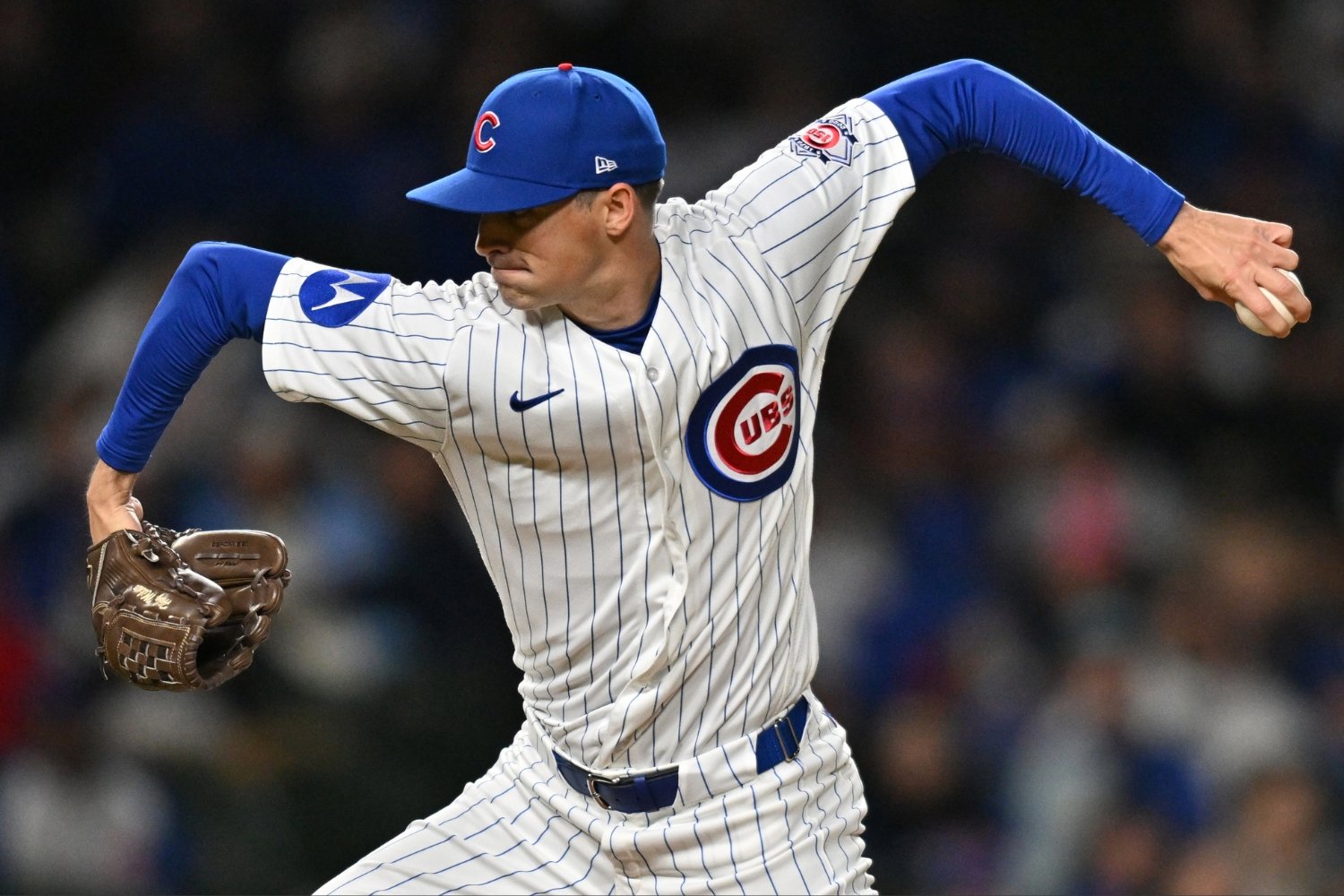 The Chicago Cubs signed left-handed pitcher Hoby Milner in the offseason to pair with Caleb Thielbar as the team's primary two southpaws in the pen. Milner had many years of service with the Milwaukee Brewers and his time overlapped with manager Craig Counsell, meaning there was (and is) a familiarity between the two. Milner has always been a unique reliever; with fastball velocities that are well below the norm (and well below 90mph) and a funky arm slot, he's carved out a role that has allowed him to thrive at times. Thus far with the Cubs, Milner has, on the surface, performed well. His ERA sits at 2.19 on the year, and he's limited left-handed hitters to just a .182 average and a .249 wOBA; this is what he was brought to Chicago to do. In fact, his wOBA against so far (in very limited sample size) for left-handed hitters is better than his career average. However, there are some red flags in his 12 innings and change so far, as well. One of the first flags can be seen within his FIP, which sits at 5.16, nearly three runs over his ERA currently. His expected FIP is over 6.00. On their own, this is not good; when FIP and ERA don't align, something is up. There are ways to outperform your FIP. We only need to look at Cubs icon Kyle Hendricks for this recipe. If you throw a lot of strikes, don't walk hitters, and keep the ball in play specifically on the ground, you can make an entire career of throwing 88mph and beating your FIP. Which brings us to our second red-flag: Hoby Milner is not getting ground balls. Milner is normally a ground-ball machine. Over his previous 264 innings before coming to the North Side, Milner sat at a groundball rate of 51.1%. That puts him just within the top 20 in terms of all relievers over that span (17th to be exact). Yet, so far, his ground-ball rate is sitting below 40% on the year; this is a massive drop in ground balls and a reason for us to pause the idea that he's somehow out-pitching his FIP and that he's well on the way to being a FIP-beater in 2026. The next red flag: a massive drop in strikeouts. Milner, despite throwing below 90mph, has never been a strikeout slouch (even if he was never a standout in that regard) Over that same 264-inning span, the side-armer struck out 22.6% of the hitters he faced. This is a bit below league average, but considering how much lower his velocity sits, this is fairly admirable. Yet in 2026, he's down to just three strikeouts total, good for a 6.1% strikeout rate. That's not good. In fact, while he's struck out only three hitters, he's walked four meaning so far, more walks than strikeouts. So, what's going on? I don't think he's broken and I think this is probably some small sample stuff more than anything. While it's true that his fastball velocity has dipped slightly (down from an 88mph average last year to an 87.5mph fastball this year), his Fangraphs' Stuff+ rating hasn't really seen a drop-off; his overall Stuff+ is at 104 (compared to his career Stuff+ 106) and his fastball Stuff+ is standing steady at 107. In his last outing against the Philadelphia Phillies on April 23, his velocity was 87.8mph. He looks fine in this regard. He's also not struggling to get swings outside the zone, as he has a 29.1% chase rate, which is the highest chase rate the lefty has gotten since 2023. His whiff% and his K% are clearly in the bottom one percent (a K% of 6.1% will do that), so it's hard to figure out why he's not really getting whiffs right away. If the velocity is fine, and the shape is fine, and he's getting more chase... you'd expect the strikeouts to follow. One reason why he may be struggling here a bit: he's featured the sinker more than you'd normally expect. His usage on this pitch is up from 33.4% to over 43% of the time. His whiff% last year on the sinker was 9.7% and this year it's 9.1%. It's just not a pitch that's designed to strike hitters out. It is used for groundballs and batted ball control and I think this is exactly why his FIP, xFIP, and K% are all out of whack: Milner has faced a ton of traffic. In fact, over his 12.1 IP, the vast majority has been when runners were on, the exact time you'd be more careful in terms of throwing strikes. We can see which pitch Milner uses as his "strike-throwing" pitch with a visualization of how he uses his offerings. His sweeper and his changeup are generally used when he wants you to chase off the plate, especially his sweeper. This is not a pitch he wants in the zone, but well out of the zone; it's why it has such a high whiff percentage. His sinker, however, is a pitch that is far more in-and-around the zone. If you're stuck facing traffic on the bases, you don't want to throw a sweeper off the plate. In a worse-case scenario, it's not only a ball, but gets past the catcher and moves the runners up. Instead, you're likely to be much more careful and intentional. Milner's best pitch has generally been that sweeper. This is a weapon out of the hand of the reliever because of how awkward his arm angle is; the only LHP in MLB with a lower arm slot so far in 2026 is former Cub and current Yankee, Tim Hill. He's using it less than normal this year, almost an 8% reduction in usage. Why? Again, there's probably a good argument that contextually, he's been less able to use it dealing with so many runners on base. MVlEYVJfWGw0TUFRPT1fQlFRRlVGWUFBMVFBREFFTFV3QUFWVlVEQUZsVVVRY0FWbFJVVWxjRlV3cFdWZ3BX.mp4 One other part of the story: the injuries the Cubs are facing. So far, the Cubs have had to send all three of their high-leverage relievers, Daniel Palencia, Phil Maton and Hunter Harvey, to the IL. Recently, Caleb Thielbar has also joined those four. The pecking order is all out of whack for Counsell. Milner hasn't always been placed in his best spots. On April 20, he was brought in to face left-handed hitter Kyle Schwarber to end an inning. He was left out to start the next inning as another lefty, Bryce Harper, was leading off. However, he walked the lefty and then got stuck facing Adolis Garcia and Alec Bohm during this inning. Is that the best usage of Milner? Probably not; I suspect the team may have replaced their southpaw with Bohm up and a runner on in a perfect world. Instead, Milner clearly worked around Bohm to put two on to face fellow lefty Bryson Stott. It all worked out; no one scored, but with the lack of bullpen depth right now, the Cubs are left to ask themselves if they would more trust Milner's experience or someone else's inexperience too often right now. What this all means is that we're in a situation where neither his ERA or his underlying numbers are telling us the whole story. What feels most likely is that, due to a combination of pitching injuries jumbling the bullpen pecking order and small sample size, Milner's going to be fine when these things normalize. His stuff appears to be about the same as it always is in both velocity and shape, and he appears healthy. Hitters are hitting him harder, but he hasn't really gotten to use his best pitches as often and he's been put into a lot of situations where runners are on base. Nothing in his profile suggests he's incapable of getting whiffs. In fact, his sweeper whiff rate is actually up from 2025! In the end, it's probably safe to expect that Milner's probably not as good as his ERA would indicate, but not nearly the disaster his xFIP suggests he's been. Data is great, but data sometimes can miss context; all xFIP sees is a lack of strikeouts, not that the Cubs' pitching staff has been ravaged by injury and that the veteran reliever, being one of the few pitchers that Counsell can trust in big moments, has likely been put in situations he isn't well-suited for. While Milner may not be someone who's going to blow you away, his availability during a time in which the Cubs need arms is not-nothing, either. He might not be striking out a ton of hitters, but he's been just effective enough and has helped the Cubs through a rough period in his own way. What do you think of Hoby Milner so far? Do you trust the ERA? Are you worried about the lack of strikeouts? Sound off in the comment section below and start a discussion!
 -
Image courtesy of © Patrick Gorski-Imagn Images The Chicago Cubs signed left-handed pitcher Hoby Milner in the offseason to pair with Caleb Thielbar as the team's primary two southpaws in the pen. Milner had many years of service with the Milwaukee Brewers and his time overlapped with manager Craig Counsell, meaning there was (and is) a familiarity between the two. Milner has always been a unique reliever; with fastball velocities that are well below the norm (and well below 90mph) and a funky arm slot, he's carved out a role that has allowed him to thrive at times. Thus far with the Cubs, Milner has, on the surface, performed well. His ERA sits at 2.19 on the year, and he's limited left-handed hitters to just a .182 average and a .249 wOBA; this is what he was brought to Chicago to do. In fact, his wOBA against so far (in very limited sample size) for left-handed hitters is better than his career average. However, there are some red flags in his 12 innings and change so far, as well. One of the first flags can be seen within his FIP, which sits at 5.16, nearly three runs over his ERA currently. His expected FIP is over 6.00. On their own, this is not good; when FIP and ERA don't align, something is up. There are ways to outperform your FIP. We only need to look at Cubs icon Kyle Hendricks for this recipe. If you throw a lot of strikes, don't walk hitters, and keep the ball in play specifically on the ground, you can make an entire career of throwing 88mph and beating your FIP. Which brings us to our second red-flag: Hoby Milner is not getting ground balls. Milner is normally a ground-ball machine. Over his previous 264 innings before coming to the North Side, Milner sat at a groundball rate of 51.1%. That puts him just within the top 20 in terms of all relievers over that span (17th to be exact). Yet, so far, his ground-ball rate is sitting below 40% on the year; this is a massive drop in ground balls and a reason for us to pause the idea that he's somehow out-pitching his FIP and that he's well on the way to being a FIP-beater in 2026. The next red flag: a massive drop in strikeouts. Milner, despite throwing below 90mph, has never been a strikeout slouch (even if he was never a standout in that regard) Over that same 264-inning span, the side-armer struck out 22.6% of the hitters he faced. This is a bit below league average, but considering how much lower his velocity sits, this is fairly admirable. Yet in 2026, he's down to just three strikeouts total, good for a 6.1% strikeout rate. That's not good. In fact, while he's struck out only three hitters, he's walked four meaning so far, more walks than strikeouts. So, what's going on? I don't think he's broken and I think this is probably some small sample stuff more than anything. While it's true that his fastball velocity has dipped slightly (down from an 88mph average last year to an 87.5mph fastball this year), his Fangraphs' Stuff+ rating hasn't really seen a drop-off; his overall Stuff+ is at 104 (compared to his career Stuff+ 106) and his fastball Stuff+ is standing steady at 107. In his last outing against the Philadelphia Phillies on April 23, his velocity was 87.8mph. He looks fine in this regard. He's also not struggling to get swings outside the zone, as he has a 29.1% chase rate, which is the highest chase rate the lefty has gotten since 2023. His whiff% and his K% are clearly in the bottom one percent (a K% of 6.1% will do that), so it's hard to figure out why he's not really getting whiffs right away. If the velocity is fine, and the shape is fine, and he's getting more chase... you'd expect the strikeouts to follow. One reason why he may be struggling here a bit: he's featured the sinker more than you'd normally expect. His usage on this pitch is up from 33.4% to over 43% of the time. His whiff% last year on the sinker was 9.7% and this year it's 9.1%. It's just not a pitch that's designed to strike hitters out. It is used for groundballs and batted ball control and I think this is exactly why his FIP, xFIP, and K% are all out of whack: Milner has faced a ton of traffic. In fact, over his 12.1 IP, the vast majority has been when runners were on, the exact time you'd be more careful in terms of throwing strikes. We can see which pitch Milner uses as his "strike-throwing" pitch with a visualization of how he uses his offerings. His sweeper and his changeup are generally used when he wants you to chase off the plate, especially his sweeper. This is not a pitch he wants in the zone, but well out of the zone; it's why it has such a high whiff percentage. His sinker, however, is a pitch that is far more in-and-around the zone. If you're stuck facing traffic on the bases, you don't want to throw a sweeper off the plate. In a worse-case scenario, it's not only a ball, but gets past the catcher and moves the runners up. Instead, you're likely to be much more careful and intentional. Milner's best pitch has generally been that sweeper. This is a weapon out of the hand of the reliever because of how awkward his arm angle is; the only LHP in MLB with a lower arm slot so far in 2026 is former Cub and current Yankee, Tim Hill. He's using it less than normal this year, almost an 8% reduction in usage. Why? Again, there's probably a good argument that contextually, he's been less able to use it dealing with so many runners on base. MVlEYVJfWGw0TUFRPT1fQlFRRlVGWUFBMVFBREFFTFV3QUFWVlVEQUZsVVVRY0FWbFJVVWxjRlV3cFdWZ3BX.mp4 One other part of the story: the injuries the Cubs are facing. So far, the Cubs have had to send all three of their high-leverage relievers, Daniel Palencia, Phil Maton and Hunter Harvey, to the IL. Recently, Caleb Thielbar has also joined those four. The pecking order is all out of whack for Counsell. Milner hasn't always been placed in his best spots. On April 20, he was brought in to face left-handed hitter Kyle Schwarber to end an inning. He was left out to start the next inning as another lefty, Bryce Harper, was leading off. However, he walked the lefty and then got stuck facing Adolis Garcia and Alec Bohm during this inning. Is that the best usage of Milner? Probably not; I suspect the team may have replaced their southpaw with Bohm up and a runner on in a perfect world. Instead, Milner clearly worked around Bohm to put two on to face fellow lefty Bryson Stott. It all worked out; no one scored, but with the lack of bullpen depth right now, the Cubs are left to ask themselves if they would more trust Milner's experience or someone else's inexperience too often right now. What this all means is that we're in a situation where neither his ERA or his underlying numbers are telling us the whole story. What feels most likely is that, due to a combination of pitching injuries jumbling the bullpen pecking order and small sample size, Milner's going to be fine when these things normalize. His stuff appears to be about the same as it always is in both velocity and shape, and he appears healthy. Hitters are hitting him harder, but he hasn't really gotten to use his best pitches as often and he's been put into a lot of situations where runners are on base. Nothing in his profile suggests he's incapable of getting whiffs. In fact, his sweeper whiff rate is actually up from 2025! In the end, it's probably safe to expect that Milner's probably not as good as his ERA would indicate, but not nearly the disaster his xFIP suggests he's been. Data is great, but data sometimes can miss context; all xFIP sees is a lack of strikeouts, not that the Cubs' pitching staff has been ravaged by injury and that the veteran reliever, being one of the few pitchers that Counsell can trust in big moments, has likely been put in situations he isn't well-suited for. While Milner may not be someone who's going to blow you away, his availability during a time in which the Cubs need arms is not-nothing, either. He might not be striking out a ton of hitters, but he's been just effective enough and has helped the Cubs through a rough period in his own way. What do you think of Hoby Milner so far? Do you trust the ERA? Are you worried about the lack of strikeouts? Sound off in the comment section below and start a discussion! View full article
-
I've lived in Kentucky for over two decades now and the the closest MLB park for me is in Cincinnati (roughly a little over an hour's drive). I've made my way to the GAB many times, mostly to see the Cubs. It does not matter if the Reds are good or the Reds are bad, you can almost always buy a $10 (or so) ticket in the LF bleachers, wander for a hot minute and grab a lower level empty seat because the place has so many empty seats. And it isn't as if it's a bad park (it's a nice field, though I don't love-love it) nor is it poorly situated to get in an out of.
-
Yep! One of these guys will burn the Cubs. Someday. Sometime. Nature of the beast.
-
He might be a slightly different bird, but he's a bird of a feather as a "lottery ticket who if he hits could be really cool but is super unlikely to hit". But also it's important to understand that Cruz isn't a "much" better prospect, or at least, hasn't been seen that way by the industry up until now. This is what was written of Cruz at the start of last year by BA: A good reminder that contact issues aren't always noticeable at lower levels in the form of K's but can become issues later on. As well, Brethowr has hovered around a 25-26% K% so far. His K% isn't horrible either. He's made considerably mechanical changes. He's striking out a ton this year, and he has had K concerns, but I wouldn't classify him as some K-monster to Cruz's as they had identical 26.7 K% in A+ right now (though Cruz's due to his age is more impressive so far!) Both were in the same draft. It's true that Cruz was selected higher, but they were ranked in a similar range, The difference between the #382nd ranked prospect and the #486th (both BA) is basically preference at that stage. Once you get there it's kind of up to the evaluator. And probably Cruz's age adds in some extra potential of the unknown. Also, the Cubs valued them similarly. Cruz was sent for 2 months of Siroka and Brethowr the return for Rogers. Neither were expensive and both were let go for pretty small rental pieces. I got no issues if you like Cruz more! Any one of us dorks who care about kids who will probably never play MLB have players we like more. I just don't think they're vastly different prospects in the grand scheme of things. Lottery ticket pet projects.
-
It's easy to say that now, that we know that Eli Morgan didn't do anything and got hurt, but the reality is that it's still more likely that the 7 innings that Eli Morgan gave the Cubs are 7 more innings than Alfonsin Rosario ever has in the MLB. No shade towards Rosario either; I hope he does well! I have no reason to root against him. But striking out over 35% of the time in AA is not a green flag whatsoever, either. And at 200 PA's it isn't impossible this isn't a speed bump, but for a player who's profile has always been "power over hit" the outlier seems to be the 82 games in A+ and not his current time in AA, too. That's not me saying "don't' draft upside" but that prospects are capital, ultimately. They can be capital in the form of players who provide value for your organization, or provide value in the form of getting established players who will provide for your organization. And I say all of this as someone who really really liked Ivan Brethowr last year. He's another one of these guys who has a lot of upside and could be good. But alas, he too will probably provide no MLB value. The reality of Rosario, Bretowr and Cruz, and almost all of these lottery tickets is this: they're far more likely to be in the camp of Michael Arias, Nelson Velazquez, Kevin Made and Alexander Canario of "guys people were upset at losing at first, and then never think of again". Every so often one of them will hit, maybe that's Rosario or Cruz or Brethowr or whomever the Cubs trade this July that someone makes their pet-project, but more likely, almost all of them will fail and the Cubs will come out ahead in almost all of those deals. Even if "coming out ahead" is "two months of an okay MLB player" or something that doesn't feel impressive.
-
Yeah, BA is being a bit hyperbolic right now. On both. Both have had cool starts to the season. Frankly, amazing starts to the year. I'll point to Alfonsin Ramirez for a moment. Ramirez was an upside mid-top-10 pick who had really fun upside but issues with the bat. We traded him to Cleveland in the first half of last year in A+ he crushed it. He dropped his K% from 32.7 in Myrtle down to 25.1% while going up a level. But since then, he's fallen back to Earth. He posted a K% over 33% in AA last year and this year it's over 40%. People were freaking out the first few months about dealing him for Eli Morgan, That's sentiment seems to have gone away. Ronny Cruz is off to a great start. But eh, he's a lottery ticket still. I'm super jazzed about Pedro Ramirez, and his I'm a little more bullish on simply because he's always hit and he's still hitting just with a little more power. Track record and stuff. But the "best prospect in baseball"? Ya'll...
-
Oh. Damn. Last I saw it was 6-2. horsefeathers hah.
-
Makes the rat make sense.
-
Thankfully for Phillies fans, Flyers hockey is back. Because if it wasn't, Philly would be a pretty ugly media landscape right now.
-
For a lot of this hotstreak, you can say that maybe the team was getting a bit lucky. They beat up on guys like Taijan Walker or whatever. Sanchez is legit-legit and they're bashing him right now.
-
Ian. horsefeathers. Happ. Wow
-
Minor League Discussion & Boxes, 4-22-26
Jason Ross replied to CaliforniaRaisin's topic in Cubs Minor League Talk
Was just talking to someone else about that. I think it's just a combo of "xData isn't super amazing in small samples" and "xData doesn't differentiate directional hitting". Pedro's pullair% is super high and xData is going to treat everything like it's neutral. -
Minor League Discussion & Boxes, 4-22-26
Jason Ross replied to CaliforniaRaisin's topic in Cubs Minor League Talk
Pedro entering today:
-
Guys, I think Taijaun Walker might suck.
-
Minor League Discussion & Boxes, 4-22-26
Jason Ross replied to CaliforniaRaisin's topic in Cubs Minor League Talk
I don't *hate* the idea of Murray in the 26th spot, but I'd have some reservations with the running. Really that's been the primary usage of Kingery. If you told me he'd give you enough value to be a decent hitter against RHP and that the team would actually use him in that role (for Busch, or PCA if you trusted someone else to take CF) in a critical spot where you'd need a RHH, I could think it'd work. But as a 1:1 right now, I'm not sure he'd get many/if any more PA's than Kingery and wouldn't add the pretty solid speed element Kingery can. -
You caught me in the 2 minutes between edits. It's 25% and down to 21%.
-
A little of column A a little of Column B, probably. He's chasing less (25% to 21% from last to this year), And his first pitch swing% is way down (38.8% to 20%). That said he's getting 10% less strikes in general, and he's gotten less pitches on the edge. So it's probably a two-fold answer: Dansby is being selective currently and picking out good pitches more often than he has in the past. Pitchers are also throwing way less pitches in the zone. At some point MLB teams will readjust to that, so we'll see where go from that.
-
The Reds have the league's 3rd worst wRC+ and the league's 4th worst fWAR for position players and are running a +3 RD. They're a false positive as well if they don't start hitting. Their pitching is fine, but a 9th best ERA and the 12th best fWAR on the pitching side cannot cover up being this bad offensively most nights. The wins they have don't come off the board. But what they are doing might be the most unsustainable thing in the league right now.