.jpg.900f6d1bc80a5a156f3ba09ea0e4b3d7.jpg)

Jason Ross
-
Posts
8,154 -
Joined
-
Last visited
-
Days Won
74
Content Type
Profiles
Joomla Posts 1
Chicago Cubs Videos
Chicago Cubs Free Agent & Trade Rumors, Notes, & Tidbits
2026 Chicago Cubs Top Prospects Ranking
News
2023 Chicago Cubs Draft Picks
Guides & Resources
2024 Chicago Cubs Draft Picks
The Chicago Cubs Players Project
2025 Chicago Cubs Draft Pick Tracker
2026 Chicago Cubs Draft Tracker: Picks & Bonuses
Blogs
Events
Forums
Store
Gallery
Everything posted by Jason Ross
-
Cubs (Rea) vs Reds (Greene): 9/18/25, 6:15pm
Jason Ross replied to Brandon Glick's topic in Fred Hornkohl Game Thread Forum
Reddit told me he sucks though and he is vastly overpaid. -
The new playoff bracket has increased randomness across the board. Higher seeds are basically a coinflip across the board. No shame to the Brewers, they've won the division (even if only virtually, I struggle to see any path that doesn't lead to that outcome). If the two meet, it would be a fun series regardless. I'm just not that worried about records against teams over or under .500. It's more anecdotal than anything it seems.
-
The Rangers had a losing record against teams above ,500 in 2023, and they won the WS. In 2022, the Phillies had a losing record against teams above ,500 and they went to the WS. There is plenty of recent data in our current playoff format that dispels this as being a disqualifier.
-
Can we bank some over the next 2 weeks and apply them until later? Like an uno-reverse card?
-
Winner of 4/5 always plays 1 seed, winner of 3/6 always plays 2 seed. There is no reseeding in the MLB playoffs. Strict bracket.
-
I assume you mean Horton. I doubt there is a "pitch count". I do think the goal will be for almost any SP "give me your best 5 innings". The playoffs are a time period in which games are won and lost, many times, through the BP. So I would expect a short leash on all arms to get to favorable BP matchups.
-
I would assume we will see Shota game 1, Horton game 2 and Boyd will be game 3 or kept for Series 2 game 1
-
For any of that to matter, the Cubs would have to literally lose every single game the rest of the year. They have virtually clinched the playoffs. It is next to impossible for everything to occur that would require a single tie-break scenario. Matt wrote an article on the front page breaking it all done, but needless to say, the Cubs have made the playoffs in any realistic scenario your brain can wrap your head around and by the end of today it will likely be even beyond any mathematical doubt.
-
Minor League Discussion & Boxes, 9-16-25
Jason Ross replied to CaliforniaRaisin's topic in Cubs Minor League Talk
Injuries and a lack of opportunity. I don't really love Jordan Wicks' profile as a reliever but I think as a SP over a handful of innings, his mix works a little better. He doesn't have a standout secondary yet; his changeup is good to attack opposite side hitters, but it's not really a devastating pitch (shape wise). The slider is making some progress but still sits at 103 Stuff+. -
Damnit! Let me fix that. I had his page up and my brain farted reading it.
-
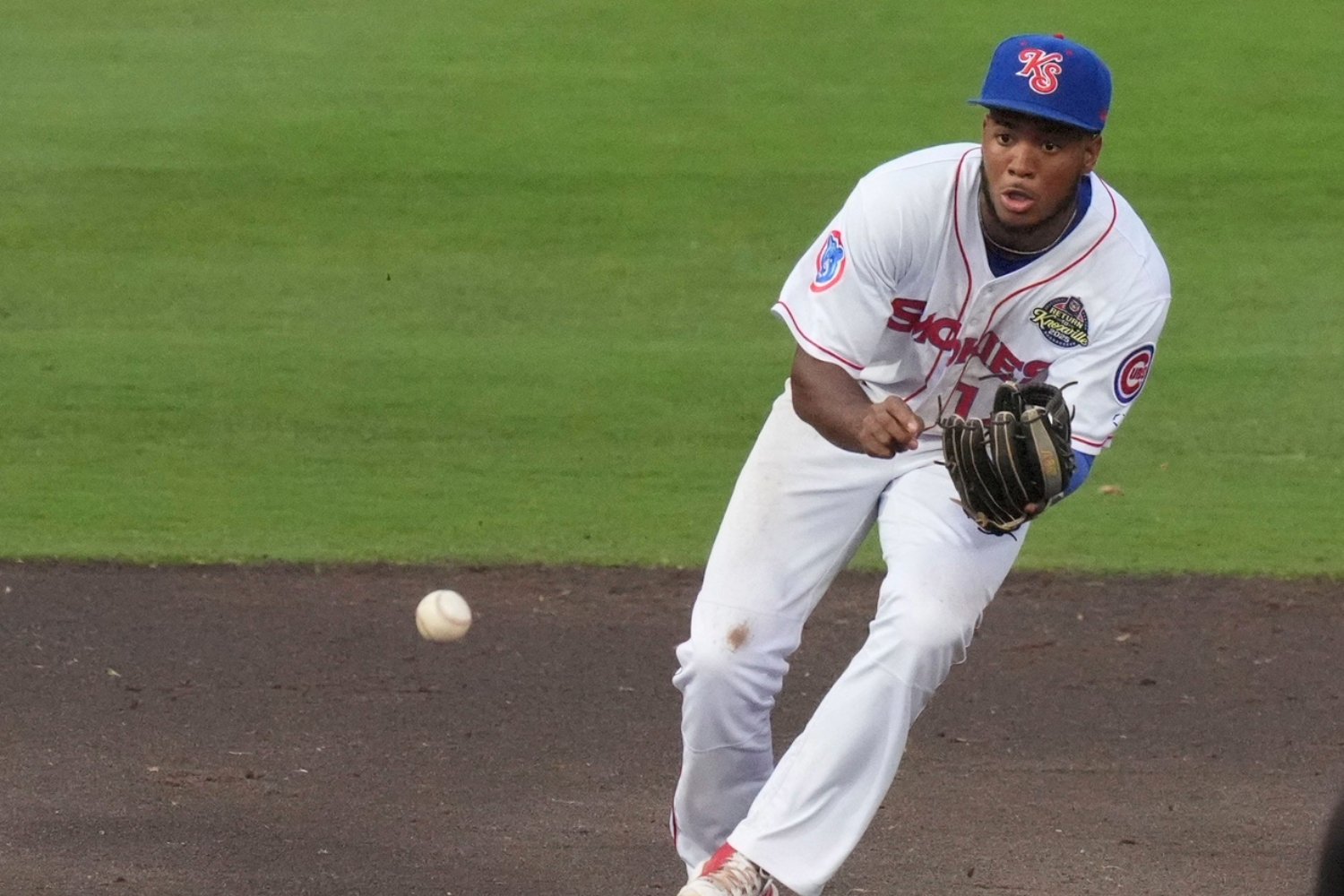 The Arizona Fall League is a fun little peek into how a team views their minor league system; we can see (especially when it comes to hitters) who an organization likes, or maybe, who they think needs a little extra work. Current Cubs and Cub-farmhands such as Kevin Alcantara, Owen Caissie, Moises Ballesteros and some former Cubs in general, like Matt Mervis, have had stints in the AFL in the past that brought attention to their game. This year, the Cubs will not be sending any Top-100 prospects to the desert, and have overall left off most of the exciting names in their system. With that said, there are still a few players I think we should keep our eyes out for, either because they offer some interesting untapped upside, or because they may be getting one of their very last chances to impress the organization. A full list of the Cubs' AFL invitees can be found by looking at MLB.com, but here are four names I'll be keeping an eye one—two for positive reasons and two for negative ones—as the minor league season comes to it's final conclusion in Arizona. Cole Mathis, 1b/3b - Myrtle Beach Pelicans This has been a lost season for the Cubs' 2023 second-round selection. A two-way player in college and thought of as an advanced hitter, the hope was that Mathis would follow in the footsteps of recent high-round draft picks such as Matt Shaw and Cam Smith and blow past low-level competition despite coming off of a Tommy John surgery. Sadly for Mathis and the Cubs, their new hitter struggled through May and then missed most of the rest of the year, returning only recently. Getting Cole to go to Arizona is a good way to help him make up for some missed time. The second-round pick did show up just in time to finish the season with a few games, even hitting a double, but could really use some time to get into the swing of things. Arizona Phil, an expert in coverage of the Complex League, reported that Mathis had been seen taking balls at third base, which might be the thing to look for the most: his defensive ability and his arm strength. Mathis can still get his career on a good track, and it could start this fall. Luis Martinez-Gomez, RP - South Bend Cubs Usually, pitching at the Arizona Fall League is not the most exciting, but Martinez-Gomez offers just enough upside that it's probably worth willing to keep and eye on. Listed at 6'2", there's enough size to be somewhat interested in his development in general. The 22-year-old struggled during his time in Myrtle Beach, walking almost one hitter per inning, but something seemed to click over his 17 innings in South Bend, as his walk rate plummeted from 18% to 5.8%. MLB.com has Martinez-Gomez sitting at 92-96mph with his fastball. While he's listed at 6"2, his weight of 178lbs does suggest there may be a little extra left in the tank. In a league where the standouts are usually the offensive players, a strong showing could mean that something has clicked for the reliever moving forward. Ed Howard, SS, Tennessee Smokies We're probably nearing the end of the line for the former first-round pick. Ed Howard gets the "bust" label from many, and while I still hesitate to call him a bad selection (the 2020 draft was near-impossible from a scouting standpoint to begin with) he hasn't done anything of note to date in his Cub career. Most of this is beyond his blame; Howard didn't shut the world down in 2020 making him miss a senior season, nor did he choose to have a litany of injuries derail his career. But, the Cubs cannot just keep rostering nice guys who you really want to succeed, and Howard is getting to a point where the Cubs may have to consider what his future may be. 2025 was a similar story for the shortstop as years past. There were fleeting moments of intrigue sandwiched around poor hitting and a lot of injuries. Much like Mathis, Howard is going to get a chance to get in some extra work. Unlike their 2023 second-rounder, however, Howard really needs this time to show he belongs. The Cubs have lots of interesting shortstop prospects currently, with players such as Ty Southsiene, Cristian Hernandez, Angel Cepeda and Top-100 prospect Jefferson Rojas floating around similar levels as Howard. A big AFL could at least help him gain a little footing heading into 2026. Koen Moreno, P, South Bend Cubs Koen Moreno was another selection from the 2020 draft, albeit a fifth-round selection. Signed away from a UCLA commitment, the prep arm had some high hopes riding on him. Much like the rest of that draft class, his Cubs' career has been marked with inconsistency and injury. Throwing only 12 innings in 2025, Moreno is another player who is fighting to remain relevant. In his 12 innings, the former fifth-round pick did post an encouraging 2.25 ERA and a 3.89 xFIP, but at age 23 in High-A, especially with a 16% walk rate, these numbers ring a little hollow. While pitchers can find their footing at older ages, Moreno's needle has gone from "encouraging prep arm" to "forgettable" over the last half-decade. If he's going to capture some magic, a good showing against some of the better offensive prospects in baseball would begin to help. Who are you going to be looking at this AFL Season? Are there other Cubs prospects that you're excited for? Let us know in the comments below!
 -
Image courtesy of © Saul Young/News Sentinel / USA TODAY NETWORK via Imagn Images The Arizona Fall League is a fun little peek into how a team views their minor league system; we can see (especially when it comes to hitters) who an organization likes, or maybe, who they think needs a little extra work. Current Cubs and Cub-farmhands such as Kevin Alcantara, Owen Caissie, Moises Ballesteros and some former Cubs in general, like Matt Mervis, have had stints in the AFL in the past that brought attention to their game. This year, the Cubs will not be sending any Top-100 prospects to the desert, and have overall left off most of the exciting names in their system. With that said, there are still a few players I think we should keep our eyes out for, either because they offer some interesting untapped upside, or because they may be getting one of their very last chances to impress the organization. A full list of the Cubs' AFL invitees can be found by looking at MLB.com, but here are four names I'll be keeping an eye one—two for positive reasons and two for negative ones—as the minor league season comes to it's final conclusion in Arizona. Cole Mathis, 1b/3b - Myrtle Beach Pelicans This has been a lost season for the Cubs' 2023 second-round selection. A two-way player in college and thought of as an advanced hitter, the hope was that Mathis would follow in the footsteps of recent high-round draft picks such as Matt Shaw and Cam Smith and blow past low-level competition despite coming off of a Tommy John surgery. Sadly for Mathis and the Cubs, their new hitter struggled through May and then missed most of the rest of the year, returning only recently. Getting Cole to go to Arizona is a good way to help him make up for some missed time. The second-round pick did show up just in time to finish the season with a few games, even hitting a double, but could really use some time to get into the swing of things. Arizona Phil, an expert in coverage of the Complex League, reported that Mathis had been seen taking balls at third base, which might be the thing to look for the most: his defensive ability and his arm strength. Mathis can still get his career on a good track, and it could start this fall. Luis Martinez-Gomez, RP - South Bend Cubs Usually, pitching at the Arizona Fall League is not the most exciting, but Martinez-Gomez offers just enough upside that it's probably worth willing to keep and eye on. Listed at 6'2", there's enough size to be somewhat interested in his development in general. The 22-year-old struggled during his time in Myrtle Beach, walking almost one hitter per inning, but something seemed to click over his 17 innings in South Bend, as his walk rate plummeted from 18% to 5.8%. MLB.com has Martinez-Gomez sitting at 92-96mph with his fastball. While he's listed at 6"2, his weight of 178lbs does suggest there may be a little extra left in the tank. In a league where the standouts are usually the offensive players, a strong showing could mean that something has clicked for the reliever moving forward. Ed Howard, SS, Tennessee Smokies We're probably nearing the end of the line for the former first-round pick. Ed Howard gets the "bust" label from many, and while I still hesitate to call him a bad selection (the 2020 draft was near-impossible from a scouting standpoint to begin with) he hasn't done anything of note to date in his Cub career. Most of this is beyond his blame; Howard didn't shut the world down in 2020 making him miss a senior season, nor did he choose to have a litany of injuries derail his career. But, the Cubs cannot just keep rostering nice guys who you really want to succeed, and Howard is getting to a point where the Cubs may have to consider what his future may be. 2025 was a similar story for the shortstop as years past. There were fleeting moments of intrigue sandwiched around poor hitting and a lot of injuries. Much like Mathis, Howard is going to get a chance to get in some extra work. Unlike their 2023 second-rounder, however, Howard really needs this time to show he belongs. The Cubs have lots of interesting shortstop prospects currently, with players such as Ty Southsiene, Cristian Hernandez, Angel Cepeda and Top-100 prospect Jefferson Rojas floating around similar levels as Howard. A big AFL could at least help him gain a little footing heading into 2026. Koen Moreno, P, South Bend Cubs Koen Moreno was another selection from the 2020 draft, albeit a fifth-round selection. Signed away from a ECU commitment, the prep arm had some high hopes riding on him. Much like the rest of that draft class, his Cubs' career has been marked with inconsistency and injury. Throwing only 12 innings in 2025, Moreno is another player who is fighting to remain relevant. In his 12 innings, the former fifth-round pick did post an encouraging 2.25 ERA and a 3.89 xFIP, but at age 23 in High-A, especially with a 16% walk rate, these numbers ring a little hollow. While pitchers can find their footing at older ages, Moreno's needle has gone from "encouraging prep arm" to "forgettable" over the last half-decade. If he's going to capture some magic, a good showing against some of the better offensive prospects in baseball would begin to help. Who are you going to be looking at this AFL Season? Are there other Cubs prospects that you're excited for? Let us know in the comments below! View full article
-
Today. Alcantara was optioned.
-
I promise not to write any of those 3.5
-
It's been explained to you a few times. It's the oddity of the projections and the data. Ultimately, splitting hairs over 3% difference is a waste of time to begin with.
-
I answered UMF before this, but the answer is the same; they run the playoff simulations 20,000 times to generate these odds. For whatever reason, the model likes the Mets a little more. The best guess I have is that there is one specific matchup that the model really favors the Mets in which they advance through fairly often. Which team that is against is unknown, as the simulations run any of the possible permeations of playoff seedings.
-
The model simulates the outcome of the postseason 20,000 times to generate these odds. For some reason, the model likes the Mets to win slightly more often than the Cubs. There is probably one team that the Mets in the simulation matchup really well against and they routinely beat in that simulation which gives them a better chance of consistently advancing. I'm unsure who that team is, however. EDIT: This mode is forward looking and uses the FanGraphs Depth Charts projections for rate statistics (a 50/50 blend of ZiPS and Steamer) and playing time to estimate the neutral-opponent winning percentage of each team -- in other words, how likely a team would be to beat a .500 opponent on a neutral field. These winning percentages are then used to find the odds of each team winning each remaining game in the major league season. - This is from the page and how the FG model handles it. This should also help explain why one team has a higher WS% over another.
-
Brian's post was very clear to me, but essentially, the Cubs are essentially locked into a WC spot because they are 5.5 games behind the Brewers. This lowers their WS odds drastically in their model because they would have to play another series in the playoffs versus the 1 and 2 seed who do not. Every series you don't play is one less chance you are knocked out. Their full explanation can be found here. https://www.fangraphs.com/standings/playoff-odds/about
-
I'll admit, missed the injury on Kirk! I saw the gamelogs, didn't check the injury history. Will admit my misses. Beyond that, nothing is "gibberish". His defense was incredibly poor between ages 21 and 22. And he barely played in his age-21 season, he played a whopping 7 games. To date, he's caught 7 more games than Ballesteros has at the MLB level at this age. 7 games. Secondly, a screen grab is even less good than an actual picture! At least a picture would be a bump up in quality. MiLB streams are on their best of days described as "potato quality" to begin with, when you add in a screen grab it becomes even less in terms of picture fidelity. All of this is because from a random screen grab you think he's too fat? C'mon dude. That's the lowest level stuff. You have to know that, right? This is a seriously horrible leg to stand on. Again, there are almost no catchers who catch games at the age of 21. Every year there is like, one maybe if you're lucky, two guys. This year there is two. Last year no catchers aged 21 caught an inning, and only two were 22 (one of whom is Francisco Alvarez, this will be important later). In 2022, only two caught an inning below the age of 23 - and an important note, Francisco Alvarez was a data point in 2023 and the year prior 2022. This means that in the last three seasons, five different catchers in MLB baseball have caught innings below the age of 22; one of whom was Tyler Soderstrom who is not a catcher, and the others are superstar prospects like Carter Jensen, Francisco Alvarez and Samuel Basallo. Do we not yet see what a ridiculous standard you're setting off of a screen grab? Again, if you want to worry about his defense, I think there are things you can point to: he's thrown out a shockingly low number of runners this year and it's not because he has bad arm strength but because his footwork is bad. This plays out on balls in the dirt. But he's also 21 and MLB catchers are notorious for taking a long time as evidenced by his contemporaries. Other people his body size have shown recent success in the MLB level. So please, if you want to worry about his defense, make it about things that matter; discuss his footwork, discuss his blocking. Stop taking poor quality screen grabs and making a mountain out of it. It's lazy stuff and you're better than that. I don't mean that in a rude way; I mean it that we are all better than using a screen grab of an MiLB game to make a point. Let's discuss his baseball and not make random assumptions about his weight because a screen grab made him look a specific way. Look, here are two more screen grabs from a week ago. The first makes him look much worse than the second and both come from the same HR trot. But again, notice how you can barely make out his face! If this is what we have to say whether or not he will or will not make it as an MLB catcher, than we need to do better.

-
You must have a scale of you can definitively say he is bigger than the spring. Can you provide more evidence other than "look at this one photo!"? We know that camera can make people appear bigger than they are, as well, awkward running photos can distort a body. You're making a lot of claims here and there is a large difference from vibes and proof. If it's the photo thing, I think we should stop making those claims. What we *think* we see is below the burden of proof here, IMO. On the Kirk thing; Kirk caught 7 games at age 21. Then got sent back for another full Triple-A season at age 22 when he was called up for 40 games at the end of the next season, his aged 22 year. You sure that's the hill we want to die on? 7 games? Using OAA he was not a positive defensive catcher in either 2020, or 2021, grading our poorly in every category except pop time. His first positive defensive grades comes in 2022, his age-23 season. So once again, I feel like you're being incredibly harsh because he isn't photogenic. Alejandro Kirk has proven that awkward shapes can be successful, and we know it takes a long time to develop catchers. Ballesteros value does hinge on his defensive ability, but he is not at an age where anything definitive has been said about his defense. Once again, he could not catch an MLB game for another year and a half and he would still make his catching debut prior to Adley Rustchman, who has been seen as the most ready-made college catcher in a decade.
-
I would be a little surprised if Pat's replacement wasn't Len, honestly. The Cubs love to use sentimentality and good will to hide overall spending patterns. And buying out Len Kasper from the White Sox (as well as him not having to supplant his family) feels like a really easy way for the Cubs to eventually not spend money on payroll one offseason.
-
I would guess that it probably hasn't most years. But do wonder how the wind is playing with that this year. The Cubs have had one of the highest pull% in baseball this year and the wind at Wrigley has been brutal. So on days when you're hitting into the wind, and add in a little extra distance, I think the Cubs are probably getting dinged more than normal. I doubt it's a massive reason on it's own (distance) but when you start adding in other factors (wind) I suspect it's somewhere in that data set hiding as a factor itself. In terms of pull/not-pull with xData, the Nationals have the fewest pull events are are underhitting their xData by .20 points, Pittsburgh is 2nd worst and is under hitting their xData by 20 points, and the Angels are under hitting theirs by .20 points and are 3rd lowest. In terms of highest pull, the Royals, Astros and Diamonbacks are all over hitting their xData by .5+ points. These teams are 2nd, 3rd and 4th in pull events. Only the Cubs, at the top, are under hitting theirs.
-
I like xData in that I think it can help us identify weirdness. Where my issues with xData is in that it treats all balls the same. I had recently done an article on Shaw and the importance of pulling balls, and used his 377 foot flyball to CF off Clase as a framing device. Similarly hit balls to CF saw 0 HR's league wide and just 5 hits. IF you hit the same distance and EV to LF, you find 16 home runs and 5 balls in play. xBA will treat both the same, but we know pulling the ball gives you a far better outcome. I'd hope that sometime we can get some directional expected data thrown in and I think it would help parse out some of the weirdness. For the Cubs, I think it's also important to note that pulling the ball is very good, but they have the deepest LF/RF down the line at Wrigley. Which also throws a wrench into xData.
-
There isn't a single Cub player who is actually out performing their xwOBA on the season. Which is weird, the Cubs pull the baseball a lot and hit enough in the air. My guess is that this is a product of Wrigley Field and the issues with the wind, but it's simply a guess. The best way to out play your xwOBA is pulling the baseball in the air. So I'm guessing league wide there is enough shift in this thought that they are doing between that expected data says they should. But again, mostly guessing.