


Cubs Video
Ben Brown was one of the fun surprises of the 2024 season. After a rough end for the hurler due to injury in 2023, it was widely expected that he wouldn't be making an impact at the highest level until mid-year at best—and even then, likely in the bullpen. Disaster struck on Opening Day, though, as de facto staff ace Justin Steele went down with a hamstring strain, forcing the right-handed rookie into rotation duty. Using just a two-pitch arsenal—a four-seam fastball and his "deathball"—Brown had an encouraging rookie campaign, striking out 28% of hitters faced; showing improved ability to limit walks; and wowing with his stuff.
Everything was not perfect for the rookie pitcher, however. While Brown showed off an above-average ability to generate whiffs, when hitters did connect, they found a lot of barrels and a lot of loud contact. At times, loud contact can be explained away with a large number of ground balls, but Brown was not a ground ball pitcher; this was going to be something that Brown would have to diagnose and fix. It's great to get whiffs, but it was unclear whether or not the rate at which Brown was surrendering hard-hit balls would be viable in the long term. Despite Brown's ability to create swings and misses, he rarely forced hitters to chase his pitches out of the zone.
It seems, as we enter 2025, that the Chicago Cubs may have found a way to help change this, by changing his arm slot. In 2024, Brown's arm slot was a pretty standard three-quarter action. Baseball Savant had it clocked in at an average angle of 41° when he threw his fastball. As the season went along, he would actually lower his arm angle considerably, as seen on the chart below.
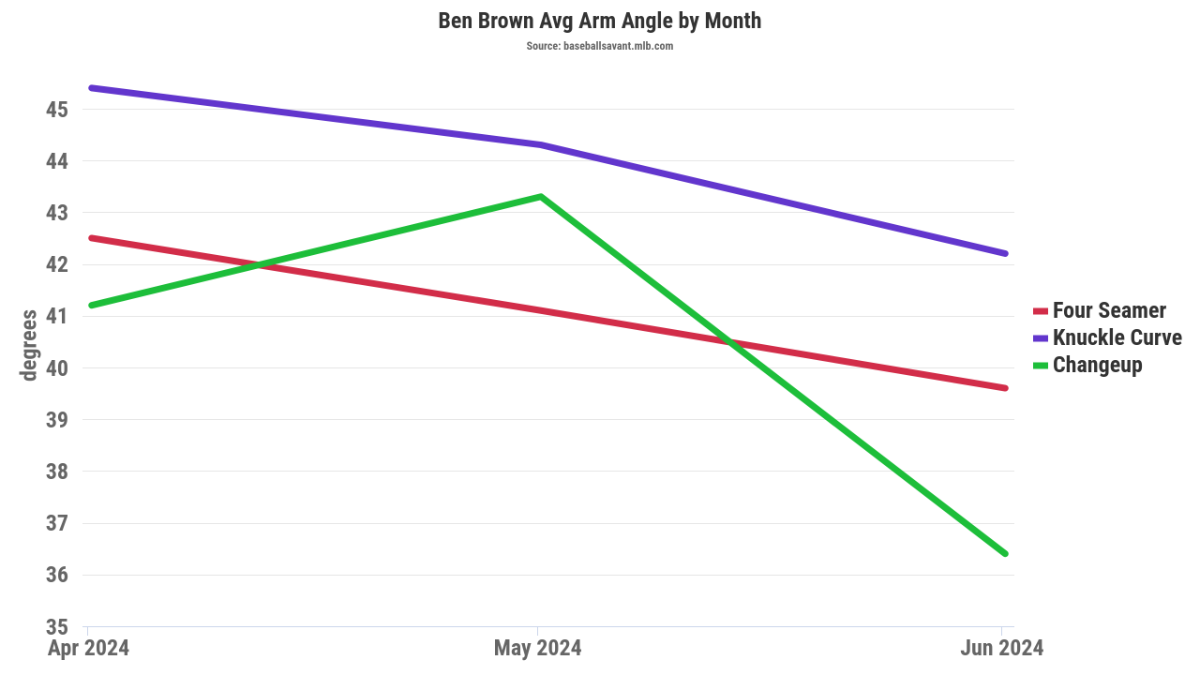
With this arm angle, most of his fastballs remained in the zone. He concentrated them higher in the zone, which is a good way to attack hitters in today's game. The problem is that you are more prone to missing in the zone, and for Brown, that meant leaving pitches center-cut. At that point, it doesn't matter how hard you throw: you're going to get hit hard. This helps explain why Brown both struggled to get chases and got hit hard when contact was made. It may also be the root cause.

So what can an arm angle change do? In this instance, the Cubs and Brown have adjusted his average fastball release point from 41° all the way to 47°. While it may not seem six degrees is a massive difference, when we talk about angles of attack, it can be. For Brown, it's created more rise (or, put another way, less drop) in his fastball. It also creates a new release point, as Brown now comes far more over the top. The result? Brown has been throwing his fastball outside the strike zone much more often. That's a good thing. When you specialize in the high heater, you want your misses to be above the one, not down at the belt.
While it's too early to focus on results, he's getting far more chase than he had been previously. FanGraphs's Stuff+ model agrees that this pitch is better, as he's jumped from an 87 Stuff+ grade last year to a far better 122 this season. He's still getting hit hard when he induces contact on the fastball, but this isn't the only result that a more over-the-top release can have.

Perhaps the best part of Brown's change is that it has made it far harder for hitters to connect and lift his pitches. Last season, when opposing hitters made contact with his pitches, they averaged a launch angle of 18° on his fastball. The reason the launch angle revolution came about was to take advantage of pitches on the lower half of the strike zone, as it creates a larger window for contact to occur. By raising his release point (and thus, raising the average location of his pitches), hitters are no longer able to get to that offering—unless they deploy a flatter, less dangerous swing. This season, the launch angle against Brown's fastball is down to 9°, a massive shift. Brown has seen his ground-ball rate shoot up, from 38.7% in 2024 to 48.7% in 2025. This means more twin killings, and more importantly, fewer fly balls.
Another thing that should help is that by raising his release point, Brown's curve can play better off the fastball. Curves usually correlate strongly with ground balls to begin with, and we know that Brown's deathball is a Stuff+ monster (grading out as a 125 Stuff+ pitch last season). Hitters had just a .183 xwOBA against it last year, and by creating more separation between where the fastball lands and where the deathball lands, the arm angle change should help create difficult decisions. For a pitcher who's yet to be able to throw a third offering, creating any extra deception with his limited arsenal is key to getting the most out of what you do have.
If there is a downside to Brown's arm angle change, however, it's that it also seems to have raised where his curveball is landing. Arguably, he's leaving it much too close to the middle of the zone. By raising the arm slot, everything has gotten a little higher. On the left is his curveball placement in 2024. On the right, see the same data for 2025.


I don't want to get ahead of myself, though. Brown still hasn't been perfect in 2025, so we're not at a finished and polished product. The curve (given how hard he throws it and the location of his fastball after the change in angle) might play fine on that glove-side edge of the zone, almost as much like a slider as a curve. It's too early for his results to even mean anything, given the environments and circumstances in which they occurred, but it's also true that those results are less than gorgeous. While we might be able to explain away some of the home runs as a little unlucky (Jacob Wilson's home run Monday night was only a home run in Sacramento, for example), his increase in walk rate tracks with an increase of throwing his fastball outside of the strike zone.
It's hard to say definitively if these changes will create more problems than positives (as seen by his current curveball location). However, despite those questions, the Cubs and Brown are clearly trying to make positive steps to fix the issues he had in his rookie season. There's enough reason to believe, looking at his improved groundball rate, his jump in fastball Stuff+, and his increased chase rate, that the sum of the changes will result in a better version of Ben Brown moving forward.





Recommended Comments
Create an account or sign in to comment
You need to be a member in order to leave a comment
Create an account
Sign up for a new account in our community. It's easy!
Register a new accountSign in
Already have an account? Sign in here.
Sign In Now