


Matthew Trueblood
-
Posts
2,479 -
Joined
-
Last visited
-
Days Won
2
Content Type
Profiles
Joomla Posts 1
Chicago Cubs Videos
Chicago Cubs Free Agent & Trade Rumors, Notes, & Tidbits
2026 Chicago Cubs Top Prospects Ranking
News
2023 Chicago Cubs Draft Picks
Guides & Resources
2024 Chicago Cubs Draft Picks
The Chicago Cubs Players Project
2025 Chicago Cubs Draft Pick Tracker
2026 Chicago Cubs Draft Tracker: Picks & Bonuses
Blogs
Events
Forums
Store
Gallery
Everything posted by Matthew Trueblood
-
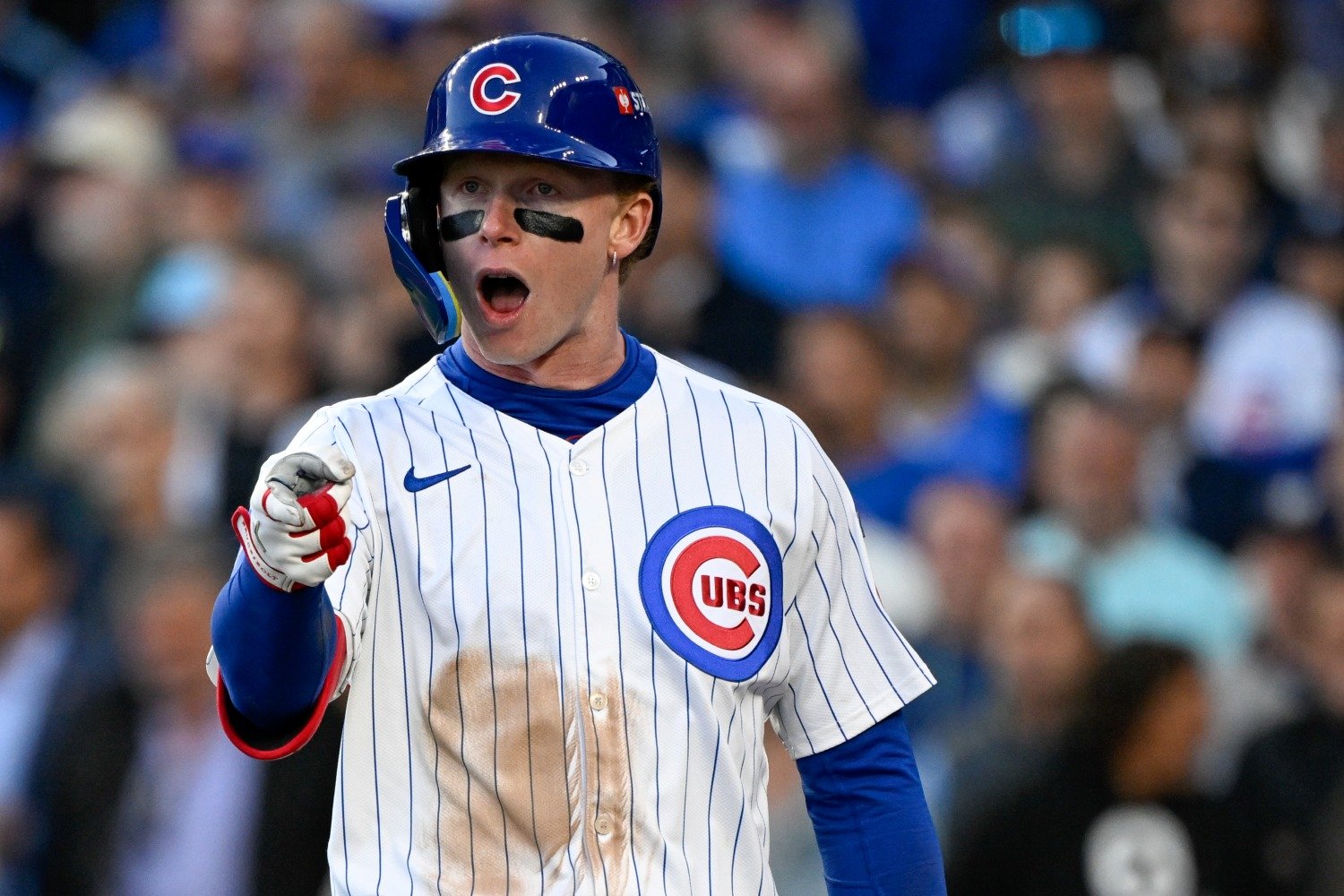 Fueled by his friendship with Seiya Suzuki and his eye-catching fashion choices, Pete Crow-Armstrong became an international star when the Cubs went to Japan to open the 2025 regular season. Next March, he won't have to endure as long a flight to experience the same global spotlight. He has accepted an offer to play for Team USA in the World Baseball Classic, starting with pool play in Houston in March, he announced Thursday night. Any list of center fielders on the wish list for American manager Mark DeRosa was going to include Crow-Armstrong, and since Byron Buxton (arguably the only other center fielder from the U.S. better than Crow-Armstrong in 2025) will probably elect to avoid the injury risk of playing high-stakes games three weeks before Opening Day, the Cubs' young star has a clear path to playing time for his country. He won't be the Cubs' only representative in the tournament, but Crow-Armstrong is the one who could enjoy a further star turn by playing well there. That doesn't come with direct benefits for the Cubs. In fact, in addition to the slight risk of injury and the significant disruption of the preparation process that is spring training, this is likely to put extra time pressure on any attempts to sign him to a long-term deal. The two sides can't talk as easily with Crow-Armstrong in Houston. As Crow-Armstrong's profile continues to grow, he's also in an increasingly comfortable negotiating position. If the Cubs want to lock him up beyond 2030, they might already need to shift their focus from trying to capture value on a team-friendly extension toward paying the market rate for his services. Contracts signed by similarly famous and talented players (Bobby Witt Jr., Julio Rodríguez, Fernando Tatis Jr.) have worked that way, even when the player didn't appear to have the short-term earning power or proximity to free agency to extract that kind of payday. Those players are all better than Crow-Armstrong, whose second-half struggles at the plate exposed very real weaknesses. However, his freakish athleticism and the upside he flashed with a calendar year (from August 2024 through July 2025) during which he batted .271/.312/.524 in 687 plate appearances make him just as dynamic as they are—and he's becoming that caliber of celebrity, too. The Tokyo Series to open 2025, his showcase at the All-Star Game and the Cubs making a two-round push into the postseason put Crow-Armstrong very much on the global map this year. Next year, he'll get to continue carving out a niche. He might even prove himself to be the best defender in baseball, anywhere in the world. The World Baseball Classic is wonderful because of players just like Crow-Armstrong; the endlessly charismatic Randy Arozarena was one of the biggest stars of the last one. Next spring's event continues to fill up with big names, and that's what Crow-Armstrong has already become.
 -
Image courtesy of © Patrick Gorski-Imagn Images The Cubs enjoyed a major free-agent success in each department of their roster in 2025. They signed Matthew Boyd to a two-year deal in late November 2024, and watched him emerge as their co-ace for much of the season. They picked up Carson Kelly in mid-December, and enjoyed his best season as a big-leaguer. Crucially, though, they also hit on multiple minor pickups in the bullpen. Most important among those was righty Brad Keller, whom they signed to a minor-league deal as a starter and who ended the year as their de facto closer. Keller, 30, is a free agent again after earning $1.5 million in 2025. He'll get a much bigger payday this time, and as he enters the market, the big question is whether he'll land a two- or a three-year deal. FanGraphs, ESPN and MLB Trade Rumors agree that Keller is in line for an annual average value in the $11 million range, but whether that stretches for two years or three could make a big difference in the chances of a reunion between the Cubs and their unexpected relief ace. President of baseball operations Jed Hoyer is a hardliner when it comes to reliever contracts. He's willing to embrace a bit of risk, but that has to come in the form of a free-agent deal he feels is rational. Otherwise, he's equally happy to let that risk take the form of building a relief corps with some lower-cost bets and some upside plays. "We've offered some [long deals to free-agent relievers]." Hoyer said at the GM Meetings Wednesday in Las Vegas. "I haven't given one out. So, I mean, it's not my favorite thing to do. I think that I prefer, you know, shorter commitments in the bullpen. But I'd never say never, like I said, we offered some last year. We just didn't win the bidding. So it's not, it's not a hard and fast rule. But I think you can, you can guess that we're probably going to be more focused on shorter commitments." The big deals he alluded to offering last year were to Tanner Scott, on whom the Cubs were willing to go to four years and roughly $70 million; and Kirby Yates, on whom the Cubs were ready to offer a second year but who preferred the Dodgers even on a one-year pact. While even a two-year deal at an eight-figure salary for Keller would come with a bit of sticker shock, it would be a very palatable alternative to a Scott-level deal for someone like Robert Suarez, of the Padres. One source familiar with the Cubs' thinking said the team considers Keller a priority winter target, but that they're very unlikely to stretch beyond two guaranteed years. A mutual or vesting option could be a way to satisfy both sides, if Keller is open to coming back. By every indication, he enjoyed his season with the team and would be happy to return, but this is the best chance he's likely to get at a major payday, so money will be a major factor. It's possible the Cubs would go further on AAV to keep it to a two-year deal. They might guarantee $25 million over that term, but balk at $34-35 million over three years. Creative structures (like the aforementioned mutual option, which would come with a buyout) could keep the annual real cost of Keller down for them, and the team is unlikely to exceed the competitive-balance tax threshold in 2026, so his AAV doesn't matter as much as the real dollars. Spreading money across a longer term doesn't hold much appeal for the Cubs, when it comes to Keller. They would want to get a shorter-term deal done. If a team steps up with an offer that bakes in some hope for Keller returning to a starting role, the Cubs will surely be outbid. He does have five pitches, which worked in concert beautifully in 2025. He's started so much during his career that some faith in his ability to return to that role is rational. A brief survey of sources in other front offices, however, found no team currently considering Keller as a candidate for a conversion back to the rotation. He's likely to make about $12 million, over either two years or three. If it be the former, there's a good chance the Cubs will be the team who signs him. If not, the odds tilt toward the righty finding a new home—and Chicago being left to chase still more bullpen help. View full article
-
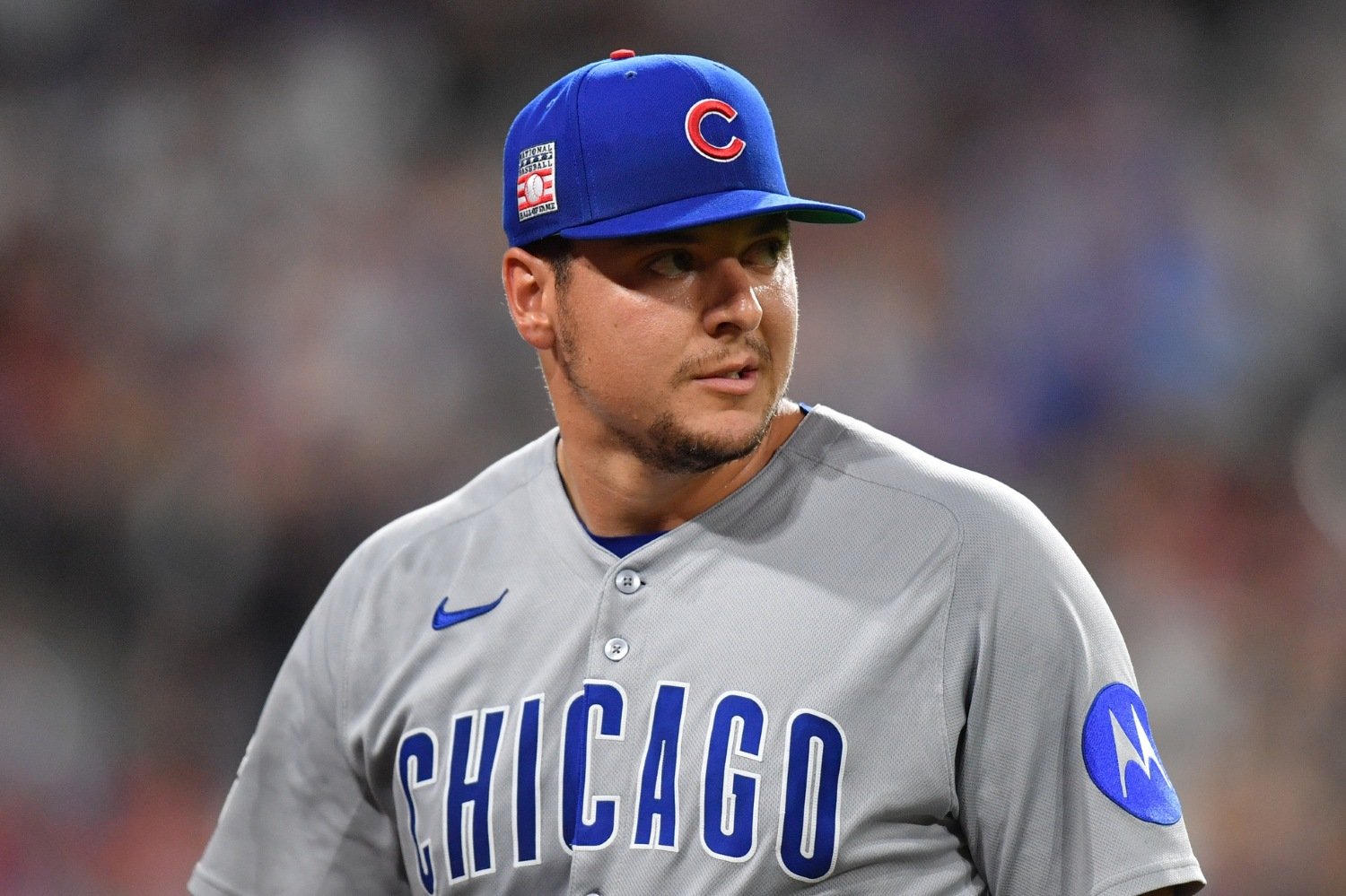 The Cubs enjoyed a major free-agent success in each department of their roster in 2025. They signed Matthew Boyd to a two-year deal in late November 2024, and watched him emerge as their co-ace for much of the season. They picked up Carson Kelly in mid-December, and enjoyed his best season as a big-leaguer. Crucially, though, they also hit on multiple minor pickups in the bullpen. Most important among those was righty Brad Keller, whom they signed to a minor-league deal as a starter and who ended the year as their de facto closer. Keller, 30, is a free agent again after earning $1.5 million in 2025. He'll get a much bigger payday this time, and as he enters the market, the big question is whether he'll land a two- or a three-year deal. FanGraphs, ESPN and MLB Trade Rumors agree that Keller is in line for an annual average value in the $11 million range, but whether that stretches for two years or three could make a big difference in the chances of a reunion between the Cubs and their unexpected relief ace. President of baseball operations Jed Hoyer is a hardliner when it comes to reliever contracts. He's willing to embrace a bit of risk, but that has to come in the form of a free-agent deal he feels is rational. Otherwise, he's equally happy to let that risk take the form of building a relief corps with some lower-cost bets and some upside plays. "We've offered some [long deals to free-agent relievers]." Hoyer said at the GM Meetings Wednesday in Las Vegas. "I haven't given one out. So, I mean, it's not my favorite thing to do. I think that I prefer, you know, shorter commitments in the bullpen. But I'd never say never, like I said, we offered some last year. We just didn't win the bidding. So it's not, it's not a hard and fast rule. But I think you can, you can guess that we're probably going to be more focused on shorter commitments." The big deals he alluded to offering last year were to Tanner Scott, on whom the Cubs were willing to go to four years and roughly $70 million; and Kirby Yates, on whom the Cubs were ready to offer a second year but who preferred the Dodgers even on a one-year pact. While even a two-year deal at an eight-figure salary for Keller would come with a bit of sticker shock, it would be a very palatable alternative to a Scott-level deal for someone like Robert Suarez, of the Padres. One source familiar with the Cubs' thinking said the team considers Keller a priority winter target, but that they're very unlikely to stretch beyond two guaranteed years. A mutual or vesting option could be a way to satisfy both sides, if Keller is open to coming back. By every indication, he enjoyed his season with the team and would be happy to return, but this is the best chance he's likely to get at a major payday, so money will be a major factor. It's possible the Cubs would go further on AAV to keep it to a two-year deal. They might guarantee $25 million over that term, but balk at $34-35 million over three years. Creative structures (like the aforementioned mutual option, which would come with a buyout) could keep the annual real cost of Keller down for them, and the team is unlikely to exceed the competitive-balance tax threshold in 2026, so his AAV doesn't matter as much as the real dollars. Spreading money across a longer term doesn't hold much appeal for the Cubs, when it comes to Keller. They would want to get a shorter-term deal done. If a team steps up with an offer that bakes in some hope for Keller returning to a starting role, the Cubs will surely be outbid. He does have five pitches, which worked in concert beautifully in 2025. He's started so much during his career that some faith in his ability to return to that role is rational. A brief survey of sources in other front offices, however, found no team currently considering Keller as a candidate for a conversion back to the rotation. He's likely to make about $12 million, over either two years or three. If it be the former, there's a good chance the Cubs will be the team who signs him. If not, the odds tilt toward the righty finding a new home—and Chicago being left to chase still more bullpen help.
 -
With Kyle Tucker officially a free agent and little early indication that the Cubs intend to chase after him with $300 million in hand, the unrest has already begun to percolate. At the GM Meetings in Las Vegas, Jed Hoyer seemed to hint that his focus this winter would be on adding pitching—presumably, at the expense of signing a top-flight hitter like Tucker, Pete Alonso, or Bo Bichette. Understandably, some will view that as a needlessly cheap way to build upon a successful 2025 season. At some point, though, the Cubs need to put up or shut up, and not in financial terms. The story of their last half-decade has been a constant insistence that they are one of the top teams in the league at scouting and developing talent, in defiance of the balance of the evidence. They use that refrain, in part, as cover for a lack of appropriate investment from ownership, but they also seem to realize that they aren't as strong as they purport to be. Time after time, they put players in the way of ascending top prospects, and it's never a superstar who supersedes the youngster. Rather, Hoyer has repeatedly hedged. When the team was still building toward something (but not yet actually competitive), he signed Trey Mancini and Eric Hosmer to stand in the way of Matt Mervis at first base. Last winter, he traded for Ryan Pressly, rather than entrust the closer's role to Porter Hodge. Hoyer was right not to think Mervis or Hodge were up to the task, but because he still believes that his administration excels at player development, he brought in players who could be easily pushed aside if they did turn out well. Rather than acquire higher-caliber talents who would be locked into their positions for multiple seasons, Hoyer has sought out short-term solutions, hoping that by the end of a one- or two-year deal, the farm system of which he so often boasts will yield the star he really needs. It hasn't happened, save in a few cases, because the Cubs aren't actually excellent at scouting and development. They're in the middle of the pack in that regard, and they're below-average when it comes to developing pitching, specifically. Because league rules give extra draft picks to rivals and penalize big-market teams like the Cubs more heavily for signing elite free agents (and because the Cubs didn't ruthlessly bottom out during their recent rebuild, amassing high-end first-round picks for multiple seasons), the team never has an above-average capacity for acquiring young talent, either. The result is a farm system that isn't good enough to build a World Series contender without greater investment, either in finding and retaining top staffers, improved technology and player resources, or a much higher big-league payroll. Now, though, the team does have three young stars under long-term, low-cost team control. Cade Horton rebounded from an injury-ruined 2024 with a breakout campaign and runner-up Rookie of the Year finish in 2025. Michael Busch, whom the Cubs wisely snatched up after the Dodgers had done the lion's share of the developmental work, is the best hitter on the team. Pete Crow-Armstrong remains an enigma at the plate, but his first full season in the majors provided a tantalizing glimpse of his upside. At the very least, he's one of the game's most valuable defensive players. The team also did well in free agency last year, when they landed Matthew Boyd and Carson Kelly on two-year deals that now look like bargains. Those two players join Ian Happ, Seiya Suzuki, Dansby Swanson, Nico Hoerner, Jameson Taillon and Colin Rea as an expensive but extremely competent supporting cast for the youngsters who have become the loci of value on the roster. The question, at the outset of the winter, is how best to supplement that group. Hoyer sounds much more dedicated to upgrading his pitching staff than to finding a replacement for the departing Tucker, even though the team was hardly an offensive juggernaut in the second half of 2025. The temptation is to read that as a failure by the Ricketts family (and by Hoyer, whose job is just as much to manage up and make the case for more robust spending as it is to manage down) to make enough money available for the team to be great. Suspicion of the Rickettses and their motives is well-founded, to be sure. Still, this is the right time for an approach Hoyer eschewed for too long. Perhaps his (not-quite-earned, but that's a separate issue) contract extension in July has emboldened him, or perhaps he's finally tucking into the hard and vital work of turning this team into what he's been begging fans to believe they already are. Either way, he's taking the right tack. The Cubs should stick with Seiya Suzuki (in right field and at DH, with a fair number of days off against right-handed pitchers), Moisés Ballesteros (as a DH who hardly ever starts against lefties and grabs perhaps 10 starts at catcher), Owen Caissie (right field, swinging over to left sometimes but rarely playing against left-handed starters), and Kevin Alcántara (a platoon partner for Crow-Armstrong in center field, picking up the occasional start in left or right, as well) to supplement their existing group for 2026. Ian Happ can remain the regular left fielder, but have his playing time reduced by roughly 10%. Crow-Armstrong and Suzuki can yield time against same-handed hurlers. Ballesteros, Caissie and Alcántara all appear ready to play in the majors. Caissie, who will turn 24 next July, has 982 plate appearances with the Iowa Cubs already. He's put up elite exit velocities in the minors, and his plate discipline is strong: he swings and strikes and doesn't expand the zone. He will strike out a lot in the big leagues, but the team needs to be willing to accept that tradeoff and embrace the power he can add to the lineup. The biggest missing ingredient for him, in that regard, is a high pulled fly ball rate, but pulled fly balls aren't the way lefties get to their power best at Wrigley Field, anyway. Caissie's bat speed, swing path and resulting batted-ball profile tell us he can slug plenty well by hitting vicious line drives and lofting the occasional 7-iron into the bleachers in left-center field, where the ball carries much better and the dimensions are friendlier. Though the team might wish him to get more playing time at catcher in Triple A, Ballesteros is similarly ripe, having taken nearly 800 plate appearances for the I-Cubs over the last two seasons. He also proved that his swing plays in the majors when called upon late in 2025. It's hit-over-power with him, but again, that's a fine approach for a lefty who calls Wrigley Field home. Alcántara is the most interesting of the set, though the lowest-probability future regular. He's the same age as Caissie, and a better athlete and defensive player. He has to learn to lift the ball to become a star, and that might never happen—but even without doing it, he might be able to carve out a very good career as a slightly matchup-protected outfield piece. He's played a bit less at Triple A than the other two, but he's still at nearly 600 plate appearances there. It's time to let him test his skills against the best pitchers in the world. It's unlikely that all three of them succeed, of course. That would be the case even if they all played for the Dodgers, and we could therefore be more confident that they were well-scouted from the jump and better-instructed on their way up the chain in the minor leagues. However, these are three legitimate, high-end offensive prospects, and the sustainable excellence that has eluded the Cubs since World War II—the decade-plus of being a winning team every year, as they should be in this division if competently run—can't come without giving them real chances to prove their mettle. Hedging time is over. As much as their 2025 playoff push might have led some fans to feel that the Cubs are ascendant in the NL Central, they're unlikely to beat the Brewers and win the division in 2026—let alone to overcome the mighty Dodgers. This team has much hard work left to do, to close the gap between what it is and what it should be. Spending big on pitching this winter makes a world of sense for them, and Hoyer should be applauded for sounding fairly intent on doing so. When it comes to the offense, it's time to let the kids play. If they don't, they're going to end up back in purgatory far too soon. View full article
-
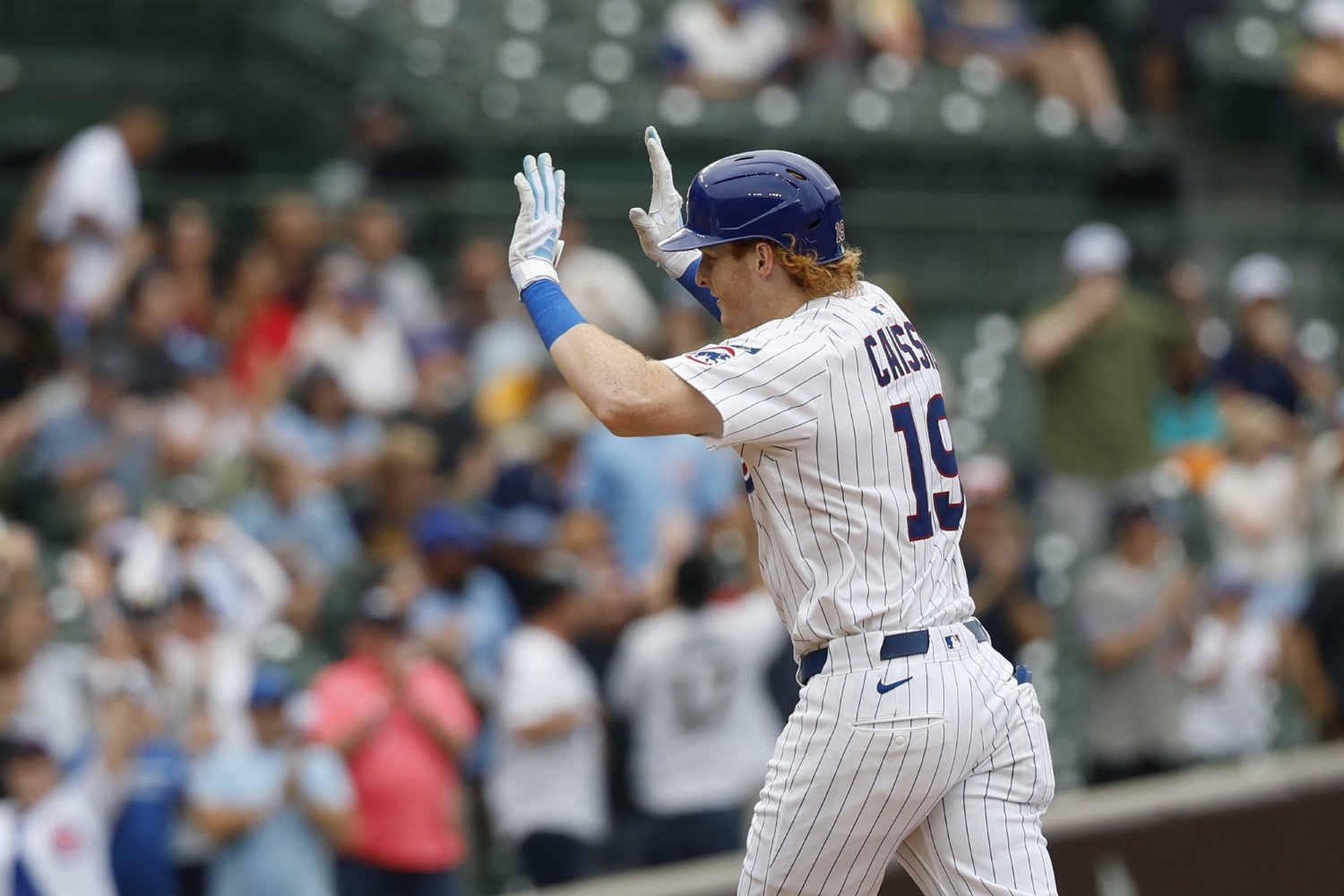 With Kyle Tucker officially a free agent and little early indication that the Cubs intend to chase after him with $300 million in hand, the unrest has already begun to percolate. At the GM Meetings in Las Vegas, Jed Hoyer seemed to hint that his focus this winter would be on adding pitching—presumably, at the expense of signing a top-flight hitter like Tucker, Pete Alonso, or Bo Bichette. Understandably, some will view that as a needlessly cheap way to build upon a successful 2025 season. At some point, though, the Cubs need to put up or shut up, and not in financial terms. The story of their last half-decade has been a constant insistence that they are one of the top teams in the league at scouting and developing talent, in defiance of the balance of the evidence. They use that refrain, in part, as cover for a lack of appropriate investment from ownership, but they also seem to realize that they aren't as strong as they purport to be. Time after time, they put players in the way of ascending top prospects, and it's never a superstar who supersedes the youngster. Rather, Hoyer has repeatedly hedged. When the team was still building toward something (but not yet actually competitive), he signed Trey Mancini and Eric Hosmer to stand in the way of Matt Mervis at first base. Last winter, he traded for Ryan Pressly, rather than entrust the closer's role to Porter Hodge. Hoyer was right not to think Mervis or Hodge were up to the task, but because he still believes that his administration excels at player development, he brought in players who could be easily pushed aside if they did turn out well. Rather than acquire higher-caliber talents who would be locked into their positions for multiple seasons, Hoyer has sought out short-term solutions, hoping that by the end of a one- or two-year deal, the farm system of which he so often boasts will yield the star he really needs. It hasn't happened, save in a few cases, because the Cubs aren't actually excellent at scouting and development. They're in the middle of the pack in that regard, and they're below-average when it comes to developing pitching, specifically. Because league rules give extra draft picks to rivals and penalize big-market teams like the Cubs more heavily for signing elite free agents (and because the Cubs didn't ruthlessly bottom out during their recent rebuild, amassing high-end first-round picks for multiple seasons), the team never has an above-average capacity for acquiring young talent, either. The result is a farm system that isn't good enough to build a World Series contender without greater investment, either in finding and retaining top staffers, improved technology and player resources, or a much higher big-league payroll. Now, though, the team does have three young stars under long-term, low-cost team control. Cade Horton rebounded from an injury-ruined 2024 with a breakout campaign and runner-up Rookie of the Year finish in 2025. Michael Busch, whom the Cubs wisely snatched up after the Dodgers had done the lion's share of the developmental work, is the best hitter on the team. Pete Crow-Armstrong remains an enigma at the plate, but his first full season in the majors provided a tantalizing glimpse of his upside. At the very least, he's one of the game's most valuable defensive players. The team also did well in free agency last year, when they landed Matthew Boyd and Carson Kelly on two-year deals that now look like bargains. Those two players join Ian Happ, Seiya Suzuki, Dansby Swanson, Nico Hoerner, Jameson Taillon and Colin Rea as an expensive but extremely competent supporting cast for the youngsters who have become the loci of value on the roster. The question, at the outset of the winter, is how best to supplement that group. Hoyer sounds much more dedicated to upgrading his pitching staff than to finding a replacement for the departing Tucker, even though the team was hardly an offensive juggernaut in the second half of 2025. The temptation is to read that as a failure by the Ricketts family (and by Hoyer, whose job is just as much to manage up and make the case for more robust spending as it is to manage down) to make enough money available for the team to be great. Suspicion of the Rickettses and their motives is well-founded, to be sure. Still, this is the right time for an approach Hoyer eschewed for too long. Perhaps his (not-quite-earned, but that's a separate issue) contract extension in July has emboldened him, or perhaps he's finally tucking into the hard and vital work of turning this team into what he's been begging fans to believe they already are. Either way, he's taking the right tack. The Cubs should stick with Seiya Suzuki (in right field and at DH, with a fair number of days off against right-handed pitchers), Moisés Ballesteros (as a DH who hardly ever starts against lefties and grabs perhaps 10 starts at catcher), Owen Caissie (right field, swinging over to left sometimes but rarely playing against left-handed starters), and Kevin Alcántara (a platoon partner for Crow-Armstrong in center field, picking up the occasional start in left or right, as well) to supplement their existing group for 2026. Ian Happ can remain the regular left fielder, but have his playing time reduced by roughly 10%. Crow-Armstrong and Suzuki can yield time against same-handed hurlers. Ballesteros, Caissie and Alcántara all appear ready to play in the majors. Caissie, who will turn 24 next July, has 982 plate appearances with the Iowa Cubs already. He's put up elite exit velocities in the minors, and his plate discipline is strong: he swings and strikes and doesn't expand the zone. He will strike out a lot in the big leagues, but the team needs to be willing to accept that tradeoff and embrace the power he can add to the lineup. The biggest missing ingredient for him, in that regard, is a high pulled fly ball rate, but pulled fly balls aren't the way lefties get to their power best at Wrigley Field, anyway. Caissie's bat speed, swing path and resulting batted-ball profile tell us he can slug plenty well by hitting vicious line drives and lofting the occasional 7-iron into the bleachers in left-center field, where the ball carries much better and the dimensions are friendlier. Though the team might wish him to get more playing time at catcher in Triple A, Ballesteros is similarly ripe, having taken nearly 800 plate appearances for the I-Cubs over the last two seasons. He also proved that his swing plays in the majors when called upon late in 2025. It's hit-over-power with him, but again, that's a fine approach for a lefty who calls Wrigley Field home. Alcántara is the most interesting of the set, though the lowest-probability future regular. He's the same age as Caissie, and a better athlete and defensive player. He has to learn to lift the ball to become a star, and that might never happen—but even without doing it, he might be able to carve out a very good career as a slightly matchup-protected outfield piece. He's played a bit less at Triple A than the other two, but he's still at nearly 600 plate appearances there. It's time to let him test his skills against the best pitchers in the world. It's unlikely that all three of them succeed, of course. That would be the case even if they all played for the Dodgers, and we could therefore be more confident that they were well-scouted from the jump and better-instructed on their way up the chain in the minor leagues. However, these are three legitimate, high-end offensive prospects, and the sustainable excellence that has eluded the Cubs since World War II—the decade-plus of being a winning team every year, as they should be in this division if competently run—can't come without giving them real chances to prove their mettle. Hedging time is over. As much as their 2025 playoff push might have led some fans to feel that the Cubs are ascendant in the NL Central, they're unlikely to beat the Brewers and win the division in 2026—let alone to overcome the mighty Dodgers. This team has much hard work left to do, to close the gap between what it is and what it should be. Spending big on pitching this winter makes a world of sense for them, and Hoyer should be applauded for sounding fairly intent on doing so. When it comes to the offense, it's time to let the kids play. If they don't, they're going to end up back in purgatory far too soon.
 -
Image courtesy of © Jonathan Hui-Imagn Images Cubs right-handed pitcher Cade Horton placed runner-up the 2025 BBWAA Jackie Robinson National League Rookie of the Year Award, the league announced Monday night. Horton pitched 118 innings of sparkling ball for the Cubs, with a 2.67 ERA, and he blossomed into their ace in the second half. By finishing in the top two of the voting for this award, he earns a full year of service time for 2025, despite the fact that he debuted on May 10 and accumulated just 142 of the 172 days usually required to qualify for that. This means that Horton (who debuted six months ago) will be a free agent after the 2030 season, the same juncture at which Pete Crow-Armstrong (who debuted 26 months ago) will do so. The league's rules about service time and club control have never seemed more farcical, and perhaps they really are so, but either way, the incentive is a major factor for Horton in shaping his long-term earning power. Any extension with which the Cubs approach him this winter will have to take into account that he will be a free agent five winters hence. For Chicago, it's a small price to pay for the dominance Horton gave them, especially in the second half. The team was 15-8 in his starts, including 8-3 over his last 11. Opponents had a .447 OPS against him after the All-Star break. The season ended in frustrating fashion for the young ace, as he broke a rib and was unable to take the mound in the playoffs, but Horton showed the ability to overpower and overwhelm hitters. He projects as their ace heading into 2026. Matt Shaw also received two down-ballot votes from participating BBWAA writers, good for a 10th-place finish. On balance, the Cubs might have hoped they would see more development from Shaw this season, but their sophomores (Crow-Armstrong, Michael Busch and Daniel Palencia, especially) were very good, and Horton was great. Jed Hoyer's goal of a winning team built more around homegrown talent and less around free-agent splurges is coming into view on the horizon. Horton is the emblem of that progress, and received a rich reward for that Monday. It should incrementally increase the Cubs' urgency, as they try to make the most of their young core by supplementing it this winter. View full article
-
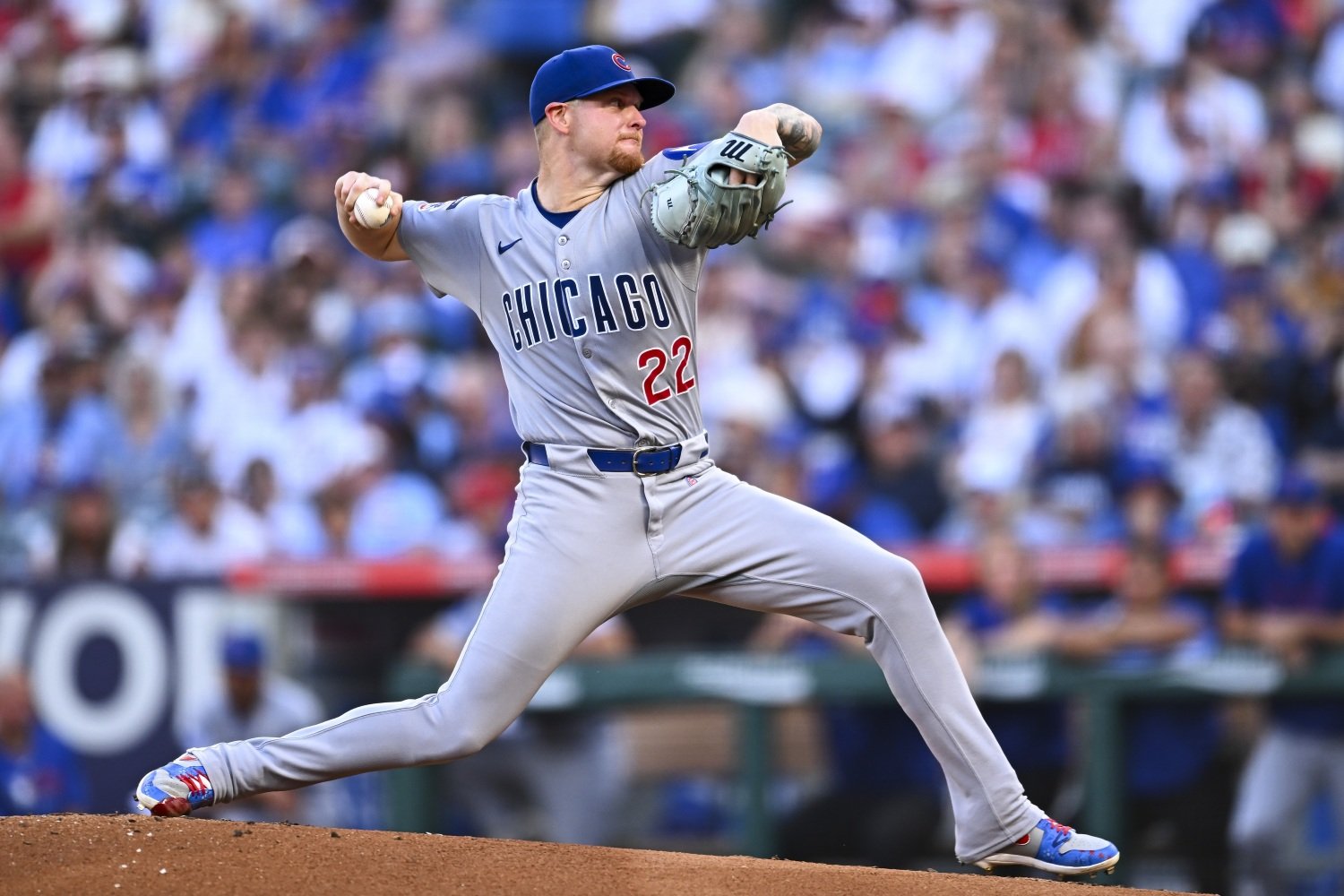 Cubs right-handed pitcher Cade Horton placed runner-up the 2025 BBWAA Jackie Robinson National League Rookie of the Year Award, the league announced Monday night. Horton pitched 118 innings of sparkling ball for the Cubs, with a 2.67 ERA, and he blossomed into their ace in the second half. By finishing in the top two of the voting for this award, he earns a full year of service time for 2025, despite the fact that he debuted on May 10 and accumulated just 142 of the 172 days usually required to qualify for that. This means that Horton (who debuted six months ago) will be a free agent after the 2030 season, the same juncture at which Pete Crow-Armstrong (who debuted 26 months ago) will do so. The league's rules about service time and club control have never seemed more farcical, and perhaps they really are so, but either way, the incentive is a major factor for Horton in shaping his long-term earning power. Any extension with which the Cubs approach him this winter will have to take into account that he will be a free agent five winters hence. For Chicago, it's a small price to pay for the dominance Horton gave them, especially in the second half. The team was 15-8 in his starts, including 8-3 over his last 11. Opponents had a .447 OPS against him after the All-Star break. The season ended in frustrating fashion for the young ace, as he broke a rib and was unable to take the mound in the playoffs, but Horton showed the ability to overpower and overwhelm hitters. He projects as their ace heading into 2026. Matt Shaw also received two down-ballot votes from participating BBWAA writers, good for a 10th-place finish. On balance, the Cubs might have hoped they would see more development from Shaw this season, but their sophomores (Crow-Armstrong, Michael Busch and Daniel Palencia, especially) were very good, and Horton was great. Jed Hoyer's goal of a winning team built more around homegrown talent and less around free-agent splurges is coming into view on the horizon. Horton is the emblem of that progress, and received a rich reward for that Monday. It should incrementally increase the Cubs' urgency, as they try to make the most of their young core by supplementing it this winter.
 -
Image courtesy of © Jon Durr-Imagn Images That Kyle Hendricks started Game 7 of the 2016 World Series—that it was he who first scooped up the baseball for the Cubs on the night that 108 years of waiting finally ended—is just trivia, really. It didn't have to be. Joe Maddon could have trusted him more, if he'd so chosen, and Hendricks would have met the moment. Maddon was on tilt by the end of the Series, though, and the Cubs' survival in that game ultimately had little to do with Hendricks. He was there. He mattered. But he wasn't the man who drove the bus. A week and a half earlier, though, he sure was. By pure happenstance, really, he was the man who took the ball in Game 6 of the NLCS. Jon Lester was the ace of that Cubs team, and he'd started Game 1 of the NLDS. Hendricks got the nod over Jake Arrieta for Game 2, but that was more because Hendricks pitched much better at home than away that year than because Maddon believed Hendricks was materially better than Arrieta. Hendricks left that NLDS start early, after being hit by a comebacker. He avoided major damage, but that game wasn't going his way, anyway. He only recorded 11 outs and surrendered two runs; he didn't strike out anyone. If things had gone a bit differently in San Francisco, for that team, Hendricks might have landed in any of several very different places in the team's rotation for the NLCS. Chicago nearly finished a sweep when they took Game 3 to extra innings. They nearly had to come home to face the Giants in a decisive Game 5, until a winning comeback in Game 4. As things panned out, though, Hendricks got the ball in Game 2 of the NLCS, and he was very much his usual self again. That night, though, Clayton Kershaw outdueled him, evening that series 1-1 as it headed to Los Angeles. Hendricks didn't participate in the West Coast segment of the series, but when it returned to Wrigley, he was slated to start, and his team held the 3-2 series edge. This time, there would be no telling comebackers. There would be no duel. There was just Hendricks, taking a moment baseball history dropped on him like an anvil and heaving it heroically into place. That weight became no obstacle to Hendricks. It became, instead, the killing stone on which the team ritually destroyed the curse of the billy goat. Hendricks was the tip of the spear. Baseball history contains two postseason games in which one side retired the other in 27 batters, winning and facing the minimum in the process. One is Don Larsen's perfect game in the 1956 World Series. The other was the night that Hendricks became a legend of Cubs lore, and of the 27 outs, 22 were his. It didn't start smoothly. Andrew Toles lined Hendricks's first pitch into right field for a single. No matter. Hendricks is unflappability personified, a low cap and a drooping chin and all the physical expressiveness of a department-store mannequin—with exactly the same capacity to be intimidated as a department-store mannequin. That first pitch had all the nerves he would show all evening in it. It was 89 miles per hour, which meant he'd overcooked it, and it ran right down the middle. His second pitch was a sinker to Corey Seager, perfectly placed, running to the outer edge at 87 MPH. Seager hit a ground ball up the middle, on which Javier Báez picked the ball on the run and made a brilliant tag en passant on Toles, then threw to Anthony Rizzo in one motion for the double play. Justin Turner gave Hendricks his first real batter. Hendricks started the late-blooming slugger with a pair of cutters down and away, one a ball and one a called strike. Then came three sinkers in a row: ball low, foul, foul, each pitch working farther in on Turner, trying to speed him up and get him looking there. He tried a dipping changeup to get the strikeout, but Turner laid off. Finally, on 3-2, he went up and away—a hole in Turner's swing, but only if you get him looking everywhere else before going there. It worked. Turner flied lazily to right fielder Albert Almora Jr. Three up, three down. When Hendricks took the mound again, he had a 2-0 lead, and the biggest challenge was not to let the excitement or a relatively long sit in the dugout take his edge off. No problem. He started Adrián González with a cutter that started on the outside edge and ran into the white of the plate. That took guts, because González had taken Hendricks deep for the Dodgers' only run against him six days earlier, to left-center. Hendricks knew, though, that González would take the first pitch unless it looked fat out of the hand. It didn't; it only looked fat once it was in Willson Contreras's mitt. González tried to get aggressive on the next offering, a changeup that tumbled down to his knees on the same line on the outer third, but whiffed. Hendricks ran a cutter way inside on him, then tried two changeups down and away. On the second of them, González hit a soft, floating liner up the middle, which reached a shifted Addison Russell on a leisurely bounce for an easy out. That brought up Josh Reddick, on whom Hendricks again began with a cutter running into the middle of the plate. Called strike one. His next pitch, this time, was not the changeup but his little-used curveball, and its big, slow arc induced a fooled Reddick to hit a topspin bouncer to the right side. It was so mishit, though, that it fooled Báez, just as it had fooled Reddick. It hit the second baseman in the chest, and Reddick got first on the error. No matter. They say Hendricks doesn't have explosive stuff, but he certainly did on the first pitch to Joc Pederson. Just as he threw a fading outside-corner changeup, fireworks went off in the distance, somewhere near the lakeshore, and Pederson tried (far too late) to step out and call time. All he got for his pleas was strike one. Strike two followed, the same changeup but a little bit off the edge, a little low, fouled away by the anxious Pederson. No anxiety afflicted Hendricks. The next pitch was a high fastball, so rare a sighting from Hendricks that it beat Pederson handily for a strikeout. Hendricks then went to work on Yasmani Grandal, but also on Reddick at first base. The Dodger right fielder was looking runnerish, and Hendricks always excelled at thwarting the running game with his quick feet. He nibbled against Grandal, with a changeup that just grabbed the outside edge for strike one and one buried in the dirt for ball one. A backdoor cutter stole him strike two and encouraged Reddick to get a little more. Lengthen that lead, try the steal, there are two strikes, anyway. Bang. Hendricks fired his 'A' pickoff move over, with that sudden turn of the hips and shoulders and that brilliantly light bit of footwork. Reddick was out by as much as any runner you've ever seen, on a pickoff by a righty pitcher. Technically, it was six up, six down. The Cubs tortured Kershaw again for a while in the second, and scored a third run. All Hendricks had to do was keep the train running. He did face an immediate challenge, though: how to get out Grandal a second time in a row, more or less. The answer was: cutter inside (ball one), then back to the outside corner (strike one, called) changeup fading away (ball two), changeup elevated (called strike two). That four-pitch sequence set up a battle. Grandal, one of the most patient hitters in the league and one of its toughest outs, had seen seven pitches already against Hendricks. Hendricks tried a perfect change on the outer edge, but this time, Grandal spoiled it. Hendricks went farther down and away; spoiled. He tried his more cutting changeup, at the bottom edge over the middle of the plate; spoiled. The high fastball that had disposed of Pederson didn't work on Grandal, because he missed too high with it. That brought the count full, but on 3-2, he went back to the cutter, down at the biottom of the zone. Strike three, on a swing that said Grandal expected the changeup. Chase Utley was due next. Though at the end of his career by then, Utley was a great hitter, and wasn't going to give away an at-bat. Hendricks took one from him by the force of precision: backdoor cutter, strike one; changeup down, on the same edge, ball one; sinker away, drawing X's on the outside corner. Utley lined the pitch to left field, but Ben Zobrist caught it with ease. Hendricks didn't mess around at all with Kershaw: three fastballs in the zone, three strikes. Nine up, nine down. Unwilling to give Toles a second chance to hit the first pitch hard somewhere, Hendricks looped in a curveball on the outer black for strike one. The next pitch was a changeup low and away, nibbling the same edge, and Toles put a very good swing on it—but the only thing it was ever going to hit was the end of his bat. Almora made another easy catch. Seager got ahead 2-0, as Hendricks tried the front-hip sinker and the backdoor curve with insufficient precision. Retreating to his bread and butter, though, Hendricks ran the sinker off the outer edge, and Seager grounded out up the middle again. This time, Hendricks cut it off himself and threw to Rizzo. Hendricks stole a strike with a backdoor sinker to Turner, then missed away with that high fastball that worked the previous at-bat. He came back with a changeup diving down and in on him for a swinging strike two, though, and ahead 1-2, he got a weak grounder to Rizzo by running the two-seamer right at Turner's hands. Twelve up, 12 down. It was when Contreras homered off Kershaw to lead off the bottom of the fourth that Wrigley went from loud and excitable to a true cauldron of sound and fearsome joy. It pretty much stayed that way, and that might have startled or overexcited a different player. Hendricks, for his part, got González on a first-pitch cutter at the bottom of the zone, inducing a sharp but manageable grounder to Russell. He started Reddick with a low cutter, for a called strike. He lost an attempt to throw another backdoor curve, but when he came back from that with a changeup in the middle of the plate, Reddick just popped it up. Báez went over and took the ball away from Rizzo, but whichever of them caught it, the play was going to be easy. Home plate umpire Ted Barrett missed what should have been strike one to start Pederson, on a high cutter, but Hendricks came back with a lower one to even the tally. He missed away with another curve (really, he didn't have great feel for that pitch for most of the night, but all his misses with it were far beyond the areas where he might have gotten hurt), then got strike two with a balloon ball of a changeup away. After that floater, when he threw a sharper, tumbling change in the dirt, Pederson had no chance. It was a swinging third strike. Fifteen up, 15 down. Anthony Rizzo made it, officially, a blowout with a fifth-inning homer. Kershaw tried to get cute with a dropdown slider against him. Rizzo did decidedly non-cute things to that ball. Hendricks had only been expected to give the team about five innings in this contest, and he'd done that. The lead was five. If his night had ended there, no one would have blinked. Instead, he took the hill again, facing Grandal—who had already seen 12 pitches against him in the game. He tried a high cutter to start him, but missed up. He went back to that floating, slightly slower high changeup away, to even the count, but then failed to get the chase when he threw a curve (executed correctly, this time, but to no avail) ankle-high over the inner third. For the first time, he started to look ever-so-slightly tired. He tested the outside corner with a cutter, but released it a hair early and missed high and away with it. For the first time all night, he was meaningfully behind in a count, 3-1. No matter. He threw two gorgeous cutters, one down and in and one that found that upper, outer edge, both drawing whiffs from the sharp-eyed Grandal. Eighteen pitches weren't enough for Grandal to figure him out; none of the other Dodgers would get anything close to that many chances. His command was still a bit compromised. He started Utley with a good cutter down and in, but his impression of a backfoot curveball proved unconvincing, and a 1-1 backdoor cutter didn't reach the plate. No matter. A 2-1 pitch that must have looked like a hittable sinker to Utley was really a changeup that ran off the plate away, and the aging star tapped a grounder to Báez. Kershaw's night ended with Andre Ethier pinch-hitting for him. Hendricks missed with a cutter, then a changeup down and away, but then he stole a strike with a low cutter. He tried to go even lower with a sinker, but missed. Another 3-1 count. No matter. Ethier was trying to buy a walk, and so Hendricks filled up the zone with a cutter. On 3-2, he landed another perfect backdoor cut-piece, and Ethier became the first Dodgers batter all night to hit the ball to Kris Bryant, at third base. It was an easy grounder. Eighteen up, 18 down. Toles had clearly been looking down and out over the plate in each of his first two turns, and he'd been aggressive, too. That made Hendricks's job the third time easy. He threw him a cutter up and in, tying him up badly and inducing a pop-up to Russell. He fired a first-pitch cutter to Seager to jump ahead 0-1, then went sinker-sinker, down and away. One of them missed off the edge; Seager fouled off the other. On 1-2, he tried a change of eye levels with a high fastball, but Seager fouled that off, too. Having set him up, Hendricks went for two straight buried changeups. but Seager laid off them, filling the count. No. Matter. Hendricks had one more changeup to offer, and it was a thing of beauty. He turned it over hard, got two-plane fade on it, and Seager tried to kill it. No luck, no contact, and a strikeout where a walk could have been but was never going to be. Like every other Dodgers batter, Seager was more anxious than Hendricks. He threw Turner another surgical first-pitch, backdoor sinker. He tried to get another whiff with that changeup slicing in under his bat path, but Turner laid off it for ball one. He tried again, but the pitch hung. Turner had been looking for the cutter, though, and even a slightly elevated change brought a weak foul pop-up to Rizzo. Twenty-one up, 21 down. González looks to do damage on the ball down and away, so much that Hendricks tried a first-pitch bender below the zone to start the eighth. It missed. He tried a cutter up and in; it missed. He then went for three straight cutters starting on the outer edge and running in, trying to get weak contact to bail him out of the bad count. Even with five runs of cushion, he wasn't going to walk González. He wasn't pitching for strikeouts or glory, but for the team. On a 3-1 pitch, González obliged him with a fly ball to center field, where Dexter Fowler got his first action of the game. Hendricks's first pitch to Reddick was a cutter that didn't start as far out on the edge as he'd meant, and which ended up right down the middle. Reddick hit a clean single to center, two balls in a row for Fowler, and that ended Hendricks's night. No matter. Aroldis Chapman would finish the job, with two double plays leading to a four-up, five-down save. Before that, though, came the ovation of a lifetime. Hendricks left Wrigley Field with the crowd in as true a frenzy as has met the departure of any starting pitcher in the stadium's history. Báez tugged at the name on the back of his jersey as he started away. Maybe Hendricks wanted to absorb the adulation head-down, brow stoic, but his teammates wanted none of that. They'd just watched him knit them all together, pick them all up when they wobbled, and carry them to the end of the curse, if not quite the end of the night. As great as Kerry Wood's 20-strikeout mega-gem was, it's not the best and greatest pitching performance in Cubs history. This was. Officially, the Dodgers collected two hits against Hendricks that night, and they reached on one error. No matter. That night, that team was perfect, and their starting pitcher made them so. Destiny chose Kyle Hendricks, a nobody eighth-round pick with a fastball from the wrong generation and a changeup from Hell, to be the one who ended sport's most famous droughts. On the night when he made baseball history, the man who famously lived at 88 miles per hour threw 88 pitches. He was masterful, and unshakable, and such a team guy that (even though it took until the very end) he leaned on every teammate to assist or record at least one out, but he was also a towering individual performer in that game. Hendricks won't go to the Baseball Hall of Fame, but he's a shoo-in for the Cubs Hall of Fame. He'll retire, it was reported Monday, so we've seen the last of him in the major leagues. No matter. For most Cubs fans, he'll live and pitch forever, over and over, whenever they close their eyes or go to YouTube to savor the highlights. There might be no more ideal image to capture one player's career in one picture than that moment when, surrounded by teammates and a manager somewhat awestruck by the massiveness and the beauty of his performance, Hendricks handed the ball to his skipper, with Báez tugging at that name to make sure everyone in the park knew just who had dominated on the biggest stage in Chicago sports history. View full article
-
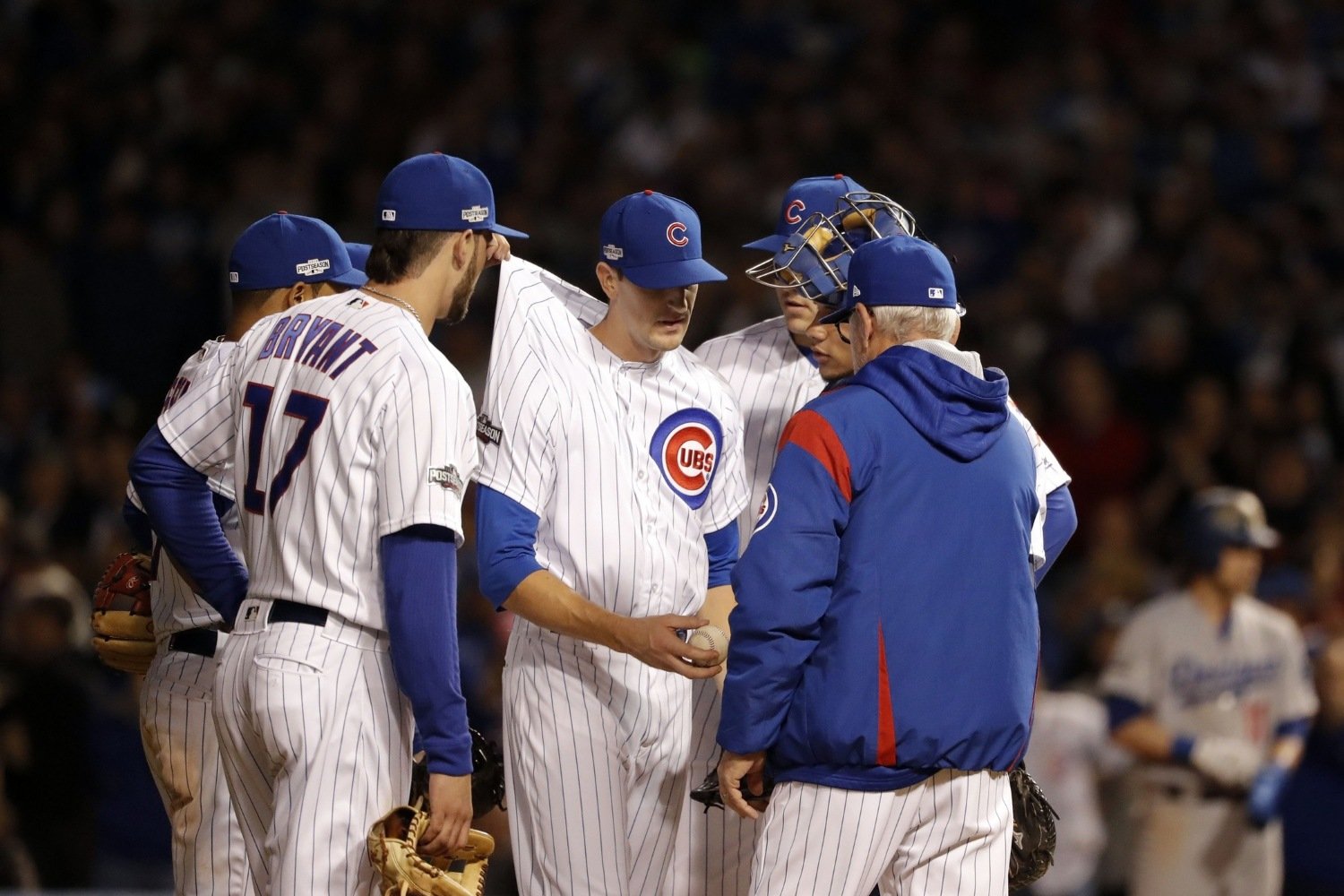 That Kyle Hendricks started Game 7 of the 2016 World Series—that it was he who first scooped up the baseball for the Cubs on the night that 108 years of waiting finally ended—is just trivia, really. It didn't have to be. Joe Maddon could have trusted him more, if he'd so chosen, and Hendricks would have met the moment. Maddon was on tilt by the end of the Series, though, and the Cubs' survival in that game ultimately had little to do with Hendricks. He was there. He mattered. But he wasn't the man who drove the bus. A week and a half earlier, though, he sure was. By pure happenstance, really, he was the man who took the ball in Game 6 of the NLCS. Jon Lester was the ace of that Cubs team, and he'd started Game 1 of the NLDS. Hendricks got the nod over Jake Arrieta for Game 2, but that was more because Hendricks pitched much better at home than away that year than because Maddon believed Hendricks was materially better than Arrieta. Hendricks left that NLDS start early, after being hit by a comebacker. He avoided major damage, but that game wasn't going his way, anyway. He only recorded 11 outs and surrendered two runs; he didn't strike out anyone. If things had gone a bit differently in San Francisco, for that team, Hendricks might have landed in any of several very different places in the team's rotation for the NLCS. Chicago nearly finished a sweep when they took Game 3 to extra innings. They nearly had to come home to face the Giants in a decisive Game 5, until a winning comeback in Game 4. As things panned out, though, Hendricks got the ball in Game 2 of the NLCS, and he was very much his usual self again. That night, though, Clayton Kershaw outdueled him, evening that series 1-1 as it headed to Los Angeles. Hendricks didn't participate in the West Coast segment of the series, but when it returned to Wrigley, he was slated to start, and his team held the 3-2 series edge. This time, there would be no telling comebackers. There would be no duel. There was just Hendricks, taking a moment baseball history dropped on him like an anvil and heaving it heroically into place. That weight became no obstacle to Hendricks. It became, instead, the killing stone on which the team ritually destroyed the curse of the billy goat. Hendricks was the tip of the spear. Baseball history contains two postseason games in which one side retired the other in 27 batters, winning and facing the minimum in the process. One is Don Larsen's perfect game in the 1956 World Series. The other was the night that Hendricks became a legend of Cubs lore, and of the 27 outs, 22 were his. It didn't start smoothly. Andrew Toles lined Hendricks's first pitch into right field for a single. No matter. Hendricks is unflappability personified, a low cap and a drooping chin and all the physical expressiveness of a department-store mannequin—with exactly the same capacity to be intimidated as a department-store mannequin. That first pitch had all the nerves he would show all evening in it. It was 89 miles per hour, which meant he'd overcooked it, and it ran right down the middle. His second pitch was a sinker to Corey Seager, perfectly placed, running to the outer edge at 87 MPH. Seager hit a ground ball up the middle, on which Javier Báez picked the ball on the run and made a brilliant tag en passant on Toles, then threw to Anthony Rizzo in one motion for the double play. Justin Turner gave Hendricks his first real batter. Hendricks started the late-blooming slugger with a pair of cutters down and away, one a ball and one a called strike. Then came three sinkers in a row: ball low, foul, foul, each pitch working farther in on Turner, trying to speed him up and get him looking there. He tried a dipping changeup to get the strikeout, but Turner laid off. Finally, on 3-2, he went up and away—a hole in Turner's swing, but only if you get him looking everywhere else before going there. It worked. Turner flied lazily to right fielder Albert Almora Jr. Three up, three down. When Hendricks took the mound again, he had a 2-0 lead, and the biggest challenge was not to let the excitement or a relatively long sit in the dugout take his edge off. No problem. He started Adrián González with a cutter that started on the outside edge and ran into the white of the plate. That took guts, because González had taken Hendricks deep for the Dodgers' only run against him six days earlier, to left-center. Hendricks knew, though, that González would take the first pitch unless it looked fat out of the hand. It didn't; it only looked fat once it was in Willson Contreras's mitt. González tried to get aggressive on the next offering, a changeup that tumbled down to his knees on the same line on the outer third, but whiffed. Hendricks ran a cutter way inside on him, then tried two changeups down and away. On the second of them, González hit a soft, floating liner up the middle, which reached a shifted Addison Russell on a leisurely bounce for an easy out. That brought up Josh Reddick, on whom Hendricks again began with a cutter running into the middle of the plate. Called strike one. His next pitch, this time, was not the changeup but his little-used curveball, and its big, slow arc induced a fooled Reddick to hit a topspin bouncer to the right side. It was so mishit, though, that it fooled Báez, just as it had fooled Reddick. It hit the second baseman in the chest, and Reddick got first on the error. No matter. They say Hendricks doesn't have explosive stuff, but he certainly did on the first pitch to Joc Pederson. Just as he threw a fading outside-corner changeup, fireworks went off in the distance, somewhere near the lakeshore, and Pederson tried (far too late) to step out and call time. All he got for his pleas was strike one. Strike two followed, the same changeup but a little bit off the edge, a little low, fouled away by the anxious Pederson. No anxiety afflicted Hendricks. The next pitch was a high fastball, so rare a sighting from Hendricks that it beat Pederson handily for a strikeout. Hendricks then went to work on Yasmani Grandal, but also on Reddick at first base. The Dodger right fielder was looking runnerish, and Hendricks always excelled at thwarting the running game with his quick feet. He nibbled against Grandal, with a changeup that just grabbed the outside edge for strike one and one buried in the dirt for ball one. A backdoor cutter stole him strike two and encouraged Reddick to get a little more. Lengthen that lead, try the steal, there are two strikes, anyway. Bang. Hendricks fired his 'A' pickoff move over, with that sudden turn of the hips and shoulders and that brilliantly light bit of footwork. Reddick was out by as much as any runner you've ever seen, on a pickoff by a righty pitcher. Technically, it was six up, six down. The Cubs tortured Kershaw again for a while in the second, and scored a third run. All Hendricks had to do was keep the train running. He did face an immediate challenge, though: how to get out Grandal a second time in a row, more or less. The answer was: cutter inside (ball one), then back to the outside corner (strike one, called) changeup fading away (ball two), changeup elevated (called strike two). That four-pitch sequence set up a battle. Grandal, one of the most patient hitters in the league and one of its toughest outs, had seen seven pitches already against Hendricks. Hendricks tried a perfect change on the outer edge, but this time, Grandal spoiled it. Hendricks went farther down and away; spoiled. He tried his more cutting changeup, at the bottom edge over the middle of the plate; spoiled. The high fastball that had disposed of Pederson didn't work on Grandal, because he missed too high with it. That brought the count full, but on 3-2, he went back to the cutter, down at the biottom of the zone. Strike three, on a swing that said Grandal expected the changeup. Chase Utley was due next. Though at the end of his career by then, Utley was a great hitter, and wasn't going to give away an at-bat. Hendricks took one from him by the force of precision: backdoor cutter, strike one; changeup down, on the same edge, ball one; sinker away, drawing X's on the outside corner. Utley lined the pitch to left field, but Ben Zobrist caught it with ease. Hendricks didn't mess around at all with Kershaw: three fastballs in the zone, three strikes. Nine up, nine down. Unwilling to give Toles a second chance to hit the first pitch hard somewhere, Hendricks looped in a curveball on the outer black for strike one. The next pitch was a changeup low and away, nibbling the same edge, and Toles put a very good swing on it—but the only thing it was ever going to hit was the end of his bat. Almora made another easy catch. Seager got ahead 2-0, as Hendricks tried the front-hip sinker and the backdoor curve with insufficient precision. Retreating to his bread and butter, though, Hendricks ran the sinker off the outer edge, and Seager grounded out up the middle again. This time, Hendricks cut it off himself and threw to Rizzo. Hendricks stole a strike with a backdoor sinker to Turner, then missed away with that high fastball that worked the previous at-bat. He came back with a changeup diving down and in on him for a swinging strike two, though, and ahead 1-2, he got a weak grounder to Rizzo by running the two-seamer right at Turner's hands. Twelve up, 12 down. It was when Contreras homered off Kershaw to lead off the bottom of the fourth that Wrigley went from loud and excitable to a true cauldron of sound and fearsome joy. It pretty much stayed that way, and that might have startled or overexcited a different player. Hendricks, for his part, got González on a first-pitch cutter at the bottom of the zone, inducing a sharp but manageable grounder to Russell. He started Reddick with a low cutter, for a called strike. He lost an attempt to throw another backdoor curve, but when he came back from that with a changeup in the middle of the plate, Reddick just popped it up. Báez went over and took the ball away from Rizzo, but whichever of them caught it, the play was going to be easy. Home plate umpire Ted Barrett missed what should have been strike one to start Pederson, on a high cutter, but Hendricks came back with a lower one to even the tally. He missed away with another curve (really, he didn't have great feel for that pitch for most of the night, but all his misses with it were far beyond the areas where he might have gotten hurt), then got strike two with a balloon ball of a changeup away. After that floater, when he threw a sharper, tumbling change in the dirt, Pederson had no chance. It was a swinging third strike. Fifteen up, 15 down. Anthony Rizzo made it, officially, a blowout with a fifth-inning homer. Kershaw tried to get cute with a dropdown slider against him. Rizzo did decidedly non-cute things to that ball. Hendricks had only been expected to give the team about five innings in this contest, and he'd done that. The lead was five. If his night had ended there, no one would have blinked. Instead, he took the hill again, facing Grandal—who had already seen 12 pitches against him in the game. He tried a high cutter to start him, but missed up. He went back to that floating, slightly slower high changeup away, to even the count, but then failed to get the chase when he threw a curve (executed correctly, this time, but to no avail) ankle-high over the inner third. For the first time, he started to look ever-so-slightly tired. He tested the outside corner with a cutter, but released it a hair early and missed high and away with it. For the first time all night, he was meaningfully behind in a count, 3-1. No matter. He threw two gorgeous cutters, one down and in and one that found that upper, outer edge, both drawing whiffs from the sharp-eyed Grandal. Eighteen pitches weren't enough for Grandal to figure him out; none of the other Dodgers would get anything close to that many chances. His command was still a bit compromised. He started Utley with a good cutter down and in, but his impression of a backfoot curveball proved unconvincing, and a 1-1 backdoor cutter didn't reach the plate. No matter. A 2-1 pitch that must have looked like a hittable sinker to Utley was really a changeup that ran off the plate away, and the aging star tapped a grounder to Báez. Kershaw's night ended with Andre Ethier pinch-hitting for him. Hendricks missed with a cutter, then a changeup down and away, but then he stole a strike with a low cutter. He tried to go even lower with a sinker, but missed. Another 3-1 count. No matter. Ethier was trying to buy a walk, and so Hendricks filled up the zone with a cutter. On 3-2, he landed another perfect backdoor cut-piece, and Ethier became the first Dodgers batter all night to hit the ball to Kris Bryant, at third base. It was an easy grounder. Eighteen up, 18 down. Toles had clearly been looking down and out over the plate in each of his first two turns, and he'd been aggressive, too. That made Hendricks's job the third time easy. He threw him a cutter up and in, tying him up badly and inducing a pop-up to Russell. He fired a first-pitch cutter to Seager to jump ahead 0-1, then went sinker-sinker, down and away. One of them missed off the edge; Seager fouled off the other. On 1-2, he tried a change of eye levels with a high fastball, but Seager fouled that off, too. Having set him up, Hendricks went for two straight buried changeups. but Seager laid off them, filling the count. No. Matter. Hendricks had one more changeup to offer, and it was a thing of beauty. He turned it over hard, got two-plane fade on it, and Seager tried to kill it. No luck, no contact, and a strikeout where a walk could have been but was never going to be. Like every other Dodgers batter, Seager was more anxious than Hendricks. He threw Turner another surgical first-pitch, backdoor sinker. He tried to get another whiff with that changeup slicing in under his bat path, but Turner laid off it for ball one. He tried again, but the pitch hung. Turner had been looking for the cutter, though, and even a slightly elevated change brought a weak foul pop-up to Rizzo. Twenty-one up, 21 down. González looks to do damage on the ball down and away, so much that Hendricks tried a first-pitch bender below the zone to start the eighth. It missed. He tried a cutter up and in; it missed. He then went for three straight cutters starting on the outer edge and running in, trying to get weak contact to bail him out of the bad count. Even with five runs of cushion, he wasn't going to walk González. He wasn't pitching for strikeouts or glory, but for the team. On a 3-1 pitch, González obliged him with a fly ball to center field, where Dexter Fowler got his first action of the game. Hendricks's first pitch to Reddick was a cutter that didn't start as far out on the edge as he'd meant, and which ended up right down the middle. Reddick hit a clean single to center, two balls in a row for Fowler, and that ended Hendricks's night. No matter. Aroldis Chapman would finish the job, with two double plays leading to a four-up, five-down save. Before that, though, came the ovation of a lifetime. Hendricks left Wrigley Field with the crowd in as true a frenzy as has met the departure of any starting pitcher in the stadium's history. Báez tugged at the name on the back of his jersey as he started away. Maybe Hendricks wanted to absorb the adulation head-down, brow stoic, but his teammates wanted none of that. They'd just watched him knit them all together, pick them all up when they wobbled, and carry them to the end of the curse, if not quite the end of the night. As great as Kerry Wood's 20-strikeout mega-gem was, it's not the best and greatest pitching performance in Cubs history. This was. Officially, the Dodgers collected two hits against Hendricks that night, and they reached on one error. No matter. That night, that team was perfect, and their starting pitcher made them so. Destiny chose Kyle Hendricks, a nobody eighth-round pick with a fastball from the wrong generation and a changeup from Hell, to be the one who ended sport's most famous droughts. On the night when he made baseball history, the man who famously lived at 88 miles per hour threw 88 pitches. He was masterful, and unshakable, and such a team guy that (even though it took until the very end) he leaned on every teammate to assist or record at least one out, but he was also a towering individual performer in that game. Hendricks won't go to the Baseball Hall of Fame, but he's a shoo-in for the Cubs Hall of Fame. He'll retire, it was reported Monday, so we've seen the last of him in the major leagues. No matter. For most Cubs fans, he'll live and pitch forever, over and over, whenever they close their eyes or go to YouTube to savor the highlights. There might be no more ideal image to capture one player's career in one picture than that moment when, surrounded by teammates and a manager somewhat awestruck by the massiveness and the beauty of his performance, Hendricks handed the ball to his skipper, with Báez tugging at that name to make sure everyone in the park knew just who had dominated on the biggest stage in Chicago sports history.
 -
BREAKING: Cubs Extend Qualifying Offers to Kyle Tucker, Shota Imanaga
Matthew Trueblood posted an article in Cubs
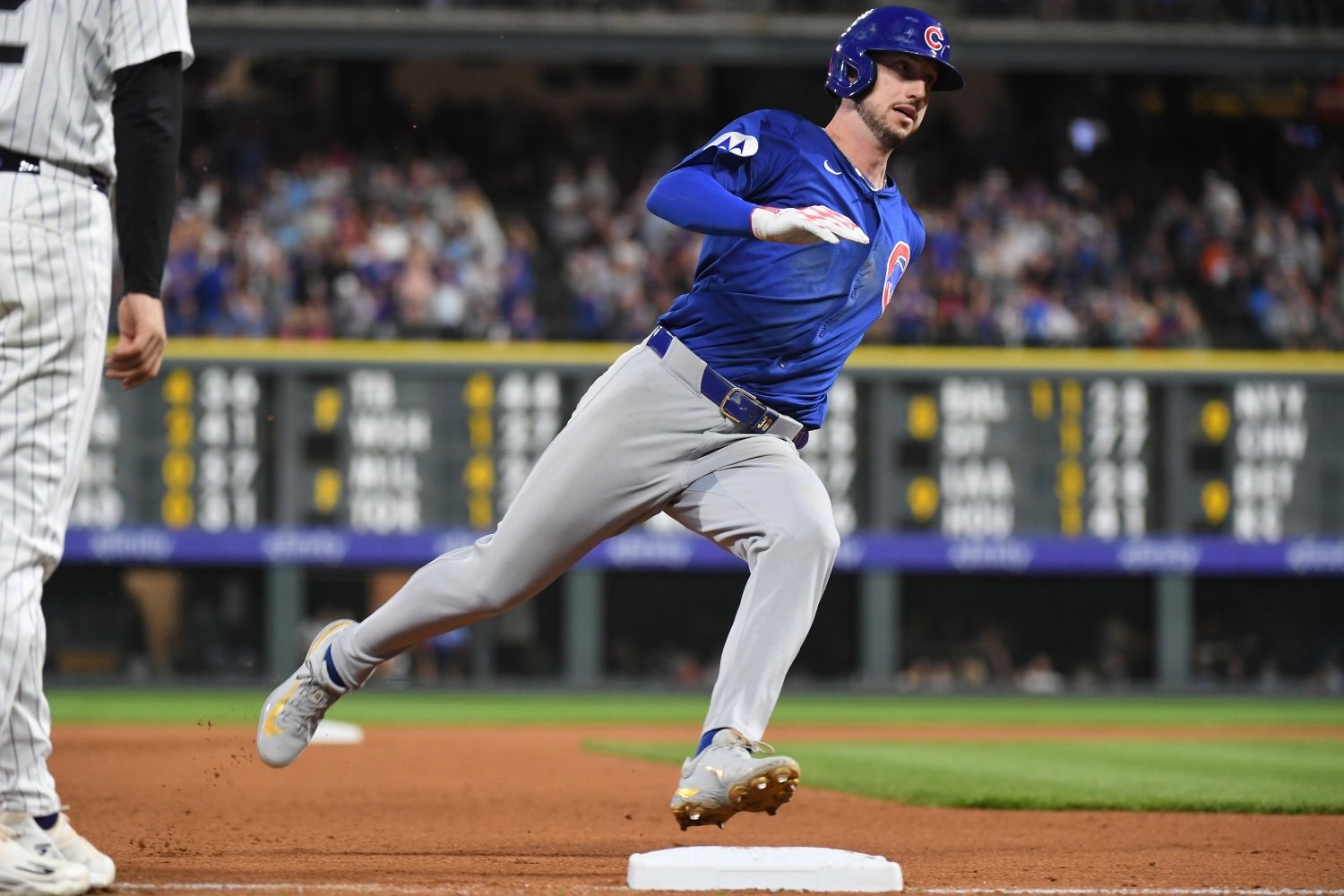 The Chicago Cubs extended the qualifying offer to outfielder Kyle Tucker and to left-handed pitcher Shota Imanaga, ahead of Thursday's deadline to make such decisions. Along with the earlier news that they extended right-hander Colin Rea and that Justin Turner's mutual option for 2026 was declined, the moves round out the team's set of roster machinations as true free agency begins in earnest. For Tucker, the offer was a mere formality. The Cubs were never going to let him go without making that offer, and Tucker will not seriously consider accepting it. This is, in a way, the completion of the trade between the Cubs and Astros last offseason. It becomes (barring the unexpected but still possible development of Tucker returning to Chicago) a trade of Cam Smith, Isaac Paredes and Hayden Wesneski for Tucker and a 2026 draft pick, between the second and third rounds. In 2025, Tucker was less than he or the Cubs hoped he would be—but that was still, on balance, quite good. He batted .266/.377/.464 in 597 plate appearances. He was worth roughly 30 runs more than an average hitter, and was great on the bases. Much of that value was concentrated in the first half of the season, though, and he was disappointingly subpar in right field. The Cubs hoped they were acquiring a player and forging a relationship that would last a decade beyond 2025, but now, they're likely to be happy to take the draft pick and find a replacement for Tucker's offense elsewhere. Issuing the offer to Imanaga is the far more interesting decision, for today. A few months ago, it still looked likely the team would pick up their three-year, $57-million option on him at the onset of the offseason, but after his brutal finish to the season, that went out the window. After Imanaga turned down his own player option, Chicago seriously considered not extending him the offer, sources familiar with the team's thinking said. They were deeply concerned by the problems that developed as he lowered his arm slot in 2025. His fastball's carry remained valuable, but the inability to hit the bottom of the zone with it or get his strike-to-ball splitter working for whiffs steadily eroded his effectiveness throughout the campaign. How the Cubs' winter goes from here might now hinge on whether Imanaga decides to accept the $22.025 million they're offering. That's a significant raise on his side of the equation, though he would have been guaranteed more if he had exercised his option, as he would also have had one after 2026. For the Cubs' part, the money is essentially a wash for 2026. If they'd exercised their own option, they'd be locked in to two extra years, and they'd also have had to make a supplemental posting fee payment to the Yokahoma Bay Stars, Imanaga's former team in NPB. They can easily justify this payment, then, but if Imanaga turns them down, they'll be especially heavy on impending draft compensation and will have lots of flexibility to spend on a replacement for him. They'll receive a draft pick for Tucker (and, if he declines the offer and finds a new home, Imanaga), so they might be more open to surrendering one for the right free-agent signing this winter—especially since, coming off a year of dipping back below the competitive-balance tax threshold, they would surrender only their second-highest pick in doing so. That would be their second-rounder, which is likely to be roughly a dozen picks ahead of the pick(s) they'll pick up. Chicago's projected payroll for 2026 is right around $144 million, but they have to replace a middle-of-the-order bat, supplement their bench, sign at least one starter and replenish their bullpen. If Imanaga accepts the offer, they might not make a splash in the starter market, but they'd then be near $170 million. They're also likely to engage at least one of Nico Hoerner, Pete Crow-Armstrong and Cade Horton about a long-term extension, which would raise their payroll for 2026, too. Now, the groundwork is laid in full, and the team knows what they will and won't have to do—and how much budgetary space they have in which to do it.
 -
Image courtesy of © Christopher Hanewinckel-Imagn Images The Chicago Cubs extended the qualifying offer to outfielder Kyle Tucker and to left-handed pitcher Shota Imanaga, ahead of Thursday's deadline to make such decisions. Along with the earlier news that they extended right-hander Colin Rea and that Justin Turner's mutual option for 2026 was declined, the moves round out the team's set of roster machinations as true free agency begins in earnest. For Tucker, the offer was a mere formality. The Cubs were never going to let him go without making that offer, and Tucker will not seriously consider accepting it. This is, in a way, the completion of the trade between the Cubs and Astros last offseason. It becomes (barring the unexpected but still possible development of Tucker returning to Chicago) a trade of Cam Smith, Isaac Paredes and Hayden Wesneski for Tucker and a 2026 draft pick, between the second and third rounds. In 2025, Tucker was less than he or the Cubs hoped he would be—but that was still, on balance, quite good. He batted .266/.377/.464 in 597 plate appearances. He was worth roughly 30 runs more than an average hitter, and was great on the bases. Much of that value was concentrated in the first half of the season, though, and he was disappointingly subpar in right field. The Cubs hoped they were acquiring a player and forging a relationship that would last a decade beyond 2025, but now, they're likely to be happy to take the draft pick and find a replacement for Tucker's offense elsewhere. Issuing the offer to Imanaga is the far more interesting decision, for today. A few months ago, it still looked likely the team would pick up their three-year, $57-million option on him at the onset of the offseason, but after his brutal finish to the season, that went out the window. After Imanaga turned down his own player option, Chicago seriously considered not extending him the offer, sources familiar with the team's thinking said. They were deeply concerned by the problems that developed as he lowered his arm slot in 2025. His fastball's carry remained valuable, but the inability to hit the bottom of the zone with it or get his strike-to-ball splitter working for whiffs steadily eroded his effectiveness throughout the campaign. How the Cubs' winter goes from here might now hinge on whether Imanaga decides to accept the $22.025 million they're offering. That's a significant raise on his side of the equation, though he would have been guaranteed more if he had exercised his option, as he would also have had one after 2026. For the Cubs' part, the money is essentially a wash for 2026. If they'd exercised their own option, they'd be locked in to two extra years, and they'd also have had to make a supplemental posting fee payment to the Yokahoma Bay Stars, Imanaga's former team in NPB. They can easily justify this payment, then, but if Imanaga turns them down, they'll be especially heavy on impending draft compensation and will have lots of flexibility to spend on a replacement for him. They'll receive a draft pick for Tucker (and, if he declines the offer and finds a new home, Imanaga), so they might be more open to surrendering one for the right free-agent signing this winter—especially since, coming off a year of dipping back below the competitive-balance tax threshold, they would surrender only their second-highest pick in doing so. That would be their second-rounder, which is likely to be roughly a dozen picks ahead of the pick(s) they'll pick up. Chicago's projected payroll for 2026 is right around $144 million, but they have to replace a middle-of-the-order bat, supplement their bench, sign at least one starter and replenish their bullpen. If Imanaga accepts the offer, they might not make a splash in the starter market, but they'd then be near $170 million. They're also likely to engage at least one of Nico Hoerner, Pete Crow-Armstrong and Cade Horton about a long-term extension, which would raise their payroll for 2026, too. Now, the groundwork is laid in full, and the team knows what they will and won't have to do—and how much budgetary space they have in which to do it. View full article
-
NEWS: Cubs Extend Colin Rea, Will Retain Key Depth Arm for 2026
Matthew Trueblood posted an article in Cubs
 The Cubs and Colin Rea agreed to a one-year deal for 2026 with a club option for 2027 Thursday, a source confirmed to North Side Baseball. Steve Adams of MLB Trade Rumors was first to break the news. Rea, 35, will make at least $6.5 million in total, and can make up to $13 million if the Cubs exercise their option next winter. The pact comes just hours before the decision point on the team's would-be 2026 option. included in the contract Rea signed last winter. That deal would have paid him $6 million this year, and the alternative would have been paying a $750,000 buyout. The Cubs ponied up an extra $500,000 to guarantee themselves a chance to bring Rea back on affordable terms in 2027, if they so choose. For Rea, this deal offers shelter from a market that projects to be frigid. As has become their custom, the league's owners have tightened their purse strings as negotiations over the next collective bargaining agreement loom. One source indicated that the Cubs considered declining the option on Rea, and pressed for the extra year of team control in exchange for picking it up. At the same time, this structure benefits the Cubs. With the buyout on next winter's option expected to be slightly larger than the one they just circumvented, they'll pay fractionally less for Rea in 2026 than they otherwise would have, and they gain the flexibility that comes with that 2027 option. Bringing Rea back in some form became something close to a no-brainer, though, once Shota Imanaga declined his team option for 2026. In fact, though they didn't have equal terms on which to make the decision, this sequence of moves suggests the front office has more faith in Rea for next year than they have in Imanaga. Earlier this week, I wrote about the decision to decline Imanaga's three-year team option (and the fact that the team might yet decline to give Imanaga a qualifying offer) at Baseball Prospectus, through the lens of the new pitcher arsenal metrics on that site. Imanaga took an important step backward last year in his ability to get the ball down, and especially to bury his splitter; that became an increasingly lethal problem as the year wore on. Other pitchers might weather such a change better, but Imanaga's limited arsenal and difficulty with deceiving or surprising hitters made it hard for him to do so. By contrast, Rea has worse raw stuff than Imanaga—more velocity, but from the right side instead of the left, and with less lively movement; no single secondary pitch with the swing-and-miss potential of Imanaga's splitter—but an exceptionally deep arsenal and a good idea of how to use it to maximum effect. Hitters can accurately identify the pitch type early against Imanaga almost 82 percent of the time. That's both because he relies so heavily on his four-seamer and splitter, and because those two pitches have such disparate movement. Right away, the trajectory, spin and velocity of the offerings lets the hitter spot differences. Rea couldn't be more different. Hitters can accurately identify which pitch he's throwing just 55.5 percent of the time, which places him in the top decile of the league in disguising pitch type. Because he has so many offerings he trusts—four-seamer, sinker, cutter, curveball, slider, sweeper and changeup, the last of which he switched from a splitter to a kick-change this year—he can also use sequencing to surprise hitters better than most pitchers, and the breadth of movement and velocity bands within which he can work is huge. As he and I discussed in July, he made changes under the Cubs' guidance this year, moving the four-seamer to a place of greater primacy within his mix, but he still made great use of all his offerings. Fascinatingly, his move from the third-base side of the rubber to the first-base side made each of his pitches work better with his four-seamer, and the concomitant switch from being sinker-heavy to letting the four-seamer lead thus led his stuff to play up nicely. Here are the stuff ratings (StuffPro, where 0 is average and negative is better; it's expressed in runs against average per 100 pitches thrown), the pitch type detectabilities (the percentage of the time the hitter was estimated to accurately identify the pitch) and the best tunnel pair for each of Rea's offerings, for 2024 and 2025. Pitch Type 2024 SutffPro 2024 Pitch Type Prob. 2024 Tunnel Pair 2025 StuffPro 2025 Pitch Type Prob. 2025 Tunnel Pair Four-Seamer 0.9 35.8 Sinker 0.6 69.4 Kick-Change Sinker 0.1 63.2 Four-Seamer -0.1 45.2 Four-Seamer Cutter 0.3 42.8 Sweeper 0.2 55.8 Four-Seamer Slider - - - -0.4 28.4 Four-Seamer Sweeper 0 50.8 Cutter -0.8 55.8 Slider Curveball 0.1 49.4 Sweeper -0.1 73.4 Kick-Change Splitter 0.7 27.8 Sinker - - - Kick-Change - - - -0.3 47.9 Four-Seamer It was actually a bit easier to identify Rea's pitches in 2025, on balance, because of his move on the rubber and the fact that he threw his four-seamer more than he had thrown even his more prominent sinker in 2024. However, the StuffPro columns show how impressively his stuff played up thanks to alterations to his angles and his mechanics. His mix also widened, with the addition of the slider, and as you can see in the tunnel pair columns, four of Rea's other six pitches looked like his fastball at least a substantial share of the time for hitters last year. On almost every pitch he threw, hitters read four-seam fastball, but they were wrong often enough to produce a fair number of whiffs and plenty of weak contact. The drawback with Rea, as we discussed late in the 2025 season, is that he runs out of steam a bit near the end of most campaigns. On balance, though, he's a very useful arm. The Cubs will work hard to ensure he's not counted on for as many innings in 2026 as he was in 2025, but he's proved himself to be an average-plus big-league arm. Unlike Imanaga, he has ways to make up for it when his stuff or even his location is less than perfect; his arsenal depth and pitchability fill in the gaps. For now, Rea can be penciled in as the Cubs' fourth starter, behind Cade Horton, Matthew Boyd, and Jameson Taillon. By the middle of next season, the team will hope to have Justin Steele back from his April Tommy John surgery and be nearly ready to promote starting prospect Jaxon Wiggins. They also have Javier Assad, Jordan Wicks and Ben Brown as depth options who could start or relieve for them. A long winter lies ahead, and one or more of those younger players might be traded before Opening Day. Injuries have to be taken into account, too. The Cubs will aim to add a high-profile arm to the front end of their rotation, pushing Rea down the depth chart, but in the meantime, they acted to secure some high-quality depth for the back end of their rotation and the long relief segment of their bullpen.
 -
Image courtesy of © Patrick Gorski-Imagn Images The Cubs and Colin Rea agreed to a one-year deal for 2026 with a club option for 2027 Thursday, a source confirmed to North Side Baseball. Steve Adams of MLB Trade Rumors was first to break the news. Rea, 35, will make at least $6.5 million in total, and can make up to $13 million if the Cubs exercise their option next winter. The pact comes just hours before the decision point on the team's would-be 2026 option. included in the contract Rea signed last winter. That deal would have paid him $6 million this year, and the alternative would have been paying a $750,000 buyout. The Cubs ponied up an extra $500,000 to guarantee themselves a chance to bring Rea back on affordable terms in 2027, if they so choose. For Rea, this deal offers shelter from a market that projects to be frigid. As has become their custom, the league's owners have tightened their purse strings as negotiations over the next collective bargaining agreement loom. One source indicated that the Cubs considered declining the option on Rea, and pressed for the extra year of team control in exchange for picking it up. At the same time, this structure benefits the Cubs. With the buyout on next winter's option expected to be slightly larger than the one they just circumvented, they'll pay fractionally less for Rea in 2026 than they otherwise would have, and they gain the flexibility that comes with that 2027 option. Bringing Rea back in some form became something close to a no-brainer, though, once Shota Imanaga declined his team option for 2026. In fact, though they didn't have equal terms on which to make the decision, this sequence of moves suggests the front office has more faith in Rea for next year than they have in Imanaga. Earlier this week, I wrote about the decision to decline Imanaga's three-year team option (and the fact that the team might yet decline to give Imanaga a qualifying offer) at Baseball Prospectus, through the lens of the new pitcher arsenal metrics on that site. Imanaga took an important step backward last year in his ability to get the ball down, and especially to bury his splitter; that became an increasingly lethal problem as the year wore on. Other pitchers might weather such a change better, but Imanaga's limited arsenal and difficulty with deceiving or surprising hitters made it hard for him to do so. By contrast, Rea has worse raw stuff than Imanaga—more velocity, but from the right side instead of the left, and with less lively movement; no single secondary pitch with the swing-and-miss potential of Imanaga's splitter—but an exceptionally deep arsenal and a good idea of how to use it to maximum effect. Hitters can accurately identify the pitch type early against Imanaga almost 82 percent of the time. That's both because he relies so heavily on his four-seamer and splitter, and because those two pitches have such disparate movement. Right away, the trajectory, spin and velocity of the offerings lets the hitter spot differences. Rea couldn't be more different. Hitters can accurately identify which pitch he's throwing just 55.5 percent of the time, which places him in the top decile of the league in disguising pitch type. Because he has so many offerings he trusts—four-seamer, sinker, cutter, curveball, slider, sweeper and changeup, the last of which he switched from a splitter to a kick-change this year—he can also use sequencing to surprise hitters better than most pitchers, and the breadth of movement and velocity bands within which he can work is huge. As he and I discussed in July, he made changes under the Cubs' guidance this year, moving the four-seamer to a place of greater primacy within his mix, but he still made great use of all his offerings. Fascinatingly, his move from the third-base side of the rubber to the first-base side made each of his pitches work better with his four-seamer, and the concomitant switch from being sinker-heavy to letting the four-seamer lead thus led his stuff to play up nicely. Here are the stuff ratings (StuffPro, where 0 is average and negative is better; it's expressed in runs against average per 100 pitches thrown), the pitch type detectabilities (the percentage of the time the hitter was estimated to accurately identify the pitch) and the best tunnel pair for each of Rea's offerings, for 2024 and 2025. Pitch Type 2024 SutffPro 2024 Pitch Type Prob. 2024 Tunnel Pair 2025 StuffPro 2025 Pitch Type Prob. 2025 Tunnel Pair Four-Seamer 0.9 35.8 Sinker 0.6 69.4 Kick-Change Sinker 0.1 63.2 Four-Seamer -0.1 45.2 Four-Seamer Cutter 0.3 42.8 Sweeper 0.2 55.8 Four-Seamer Slider - - - -0.4 28.4 Four-Seamer Sweeper 0 50.8 Cutter -0.8 55.8 Slider Curveball 0.1 49.4 Sweeper -0.1 73.4 Kick-Change Splitter 0.7 27.8 Sinker - - - Kick-Change - - - -0.3 47.9 Four-Seamer It was actually a bit easier to identify Rea's pitches in 2025, on balance, because of his move on the rubber and the fact that he threw his four-seamer more than he had thrown even his more prominent sinker in 2024. However, the StuffPro columns show how impressively his stuff played up thanks to alterations to his angles and his mechanics. His mix also widened, with the addition of the slider, and as you can see in the tunnel pair columns, four of Rea's other six pitches looked like his fastball at least a substantial share of the time for hitters last year. On almost every pitch he threw, hitters read four-seam fastball, but they were wrong often enough to produce a fair number of whiffs and plenty of weak contact. The drawback with Rea, as we discussed late in the 2025 season, is that he runs out of steam a bit near the end of most campaigns. On balance, though, he's a very useful arm. The Cubs will work hard to ensure he's not counted on for as many innings in 2026 as he was in 2025, but he's proved himself to be an average-plus big-league arm. Unlike Imanaga, he has ways to make up for it when his stuff or even his location is less than perfect; his arsenal depth and pitchability fill in the gaps. For now, Rea can be penciled in as the Cubs' fourth starter, behind Cade Horton, Matthew Boyd, and Jameson Taillon. By the middle of next season, the team will hope to have Justin Steele back from his April Tommy John surgery and be nearly ready to promote starting prospect Jaxon Wiggins. They also have Javier Assad, Jordan Wicks and Ben Brown as depth options who could start or relieve for them. A long winter lies ahead, and one or more of those younger players might be traded before Opening Day. Injuries have to be taken into account, too. The Cubs will aim to add a high-profile arm to the front end of their rotation, pushing Rea down the depth chart, but in the meantime, they acted to secure some high-quality depth for the back end of their rotation and the long relief segment of their bullpen. View full article
-
That's certainly his attitude, and he got it done more often than not late in the season. But remember, you only saw a snapshot of him. He missed the first two months of the season. He's only pitched full seasons twice in his career (2021 and 2024). And again, he'll turn 36 before Opening Day. If you carry him for the full season, you have to be pretty careful with his usage, or he's going to either wear down or break down. That's the real track record here.
-
.png.e75de578f0e03485d90b1324561f582a.png) The Cubs traded Andrew Kittredge to the Baltimore Orioles Tuesday, saving the $1 million they were otherwise poised to invest via buyout on the $9-million option they held for his services in 2026. In return, they received only cash. They chose, in effect, something just under $2 million in extra financial flexibility right away over the chance to spend $8 million (the value of the option, less the buyout) to keep Kittredge. That deal won't be especially popular, at the front end of an offseason and before Jed Hoyer has made any more concrete moves toward maintaining his team's competitive position for 2026. Importantly, though, the concreteness of Kittredge worked against him. This moment of the offseason is all about fluidity. By not committing to Kittredge, the Cubs freed up the money they would otherwise have spent on him, keeping their options open—and freed up a place on their 40-man roster, to boot. That's not to say that the trade will prove to have been wise. In chess parlance, it's an opening move that sharpens the position quickly—just as shoving out Shota Imanaga was. Hoyer is fighting to keep options open, but in so doing, he's reducing the chances of a broadly popular, successful but unspectacular offseason. Moves like this one raise the stakes of the rest of the winter's work; they make it harder to envision a comfortable middle road. They will, inevitably, make fans more nervous, because they trade in safety nets for the walk on a high wire. Nonetheless, it's easy to see the logic at work. As I wrote back on October 22, there was never a chance the Cubs would bring back both Kittredge and fellow right-hander Brad Keller this winter. They had to make an early choice between the two, and saving the buyout (plus getting a little extra cash) does incrementally increase the chances that they can retain Keller. Considered in that light, this decision makes a good amount of sense. It's still possible that the Cubs will divert these resources elsewhere, and not spend as much as $9 million on any one reliever this winter. It's more likely that they'll reinvest this money somewhere, though, and Keller—a player with whom they're familiar, now; one five and a half years Kittredge's junior; and with a different path to similar levels of brilliance this year—appears to be the option they preferred of these two. Hoyer's biggest goal for the pitching staff this winter has to be missing more bats. A key question, then, is whether Kittredge (despite a gaudy strikeout rate over 30% in 2025) can be that swing-and-miss reliever. Keller had a lower strikeout rate than Kittredge's in 2025 and has a much lower one for their respective careers, but Keller had also been a starter until this year. The Cubs probably assessed the two along lines that look roughly like this. Let's walk through it together. Pitcher StuffPro PitchPro Pitch Probability Surprise Factor Mvmt. Spread Vel. Spread Andrew Kittredge -0.2 -1 80.9 101.4 79.4 71.1 Brad Keller -0.5 -0.5 71.9 109.5 93.9 89.9 StuffPro and PitchPro are Baseball Prospectus's pitch quality metrics, akin to the slightly more famous (but slightly less robust) Stuff+ metrics at FanGraphs. StuffPro measures the sheer nastiness of a pitch's movement, speed, release and approach angles, while PitchPro also adjusts for location. Zero is average, and a negative number is better; the scale of those two numbers is runs against average, per 100 pitches. In brief, Keller has better raw stuff than Kittredge. The latter achieved more, in 2025, by being more precise with his locations. Pitch Probability expresses the likelihood that a hitter's diagnosis of pitch type out of the hand will be accurate for any given pitch by that pitcher. Surprise Factor utilizes a pitcher's mix and their usage patterns to give an indexed rating to the ability to violate a hitter's expectations, not via immediate release point or trajectory but by going to a pitch they rarely use or using it in a rare situation. Movement and Velocity Spread rate the extent to which a pitcher's pitches tend to vary from the movement or the speed a hitter expects based on the pitch type they're likely to guess on a given offering. For Surprise Factor and both Spreads, the baseline is 100, and higher is better. Keller is better at disguising which pitches he's throwing that Kittredge is. He's better at using unpredictable variations in usage or sequencing to put a hitter on the defensive. His pitches move in a more productive variety of ways, and he changes speeds more deceptively, to boot. The only fundamental skill at which Kittredge outstrips Keller is hitting his spots. While that's an important skill—and one the Cubs value, perhaps, as much as any team in baseball—it's a hard one to carry from year to year, especially as (mostly) a two-pitch reliever well into your mid-30s. The Cubs liked Keller's fit in their clubhouse in 2025. They liked the way he responded to their challenges and input after they signed him. In their high-level assessment of Kittredge and Keller for 2026, they came away with a strong preference for the latter. That doesn't mean they'll re-sign him. Keller could be in line for a handsome three-year deal this winter, and Chicago might prefer to redirect the money they've saved by moving Kittredge toward hitters or starting pitchers and go try to find the next Keller on the scrap heap. The decision to trade Kittredge will and should be judged on how they spend the money, the roster spot, and the high-leverage situations in relief they're choosing not to offer him. However, the deal decidedly increased the chances that they'll bring back Keller, and since they clearly believe Keller is the better bet of the two hurlers, there's a definite underlying sensibleness to it.
The Cubs traded Andrew Kittredge to the Baltimore Orioles Tuesday, saving the $1 million they were otherwise poised to invest via buyout on the $9-million option they held for his services in 2026. In return, they received only cash. They chose, in effect, something just under $2 million in extra financial flexibility right away over the chance to spend $8 million (the value of the option, less the buyout) to keep Kittredge. That deal won't be especially popular, at the front end of an offseason and before Jed Hoyer has made any more concrete moves toward maintaining his team's competitive position for 2026. Importantly, though, the concreteness of Kittredge worked against him. This moment of the offseason is all about fluidity. By not committing to Kittredge, the Cubs freed up the money they would otherwise have spent on him, keeping their options open—and freed up a place on their 40-man roster, to boot. That's not to say that the trade will prove to have been wise. In chess parlance, it's an opening move that sharpens the position quickly—just as shoving out Shota Imanaga was. Hoyer is fighting to keep options open, but in so doing, he's reducing the chances of a broadly popular, successful but unspectacular offseason. Moves like this one raise the stakes of the rest of the winter's work; they make it harder to envision a comfortable middle road. They will, inevitably, make fans more nervous, because they trade in safety nets for the walk on a high wire. Nonetheless, it's easy to see the logic at work. As I wrote back on October 22, there was never a chance the Cubs would bring back both Kittredge and fellow right-hander Brad Keller this winter. They had to make an early choice between the two, and saving the buyout (plus getting a little extra cash) does incrementally increase the chances that they can retain Keller. Considered in that light, this decision makes a good amount of sense. It's still possible that the Cubs will divert these resources elsewhere, and not spend as much as $9 million on any one reliever this winter. It's more likely that they'll reinvest this money somewhere, though, and Keller—a player with whom they're familiar, now; one five and a half years Kittredge's junior; and with a different path to similar levels of brilliance this year—appears to be the option they preferred of these two. Hoyer's biggest goal for the pitching staff this winter has to be missing more bats. A key question, then, is whether Kittredge (despite a gaudy strikeout rate over 30% in 2025) can be that swing-and-miss reliever. Keller had a lower strikeout rate than Kittredge's in 2025 and has a much lower one for their respective careers, but Keller had also been a starter until this year. The Cubs probably assessed the two along lines that look roughly like this. Let's walk through it together. Pitcher StuffPro PitchPro Pitch Probability Surprise Factor Mvmt. Spread Vel. Spread Andrew Kittredge -0.2 -1 80.9 101.4 79.4 71.1 Brad Keller -0.5 -0.5 71.9 109.5 93.9 89.9 StuffPro and PitchPro are Baseball Prospectus's pitch quality metrics, akin to the slightly more famous (but slightly less robust) Stuff+ metrics at FanGraphs. StuffPro measures the sheer nastiness of a pitch's movement, speed, release and approach angles, while PitchPro also adjusts for location. Zero is average, and a negative number is better; the scale of those two numbers is runs against average, per 100 pitches. In brief, Keller has better raw stuff than Kittredge. The latter achieved more, in 2025, by being more precise with his locations. Pitch Probability expresses the likelihood that a hitter's diagnosis of pitch type out of the hand will be accurate for any given pitch by that pitcher. Surprise Factor utilizes a pitcher's mix and their usage patterns to give an indexed rating to the ability to violate a hitter's expectations, not via immediate release point or trajectory but by going to a pitch they rarely use or using it in a rare situation. Movement and Velocity Spread rate the extent to which a pitcher's pitches tend to vary from the movement or the speed a hitter expects based on the pitch type they're likely to guess on a given offering. For Surprise Factor and both Spreads, the baseline is 100, and higher is better. Keller is better at disguising which pitches he's throwing that Kittredge is. He's better at using unpredictable variations in usage or sequencing to put a hitter on the defensive. His pitches move in a more productive variety of ways, and he changes speeds more deceptively, to boot. The only fundamental skill at which Kittredge outstrips Keller is hitting his spots. While that's an important skill—and one the Cubs value, perhaps, as much as any team in baseball—it's a hard one to carry from year to year, especially as (mostly) a two-pitch reliever well into your mid-30s. The Cubs liked Keller's fit in their clubhouse in 2025. They liked the way he responded to their challenges and input after they signed him. In their high-level assessment of Kittredge and Keller for 2026, they came away with a strong preference for the latter. That doesn't mean they'll re-sign him. Keller could be in line for a handsome three-year deal this winter, and Chicago might prefer to redirect the money they've saved by moving Kittredge toward hitters or starting pitchers and go try to find the next Keller on the scrap heap. The decision to trade Kittredge will and should be judged on how they spend the money, the roster spot, and the high-leverage situations in relief they're choosing not to offer him. However, the deal decidedly increased the chances that they'll bring back Keller, and since they clearly believe Keller is the better bet of the two hurlers, there's a definite underlying sensibleness to it. -
Image courtesy of © Kirby Lee-Imagn Images, Patrick Gorski-Imagn Images The Cubs traded Andrew Kittredge to the Baltimore Orioles Tuesday, saving the $1 million they were otherwise poised to invest via buyout on the $9-million option they held for his services in 2026. In return, they received only cash. They chose, in effect, something just under $2 million in extra financial flexibility right away over the chance to spend $8 million (the value of the option, less the buyout) to keep Kittredge. That deal won't be especially popular, at the front end of an offseason and before Jed Hoyer has made any more concrete moves toward maintaining his team's competitive position for 2026. Importantly, though, the concreteness of Kittredge worked against him. This moment of the offseason is all about fluidity. By not committing to Kittredge, the Cubs freed up the money they would otherwise have spent on him, keeping their options open—and freed up a place on their 40-man roster, to boot. That's not to say that the trade will prove to have been wise. In chess parlance, it's an opening move that sharpens the position quickly—just as shoving out Shota Imanaga was. Hoyer is fighting to keep options open, but in so doing, he's reducing the chances of a broadly popular, successful but unspectacular offseason. Moves like this one raise the stakes of the rest of the winter's work; they make it harder to envision a comfortable middle road. They will, inevitably, make fans more nervous, because they trade in safety nets for the walk on a high wire. Nonetheless, it's easy to see the logic at work. As I wrote back on October 22, there was never a chance the Cubs would bring back both Kittredge and fellow right-hander Brad Keller this winter. They had to make an early choice between the two, and saving the buyout (plus getting a little extra cash) does incrementally increase the chances that they can retain Keller. Considered in that light, this decision makes a good amount of sense. It's still possible that the Cubs will divert these resources elsewhere, and not spend as much as $9 million on any one reliever this winter. It's more likely that they'll reinvest this money somewhere, though, and Keller—a player with whom they're familiar, now; one five and a half years Kittredge's junior; and with a different path to similar levels of brilliance this year—appears to be the option they preferred of these two. Hoyer's biggest goal for the pitching staff this winter has to be missing more bats. A key question, then, is whether Kittredge (despite a gaudy strikeout rate over 30% in 2025) can be that swing-and-miss reliever. Keller had a lower strikeout rate than Kittredge's in 2025 and has a much lower one for their respective careers, but Keller had also been a starter until this year. The Cubs probably assessed the two along lines that look roughly like this. Let's walk through it together. Pitcher StuffPro PitchPro Pitch Probability Surprise Factor Mvmt. Spread Vel. Spread Andrew Kittredge -0.2 -1 80.9 101.4 79.4 71.1 Brad Keller -0.5 -0.5 71.9 109.5 93.9 89.9 StuffPro and PitchPro are Baseball Prospectus's pitch quality metrics, akin to the slightly more famous (but slightly less robust) Stuff+ metrics at FanGraphs. StuffPro measures the sheer nastiness of a pitch's movement, speed, release and approach angles, while PitchPro also adjusts for location. Zero is average, and a negative number is better; the scale of those two numbers is runs against average, per 100 pitches. In brief, Keller has better raw stuff than Kittredge. The latter achieved more, in 2025, by being more precise with his locations. Pitch Probability expresses the likelihood that a hitter's diagnosis of pitch type out of the hand will be accurate for any given pitch by that pitcher. Surprise Factor utilizes a pitcher's mix and their usage patterns to give an indexed rating to the ability to violate a hitter's expectations, not via immediate release point or trajectory but by going to a pitch they rarely use or using it in a rare situation. Movement and Velocity Spread rate the extent to which a pitcher's pitches tend to vary from the movement or the speed a hitter expects based on the pitch type they're likely to guess on a given offering. For Surprise Factor and both Spreads, the baseline is 100, and higher is better. Keller is better at disguising which pitches he's throwing that Kittredge is. He's better at using unpredictable variations in usage or sequencing to put a hitter on the defensive. His pitches move in a more productive variety of ways, and he changes speeds more deceptively, to boot. The only fundamental skill at which Kittredge outstrips Keller is hitting his spots. While that's an important skill—and one the Cubs value, perhaps, as much as any team in baseball—it's a hard one to carry from year to year, especially as (mostly) a two-pitch reliever well into your mid-30s. The Cubs liked Keller's fit in their clubhouse in 2025. They liked the way he responded to their challenges and input after they signed him. In their high-level assessment of Kittredge and Keller for 2026, they came away with a strong preference for the latter. That doesn't mean they'll re-sign him. Keller could be in line for a handsome three-year deal this winter, and Chicago might prefer to redirect the money they've saved by moving Kittredge toward hitters or starting pitchers and go try to find the next Keller on the scrap heap. The decision to trade Kittredge will and should be judged on how they spend the money, the roster spot, and the high-leverage situations in relief they're choosing not to offer him. However, the deal decidedly increased the chances that they'll bring back Keller, and since they clearly believe Keller is the better bet of the two hurlers, there's a definite underlying sensibleness to it. View full article
-
Will Jed Hoyer Finally Spend Big in the Reliever Market This Winter?
Matthew Trueblood posted an article in Cubs
 It's never been Jed Hoyer's style to pay top dollar for relievers—even great, relatively reliable ones. When Theo Epstein was still with the Cubs, they did sign Craig Kimbrel to a three-year deal in 2019, but those were special circumstances, and Hoyer isn't Epstein. Last winter, however, Hoyer did have a long flirtation with Tanner Scott. Though the hard-throwing lefty eventually signed with the Dodgers, the Cubs' offer was competitive. In fact, it had a greater net present value (after accounting for the deferrals in the deal he signed with Los Angeles) than any other team's highest bid. Hoyer is increasingly open to big moves like signing a top-flight reliever to a multi-year deal, and well he should be. The Cubs are very much entering a winning phase in their competitive cycle, and the affordability of young stars Pete Crow-Armstrong, Michael Busch and Cade Horton gives them some financial wiggle room this winter. This winter, there are a handful of hurlers at roughly the same tier as Scott who should be on the team's radar, including a couple who officially became free agents Monday. Here's a rundown. Edwin Díaz, RHP Díaz opted out of the final two years of his deal with the Mets Monday, leaving $38 million on the table. Because the Mets did not extend him a qualifying offer before signing him when he first hit free agency three years ago, they can do so now, which would dampen his market. He and his representatives clearly believe he can still get a third year on a new deal. They're right, too. It feels like he's been around for a long time, but Díaz is just 31 years old. He has a career strikeout rate a hair under 40%, and he doesn't walk an inordinate number of batters, either. His fastball sits 97 and still touches 100, with life. His slider plays off it viciously well, coming in around 90 miles per hour and looking like the heater until it's too late for the batter. He's likely to make another $80 million over four years, although the qualifying offer could bring that number down 10 percent or so. The Cubs will take an interest, but it's a longshot that they'd actually be the ones to land him. Robert Suarez, RHP By contrast, Suarez is much more natural a Hoyer target. He opted out of two more years with the Padres, but that deal was going to pay him much less than Díaz's would have. For multiple reasons, he's also less likely to receive a qualifying offer from San Diego. That would make him available without draft-pick compensation attached, which would increase his appeal to the Cubs. Cubs fans got a good look at Suarez during the team's triumph over San Diego in the Wild Card Series last month. He fills up the zone with a fastball that often hits triple digits, consistently limiting walks and damaging contact well. He struck out 27.9% of opposing batters this season, which would be a boost for the Cubs' pen. However, that's not elite bat-missing ability, by the standards of modern relievers. Nor will Suarez, who turns 35 next March, have the same chance to command a long-term deal that Díaz has. He's not quite as dominant as some of the other arms hitting the market are capable of being, but Suarez should land in a price range more comfortable for Chicago than some of the others. His age and skill set make him the type of arm some of the other big-market teams shy away from. He fits what the Cubs like to a tee, though, and could be their top target on this market. Devin Williams, RHP What a disaster his year in the Bronx was. Williams is probably craving an escape from that situation, and his struggles in New York forced the Yankees to trade for David Bednar in July, so they won't be giving Williams a qualifying offer on the way out the door. He worked a career-high 62 innings in his walk year, but his 4.79 ERA will keep the market for his services from heating up to the extent he surely imagined as recently as six months ago. Williams can be a mercurial clubhouse presence, which might turn off some would-be suitors. It makes the notion of a reunion with a manager who understood and accommodated him especially appealing, so this could be one way that Craig Counsell delivers value to his new team based on the work he did for his old one. The most intriguing thing about him, though, is that despite the bad vibes and the ugly surface-level numbers during his stint with the Yankees, Williams still has good stuff. He ran into a few more barrels this year, and his 34.7% strikeout rate was a career-worst mark—but it would be the career-best for many guys. He also walked fewer batters than usual, dipping under 10% for the first time since his rookie campaign. Luke Weaver, RHP The former Cardinals prospect became a bit of a bust with the Diamondbacks, but when he moved to the bullpen in subsequent stops, he unlocked something impressive. For the last two years, he's been a co-ace in the Yankees bullpen, running an aggregate strikeout rate around 30% while limiting walks well. He has a high arm slot, a high-riding four-seamer, and a great changeup that plays against both lefties and righties (with the odd cutter to keep righties off of it a bit). He's also below the QO threshold, which should result in a robust market; he weathered heavy usage in the 2024 postseason well and was pretty much the same guy in 2025. Pete Fairbanks, RHP We haven't yet heard what the Rays intend to do with Fairbanks, on whom they hold an $11-million option with a $1-million buyout for 2026. That would be a lot of money for Tampa to spend on a reliever, though, so even if they pick up the option, he'll be on the trade market. He's the same age as Díaz and throws just as hard, but he doesn't have the devastating secondary pitch to go with it. His strikeout rate since the start of 2024 is just 24%, which makes him decidedly less than an elite arm at this point. However, he also keeps the bases relatively clear, and he can still be overwhelming in the right matchups or on the right days. José Alvarado, LHP The Phillies hold a relatively affordable $9-million option on Alvarado for 2026, but we haven't yet heard whether they'll exercise it. He was unavailable to them in October due to a suspension for PEDs that also cut a big chunk out of his season. However, when he's on the mound, few relievers can match Alvarado for sheer nastiness. His sinker sits 99 and touches 102, and the hard cutter he throws off of it induces whiffs at an exceptional rate. Conditioning and mechanical work helped him dramatically reduce his walk rate in 2025. If the Phillies let him walk or are open to trading him, the Cubs are likely to be among the interested parties. In addition to that sextet, the Cubs have to weigh whether or not to bring back incumbent high-leverage relievers Brad Keller or Andrew Kittredge. In the next two days, we'll hear which choice they make about Kittredge, on whom they hold a $9-million option for 2026. Keller is a free agent, though, so if they don't bring him back, they have to replace him. One way or another, Hoyer is likely to spend more than usual on the bullpen this winter.
 -
Image courtesy of © Gregory Fisher-Imagn Images It's never been Jed Hoyer's style to pay top dollar for relievers—even great, relatively reliable ones. When Theo Epstein was still with the Cubs, they did sign Craig Kimbrel to a three-year deal in 2019, but those were special circumstances, and Hoyer isn't Epstein. Last winter, however, Hoyer did have a long flirtation with Tanner Scott. Though the hard-throwing lefty eventually signed with the Dodgers, the Cubs' offer was competitive. In fact, it had a greater net present value (after accounting for the deferrals in the deal he signed with Los Angeles) than any other team's highest bid. Hoyer is increasingly open to big moves like signing a top-flight reliever to a multi-year deal, and well he should be. The Cubs are very much entering a winning phase in their competitive cycle, and the affordability of young stars Pete Crow-Armstrong, Michael Busch and Cade Horton gives them some financial wiggle room this winter. This winter, there are a handful of hurlers at roughly the same tier as Scott who should be on the team's radar, including a couple who officially became free agents Monday. Here's a rundown. Edwin Díaz, RHP Díaz opted out of the final two years of his deal with the Mets Monday, leaving $38 million on the table. Because the Mets did not extend him a qualifying offer before signing him when he first hit free agency three years ago, they can do so now, which would dampen his market. He and his representatives clearly believe he can still get a third year on a new deal. They're right, too. It feels like he's been around for a long time, but Díaz is just 31 years old. He has a career strikeout rate a hair under 40%, and he doesn't walk an inordinate number of batters, either. His fastball sits 97 and still touches 100, with life. His slider plays off it viciously well, coming in around 90 miles per hour and looking like the heater until it's too late for the batter. He's likely to make another $80 million over four years, although the qualifying offer could bring that number down 10 percent or so. The Cubs will take an interest, but it's a longshot that they'd actually be the ones to land him. Robert Suarez, RHP By contrast, Suarez is much more natural a Hoyer target. He opted out of two more years with the Padres, but that deal was going to pay him much less than Díaz's would have. For multiple reasons, he's also less likely to receive a qualifying offer from San Diego. That would make him available without draft-pick compensation attached, which would increase his appeal to the Cubs. Cubs fans got a good look at Suarez during the team's triumph over San Diego in the Wild Card Series last month. He fills up the zone with a fastball that often hits triple digits, consistently limiting walks and damaging contact well. He struck out 27.9% of opposing batters this season, which would be a boost for the Cubs' pen. However, that's not elite bat-missing ability, by the standards of modern relievers. Nor will Suarez, who turns 35 next March, have the same chance to command a long-term deal that Díaz has. He's not quite as dominant as some of the other arms hitting the market are capable of being, but Suarez should land in a price range more comfortable for Chicago than some of the others. His age and skill set make him the type of arm some of the other big-market teams shy away from. He fits what the Cubs like to a tee, though, and could be their top target on this market. Devin Williams, RHP What a disaster his year in the Bronx was. Williams is probably craving an escape from that situation, and his struggles in New York forced the Yankees to trade for David Bednar in July, so they won't be giving Williams a qualifying offer on the way out the door. He worked a career-high 62 innings in his walk year, but his 4.79 ERA will keep the market for his services from heating up to the extent he surely imagined as recently as six months ago. Williams can be a mercurial clubhouse presence, which might turn off some would-be suitors. It makes the notion of a reunion with a manager who understood and accommodated him especially appealing, so this could be one way that Craig Counsell delivers value to his new team based on the work he did for his old one. The most intriguing thing about him, though, is that despite the bad vibes and the ugly surface-level numbers during his stint with the Yankees, Williams still has good stuff. He ran into a few more barrels this year, and his 34.7% strikeout rate was a career-worst mark—but it would be the career-best for many guys. He also walked fewer batters than usual, dipping under 10% for the first time since his rookie campaign. Luke Weaver, RHP The former Cardinals prospect became a bit of a bust with the Diamondbacks, but when he moved to the bullpen in subsequent stops, he unlocked something impressive. For the last two years, he's been a co-ace in the Yankees bullpen, running an aggregate strikeout rate around 30% while limiting walks well. He has a high arm slot, a high-riding four-seamer, and a great changeup that plays against both lefties and righties (with the odd cutter to keep righties off of it a bit). He's also below the QO threshold, which should result in a robust market; he weathered heavy usage in the 2024 postseason well and was pretty much the same guy in 2025. Pete Fairbanks, RHP We haven't yet heard what the Rays intend to do with Fairbanks, on whom they hold an $11-million option with a $1-million buyout for 2026. That would be a lot of money for Tampa to spend on a reliever, though, so even if they pick up the option, he'll be on the trade market. He's the same age as Díaz and throws just as hard, but he doesn't have the devastating secondary pitch to go with it. His strikeout rate since the start of 2024 is just 24%, which makes him decidedly less than an elite arm at this point. However, he also keeps the bases relatively clear, and he can still be overwhelming in the right matchups or on the right days. José Alvarado, LHP The Phillies hold a relatively affordable $9-million option on Alvarado for 2026, but we haven't yet heard whether they'll exercise it. He was unavailable to them in October due to a suspension for PEDs that also cut a big chunk out of his season. However, when he's on the mound, few relievers can match Alvarado for sheer nastiness. His sinker sits 99 and touches 102, and the hard cutter he throws off of it induces whiffs at an exceptional rate. Conditioning and mechanical work helped him dramatically reduce his walk rate in 2025. If the Phillies let him walk or are open to trading him, the Cubs are likely to be among the interested parties. In addition to that sextet, the Cubs have to weigh whether or not to bring back incumbent high-leverage relievers Brad Keller or Andrew Kittredge. In the next two days, we'll hear which choice they make about Kittredge, on whom they hold a $9-million option for 2026. Keller is a free agent, though, so if they don't bring him back, they have to replace him. One way or another, Hoyer is likely to spend more than usual on the bullpen this winter. View full article
-
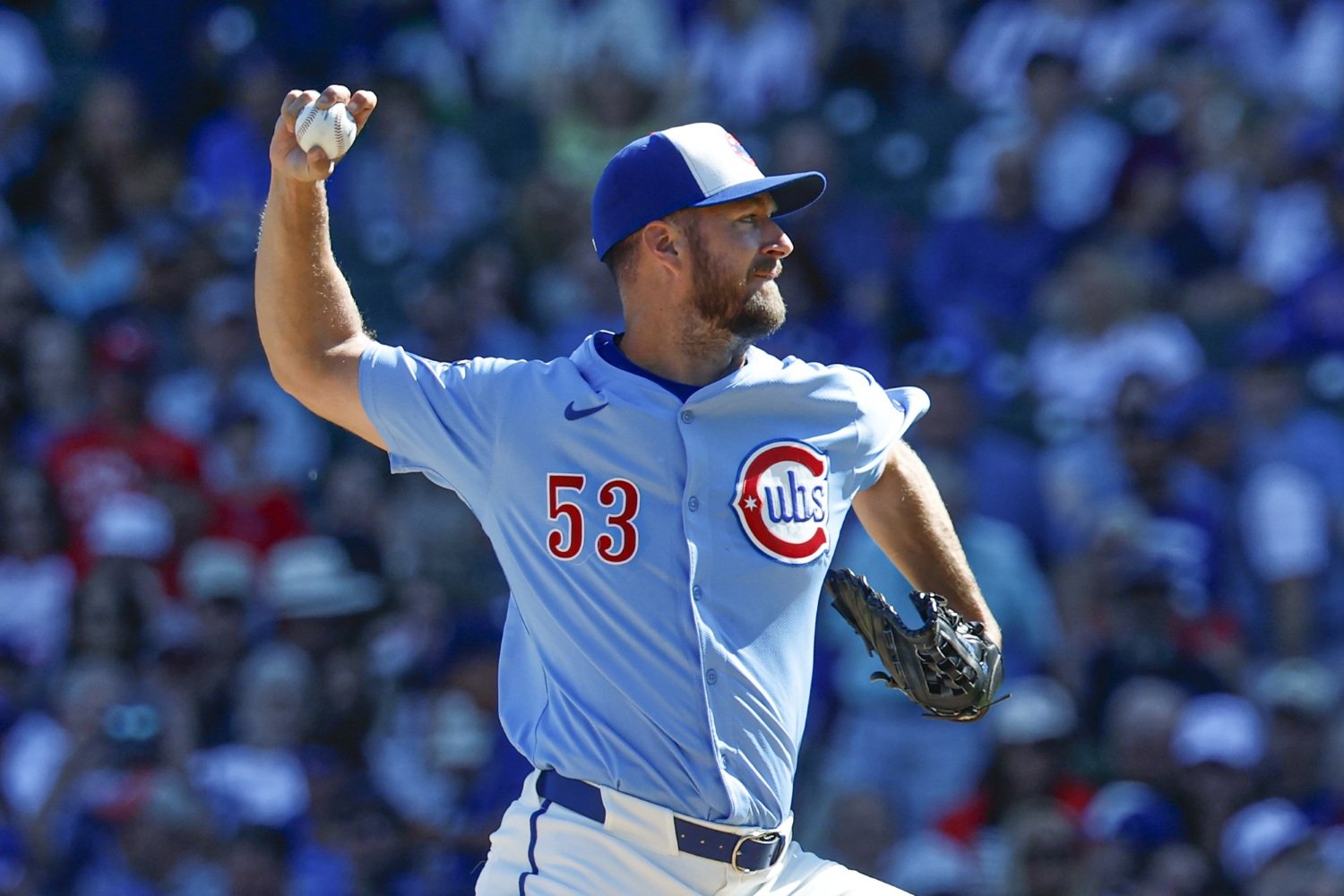 The offseason begins the moment the World Series ends, and even though the 2025 World Series ended in spectacular, exhausting fashion, teams have to start making choices immediately. The Chicago Cubs, for instance, have until Thursday to decide whether to exercise their club options on Colin Rea and Andrew Kittredge. We broke down those choices and their implications late last month. They also have one side of a mutual option with Justin Turner. Chicago also has to decide whether to trigger their three-year, $57-million option on Shota Imanaga. As we discussed in the wake of his last appearance in Game 2 of the NLDS, the team will not pick that up. Once they inform Imanaga of that (a step they'll take right away), the lefty has to decide on a $15-million option of his own, which also comes with another one for 2027. Imanaga is likely to exercise that option, but if he doesn't, it leaves Chicago with another dilemma. If Imanaga elects free agency over the promise of at least $30 million over two years, Chicago can give him a qualifying offer worth $22.025 million. They have the same choice to make about Kyle Tucker, of course, and technically, about out-of-nowhere relief ace Brad Keller. They certainly won't make that offer to Keller, and sources indicate they won't do so with Imanaga, either, should it come to that. They will extend one to Tucker, though. All of the qualifying offer calls also have to be made by Thursday, which is when free agency opens for real. Until then, players can only negotiate with their own teams. Starting then, though, they can sign elsewhere, and the landscape will be better-defined. Players (including Tucker) have until Nov. 18 to accept or decline the qualifying offer. For Tucker, that deadline doesn't matter. He'll officially decline the offer right away, and the Cubs will be eligible for a pick after the second round when he signs elsewhere—although, of course, that signing is unlikely to happen until some time in December or January. For other players, that two-week window will be much more like limbo. If, for instance, the Cubs surprise everyone by extending an offer to Imanaga, he'll have to weigh the likely impact on his market and the security of that significant payday against the theoretical upside of a deeper foray into free agency. Some players on the margins prefer to get deals done by that deadline, electing to accept the offer unless they can hammer out a multi-year guarantee elsewhere. Despite the lack of games, November has become a busy month on the baseball calendar. The Cubs' offseason plans will come into focus over the next four weeks; they have a lot of work to do. With labor unrest looming next winter, this could be a deep-freeze winter, but Chicago doesn't have the luxury of remaining inactive for long.
 -
Image courtesy of © Kamil Krzaczynski-Imagn Images The offseason begins the moment the World Series ends, and even though the 2025 World Series ended in spectacular, exhausting fashion, teams have to start making choices immediately. The Chicago Cubs, for instance, have until Thursday to decide whether to exercise their club options on Colin Rea and Andrew Kittredge. We broke down those choices and their implications late last month. They also have one side of a mutual option with Justin Turner. Chicago also has to decide whether to trigger their three-year, $57-million option on Shota Imanaga. As we discussed in the wake of his last appearance in Game 2 of the NLDS, the team will not pick that up. Once they inform Imanaga of that (a step they'll take right away), the lefty has to decide on a $15-million option of his own, which also comes with another one for 2027. Imanaga is likely to exercise that option, but if he doesn't, it leaves Chicago with another dilemma. If Imanaga elects free agency over the promise of at least $30 million over two years, Chicago can give him a qualifying offer worth $22.025 million. They have the same choice to make about Kyle Tucker, of course, and technically, about out-of-nowhere relief ace Brad Keller. They certainly won't make that offer to Keller, and sources indicate they won't do so with Imanaga, either, should it come to that. They will extend one to Tucker, though. All of the qualifying offer calls also have to be made by Thursday, which is when free agency opens for real. Until then, players can only negotiate with their own teams. Starting then, though, they can sign elsewhere, and the landscape will be better-defined. Players (including Tucker) have until Nov. 18 to accept or decline the qualifying offer. For Tucker, that deadline doesn't matter. He'll officially decline the offer right away, and the Cubs will be eligible for a pick after the second round when he signs elsewhere—although, of course, that signing is unlikely to happen until some time in December or January. For other players, that two-week window will be much more like limbo. If, for instance, the Cubs surprise everyone by extending an offer to Imanaga, he'll have to weigh the likely impact on his market and the security of that significant payday against the theoretical upside of a deeper foray into free agency. Some players on the margins prefer to get deals done by that deadline, electing to accept the offer unless they can hammer out a multi-year guarantee elsewhere. Despite the lack of games, November has become a busy month on the baseball calendar. The Cubs' offseason plans will come into focus over the next four weeks; they have a lot of work to do. With labor unrest looming next winter, this could be a deep-freeze winter, but Chicago doesn't have the luxury of remaining inactive for long. View full article
-
 Though neither Kazuma Okamoto nor Munetaka Murakami qualified for the batting title in Japan this year, if you bring down the required number of plate appearances to 200, they sit atop the leaderboard for offensive production. Okamoto, 29, batted an eye-popping .327/.416/.598 in 69 games and 293 plate appearances. Murakami, 25, finished fifth in NPB in home runs (22), despite playing just 56 games. Overall, he hit .273/.379/.663 in 224 trips to the plate. Obviously, both sluggers will be in high demand this winter, but it's likely to be at two different levels. Murakami has been a bigger name in American baseball circles for the last several years, because he flashed prodigious power at a young age and because it's long been known that he had interest in coming to the States. In 2022, he hit 56 home runs, proving his pop to be not just good, but potentially elite, and he's always demonstrated good plate discipline. Since he'll come to MLB at age 26, there's a good chance he'll make over $200 million on a long-term deal. Okamoto doesn't have the same buzz. He'll turn 30 next June, and has been a regular in NPB for eight seasons. He's always hit well, with a career line of .277/.361/.521, but he'd never demonstrated the ability to dominate quite the way he did when he was on the field in 2025. He did hit at least 30 home runs in every season from 2018 through 2023, but that dipped to 27 in 2024 and to 15 (albeit only because of injury) in 2025. Projections for his earning power this winter have come in closer to the deals signed by Seiya Suzuki (5 years, $85 million) and Masataka Yoshida (5 years, $90 million) when they came over in successive offseasons. Okamoto is older than either of those two were when they made the move, too, so he's likely to sign an even shorter-term deal. However, for multiple reasons, the Cubs should take a greater interest in Okamoto. He's the better fit for their roster, their home park, and their competitive window—and he might just be the better player, anyway. Okamoto bats right-handed, whereas Murakami bats lefty. As we've discussed here recently, the Cubs already have Michael Busch, Pete Crow-Armstrong, Ian Happ, Owen Caissie and Moisés Ballesteros to hurt right-handed pitchers from the left side, and they need to emphasize righty power instead. It's also important to note that, while Murakami's ceiling appears to be higher, Okamoto is the one with the more obviously translatable skill set. Murakami has struck out over 28% of the time in three straight seasons and whiffs on more than 30% of his swings, even in NPB. Okamoto, by contrast, struck out in just 11.3% of his plate appearances this year and hasn't struck out at a rate of 20% or higher since 2019. He makes contact on roughly 80% of his swings in Japan. Both players are patient, but Murakami's swing rate spiked in his interrupted season in 2025; Okamoto's has been steady. When they each played for Samurai Japan in the 2023 World Baseball Classic, Okamoto was the standout. In 27 plate appearances, he batted .333, hit two home runs, and drew eight walks against four strikeouts. Among players with at least 20 trips to the plate in that tournament, only Randy Arozarena, Trea Turner, Shohei Ohtani and Anthony Santander had a higher OPS than Okamoto's 1.278. Both Murakami and Okamoto are third basemen who have been splitting their time and moving over to first base at times over their last few years in Japan; both are expected to play more first base in the States. Each is a good size (Okamoto: 6-foot-1, 220 pounds; Murakami: 6-foot-2, 213), but a bit slow. Of the two, Okamoto is the better defender right now, and he's even been shifted into the outfield for fistfuls of games over the last few years. In the medium-term future, one should bet on Murakami to have more defensive value, because he's considerably younger, but Okamoto will be more useful as a four-corners player in 2026. Okamoto is just a much better fit for the Cubs, who have every chance to win now and need a right-handed slugger to slot into their lineup to make the most of that opportunity. He can platoon with Busch at first base and play plenty of third base against righties, but also mix in at designated hitter as Suzuki (likely) moves back to right field on something close to a full-time basis. A lineup against righties could go: Nico Hoerner - 2B Michael Busch - 1B Seiya Suzuki - RF Ian Happ - LF Kazuma Okamoto - 3B Moisés Ballesteros - DH Dansby Swanson - SS Miguel Amaya - C Pete Crow-Armstrong - CF Against lefties, they could switch that to: Nico Hoerner - 2B Seiya Suzuki - DH Ian Happ - LF Kazuma Okamoto - 1B Dansby Swanson - SS Matt Shaw - 3B Kevin Alcántara - RF Carson Kelly - C Pete Crow-Armstrong - CF Craig Counsell would have the luxury of mixing and matching within that group, swapping Alcántara into center to spell Crow-Armstrong against some lefties; leaving Busch in against some southpaws while sliding Okamoto to DH; or even spelling Hoerner by using Shaw at the keystone. That assumes that none of Shaw, Ballesteros or Alcántara are traded, but a major offensive addition like Okamoto would make it easier to do just that if the situation demanded it, thereby opening up the starting pitching market for Chicago. The inroads the team has made in Japan through their signings of Suzuki and Shota Imanaga (among others) make the Cubs a frequent subject of rumors when stars come over from NPB. That won't change this winter, and it shouldn't. Starting pitcher Tatsuya Imai is another name that will be linked with the team often in the weeks ahead. There's a good case to be made for simply directing their spending toward Imai. When it comes to the dilemma between the top two power hitters coming Stateside, though, the clear preference should be for Okamoto.
 -
Image courtesy of © Rhona Wise-Imagn Images Though neither Kazuma Okamoto nor Munetaka Murakami qualified for the batting title in Japan this year, if you bring down the required number of plate appearances to 200, they sit atop the leaderboard for offensive production. Okamoto, 29, batted an eye-popping .327/.416/.598 in 69 games and 293 plate appearances. Murakami, 25, finished fifth in NPB in home runs (22), despite playing just 56 games. Overall, he hit .273/.379/.663 in 224 trips to the plate. Obviously, both sluggers will be in high demand this winter, but it's likely to be at two different levels. Murakami has been a bigger name in American baseball circles for the last several years, because he flashed prodigious power at a young age and because it's long been known that he had interest in coming to the States. In 2022, he hit 56 home runs, proving his pop to be not just good, but potentially elite, and he's always demonstrated good plate discipline. Since he'll come to MLB at age 26, there's a good chance he'll make over $200 million on a long-term deal. Okamoto doesn't have the same buzz. He'll turn 30 next June, and has been a regular in NPB for eight seasons. He's always hit well, with a career line of .277/.361/.521, but he'd never demonstrated the ability to dominate quite the way he did when he was on the field in 2025. He did hit at least 30 home runs in every season from 2018 through 2023, but that dipped to 27 in 2024 and to 15 (albeit only because of injury) in 2025. Projections for his earning power this winter have come in closer to the deals signed by Seiya Suzuki (5 years, $85 million) and Masataka Yoshida (5 years, $90 million) when they came over in successive offseasons. Okamoto is older than either of those two were when they made the move, too, so he's likely to sign an even shorter-term deal. However, for multiple reasons, the Cubs should take a greater interest in Okamoto. He's the better fit for their roster, their home park, and their competitive window—and he might just be the better player, anyway. Okamoto bats right-handed, whereas Murakami bats lefty. As we've discussed here recently, the Cubs already have Michael Busch, Pete Crow-Armstrong, Ian Happ, Owen Caissie and Moisés Ballesteros to hurt right-handed pitchers from the left side, and they need to emphasize righty power instead. It's also important to note that, while Murakami's ceiling appears to be higher, Okamoto is the one with the more obviously translatable skill set. Murakami has struck out over 28% of the time in three straight seasons and whiffs on more than 30% of his swings, even in NPB. Okamoto, by contrast, struck out in just 11.3% of his plate appearances this year and hasn't struck out at a rate of 20% or higher since 2019. He makes contact on roughly 80% of his swings in Japan. Both players are patient, but Murakami's swing rate spiked in his interrupted season in 2025; Okamoto's has been steady. When they each played for Samurai Japan in the 2023 World Baseball Classic, Okamoto was the standout. In 27 plate appearances, he batted .333, hit two home runs, and drew eight walks against four strikeouts. Among players with at least 20 trips to the plate in that tournament, only Randy Arozarena, Trea Turner, Shohei Ohtani and Anthony Santander had a higher OPS than Okamoto's 1.278. Both Murakami and Okamoto are third basemen who have been splitting their time and moving over to first base at times over their last few years in Japan; both are expected to play more first base in the States. Each is a good size (Okamoto: 6-foot-1, 220 pounds; Murakami: 6-foot-2, 213), but a bit slow. Of the two, Okamoto is the better defender right now, and he's even been shifted into the outfield for fistfuls of games over the last few years. In the medium-term future, one should bet on Murakami to have more defensive value, because he's considerably younger, but Okamoto will be more useful as a four-corners player in 2026. Okamoto is just a much better fit for the Cubs, who have every chance to win now and need a right-handed slugger to slot into their lineup to make the most of that opportunity. He can platoon with Busch at first base and play plenty of third base against righties, but also mix in at designated hitter as Suzuki (likely) moves back to right field on something close to a full-time basis. A lineup against righties could go: Nico Hoerner - 2B Michael Busch - 1B Seiya Suzuki - RF Ian Happ - LF Kazuma Okamoto - 3B Moisés Ballesteros - DH Dansby Swanson - SS Miguel Amaya - C Pete Crow-Armstrong - CF Against lefties, they could switch that to: Nico Hoerner - 2B Seiya Suzuki - DH Ian Happ - LF Kazuma Okamoto - 1B Dansby Swanson - SS Matt Shaw - 3B Kevin Alcántara - RF Carson Kelly - C Pete Crow-Armstrong - CF Craig Counsell would have the luxury of mixing and matching within that group, swapping Alcántara into center to spell Crow-Armstrong against some lefties; leaving Busch in against some southpaws while sliding Okamoto to DH; or even spelling Hoerner by using Shaw at the keystone. That assumes that none of Shaw, Ballesteros or Alcántara are traded, but a major offensive addition like Okamoto would make it easier to do just that if the situation demanded it, thereby opening up the starting pitching market for Chicago. The inroads the team has made in Japan through their signings of Suzuki and Shota Imanaga (among others) make the Cubs a frequent subject of rumors when stars come over from NPB. That won't change this winter, and it shouldn't. Starting pitcher Tatsuya Imai is another name that will be linked with the team often in the weeks ahead. There's a good case to be made for simply directing their spending toward Imai. When it comes to the dilemma between the top two power hitters coming Stateside, though, the clear preference should be for Okamoto. View full article
-
How Big a Role Will Cubs Play in 2026 World Baseball Classic?
Matthew Trueblood posted an article in Cubs
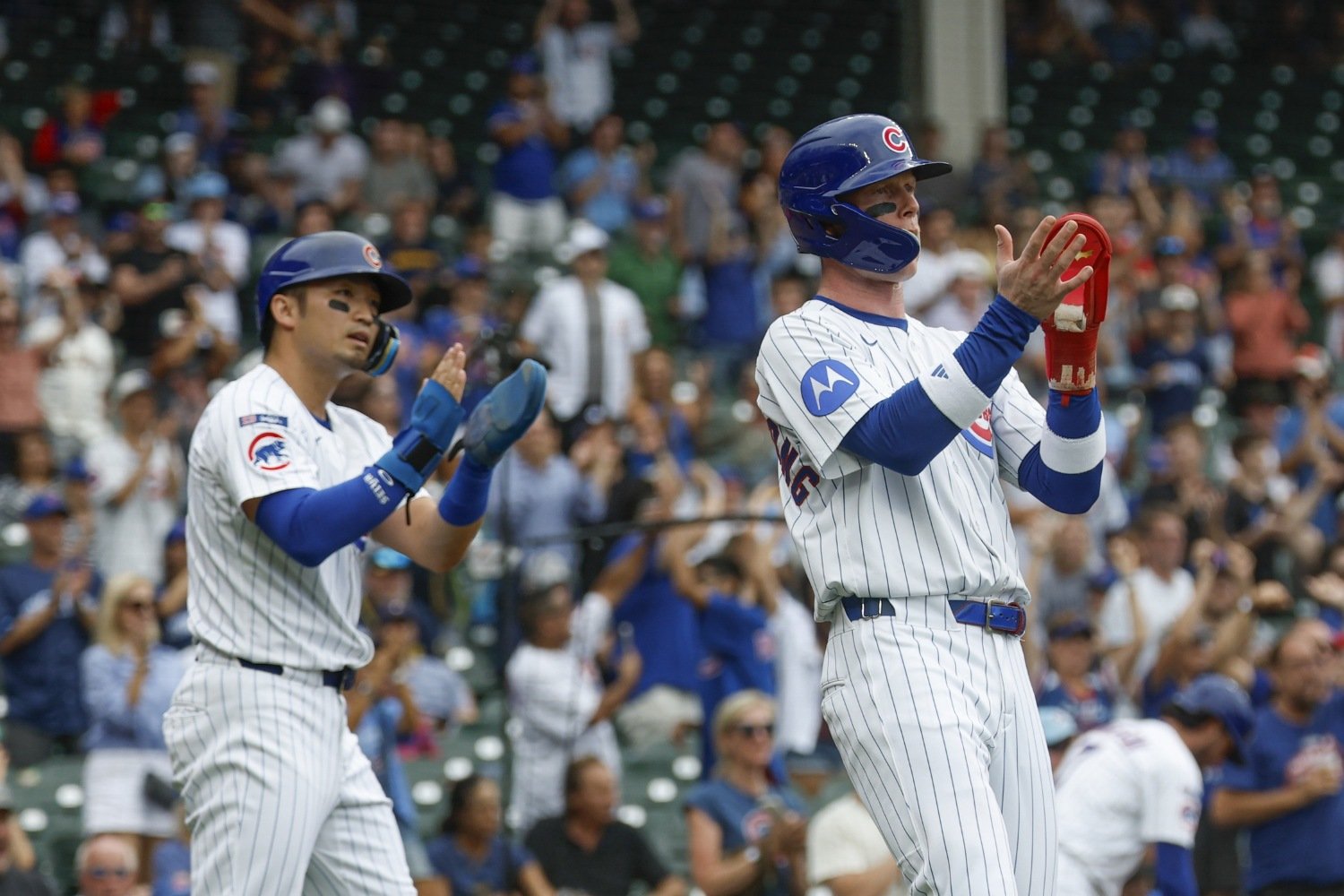 Three years ago, in early 2023, there were several Cubs storylines attached to the World Baseball Classic. Though an oblique strain sidelined Seiya Suzuki for the tournament, it was poignant to see his jersey hanging in the dugout for Samurai Japan throughout their run to the championship. Meanwhile, for Team México, Javier Assad showed up and shoved; it was a thrilling glimpse of the intensity his stuff could achieve in short bursts. Then-Cub Marcus Stroman made two strong starts for Team Puerto Rico. Then-prospects BJ Murray (Great Britain), Matt Mervis (Israel), Jared Young and Owen Caissie (Canada) each played in the tournament, too, with Caissie giving confirmation of his prospect status by holding his own in a high-level international competition. Only Caissie remains a relevant Cubs concern with the 2026 tournament on the horizon, but in addition to him, Suzuki and Assad, there are several players now attached to the organization who could very well be involved come March. Third baseman Matt Shaw played for Team USA in the Premier 12 tournament in Japan in November 2024, leading into his rookie campaign with the Cubs. He's far from the top of the United States's likely depth chart for this higher-profile tournament, but he could be a candidate to get a call from manager Mark DeRosa as the former Cub seeks to round out his infield. Three other young Cubs position players might be even more likely to hear from DeRosa, though. After his breakout season, Pete Crow-Armstrong is arguably the most famous American center fielder. The injuries that disrupted Jackson Merrill's sophomore season with the Padres and the ones that have plagued the career of Twins star Byron Buxton make each of them unlikely to don the stars and stripes for a preseason tournament next spring, and the days of Aaron Judge roaming center field in any high-level competition are over. Crow-Armstrong would be a big get for DeRosa, with a chance to burnish his resume as the game's premier defender in center and to get some more concretely valuable offensive reps in preparation for the season. This seems like a fairly likely assignment, on balance. It's less likely that Nico Hoerner draws the call to play second base for DeRosa's squad, but it's certainly not out of the question. Hoerner's Fielding Bible Award-winning season at the keystone and his superb second half at the plate caught the attention of much of the league. That free agents Bo Bichette and Alex Bregman might be discouraged from playing in the WBC by their new teams could leave more room than would normally be there for the likes of Shaw or Hoerner to filter into the infield equation for Team USA. Speaking of that same variable, longtime Team USA slugger Pete Alonso is also a free agent-to-be, which could make him less likely to participate. Former Captain America Paul Goldschmidt still wants to play in 2026, but at his advanced age, he's not going to be a first-choice guy for DeRosa. Matt Olson, Nick Kurtz, Bryce Harper and Freddie Freeman are all candidates to play first base for the U.S., but there's some chance that Michael Busch is now on that radar, too. After hitting 34 regular-season homers and four more in the postseason, Busch is firmly in the mix for the title of best-hitting American first baseman right now. If age or injury leads to hesitation by the veterans who might otherwise be interested, DeRosa could tab Busch. The Cubs also have a bevy of lesser stars who might be asked to play by their smaller home countries. Miguel Amaya and Daniel Palencia will be in consideration for the Team Venezuela roster. Shota Imanaga (presumably, still a Cub next year, although on what contract terms is still in question) could be in line to play a key role again for Samurai Japan. That's not to mention any of the prospects with foreign attachments, like Venezuelan catcher Moisés Ballesteros and Dominican outfielder Kevin Alcántara. Something like five or six Cubs could be involved in the WBC next year, before accounting for guys (like potential trade targets Pablo López or Joe Ryan, or potential signees via the NPB-to-MLB posting system Tatsuya Imai, Munetaka Murakami or Kazuma Okamoto) who aren't currently in the organization but might be by then. It should be fun, once again, to track their contributions to the buzz and wonder of the tournament.
 -
Image courtesy of © Kamil Krzaczynski-Imagn Images Three years ago, in early 2023, there were several Cubs storylines attached to the World Baseball Classic. Though an oblique strain sidelined Seiya Suzuki for the tournament, it was poignant to see his jersey hanging in the dugout for Samurai Japan throughout their run to the championship. Meanwhile, for Team México, Javier Assad showed up and shoved; it was a thrilling glimpse of the intensity his stuff could achieve in short bursts. Then-Cub Marcus Stroman made two strong starts for Team Puerto Rico. Then-prospects BJ Murray (Great Britain), Matt Mervis (Israel), Jared Young and Owen Caissie (Canada) each played in the tournament, too, with Caissie giving confirmation of his prospect status by holding his own in a high-level international competition. Only Caissie remains a relevant Cubs concern with the 2026 tournament on the horizon, but in addition to him, Suzuki and Assad, there are several players now attached to the organization who could very well be involved come March. Third baseman Matt Shaw played for Team USA in the Premier 12 tournament in Japan in November 2024, leading into his rookie campaign with the Cubs. He's far from the top of the United States's likely depth chart for this higher-profile tournament, but he could be a candidate to get a call from manager Mark DeRosa as the former Cub seeks to round out his infield. Three other young Cubs position players might be even more likely to hear from DeRosa, though. After his breakout season, Pete Crow-Armstrong is arguably the most famous American center fielder. The injuries that disrupted Jackson Merrill's sophomore season with the Padres and the ones that have plagued the career of Twins star Byron Buxton make each of them unlikely to don the stars and stripes for a preseason tournament next spring, and the days of Aaron Judge roaming center field in any high-level competition are over. Crow-Armstrong would be a big get for DeRosa, with a chance to burnish his resume as the game's premier defender in center and to get some more concretely valuable offensive reps in preparation for the season. This seems like a fairly likely assignment, on balance. It's less likely that Nico Hoerner draws the call to play second base for DeRosa's squad, but it's certainly not out of the question. Hoerner's Fielding Bible Award-winning season at the keystone and his superb second half at the plate caught the attention of much of the league. That free agents Bo Bichette and Alex Bregman might be discouraged from playing in the WBC by their new teams could leave more room than would normally be there for the likes of Shaw or Hoerner to filter into the infield equation for Team USA. Speaking of that same variable, longtime Team USA slugger Pete Alonso is also a free agent-to-be, which could make him less likely to participate. Former Captain America Paul Goldschmidt still wants to play in 2026, but at his advanced age, he's not going to be a first-choice guy for DeRosa. Matt Olson, Nick Kurtz, Bryce Harper and Freddie Freeman are all candidates to play first base for the U.S., but there's some chance that Michael Busch is now on that radar, too. After hitting 34 regular-season homers and four more in the postseason, Busch is firmly in the mix for the title of best-hitting American first baseman right now. If age or injury leads to hesitation by the veterans who might otherwise be interested, DeRosa could tab Busch. The Cubs also have a bevy of lesser stars who might be asked to play by their smaller home countries. Miguel Amaya and Daniel Palencia will be in consideration for the Team Venezuela roster. Shota Imanaga (presumably, still a Cub next year, although on what contract terms is still in question) could be in line to play a key role again for Samurai Japan. That's not to mention any of the prospects with foreign attachments, like Venezuelan catcher Moisés Ballesteros and Dominican outfielder Kevin Alcántara. Something like five or six Cubs could be involved in the WBC next year, before accounting for guys (like potential trade targets Pablo López or Joe Ryan, or potential signees via the NPB-to-MLB posting system Tatsuya Imai, Munetaka Murakami or Kazuma Okamoto) who aren't currently in the organization but might be by then. It should be fun, once again, to track their contributions to the buzz and wonder of the tournament. View full article
-
 The list of comparable phenomena in the history of sports is short. Shohei Ohtani is the best baseball player ever, without a close or serious rival, and the way he's swept up the sport—advancing it as a global interest while simultaneously wrapping the whole apparatus around himself, becoming the center of its attention and the source of its gravity—has very few precedents. In whichever order you care to consider them, the people who have had a similarly profound impact on their sport to the one Ohtani is having on baseball right now are: Babe Ruth Tiger Woods Michael Jordan Pelé Simone Biles If we acknowledge the fundamental and irreconcilable differences between team and individual sports, we can cull that list down to Ruth, Jordan, and Pelé, and thus have a more serious conversation. Ohtani is transcending his sport in a way no one but those three has ever done, and in a way few are ever likely to do again. His latest trick, of course, was becoming the first player since 1906 to notch four extra-base hits in a World Series game—which he did in the first seven innings of Game 3, thereafter drawing a record five walks in the Dodgers' 18-inning triumph. He reached base nine times, and although the Blue Jays refused to let him be the one who sank the dagger into them, their inability to get him out (and unwillingness to even try, once he forced the game to final at-bat leverage with his game-tying seventh-inning home run) eventually led to Los Angeles's win. His next trick will be taking the ball to start Game 4 of the Series on the mound. Baseball is not a game one can take over as completely as is possible in basketball. The Jays had a mechanism to work around Ohtani that is much more robust than the double-team defense teams could sometimes run at Jordan at the peak of his powers. Ohtani, however, stretches baseball to its breaking point. He's far more impactful than Ruth was, even at his best. By being both a dominant pitcher and such an otherworldly offensive weapon, he's become more of an all-around force than any soccer player can consistently be. Jordan is the only real comparator—and it's becoming a more apt one almost by the day. Michael Jordan had a great career in the world's second-best basketball league before being drafted by the Chicago Bulls; he was a star in NCAA for the North Carolina Tar Heels. Jordan won a national title and was the National Player of the Year during his college years. He then won the Rookie of the Year Award in 1985, and he won the NBA MVP Award in his fourth season in the league. Shohei Ohtani had a great career in the world's second-best baseball league, before coming over to the United States. With the Nippon Ham Fighters, he won a Japan Series and was the Pacific League MVP in 2016. He then won the Rookie of the Year Award in 2018, and won his first MVP Award in his fourth season in the American League. Each player also achieved international glory. Jordan was on the 1984 Gold Medal-winning Team USA basketball team at the Seoul Olympics. Ohtani closed the championship game of the 2023 World Baseball Classic. However, each was driven—at first bemusedly, then furiously—by the desire to win the championship of the world's best league in their respective sport. Neither felt complete without it, even as each did things their sport had never seen before and achieved fame and wealth that sport had never before afforded to anyone. In their seventh seasons in those top leagues, each finally made it to the mountaintop. Jordan's victory, of course, felt more like the culmination of a long climb, whereas Ohtani seemed to take a running start and fly to the peak, but the result was the same. Each had quieted any possible (at least any halfway serious) critics, but neither was remotely satisfied. In fact, each came back (if anything) more driven the following year, and somehow got even better. In Ohtani's case, it was by sustaining the new level of offensive brilliance he'd reached in 2024 while returning to the mound. In Jordan's, it was by conserving his energy better during the regular season so he could explode for 34.5 points in over 41 minutes per game during the 1992 Playoffs. Ohtani won't be able to singlehandedly carry his team to a second straight title, as Jordan sometimes seemed to do. However, he won the NLCS MVP Award by finishing off the Brewers with the best single-game performance in baseball history. Now, in the first three games of his second World Series, he's batting .500/.667/1.417. He's relentlessly dominant. Even when they go miles out of their way to stop him from landing the killing blow, the opponents can't stop him from pushing his team to the win. Intentional walks to Ohtani led to the pivotal runs in Game 4 of the NLDS and Game 1 of the NLCS. Teams could double- and triple-team Jordan, but he still created scoring chances for the Bulls in ways they couldn't neutralize—and he still played shutdown defense, at times, taking the opponent's offense out of its rhythm. Ohtani is the only team-sport athlete who has matched Jordan narrative beat for narrative beat, and who can also match his all-around flair. Yes, LeBron James is a better basketball player than Jordan was. But he didn't have the chance to reinvent the game; Jordan had already invented a version of it that will last as long as the sport does. He also couldn't match the competitive ferocity or the results that Jordan produced. Similarly, no baseball player can now reinvent the game in any real sense. Ohtani has cracked it open and created whole new swaths of possibility. Nor, apparently, can an Ohtani surrounded by sufficient talent be stopped—because he's showing the same dangerously indomitable will Jordan had. It's a unique pleasure to watch the heir to Air Jordan's legacy at work. He's not as charismatic as Jordan could be, at least to English-speaking audiences, but it's clear that he has every bit of the ambition that set Jordan apart from lots of other extraordinarily talented people. He's on the precipice of his second straight World Series ring. Maybe another one (or four) awaits after that. Maybe, even after this long season, he'll go fight to win a second World Baseball Classic next spring, the same way Jordan went and won a second medal in Barcelona on the heels of his second NBA Finals. Maybe injury or the vagaries of the game will rob Ohtani of some of the glory Jordan achieved. By now, though, there's no more question that he's that same combination of freakish talent and utterly unwavering commitment to winning. It's almost psychotic. It's not the attitude of a perfectly well-adjusted person. It is, however, what the very best athletes are made of.

.png.e75de578f0e03485d90b1324561f582a.png)
