

.jpg.900f6d1bc80a5a156f3ba09ea0e4b3d7.jpg)

Jason Ross
-
Posts
8,154 -
Joined
-
Last visited
-
Days Won
74
Content Type
Profiles
Joomla Posts 1
Chicago Cubs Videos
Chicago Cubs Free Agent & Trade Rumors, Notes, & Tidbits
2026 Chicago Cubs Top Prospects Ranking
News
2023 Chicago Cubs Draft Picks
Guides & Resources
2024 Chicago Cubs Draft Picks
The Chicago Cubs Players Project
2025 Chicago Cubs Draft Pick Tracker
2026 Chicago Cubs Draft Tracker: Picks & Bonuses
Blogs
Events
Forums
Store
Gallery
Everything posted by Jason Ross
-
Chicago Cubs 2025 Offseason Top-20 Prospects: No. 2 Cade Horton
Jason Ross posted an article in Minor Leagues
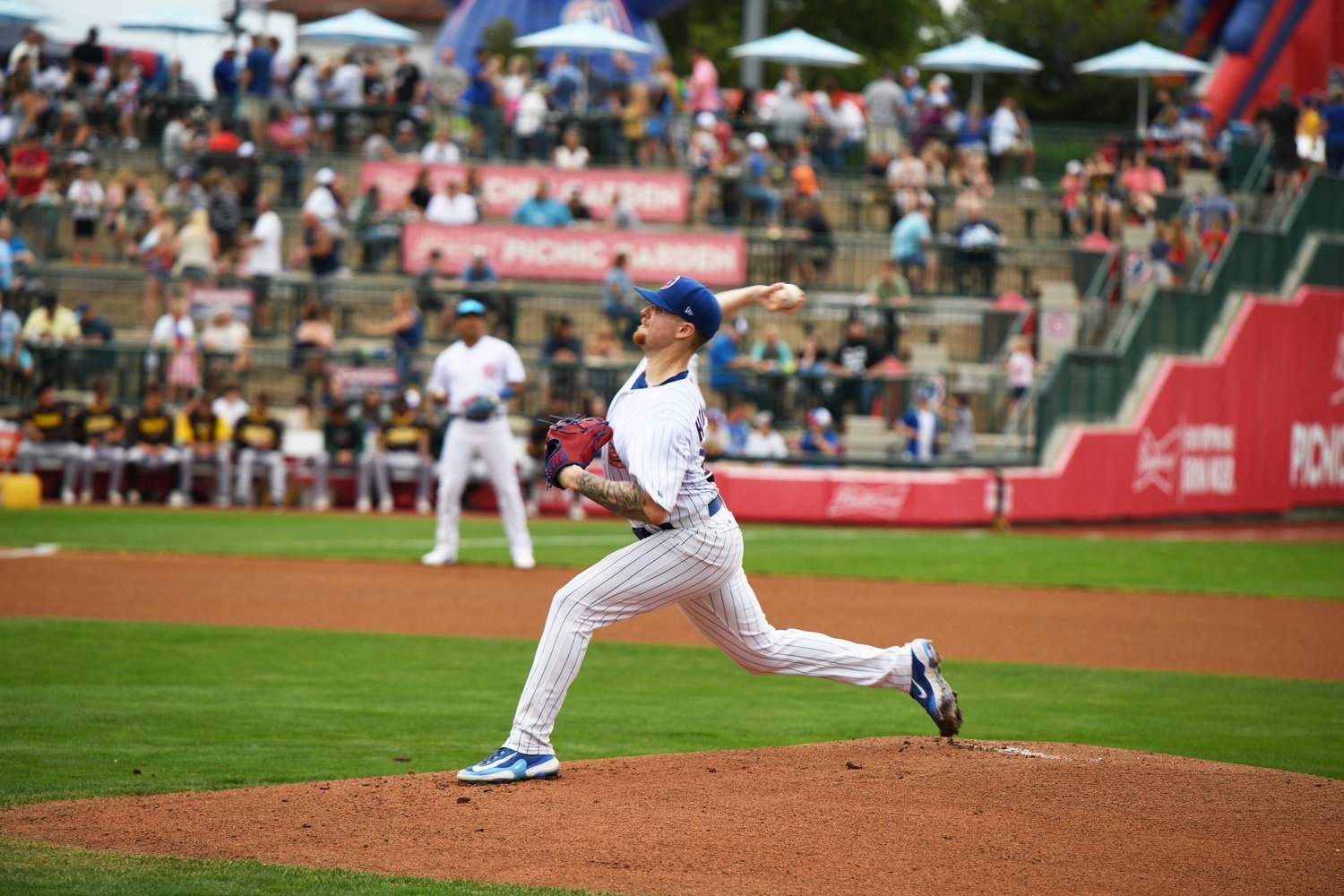 Today, we continue our review of the Top 20 Chicago Cubs prospects (as voted on by the readers of NSBB). Second-best, by their reckoning, is the team's top pick in the 2022 MLB Draft and a pitcher they hope will soon find a home in the middle of their rotation. Before you read about Cade Horton, though, don't miss our previous Top 20 Cubs Prospect articles including our look at some honorable mentions, the Cubs' Top Prospects #20-16 and the Top Prospects #15-11. #20 - Pedro Ramirez, INF #19 - Luis Vazquez, INF #18 - Michael Arias, RP #17 - Alfonsin Rosario - OF #16 - Drew Gray, SP #15 - Jonathon Long, 1B #14 - Fernando Cruz, SS #13 - Derniche Valdez, SS #12 - Alexander Canario, OF #11 - Cristian Hernandez, SS #10 - Brandon Birdsell, SP #9 - Jaxon Wiggins, SP #8 - Jefferson Rojas #7 - James Triantos #6 - Cam Smith #5 - Kevin Alcantara, OF #4 - Moises Ballesteros, C/1B/DH #3 - Owen Caissie, OF 2024 Season Review - Cade Horton, SP Horton's 2024 started like gangbusters. With 18 strikeouts in 16 innings at Tennessee, it was pretty clear that the pitcher was picking up right where he left off the year before. Perhaps more impressive was that, through those four starts, Horton only walked two hitters. On Apr. 27, Horton gave the Smokies five strong frames, striking out six, walking none and surrendering no runs. It would be his highwater mark of the season, and his last start at Double A. Getting promoted to Triple-A Iowa at the start of May, it seemed as if the righty was on the precipice of being ready for the biggest stage. All he had to do was continue the good times against International League hitters. Sadly for the pitcher and the Cubs, that did not come to fruition. Horton struggled with his new assignment, especially in the control department. Walks had not been a problem at any level previously, but at Iowa, the pitcher walked 11 opposing batters in 18 innings. He still displayed a penchant for striking hitters out, as he had a 27% strikeout rate, but he also got hit when he came in the zone. Displaying a velocity drop, and with reports of mediocre fastball shape, it was obvious something wasn't right. Things went from bad to worse for Horton. His last trip to the mound was on May 29. After that start, in which he was knocked around, we learned of a lat injury. The Cubs, in a combination of rehabbing the injury and an abundance of caution for a pitcher who has a Tommy John surgery on his record already, shut the starting pitcher down for the rest of the season. The lat strain could be attributed to a few causes. It could be that the fastball shape and velocity decline were tied to the lat strain, or it could be that the Cubs were tweaking his pitch grips and mechanics, which caused the strain to begin with. It's also possible that whatever diminution in stuff he suffered was unrelated, of course. Either way, it was a disappointing end to his season. Season Outlook and Scouting Report - ETA: Back Half of 2025 Horton's disjointed, disappointing season has added some fog as we try to project what 2025 could bring for the Cubs' top-ranked pitcher. Throwing fewer than 35 innings last year will make it difficult for the Cubs to consider him getting 140-plus innings on the 2025 campaign. It likely means that the Cubs will have to find ways to limit him (most likely in his buildup) if they want him to contribute in the majors this season. It could also mean that he works as a reliever in 2025, before a transition to the MLB rotation in 2026. We shouldn't fully rule out an MLB rotation inclusion; the Cubs were quick to put Ben Brown into the rotation last year after an injury-shortened season in 2023. However, the Cubs enter 2025 much deeper in pitching talent than last year. The good news for the Cubs and their pitcher is that Horton is already throwing in Arizona, saying he's fully healthy and over the lat strain. Moving forward, it will be interesting to follow the trends with his fastball shape and velocity. The Cubs are a team of tinkerers, and bringing in Tyler Zombro should only help them tinker with and tweak Horton a bit more. I know the initial reaction will be to think a bit doom-and-gloom with Horton moving forward. He'll have injury worries attached to him for a bit, and the velocity drop and fastball shape slump (if that's what it was) is a bit concerning. With that said, there are reasons to remain optimistic on him. With a clean bill of health, a new voice and a new season, he could once again show dominance on the mound. I still think there's a pitcher who can anchor a rotation within Horton, though we are seeing some of the risk that he lands in the bullpen or is neutralized by injuries play out before our very eyes. What do you think of Cade Horton's development so far? Do you think we should be worried about the velocity dip? Do you think it's a result of the injury? And when do you think he'll debut? Let us know in the comments below!
 -
No one has said this. People are not complaining that Alex Bregman makes too much money on this forum. They've said that it's okay that the Red Sox are the team who have chosen to pay him that amount, but from what I can tell, it's exclusively from a "we understand the Cubs have a budget" standpoint. No one likes the budget. And no one is rallying about MLB players making millions here. They're understanding that it sucks that the Cubs operate under a budget, but as long as they do, maybe they could use the money in a different way to better help the team win.
-
I think we have to address the contract two ways: 1. I remain frustrated that the Cubs have a desperate need to act within the LT. The Cubs shouldn't need to act this way. The Cubs have the capacity to do more. And we should continue to call that out. The Cubs should not have to penny pinch and act like these contracts are impossible. It's horsefeathers. 2. We also have to accept that regardless of calling that out, being frustrated, etc, that Tom Ricketts is who Tom Ricketts is. He's not going anywhere. He doesn't care what anyone thinks. And he's going to continue to put the Cubs on a controlled budget. In that aspect, we have to view any contract through that lens, as well. And I think it's fair to say "within the budgetary constrains that are here, that signing Bregman at that level probably isn't the best usage of that money". I think it's fair to point out that you may think it was the best use of that money too - but it's an understanding that the money is limited regardless. I sincerely wish Ricketts would open up the pockets. He's not a good owner, and he deserves no plaudits. At the same time, Jed Hoyer can only do what he can do within a budget. So there's a few ways to look at it. It doesn't mean anyone is necessarily complicit in Rickett's spending to acknowledge the second point - I'd argue it's being aware of the reality of the situation.
-
Spring Training Moves/Transactions Thread
Jason Ross replied to Outshined_One's topic in Chicago Cubs Talk
We have discussed this before, but I don't think the Cubs missed on anyone they cared about. The Cubs have never seemed to operate on a tunnel vision (I think evidence on this is their pursuit of Bregman to begin with - a creative an opportunistic concept and one they waited out), and if the Cubs felt like there was a can't miss addition, they would have pulled that trigger there. So regardless of if the Cubs liked someone Randall Grichuk, they didn't like them enough to make them a priority. That probably tells you all you need to know about how they feel about their other options. More likely, the Cubs have viable options for anyone that has signed for another team over the past week or two. It feels like a worry fans have more so than the Cubs. -
Let's take name out of it. The player we are discussing: - Has a 91 wRC+ over his last 796 PA's - Has an ISO of .121. This is despite playing in a very LHH friendly field. - Had a 68 wRC+ away from that home field advantage last year - Is LHH, and doesn't really compliment our already LHH 1b - Has a long history of back injuries - a likely reason for the major decline in offense and power - Is 35 and will turn 36 mid-year I adore what Rizzo did for the Cubs. But outside of nostalgia for the name, there's little there to make you think he'd be a asset to the Cubs or fill in the gaps needed. Just imagine his name was Sam Baker and had a career as a Pittsburgh Pirate. Then re-apply all of the information above. Nostalgia is a powerful drug - I watched Gladiator II the other night. It was horsefeathers. They got me. So there's no blame or shame and I dont want to make you feel bad...I just think we have to take nostalgia out of it. Or we'll get Gladiator II at 1b.
-
They could pivot to Cease (who feels likely to go shortly after they signed Pivetta). Or could be a Turner/Robertson combo.
-
Man, that's insane. Yeah, have at him, Boston.
-
Feels a bit like Kris Bryant's FA. Where Bryant took the money and ended up in Colorado. Detroit isn't Colorado from a baseball perspective, but it also isn't a sexy destination.
- 470 replies
-
- 1
-

-
- alex bregman
- matt shaw
- (and 1 more)
-
I think they probably all fit into the bigger puzzle. For example - I think if Bregman were willing to sign a shorter deal, he'd have done so already. Same as with signing with Detroit on a six year deal. Feels like either: Bregman is going to take the AAV and sign with the Cubs or the Tigers will blink and give him another year. But that's my read of the tweets.
- 470 replies
-
- 2
-
-
- alex bregman
- matt shaw
- (and 1 more)
-
Yeah it's been a hot minute. I think, IIRC, it was Ofman who early in the offseason last year was suggesting the Cubs were involved in Soto trade talks much more heavily than it eventually seemed to have been (as it seems more exploratory than anything).
-
The Cubs Are "One Team To Watch" In Dylan Cease Sweepstakes
Jason Ross replied to Matthew Lenz's topic in Chicago Cubs Talk
Not King, but Nick Pivetta. His contract will pay him out only $4m in 2025. That's not differed money, literally, his salary+signing bonus in 2025 is $4m. There's more money on the back end if he opts in, but he's basically free next year for SD in a cash-flow perspective. -
In his defense, I'd be shocked, too. Not because I don't think the Cubs have a legit chance (there's enough smoke out there that makes you believe they could be the likely destination ultimately) but because I wouldn't have guessed the Cubs would have ever had a chance on him at this stage with how they do FA.
-
The Cubs Are "One Team To Watch" In Dylan Cease Sweepstakes
Jason Ross replied to Matthew Lenz's topic in Chicago Cubs Talk
He's only making $4m. I would guess this means they will definitely trade a SP though. And this is their way of getting him into their current budget. -
Spring Training Moves/Transactions Thread
Jason Ross replied to Outshined_One's topic in Chicago Cubs Talk
Well now that's interesting. With King being less expensive than Cease, this feels even more unlikely that King is moved. And more likely that Cease is moved. -
Spring Training Moves/Transactions Thread
Jason Ross replied to Outshined_One's topic in Chicago Cubs Talk
While possible, it feels unlikely that any of those names are truly on the cutting block outside of like, Thompson and Merryweather who feel like 40-man casualties on their own. The Cubs have made a habit all offseason of collecting any pitcher they can as if they were pokemon in the name of added depth. I'm not married to any single name on that list, but a few of them (Thompson and Merryweather) probably aren't enough to get under the LT enough to where the Cubs are under the LT and can make a move later on their own. Rea, Morgan, Braiser were all acquired recently - while they *could* trade them, it feels...more like fanfic than something they'll actually do. That leaves Jameson Taillon, a durable and reliable (if not particularly exciting) SP with a rotation of guys I'm not sure you really want to super count on right off the bat (be it that they have tweaks to likely show or overcoming injury, or, both). He has a limited NTC and with 2 years left, is probably more likely to be picky on the move than less. All the while. Assad and Brown are already down on the injury report. I don't want to entirely discount it - if you want to get creative, you could do these. But the Cubs just don't feel like a team in a position to really explore that - whether we like it or not. I don't want to give the Cubs a pass here for continued behavior of using the LT like the Boogeyman (it's nonsense and shouldn't be a thing). But I also think living in a reality where Tom owns the Cubs, that the Cubs will continue to use it as an excuse and that's just something we have to factor in here. -
Maddie Lee reports the Cubs are "evaluating" whether Canario can handle 1b currently. Which sounds like a very cheap, internal 1b option....in the case that the Cubs don't really have much money to get someone else. *cough* Bregman *cough*.
-
Spring Training Moves/Transactions Thread
Jason Ross replied to Outshined_One's topic in Chicago Cubs Talk
Yep! I just think that the way this goes is basically, two pronged at this stage: 1. The Cubs sign Bregman, and likely, pretty quickly move Hoerner for prospects. They bring in a pretty cheap 1b who is RHH, and offseason is done. 2. The Cubs miss on Bregman. They sign a better bench player (Canha or Turner). They add a RP like Robertson or Finnegan as well. -
Spring Training Moves/Transactions Thread
Jason Ross replied to Outshined_One's topic in Chicago Cubs Talk
I think we have to expect that any Nico Hoerner trade in the interim is going to return prospects. I'd love for the Cubs to sign Alex Bregman, keep Nico or trade him for a SP immediately...but it seems as neither are in the cards. The Cubs seemingly want to be under the LT - meaning money has to clear. And I just don't see a Nico for SP swap currently as one that happens (maybe it does! but it's hard to find that move). There have been enough minor reports out there that the Cubs would likely look to deal Hoerner and Trueblood suggested it was for prospects, that I think that's the most likely outcome. I'll say this - I'm okay with this scenario assuming the Cubs get back acceptable prospect value from Hoerner (and I'll assume they will - Hoyer trades are rarely terrible). It would give the Cubs a bit extra ceiling, as I think Bregman's best 2025 is better than that of Hoerner's best 2025, while also allowing the Cubs to remain nimble enough to trade for their biggest need at the deadline - be that a SP, a RP, or to replace an injury. As much as I think the Cubs could use a SP, if Jordan Wicks' breaking balls progress, or Brandon Birdsell grabs a spot, or if Ben Brown is rockin' and rolling....there's a world where a SP isn't needed. These prospects would help pay for that other option, or a SP or whatever. I'd love for the Cubs to just snap out of it and go ham, but I just don't think that's going to happen. But I also think a Bregman signing and a Hoerner trade can remain as a viable outcome for a good season, so accepting the reality we live in, I think it's a positive outcome. -
Entirely. Saving a bit more because you're really expecting to add some impact at the deadline is fine for me. We don't need to spend for spending sake. At the same time, eschewing signing any help with the idea of "save it all for later!" misses the mark as well. Find a middle ground. It doesn't have to be Justin Turner (though I think he solves a needed role of a RHH who you can count on to hit LHP on the bench) or Kyle Finnegan or any particular name - but if the Cubs don't sign Bregman than they should make one or two moves with the $30m as well - unless they really want to push their luck on a pre-November contract extension for Kyle Tucker that for accounting purposes starts in 2025 as opposed to 2026.
-
Just to add to how difficult to impossible the team would find it to spend that much money - all of the LT money they would add would be partial LT money - meaning that a $20m contract would count as far less - probably under $10m on the 2025 LT with two months to go. The likelihood that the Cubs gut the system enough to add in three impact players like that under the LT in July is...very, very, very small.
-
Currently, the Cubs have around $30m under the LT. Now, the Cubs may sign Bregman, which makes this entire thing moot - they probably won't sign Turner in that case, so let's assume that the Cubs don't sign Bregman, but do sign Turner. At this stage, it's likely Turner will make >$10m this year - not only has he not signed, he's 40 now. The market just isn't there. So the difference in LT money remaining is $30m in the event they didn't sign Turner after missing on Bregman, and $20m (or more) would be the remainder if they did. So here's the question: what exactly do you think the Cubs would be able to do in the first scenario mid-season that they can't in the second?
-
I know that everyone has some concerns about backup 1b currently, but I am going to assume that the Cubs are less worried than we are with a Caissie/Ballesteros situation arising than many here are, and the thing I'll point to is Michael Busch. When the Cubs traded for Busch, it was pretty clear that he wasn't really going to supplant Hoerner at 2b, and he probably wasn't up to snuff for 3b. We all agreed - 1b was his best home. One thing I didn't see people pointing out last year, is that through his MiLB career, Busch had started just 17 games at 1b. By the end of the year, he was among the better defensive 1b in baseball. That doesn't mean to say that Owen Caissie or Moises Ballesteros will take to it like a fish in water, either, but that I do run a bit less worried about either of those guys getting the spot. Both handle positions in which you can't have stone hands - RF and C. That isn't saying I wouldn't welcome a Justin Turner type either - I think, more importantly than simply playing 1b, he does something the team doesn't really have a lot of: RHH with power. Kevin Alcantara or Alexander Canario might fit that void, but I for one really question Canario's hit tool and if it's MLB capable, and the other still probably needs to be in Triple-A over being a bench player. Turner could help fill that role. On the bench in general - I think we have to remember "this is a benefit of having a bunch of top-100 types this close to the MLB:". Any 3+ week injury can be covered with a top-100 type outside of maybe shortstop...but I kind of think the Cubs plan there is Matt Shaw (and then allowing Berti or Triantos to fill in the created gap) if they were to deal Hoerner. Even as is, with Hoerner coming off an arm surgery, I'm not sure how capable he is to handle a more demanding arm position like SS in the event of a May injury to Swanson. But realistically, the bench probably stays "the bench" on any longer term spot. It's why I kind of settle on "get me one more guy", particularly a RHH with some power, to fill it up. And even in the event of a Hoerner trade, I'll probably be pretty okay with the group.
-
Very small follower count and no one reputable. I'd say it's nothing but your typical clout chaser.
-
Buster Onley says it's between the Cubs, Tigers and Red Sox and a decision will happen "soon". If those are the finalists, I would guess he's coming here. If he wanted to sign in Detroit, he probably would have by now. I'd guess they have the most guaranteed money on the table but have yet to meet the years or AAV in some way. They feel like they have to give him more or less exactly what he wants there or he won't sign. Just my read. Boston vs Chicago is a bit of a tossup because I'm guessing Breslow is going to the Hoyer school of "creative contract" here. But the Cubs have a more direct path to the playoffs and his buddies are here.
