


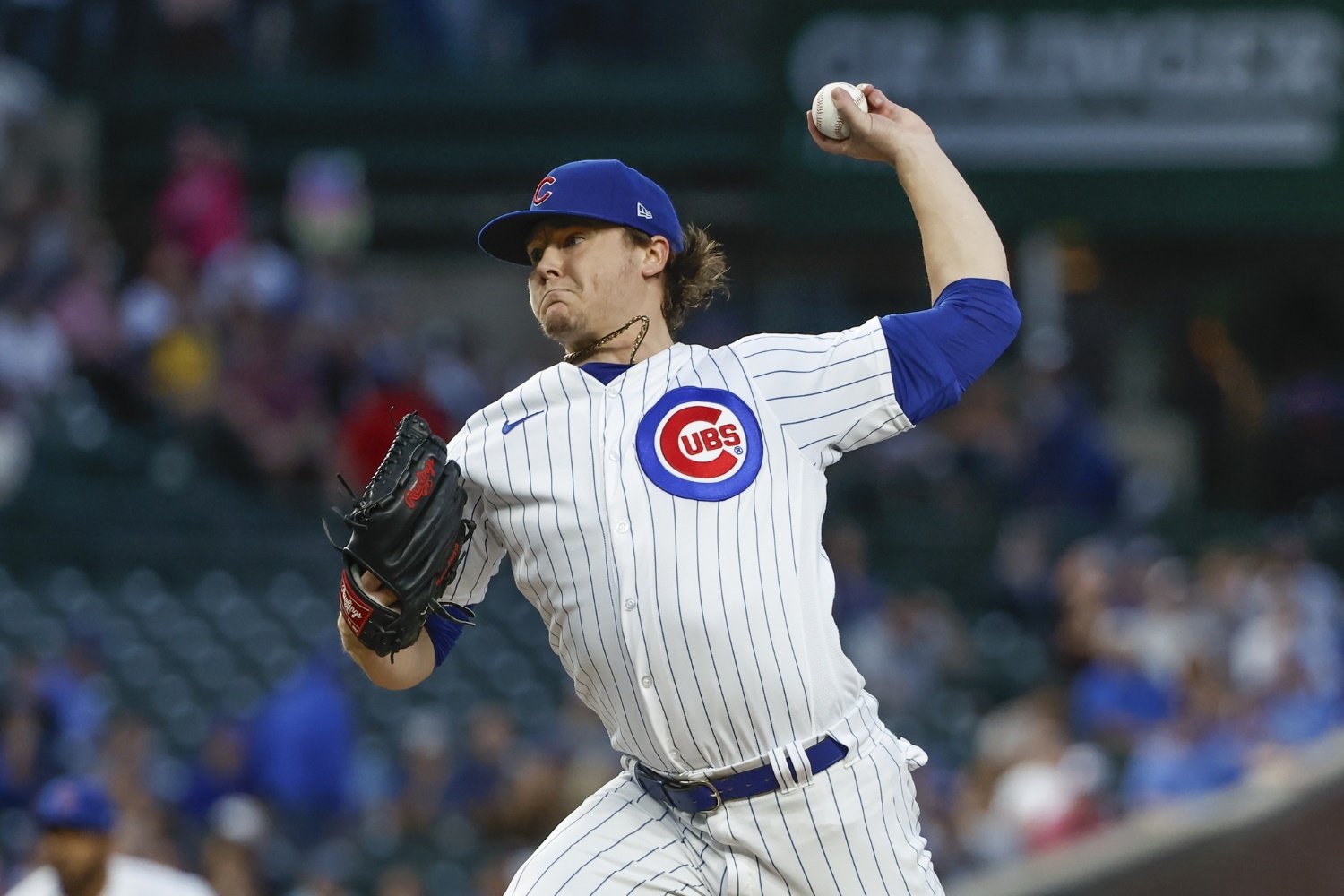
Cubs Video
Despite an impressive close to his 2022 season, you’d be hard-pressed to find anyone who straight-facedly predicted that Justin Steele would receive Cy Young Award votes in 2023. Sure, he showed that he could have big-league success, but his two-pitch arsenal and lack of elite stuff left many skeptical that his 0.98 ERA in the second half would carry over into the next season.
Yet, here we are. Steele cut his walk rate in half, while holding steady in almost every other important statistic en route to finishing fifth in the voting for the National League Cy Young Award. Does this make him a bona fide ace, or did we just witness the best season of the left-hander’s career?
Let’s start by taking a look at the numbers behind what was, essentially, a tale of two halves for the Mississippian.
|
Split |
IP |
HR/9 |
K% |
BB% |
AVG |
WHIP |
BABIP |
FIP |
xFIP |
|
First Half |
91.1 |
0.39 |
22.01% |
5.16% |
0.230 |
1.06 |
0.286 |
2.84 |
3.86 |
|
Second Half |
82.0 |
1.10 |
27.30% |
4.89% |
0.272 |
1.29 |
0.353 |
3.22 |
2.72 |
Stats Courtesy of FanGraphs
Results-wise, this looks like two completely different pitchers. One doesn’t strike a ton of guys out, but manages contact well, giving up just 0.39 HR/9. The .230 batting average against is supported by the good, but not completely unsustainable, .286 BABIP. The second-half pitcher strikes out a lot more opponents, but doesn’t seem to manage contact quite as well.
As a reminder, Steele is a truly unique pitcher. According to pitch-tracking data at FanGraphs, Steele was the only qualified pitcher in all of baseball last year to throw only two pitches more than five percent of the time. Some came close: Spencer Strider and Patrick Corbin are mostly fastball and slider pitchers, like Steele, though they at least mix in a changeup to opposite-handed hitters. With Steele, whether you are a righty or a lefty, you know you’re getting a fastball or a slider.
Steele succeeds with that arsenal by pitching inside to righties with the fastball, which really behaves like a high-velocity cutter, and then burying the slider down and in to put hitters away. What makes that so tough to hit is that both of those pitches look so similar, yet behave so differently and come in at such different velocities that the hitter typically doesn’t know whether the pitch will break out of the strike zone or stay right in the meat of it, until it’s too late.
All of this is to say that a lot of Steele’s success, and lack of hard contact, hinges on his ability to control the fringes of the strike zone. If he leaves a fastball out over the plate, where the hitter doesn’t have to wonder if it’ll break out of the zone, it’s going to get hit. And it goes without saying that a slider (from any pitcher) that is left out over the plate is going to get hit. With that in mind, let’s take a look at Steele’s pitch locations in the first half, compared to the second half:


I certainly do not proclaim myself to be a genius; it also doesn’t take a genius to see what is going on there. In the second half, Steele left far too many pitches out over the middle of the plate, where hitters could swing much more freely, rather than nibbling in that fringe area just outside the strike zone. This helps explain the jump in batting average and homers from the first half to the second half, both of which are supported by his hard-hit rate going from 20.9 percent in the first half, to 35.5 percent in the second half.
Come September, when every game was a must-win situation for the Cubs, Steele’s Zone rate, per FanGraphs, was 50.8%. That was his highest for any month this season, and would have led all of baseball for the full season. Coincidentally, this was also his worst month of the season by ERA, with a mark of 4.91.
This also, in part, explains the jump in strikeouts. Pitching in the zone more often means more strikes, which means more strikeouts. It’s simple math, at that point. Unfortunately, for a pitcher like Steele, sometimes the margin between good and average in baseball is razor-thin, and since he doesn’t have great, raw, swing-and-miss type stuff, the jump in strikeouts, as a result of pitching in the strike zone more often, also coincided with much louder contact.
Are his relative struggles late in the season a blip on the radar, or a sign of things to come? If I am being honest, I came away from this exercise more confident in Steele’s projection going forward than I was beforehand. Despite the jump in ERA, Steele’s 2.23 xFIP in September suggests that he may have been the victim of some bad batted-ball luck. His 3.86 xFIP in the first half suggests that he might have gotten lucky to achieve those results.
Instead, I’ll pose another question: have we witnessed two different versions of Justin Steele that can both be effective? We’ve seen one who strikes fewer guys out, but limits hard contact and walks so that it becomes very difficult to string several runs together; and one who gives up harder contact, but limits walks and gets enough strikeouts to balance things out.
From a raw results perspective, we may not see another season for Justin Steele like this past one. His 30 starts were an unprecedented workload for him, and it’s so difficult for someone without overpowering stuff to pitch to a 3.06 ERA. At the same time, though, Steele’s second-half issues seem very correctable to me. If he can get back to pounding the edges of the zone like he did in the first half, he can become that guy again. Alternatively, he can keep filling up the strike zone like he did in the second half, and we can hope that his luck evens out. Either way, I look forward to seeing what 2024 brings for the ace of the Chicago Cubs.





Recommended Comments
There are no comments to display.
Create an account or sign in to comment
You need to be a member in order to leave a comment
Create an account
Sign up for a new account in our community. It's easy!
Register a new accountSign in
Already have an account? Sign in here.
Sign In Now