.jpg.900f6d1bc80a5a156f3ba09ea0e4b3d7.jpg)

Jason Ross
-
Posts
8,153 -
Joined
-
Last visited
-
Days Won
74
Content Type
Profiles
Joomla Posts 1
Chicago Cubs Videos
Chicago Cubs Free Agent & Trade Rumors, Notes, & Tidbits
2026 Chicago Cubs Top Prospects Ranking
News
2023 Chicago Cubs Draft Picks
Guides & Resources
2024 Chicago Cubs Draft Picks
The Chicago Cubs Players Project
2025 Chicago Cubs Draft Pick Tracker
2026 Chicago Cubs Draft Tracker: Picks & Bonuses
Blogs
Events
Forums
Store
Gallery
Everything posted by Jason Ross
-
Oh, I know. Mostly just throwing out there that I don't like him. His fastball bleed and pitch mix changes are not ones I love on a multi-year deal.
-
Sharma and Mooney talked about it in an article on The Athletic today and it seems more along the lines of "teams are asking, and while the Cubs do not operate on sentimentality, it probably isn't going to happen"
-
Chicago Cubs Have "Renewed Interest" In Alex Bregman
Jason Ross replied to Matthew Lenz's topic in Chicago Cubs Talk
-
I'm pretty bearish on Suarez the reliever myself. I've come around on Fairbanks for a few reasons (including my new obsession, popups) but I'm probably out on Robert Suarez for a multi-year deal. I don't like the trajectory of his pitch mix right now. In fact, between E, Suarez, Robert Suarez, and Ranger Suarez, they might represent three of my least favorite free agents. And I promise it has nothing to do with some deep seeded hatred for people names Suarez!
-
Embracing the Pop-Up: How the Cubs Can Forge a New Pitching Frontier in 2026
Jason Ross posted an article in Cubs
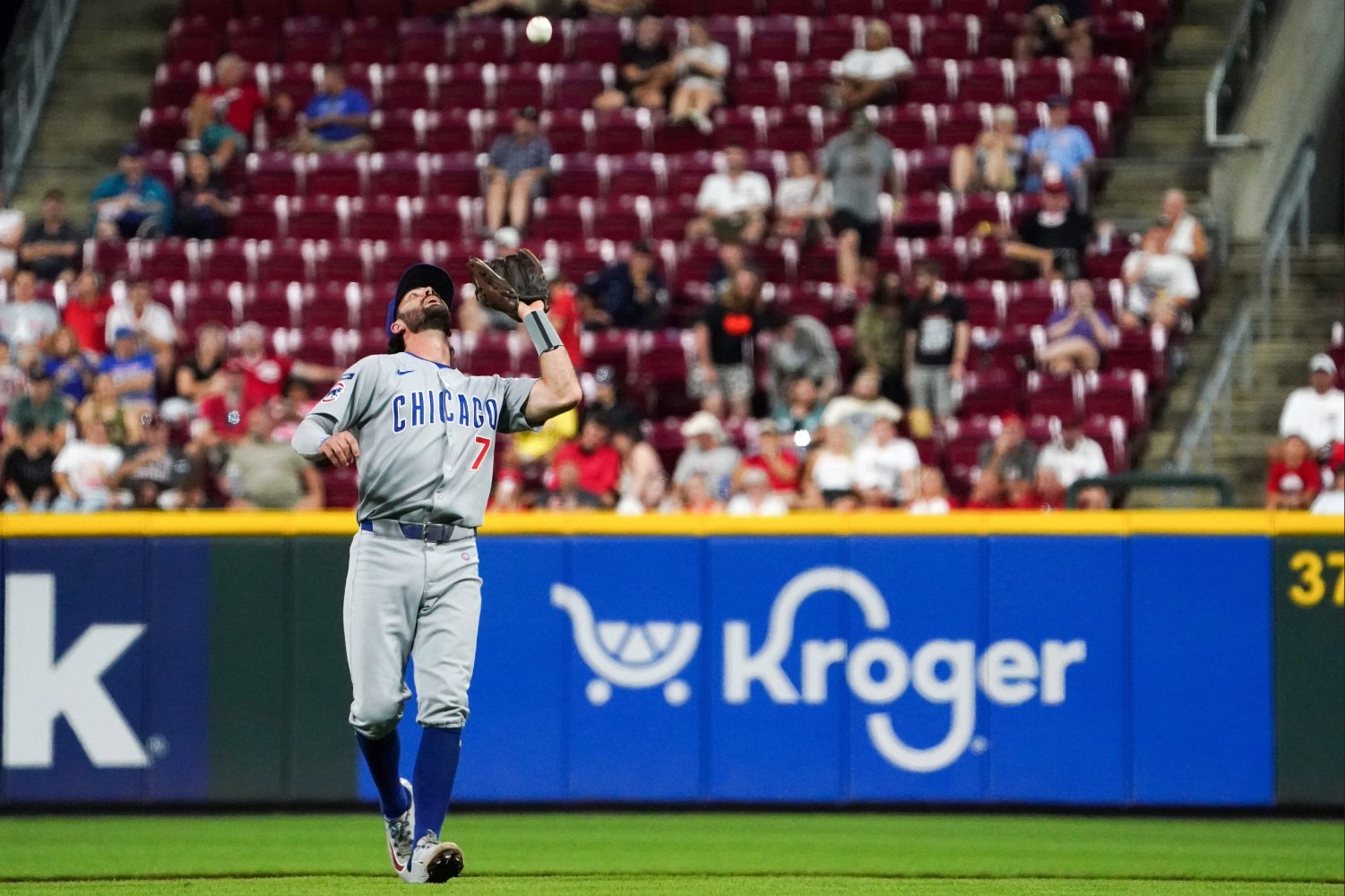 I want the 2026 Chicago Cubs pitching staff to become "King of the Pop-Up". I admit, it sounds a little less sexy than becoming "King of the Strikeouts" (or for any Tim Robinson fans out there, Rog, the "King of the Slams") and frankly, a pop-up is just less exciting. There is a reason that, in the movie Major League in the penultimate scene, Ricky "Wild Thing" Vaughn gets Clu Heywood to strike out on a 99-mph fastball instead of inducing a weak can-of-corn to the first baseman; it'd be hard for audiences to go crazy about that. And yet, I'm here to tell you that, in a baseball-sense, it would have made no difference, and that getting a "Texas Leaguer" is basically the same as a powerful punchout. First, we should look just how devastating a pop-up actually is. Using MLB's Baseball Savant, there were 8,716 balls-in-play during the 2025 season that were classified as pop-ups fielded by an infielder. Of those 8,716 pop-ups, just 71 landed for a hit. What this means is that if you hit a pop-up on the in-field, it is the most guaranteed form of out one can imagine, at least from balls put in play. It may not look devastating — a baseball flying just 50 feet in distance, landing safely in the second baseman's webbed glove is kind of boring in real time — but in terms of getting an out? It's absolutely devious. Now, I can already hear the counterargument, "but a player can make an error." So, I'm going to push my (non-existent) glasses up on my nose and give you my best "uhm, actually" to point out this: There were only 20 errors in the league on those 8,716 balls in play. This means just 91 hitters found any way to reach base on an infield pop-up last season. This gives teams a 99% chance of recording an out on a pop-up — it's a near-guarantee. As I said: it's truly a fatal to a hitter. Further comparing it to a strikeout, lest us not forget about dumbest of all rules: the dreaded dropped-third-strike. That rule proves that not even a strikeout is immune to a player getting on base. In an article by Sam Miller, he outlines how many dropped-third-strikes happen on a year-to-year-basis; a strikeout is not a guaranteed out either, and by July of 2025, there were already 29 instances of a player reaching first on a K. In 2024, this number was 50, which is not many more than the pop-up. It's true, that there are far more instances of strikeouts, but in total, hitting a pop-up is just shy of a guaranteed out in a very similar way the strikeout is. Enter the Chicago Cubs. In 2025, the Cubs were second in baseball (behind the Minnesota Twins), inducing 345 infield pop-ups on the season. This included the seventh-best pop-up inducer in Matthew Boyd, the 13th-best in Shota Imanaga, the 19th-best in Colin Rea, and the 29th-best in Jameson Taillon. You'll note that two of these three were new additions to the team, and Taillon worked extensively on his pitch repertoire last year. The Cubs, as a team, use cutting motions on their fastballs, almost more than any other organization, which likely leads to the extensive pop-up heavy approach; they just have that added movement which misses barrels. The Cubs should improve on their pop-up-generation in 2026 simply by having their stalwart, Justin Steele, healthy. The left-handed pitcher has been a very reliable pop-up getter, ranking 70th of 361 pitchers between 2022 and 2024. While Steele may not be the master of his craft as much as Matthew Boyd of Shota Imanaga are, he uses a cut-ride fastball that is useful in this area. Why are pop-ups important? Well, our advanced metrics don't take them into account currently. Fielding Independent Pitching (FIP), which has become the basis of a lot of our advanced data on pitching, does not take batted ball data (such as pop-ups or ground balls) into it's equation, focusing heavily on strikeouts, walks and home runs. As FIP has become more popular, "FIP-beater" profiles, or pitchers who routinely post lower ERAs than their FIPs would suggest them capable of, have become an undervalued property at times. Kyle Hendricks is a great example of a FIP-beater; someone who threw a slew of strikes, generated abundant groundballs, and didn't walk hitters proved that this combination was effective here. Guys who induce a lot of pop-ups just may be the next "FIP-beater" out there. Last year, the Cubs were one of the biggest "FIP-beaters" as a team in the league, finishing ninth in baseball with a 3.81 ERA but just 20th (4.16) in FIP and 18th (4.16) in xFIP. Part of this is that the Cubs have a great defense, ranking among the top three in almost any category you can think of. But the team is just 25th in ground-ball rate, and this is generally a part of the "FIP-beater" profile. How do they achieve this? Well, in part, due to their innate ability to get hitters to get under the ball and hit weak pop flies. Getting even more Texas Leaguers is a way the Cubs can close the strikeout gap they currently face. Last year, the Cubs ranked just 27th in total strikeouts (1,271) and 21st in strikeout rate. Compare that to, say, the Yankees, who were fourth in total strikeouts (1,440) and seventh in K%. When we include the near-guaranteed out of a popup into the "easy out" equation, the Cubs close the gap from a difference of 281 to 205 — a healthy reduction. This isn't to say the Cubs don't still need to find swing-and-miss, but finding more pop-outs can also help to close the gap in terms of "guaranteed outs". This may be a way to figure out which pitchers on the current market appeal to the team. Michael King, in his healthy 2024 campaign, induced the 25th most pop-ups in baseball. He's been routinely connected to the Chicago Cubs this offseason, and while it's unlikely that the primary reason is his ability to generate pop-ups, that almost assuredly appeals to the team. Another starting pitcher who induces a lot of pop-ups? The Minnesota Twins' Joe Ryan, who is rumored to be among those who could be traded this offseason. Using the same properties, relievers Kenley Jansen and Ryne Stanek (of whom we reported recently that the Cubs do have interest in) have history of creating a lot of pop-ups and could interest the team. Caleb Thielbar as well could be a candidate for a reunion, based on his history with the team and his history with the pop-out. This obviously won't be the only factor a team like the Cubs will taken into account, but as we look for under-the-radar pickups, it's clear that this can matter in player evaluation. Ultimately, the pop-out is a boring version of an out; a hitter meekly hits a ball in the air a relatively short-distance and a defender camps out under it and catches it with ease. It doesn't have the same panache as an overbearing 99-mph heater, and a defensive player isn't tasked with doing some amazing. It's a play that literally results in an out at the major-league level 99% of the time, but one we generally have ignored as a viable way of limiting base runners. The Cubs cannot just get pop-outs, but they can look to add more of them coupled with swing-and-miss options. For a team who has a bunch of pitching to add, finding a few cheap pop-out getters is a way the team can continue to defeat its FIP reliably. What do you think of the pop-out? Do you think more teams need to embrace it as a legitimate way to get outs? Sound off in the comment section below!
 -
Image courtesy of © Frank Bowen IV/The Enquirer / USA TODAY NETWORK via Imagn Images I want the 2026 Chicago Cubs pitching staff to become "King of the Pop-Up". I admit, it sounds a little less sexy than becoming "King of the Strikeouts" (or for any Tim Robinson fans out there, Rog, the "King of the Slams") and frankly, a pop-up is just less exciting. There is a reason that, in the movie Major League in the penultimate scene, Ricky "Wild Thing" Vaughn gets Clu Heywood to strike out on a 99-mph fastball instead of inducing a weak can-of-corn to the first baseman; it'd be hard for audiences to go crazy about that. And yet, I'm here to tell you that, in a baseball-sense, it would have made no difference, and that getting a "Texas Leaguer" is basically the same as a powerful punchout. First, we should look just how devastating a pop-up actually is. Using MLB's Baseball Savant, there were 8,716 balls-in-play during the 2025 season that were classified as pop-ups fielded by an infielder. Of those 8,716 pop-ups, just 71 landed for a hit. What this means is that if you hit a pop-up on the in-field, it is the most guaranteed form of out one can imagine, at least from balls put in play. It may not look devastating — a baseball flying just 50 feet in distance, landing safely in the second baseman's webbed glove is kind of boring in real time — but in terms of getting an out? It's absolutely devious. Now, I can already hear the counterargument, "but a player can make an error." So, I'm going to push my (non-existent) glasses up on my nose and give you my best "uhm, actually" to point out this: There were only 20 errors in the league on those 8,716 balls in play. This means just 91 hitters found any way to reach base on an infield pop-up last season. This gives teams a 99% chance of recording an out on a pop-up — it's a near-guarantee. As I said: it's truly a fatal to a hitter. Further comparing it to a strikeout, lest us not forget about dumbest of all rules: the dreaded dropped-third-strike. That rule proves that not even a strikeout is immune to a player getting on base. In an article by Sam Miller, he outlines how many dropped-third-strikes happen on a year-to-year-basis; a strikeout is not a guaranteed out either, and by July of 2025, there were already 29 instances of a player reaching first on a K. In 2024, this number was 50, which is not many more than the pop-up. It's true, that there are far more instances of strikeouts, but in total, hitting a pop-up is just shy of a guaranteed out in a very similar way the strikeout is. Enter the Chicago Cubs. In 2025, the Cubs were second in baseball (behind the Minnesota Twins), inducing 345 infield pop-ups on the season. This included the seventh-best pop-up inducer in Matthew Boyd, the 13th-best in Shota Imanaga, the 19th-best in Colin Rea, and the 29th-best in Jameson Taillon. You'll note that two of these three were new additions to the team, and Taillon worked extensively on his pitch repertoire last year. The Cubs, as a team, use cutting motions on their fastballs, almost more than any other organization, which likely leads to the extensive pop-up heavy approach; they just have that added movement which misses barrels. The Cubs should improve on their pop-up-generation in 2026 simply by having their stalwart, Justin Steele, healthy. The left-handed pitcher has been a very reliable pop-up getter, ranking 70th of 361 pitchers between 2022 and 2024. While Steele may not be the master of his craft as much as Matthew Boyd of Shota Imanaga are, he uses a cut-ride fastball that is useful in this area. Why are pop-ups important? Well, our advanced metrics don't take them into account currently. Fielding Independent Pitching (FIP), which has become the basis of a lot of our advanced data on pitching, does not take batted ball data (such as pop-ups or ground balls) into it's equation, focusing heavily on strikeouts, walks and home runs. As FIP has become more popular, "FIP-beater" profiles, or pitchers who routinely post lower ERAs than their FIPs would suggest them capable of, have become an undervalued property at times. Kyle Hendricks is a great example of a FIP-beater; someone who threw a slew of strikes, generated abundant groundballs, and didn't walk hitters proved that this combination was effective here. Guys who induce a lot of pop-ups just may be the next "FIP-beater" out there. Last year, the Cubs were one of the biggest "FIP-beaters" as a team in the league, finishing ninth in baseball with a 3.81 ERA but just 20th (4.16) in FIP and 18th (4.16) in xFIP. Part of this is that the Cubs have a great defense, ranking among the top three in almost any category you can think of. But the team is just 25th in ground-ball rate, and this is generally a part of the "FIP-beater" profile. How do they achieve this? Well, in part, due to their innate ability to get hitters to get under the ball and hit weak pop flies. Getting even more Texas Leaguers is a way the Cubs can close the strikeout gap they currently face. Last year, the Cubs ranked just 27th in total strikeouts (1,271) and 21st in strikeout rate. Compare that to, say, the Yankees, who were fourth in total strikeouts (1,440) and seventh in K%. When we include the near-guaranteed out of a popup into the "easy out" equation, the Cubs close the gap from a difference of 281 to 205 — a healthy reduction. This isn't to say the Cubs don't still need to find swing-and-miss, but finding more pop-outs can also help to close the gap in terms of "guaranteed outs". This may be a way to figure out which pitchers on the current market appeal to the team. Michael King, in his healthy 2024 campaign, induced the 25th most pop-ups in baseball. He's been routinely connected to the Chicago Cubs this offseason, and while it's unlikely that the primary reason is his ability to generate pop-ups, that almost assuredly appeals to the team. Another starting pitcher who induces a lot of pop-ups? The Minnesota Twins' Joe Ryan, who is rumored to be among those who could be traded this offseason. Using the same properties, relievers Kenley Jansen and Ryne Stanek (of whom we reported recently that the Cubs do have interest in) have history of creating a lot of pop-ups and could interest the team. Caleb Thielbar as well could be a candidate for a reunion, based on his history with the team and his history with the pop-out. This obviously won't be the only factor a team like the Cubs will taken into account, but as we look for under-the-radar pickups, it's clear that this can matter in player evaluation. Ultimately, the pop-out is a boring version of an out; a hitter meekly hits a ball in the air a relatively short-distance and a defender camps out under it and catches it with ease. It doesn't have the same panache as an overbearing 99-mph heater, and a defensive player isn't tasked with doing some amazing. It's a play that literally results in an out at the major-league level 99% of the time, but one we generally have ignored as a viable way of limiting base runners. The Cubs cannot just get pop-outs, but they can look to add more of them coupled with swing-and-miss options. For a team who has a bunch of pitching to add, finding a few cheap pop-out getters is a way the team can continue to defeat its FIP reliably. What do you think of the pop-out? Do you think more teams need to embrace it as a legitimate way to get outs? Sound off in the comment section below! View full article
-
Chicago Cubs Have "Renewed Interest" In Alex Bregman
Jason Ross replied to Matthew Lenz's topic in Chicago Cubs Talk
A two-part question: 1. How many second baseman in MLB do you think are better than Nico Hoerner? 2. How many position players do you think are better than Nico Hoerner in general? -
It probably isn't what people want to hear or see, but in the world where the Cubs are prioritizing Tatsuya Imai, this is likely what our Winter Meetings would have looked like. Doesn't mean they are....but he wasn't going to sign these three days. Last year as well, we came away from the Winter Meetings with just Matthew Boyd (who, reminder, wasn't exciting) and then 2 days later traded for Kyle Tucker. So hopefully groundwork was done. We'll see. I still feel there is enough smoke on the Cubs really caring about the SP market that we'll make a good sized move there.
-
That would have likely come out by now. They almost assuredly haven't selected or traded for anyone.
-
-
Absolutely. Which I'm fine with. As much as I trust the Cubs pitching infrastructure, it'd be nice if we didn't have to build the plane midflight this year.
-
Same. I think if you told me to rank things that would surprise me, which would include outlandish things like "The Cubs resign Kyle Tucker to a 10 year market value contract" I still might put "The Cubs elect to not select a P in the Rule-5 draft with 9 available 40-man-slots" as the most surprising. I guess they have a plan for those 9 spots that doesn't include a Rule 5 guy.
-
Listen, I'm shocked. Nothing is more Jed-coded than a free shot at an upside arm and they didn't take it.
-
Cubs pass on Rule 5 pick.
-
That is shocking. Their 40-man has the most open slots in the entire league. I guess they're planning on adding that many players?
-
But I want him...
-
Basically, pop-outs and cut-ride fastballs correlate. The Cubs are the masters of the cut-ride fastball. I think it's institutional, Colin Rea turned into an elite pop-out getter last year after the switch in arm angle and pitch mix. They target pronators - people who get more horizontal action as well. And they were 2nd in pop-ups last year; something I don't think is an accident when you break it down. I don't think the Cubs necessarily taught Boyd the pop-up, but his arm angle is cut-ride heavy. But I do think they targeted Boyd because of it. If that makes sense? Because the pitch moves and misses barrels, hitters tend to just miss them. It's that late ride movement that messes with the bat. I think their usage of the seam-shifted wake stuff, as well, like Horton plays into it. I think 2025 is probably the start of what Zombro likes; and I think the cut-ride fastball is it. They used it more in MiLB than any other team. So I think moving forward, we should expect more popups. (who knew they were so fun!?)
-
I don't agree with this. Jon Heyman is known to have ties to Boras. Now, you might want to say that Boras is planting the Cubs name there, and maybe, okay. But let's pretend for a minute that the Cubs' interest is legitimate. It's not a stretch; pitch wise he matches with a lot of what they look for, they love the IFA market, and the Cubs need an impact P. We have heard a few times the Cubs are more engaged at the top of the market and seemingly were willing to offer near $200m for Cease (maybe it's a we tried? but maybe it's just legitimately where they're at). If it's legitimate interest, the Cubs know what his price is. And they can't just sit there, wait for Imai, miss on Imai because despite every report and prediction of his market being likely over $100m the Cubs offered him some bonkers deal and still hope to realistically address their SP. The Cubs have yet to address SP yet. There's enough reason to believe the Cubs are legitimately interested. And in that case, they know what it'd take. So sorry, don't agree.
-
That kind of a contract is almost assuredly not even in the ballpark of what Imai is going to get. Imai is a tier of a FA above that of what Imanaga was. He's 3-years younger, and has a higher ceiling. He's also far more "traditional" - Shota is a fastball heavy pitcher who throws 91mph - it's a weird profile. Imai sits 94-95mph and has a good slider. It's a much more traditional build. I think the low end on Imai is going to be in the $18m AAV for 5 years with absolutely no sliding scale like the Imanaga contract. But I expect it'll be closer to something along the lines of 6-7 years and $22-$24m AAV.
-
Heyman once again talking about the Cubs suggests that their top priority remains Tatsuya Imai.
-
So, I'm going to do something here that is going to seem counterintuitive a bit, but I promise I have a reason; I'm going to avoid using fWAR. I actually don't think that fWAR entirely incapsulates what the Cubs do very well in two ways; 1. The Cubs have an elite defense which erases runs. The Cubs significantly outpitched their FIP and xFIP last year and their elite defense is a reason why. There's nothing to suggest the Cubs won't continue to be pretty elite defensively, and I think that factors into an elite pitching unit. Overall, consider them symbiotic. 2. I've got an article dropping maybe in a day or so that explores what I think is a very undervalued and underrated aspect of the Cubs pitching staff and that is their unique and elite way of inducing infield popups. This is a new frontier of "FIP-beating". I'll make you guys read the whole thing to get the full picture, but the gist is this: pop-ups are about as guaranteed of an out as a strikeout, and the Cubs have a pitching staff that has a skill in inducing them. With these in mind, I think the Cubs have the building blocks for a pitching staff that generally runs in the top-5 of most categories. A SP group that includes (New impact FA), Steele (60% of the year?), Horton, Boyd, Imanaga and Taillon (three of which are top-20 in that all-important pop-up thing I'm talking about) is a good rotation. It's very deep. It lacks a Paul Skenes, but especially if you can solve the Imanaga velocity (there's a great tweet thread I'll post that explains the cut-off between like top-30 SP Imanaga and mediocre Shota) you could really have a near-elite run prevention team. Think of it almost like the offense Bertz posted; it might not have the top-end stud, but it's a group that wins with pretty excellent depth. As it pertains to the BP, I'm at a point where if the Cubs are as interested in the BP as some of the non-Matt sources lead us to believe (Jed's words, Michael Cerami and Sharma/Mooney) I think we can hope they add another safe-reliever. I've come around to the Fairbanks idea based on his pitch profile more than I thought, but let's call it Fairbanks or Keller or Suarez (who I'm far more bearish on). You have a legit 7-8-9 in that case with Maton and Palencia, you have a team who's shown an ability to find guys, and you have enough young development that I think the Cubs will be able to find themselves at a point where once again, they have a run prevention BP. At the end of the day I don't expect the Cubs will be a top-5 fWAR unit here. But I do think there's a real path to a top-5 run preventing staff that couples their defense that is coupled with a philosophy that is created to beat FIP. They have also seemed to want to add more whiff in there as well (which helps with the FIP but also in outs creation).
-
I'd love for them to make it elite again (offensively) but I don't think I see a path for that this year, at least initially. My best case scenario for the offseason has been: 1. Make the pitching elite by spending the bulk of the offseason buying up legitimate BP arms and one impact SP. Coupled with Wiggins who could come up, and Steele returning, I think the Cubs can put together a top-5 rotation and a top-5 bullpen with their development 2. Hope that Caissie, Ballesteros can do enough but then if they don't buy a bat in July. Suarez was pretty cheap at the deadline, and you hope that there's another option like that in July. We learned last year pitching prices are a lot. Hitters are less so.
-
I have reservations on how his bat ages. He's someone who couples mediocre bat-speed with a very pull-heavy approach. His pull-ability helps to mask the bat-speed and keeps his ISO pretty solid. But he's entering the ages in which we see bat-speed slow down (it's around the age of 32 where we see definitive bleed and 35 is looking like more of a cliff). So how long does the bat speed stay above water? I think the approach will maintain, but I do wonder how quickly does he drop to say, a 105-110 wRC+ hitter? He's a positive defender as a +3 OAA but was a neutral DRS defender, so we're seeing bleed here too. The Cubs may have a way to counteract that. The team has generally stayed away from big contracts and yet they've come back to Bregman two years running - I think that says something. They don't gamble much or spend money willy-nilly so something internally is telling them this isn't that bad of an idea.
-
I think in that case, Alex Bregman. I have a lot of reservations on Bregman - but the Cubs, seemingly, don't. I also don't think they will punt on SP. I think it's either a trade and Bregman or a FA heavy class.
-
There's a lot of really interesting BP-style arms out there. I had those names on my radar as well. Sadly, neither can compete with RJ Petit in the facial hair department and that's an important part of my "reliever scouting report". I know my blindspots.