.jpg.900f6d1bc80a5a156f3ba09ea0e4b3d7.jpg)

Jason Ross
-
Posts
8,154 -
Joined
-
Last visited
-
Days Won
74
Content Type
Profiles
Joomla Posts 1
Chicago Cubs Videos
Chicago Cubs Free Agent & Trade Rumors, Notes, & Tidbits
2026 Chicago Cubs Top Prospects Ranking
News
2023 Chicago Cubs Draft Picks
Guides & Resources
2024 Chicago Cubs Draft Picks
The Chicago Cubs Players Project
2025 Chicago Cubs Draft Pick Tracker
2026 Chicago Cubs Draft Tracker: Picks & Bonuses
Blogs
Events
Forums
Store
Gallery
Everything posted by Jason Ross
-
We have been through this already this offseason, man. The Cubs probably had low $50m under the LT to spend. Your numbers were wrong then, they're wrong now. Reports are that the Cubs will come in under the LT more than they did last year, with more breathing room. Likely $10m or so. $50-$10 = $40m, or so. Maybe add a few mil, or subtract it.
-
I'll add here to what I did else where, on its surface, I'll remain confused by this, but mostly because I cannot see the bigger picture from where I'm sitting. It's not that I think this is bad, but the Cubs position now feels more and more like they have to nail the second SP. It's clear, as @Bertz said that the Cubs will add two pitchers. It's also clear that with the money they have left, that will almost assuredly have to be accomplished via trade. If the Cubs can come away with a bang-on top-three pitcher that you can really be confident on, I think Boyd offers interesting value as an 80-100 IP guy who shares innings with guys like Birdsell, Horton, Wicks maybe Brown, Assad, etc in that #5 space, akin to how the Dodgers seemed to perpetually sign an Andrew Heaney or an Alex Wood type. Where I fear is that the 2nd SP will be more along the lines of a "fix-em" or a "build-em" type which I think creates a bit more of an uneasy rotation heading into 2025 than I'd like to see. I'd like to see the Cubs chase current value as opposed to surplus value every waking moment, and with the limited chances the Cubs have to really upgrade this offseason, the remaining SP really represents one of the biggest and easiest ways to do that. It may work out in the end, but it might not. And seeing the Cubs put a confidently very good team on the field would be preferable.
-
I think you're a lot higher on Bryce Miller than I am, because I would argue there are more free agent SP's I like more than Miller in a vacuum. I think he's a guy I've got as a low-end #3 but realistically, a guy you want more as a good #4 with some upside that you have to coax out. He's not particularly adept at pulling chase, whiff, limiting hard contact...his pitches grade out as good, but for some reason, these things don't follow. Miller's value to me seems more tied to control/.cost and less to immediate impact. But without turning this into a Miller debate, it's the brooder point I'm making is that the Cubs, as they sign a pitcher you cannot trust in Matt Boyd, now feel forced to trade for something you can really count on to be very good. And I'll be pretty disappointed with a plan that consistent, top-to-bottom of "we can fix'ems" if they go with a Miller profile instead. I think there's power in finding value that way and the Cubs need to do some of that. By signing a Matt Boyd today, it feels more like you really have to get past the fix-em and need something you know. Like I said, there's a lot going on behind the scenes, and the Cubs know their position infinitely better than I do. Maybe the trade is close, or they really like what they're getting close to. Or maybe they know the pitching market is about to speed run past this point. This kind of trade just really puts an emphasis on who the second SP is to me. As I stated originally, I remain quite perplexed. It's not necessarily I think this is bad, but the next move is going to be kind of what seals this move for me.
-
I hope that they feel like they have those machinations in place. I would say that it's probably pretty unlikely anything would get held up with Sasaki however. Even if you get him, he's probably going to be on some limitations on innings and a 6-man feels likely. You make the trade...then you worry about Roki. He won't sign until mid-January. Too much time for those foundations to change. I think you do your off-season regardless of Sasaki. Then you either win that or not.
-
He does only have so much control, totally agree. I think we can make a counter point, however, that it didn't have to be Matt Boyd. Boyd doesn't seem like a relative bargain for what he signed ($2/29m sounds about where you'd have predicted it) and the market didn't seem to be moving so fast that without singing Boyd right now that you'd be left holding the bag. It's hard to say what the undercurrents are here, and maybe the market is about to move fast and we just don't know from our position. But it does really force his hand. And I think it forces his hand to a point where the trade that has to come has to be pretty significant. Like, I'd say it has to be more than a Bryce Miller or a Clarke Schmidt. I could see a world where you brought in someone who was less a gamble (i.e. Nathan Eovaldi) and someone like that works as a guy who really adds length into the 3/4 spots together, but with even more money locked up, and even even less glaring roster fixes...it feels like the Cubs now have to go really into a "this guy is for-sure-pretty damn good" territory on who they round the rotation out with.
-
This is really going to force them to make a significant and consequential trade for a young, cost controlled SP. With that kind of a trade, I kind of understand Boyd, but it feels very much like the Cubs have put themselves into a corner here to make that kind of acquisition by signing Boyd then going the trade route. They must feel very confident of pulling that off. I'd prefer having that kind of a trade done before Boyd, as there probably just isn't enough money left to pivot substantially if they need to.
-
That just doesn't feel like a great usage of the $40m or so we have. He isn't a durable starter. He's overpaid as a Smyly guy in the pen. I don't really understand this. At all. Is this better than signing a Kikuchi or an Eovaldi for a little more AAV? He doesn't solve the need for some right-handed-ommph in the rotation, and adds another low-90's fastball velo LHP into the mix with other pitchers like that. It feels like a luxury signing, as Boyd can be effective. But you can't count on him for more than 80 innings and at $14.5m that's not a small amount of the money the team has available for those 80 innings you can count on him for. That's a lot of money per start-you-can-count-on for a team who doesn't feel like they have that kind of money laying around. Maybe he gets to more and the recent TJS fixed him! But he hasn't done that since pre-covid and at 34 I wouldn't make that gamble. Like, maybe this is your "Shane Bieber reclamation signing" but this feel expensive for someone at his age and his injury history. Maybe it signals a pretty quick exiting of other money (Hoerner/Bellinger seem to be the possibilities) or the Cubs are super sure for whatever reason they're getting Sasaki and want to build a 6-man rotation with a top-3 guy coming in super cheap, but if not, it leaves the Cubs with $25m or so and you still need BP help, a better rotational arm, and bench players and all you can really be sure of is you're getting 50-100 innings of production. In the vacuum of the offseason we have so far, it feels pretty far removed from what I'd consider things that make a ton of sense. There's a pretty scary world in which the Cubs acquire Matt Boyd as the mid-rotational arm addition, but I'm going to assume they're not that wacky. So I'm not going to really ruminate on that too much right now. They see the big picture right now that I don't see and the math can change quickly, but I'm pretty perplexed by this as of now. It's not exactly the same, but this feels like it could become another version of the Mancini/Barnhart/Smyly type of deal where it's not soul crushing money, but you just look back on it an and wonder if the money could have been much more effectively spent elsewhere.
-
But why do you think that? You have yet to provide a shred of reasoning behind your opinion. You say you think that, but why do you think that? That's important here. Is there data you're basing this off of? If so, please share. However, from where I'm sitting, it really feels like the reason you think that is something along the lines of "I'm a Cub fan, and Matt Shaw is a Cub prospect. The other prospects are not Cubs, thus Matt Shaw will do better". Maybe that's enough for you, but by god I hope that's not enough for the Chicago Cubs' decision makers to rush out and find a way to replace their already pretty damn good 2b. I'm a big Matt Shaw guy. Honestly ,when I look at the data, I think there's a lot to really like there. He makes a good amount of contact, and while the leg kick is a bit funky (I'm not entirely convinced the leg kick is an issue. Some guys do things funky), he tones it down with two strikes and still shows good EV's. He handles velocity really well. He crushes fastballs. He's killed it in the Premier12. And if you told me he ended up being a Dustin Pedroia of sorts...I'd probably believe you - I think he's got that kind of a profile. But he's almost assuredly going to be over matched for 60+ games like all of the other really good prospects in baseball have been and I can't find much of a reason to think that he's going to forgo that. He's a free swinger and pitchers are going to exploit that. He struggled on sweepers at Triple-A. It's small sample size, but he didn't do well against them. And his leg kick may very well be exploitable too - Zach Neto had a similar profile and he had to eliminate it. He could probably pull the ball more too - hitting opposite field home runs is not a strategy for sustained success at the MLB level and Shaw does that a bunch. Pitchers are going to exploit him like he's never been exploited before. I think he'll adjust, but it's probably going to take 45-60+ games of struggles to get there as pitchers adjust to him, and then he adjusts to pitchers. It almost assuredly won't take a week and magically he'll be fine. It's why rooting for Hoerner to be hurt for 2-3 weeks so Shaw gets a chance is a bit silly. Those will be weeks he's probably not particularly good during. It won't help the Cubs win. He doesn't play defense well enough to give him a floor during that struggle time. And the Cubs aren't good enough to just have a hole on the team.
-
So you expect him to be in a tier above most of those other uber prospects, because none of them have settled into anything yet. They've flashed, but settled into nothing. That's very outlandish. You do realize that, right? What exactly makes you think Matt Shaw will settle in fairly quickly when someone like Dylan Crews or Jackson Holiday didn't? There will be an injury. Hoerner is good for a trip to the IL every year, and he's hurt now. When was the last time the Cubs had a full season where an infielder didn't go down? And if the Cubs have the good fortune of having their 4 win SS, their 4 win 2b and their 3 win 3b be healthy for a full season? Guess what? Matt Shaw is going to be just fine. He's not going to wither and die because he was in Iowa. It's not going to make him not develop. He has less than 40 games in Iowa, Thaw. It will just delay your want to see Shaw in Chicago. That's it.
-
Again, I implore you to go look at what the best offensive prospects in the MLB did upon their call up. Then I want you to think "is it logical that Matt Shaw might also struggle initially?" then reconsider this opinion. Because the absolute best prospects struggled. We're talking uber prospects like Chourio, Holiday, Wood, Crews, Langford...all struggled. What's more likely? That Matt Shaw is not only better day 1 than Nico Hoerner (3-5% better than league average), but that he's also in some tier above all of those uber prospects? Or that Shaw will likely struggle for a while? Probably a few months? You're allowed your opinion, but I think it's probably a good thing to reflect on your opinion and see there's much evidence for it being a solid one. Because I think it's incredibly outlandish to hope that the 2025 Cubs start the season without one of their few bang-on players you can pencil in for four win talent just so we can play a rookie who probably won't hit the ground running, simply because it's very hard to do right now.
-
You keep moving the goal posts. The Cubs shouldn't do what you want, they should put the best team on the field. The best team in 2025 is almost assuredly with Nico Hoerner over Matt Shaw. We have discussed the potential of a Hoerner trade. If he was healthy, maybe a team trades you a mid rotation arm for him, but those teams are very limited. He's not healthy, it almost assuredly means there's even less teams. What trade do you think the Cubs can make here?
-
Matt Shaw is unlikely to be better than Nico Hoerner for a bit. Probably all 2025. Again, unless you think Matt Shaw is a top-3 2b, *right now*, than Matt Shaw isn't better than Nico Hoerner right now. *Maybe* he's better offensively. But he's not a better player or does he add more value. Go look at all of the best offensive prospects in the MLB. How many came up right away and were successful? Even the best of the best struggled for months on end. It would be a bad idea for the Cubs to force feed through a worse player *right now*. They're not good enough. We have things like fWAR that do a really great job at determine value. A far better job than you and I. And it's pretty unlikely Shaw is a 4 win player right now. It's very likely Nico Hoerner is. He's been one for all intents and purposes for three years now.
-
Three 2b have been worth more than Nico Hoerner the last three seasons. Youre entitled to your own opinion, but thinking Matt Shaw, today, is a top-3 second baseman feels like a pretty outlandish opinion. I didn't say you were "rushing" Shaw. I said you were in a rush to trade a four win player. The Cubs aren't so good that they should be dumping 4 win players or be in a rush to move them. As I said, if a really good trade offer comes in on Hoerner we can talk. But that feels pretty unlikely. Meaning the Cubs should be in no rush to make that happen.
-
Pete Crow-Armstrong was just fine doing the "wait until an injury opens up PT" plan. Shaw will be as well. Any injury to a 2b, SS or 3B will open up time for him. It'll be fine. We shouldn't be in such a rush to move in from a 4 win player. If a really good trade presents itself? Okay we can talk. But there is *literally* no rush.
-
The cutting payroll thing is overblown. They're just going to get comfortably under the LT. Which I think we all expected. It's cheap, and Im not defending thr practice, but its not some massive cut either. Like, instead of spending right at the LT, I bet it's like $10m or whatever under it. Matt was talking about it in his front page article this AM.
-
Either are fine single additions. If that's the biggedt offseason addition, the Cubs have probably not done enough. Flaherty was not good in LAD and while I think Eovaldi can be an interesting addition, hes entering the back half of 30 and has had some small velo drops already. Hes fine. But that would mean the plan is essentially run-it-back, pray that Wrigley field fixes the offense and that a good #3 is the difference. That doesn't feel enough.
-
On one hand, if the Cubs are hand ringing over the picks, they need to get a bit braver. These picks, while useful, shouldn't be a stopping point for a big team. On the other hand, with going over the LT, it would reduce their 2025 IFA pool. And with Sasaki, it may mean they need every penny and they like their position with him for whatever reason. Ill remain entirely upset at the org if their answer is "Walker Buehler" only. But I can get behind a Buehler+trade for a front line guy.
-
Cubs "Probably Out" On Top-End Free Agents
Jason Ross replied to Brock Beauchamp's topic in Chicago Cubs Talk
Ah yeah, Justin Steele was a 5th rounder! Sometimes I forget how long ago it was when we picked him and how long it took for him to break out. And a fair point to make. Probably means I need to take the Jake Burgmann slander back. Guy still has a chance... All kidding aside, I entirely agree with everything here. A 5th round pick should never be the reason we worry about signing a FA. They so rarely become anything meaningful (we had to go back to 2014 to find the first stable MLB player the Cubs picked in that round) that the risk of trading a potential MLB player for the chance to sign a guaranteed good player today should always be taken. -
Cubs "Probably Out" On Top-End Free Agents
Jason Ross replied to Brock Beauchamp's topic in Chicago Cubs Talk
Brandon Birdsell was a 5th round pick! So they're not 100% awful all the time, but here's the Cubs 5th rounders going back to 2016 Bailey Clark, RHP Nelson Velazquez, OF Andy Weber, 2b Jake Burgmann, RHP Koen Moreno, RHP Liam Spence, RHP Brandon Birdsell, RHP Michael Carico, C Ariel Armas, C Most of these names are "who the hell is that?" (looking at you Jake Burgmann). I could probably replace 6 or 7 of these names with completely made up people and 95% of people wouldn't know...you'd kind of have to be a draft dork to even remember most of them! Every so often a Nelson Velazquez breaks through as a fringe player, and Brandon Birdsell will almost assuredly make the MLB at some point. But if the price you pay for signing talent is missing out on Bailey Clark or Liam Spence...you make that trade every time and twice on Sunday. -
Cubs "Probably Out" On Top-End Free Agents
Jason Ross replied to Brock Beauchamp's topic in Chicago Cubs Talk
Probably not. I doubt that the reason the Cubs aren't even bothering with Soto or Burnes is because: 1. They'd have to give up a 5th round pick now and a little IFA money 2. That they had to pay 10% tax on the difference in going over the tax They'd be just as out on those players if they had ended a few million under the LT. I don't necessarily think it has to be a boring offseason because they're not going after Burnes or Soto. They have to be trade aggressive and what I think gets lost in the reporting and the framing of this is that just because the Cubs aren't in on Burnes doesn't mean they can't be in on another exciting, top-line rotation arm, for example. The Cubs rarely make any chatter or smoke when it comes to trades and rumors, so that stuff could be very much bubbling under the surface and we just don't know. -
I think the end thing we have to remember and keep in mind is that while this feels like a particular "Cub centric" thing, that it's not...the the price you pay in the prospect game. We pay more attention to the Cubs, so we're much more tuned in. Just be honest - do you know who the 8th best prospect in the Giants system is? Maybe you do! But...I don't. I could look it up, but the point I'm trying to make is this; we are in tune with the Cubs system, so we know far more fringe prospects off the top of our head. I can tell you all about Will Sanders and we didn't even rank him top-20 in our system! But I can't name most of the top-5 guys in most team's systems on demand and I'm certainly not really following them. These players fail consistently, we just don't really notice it. Even the world's best prospects are a gamble. The Braves have acquired a few former top-guys recently in Jared Kelenic and Griffin Canning. These were the Mariners/Mets and Angels top guys for a hot minute. To-date, neither have succeeded. These stories are everywhere. Even more so when you go down that prospect list. Here's an article from Fangraphs I think explains what I'm getting at. There's another article I'll see if I can find again, but it was about the bust rate of the #1 hitting prospect and the #1 pitching prospect most years...and even that is incredibly high. There's also, I think, some...unrealistic outcomes placed on guys. Like, just because someone doesn't become a bang-on four win player, or a standout closer that somehow being a decent platoon bat or a 6th/7th inning guy ends up a "bust" or "disappointing" when I think that still makes them a success story in most regards. I do actually think the Cubs have done a pretty damn good job recently. Look at the team; Nico Hoerner, Ian Happ, Justin Steele, Porter Hodge, Pete-Crow Armstrong, Ben Brown, Jordan Wicks, Javier Assad, and Ben Brown are all likely to play some sort of important role on the 2025 Cubs. Matt Shaw, Daniel Palencia, Luke Little, Owen Caissie, James Triantos, Cade Horton and Kevin Alcantara will probably see MLB action whether with the Cubs or elsewhere - a handful may play important roles. All of them have been drafted or developed heavily into the Cubs system. They're doing pretty damn good on that front! Many of these players have required real development and weren't just your easy top-5 picks. So to answer your question; I think the answer is...this is the prospect game. Your favorite prospect is probably going to fail. My favorite prospect is probably going to fail. Wins are far less frequent than losses.
-
There was no hotter, more hyped name in the Cubs farm system entering 2024. The breakout didn't come, though. Is it going to materialize in 2025? There was no hotter, more hyped name in the Cubs farm system entering 2024. The breakout didn't come, though. Is it going to materialize in 2025? We continue today looking at the Cubs' top 20 prospects (as ranked by our readers here at NSBB), by looking at Jefferson Rojas, the eighth-ranked prospect. Before you read about him, though, don't miss our previous posts on the current state of the Cubs' farm system, with my looks at some honorable mentions, the Cubs' Top Prospects #20-16 and the Top Prospects #15-11. #20 - Pedro Ramirez, INF #19 - Luis Vazquez, INF #18 - Michael Arias, RP #17 - Alfonsin Rosario - OF #16 - Drew Gray, SP #15 - Jonathon Long, 1b #14 - Fernando Cruz, SS #13 - Derniche Valdez, SS #12 - Alexander Canario, OF #11 - Cristian Hernandez, SS #10 - Brandon Birdsell, SP #9 - Jaxon Wiggins, SP 2024 Recap: Jefferson Rojas As Rojas entered the 2024 season, there were very few prospects in the Cubs system with as much helium in their balloon as the shortstop. Coming off a season that saw the teen hit an impressive 15% better than league average in Low-A, expectations were sky high—maybe a bit too high. At first, it seemed like not only was Rojas ready for an encore, he was going to break through the ceilings of what we assume 19 year-olds can do. Through 89 plate appearances, the right-handed batter was slashing .315/.361/.427, with a 126 wRC+. Sadly, it was around that point at which the excitement surrounding him was doused in some cold water. From May 3 until the end of the year, the season came crashing down on him a bit, as he struggled to adapt to a higher level, posting a sub-80 wRC+. If there was one thing that was really disappointing, it's that the power just entirely dried up, with Jefferson posting just a .080 ISO over that span. If there was a positive, it's that Rojas showed a pretty advanced approach at the plate, limited strikeouts and took his fair share of walks. Clearly, it wasn't enough to steer the ship entirely back to smooth water, but knowing that he's advanced in his approach can give some positive vibes moving forward. If it feels a bit harsh on a 19-year-old, it probably is a mix between just how impressive he was in 2023, while being a bit underwhelmed on the data in 2024. This is a good time to remind ourselves that development isn't linear, that he was very young for his level, and that none of this is a referendum on his future. It may make us pump our brakes a bit on dreaming of him making his debut before he can buy a drink, but that's a pretty outlandish outcome for any prospect, and maybe lowering those kinds of dream scenarios early is a good thing. 2025 Season Outlook and Scouting Report: ETA - 2027 So, maybe 2024 wasn't the dream scenario for Rojas, but that shouldn't mean we don't have plenty to dream on. The good news is that he's still going to be 19 when the 2025 season kicks off and he plays a premium position, meaning he has youth and positional variability on his side. He also has the makeup of a plus approach. Moving forward, you hope that the bat Rojas showed the first month in South Bend re-emerges and he can get on a roll quickly. It's likely that he will repeat High-A for the first half of the season, but he shouldn't have to stay there all year, either. Even remaining optimistic and positive, his season doesn't have the look of a player who conquered the level yet and there should be no reason to rush his development. A big place I'd like to see improvement is turning what should be a swing and a body with power into more of it on a consistent basis. Listed online at 5-foot-10 and 150 pounds, Rojas's figure tells you those data are out of date. These are usually from when these kids sign at the age of 16. There's some power to tap into (hopefully), and combining that with the approach would be excellent moving forward. With a strong showing, it's likely that we should be looking at a promotion to Double-A in his age-20 season; that's still really impressive. It's also more fun when a player just straps a rocket to his back and jumps level-over-level with ease, but those cases are few and far between. While many humans were just finishing graduating high school, Rojas was playing baseball professionally against people 2-4 years older than he was. It's okay to struggle, as long as you're progressing and learning. It'd be easy to wonder if he was another version of Kevin Made, another IFA signing who stagnated around his age-19/20 season and was ultimately moved in a trade, but I don't want to pigeonhole him. There's still plenty in the tank with Rojas, View full article
-
Chicago Cubs 2024 Offseason Top 20 Prospects: No. 8, Jefferson Rojas
Jason Ross posted an article in Minor Leagues
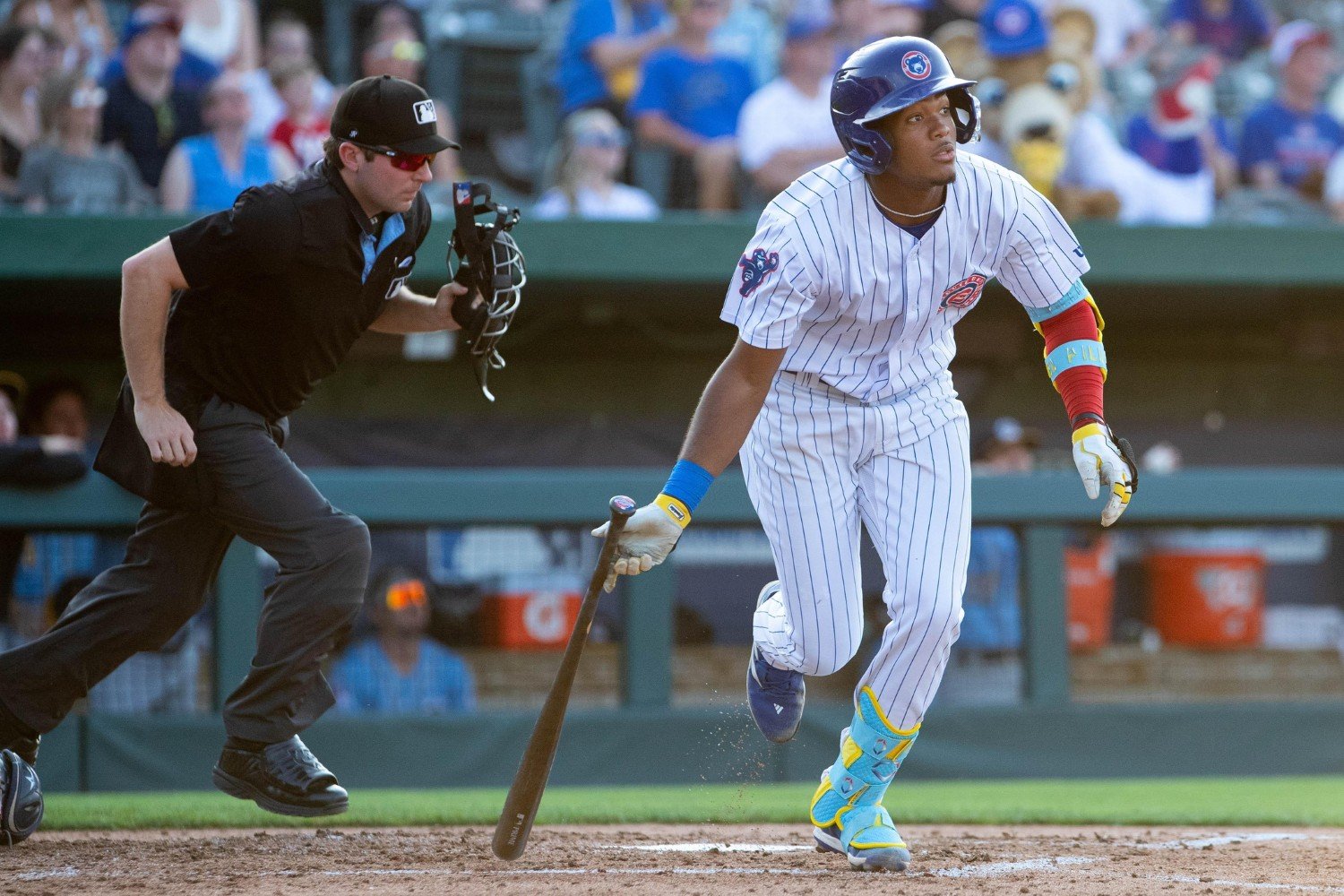 We continue today looking at the Cubs' top 20 prospects (as ranked by our readers here at NSBB), by looking at Jefferson Rojas, the eighth-ranked prospect. Before you read about him, though, don't miss our previous posts on the current state of the Cubs' farm system, with my looks at some honorable mentions, the Cubs' Top Prospects #20-16 and the Top Prospects #15-11. #20 - Pedro Ramirez, INF #19 - Luis Vazquez, INF #18 - Michael Arias, RP #17 - Alfonsin Rosario - OF #16 - Drew Gray, SP #15 - Jonathon Long, 1b #14 - Fernando Cruz, SS #13 - Derniche Valdez, SS #12 - Alexander Canario, OF #11 - Cristian Hernandez, SS #10 - Brandon Birdsell, SP #9 - Jaxon Wiggins, SP 2024 Recap: Jefferson Rojas As Rojas entered the 2024 season, there were very few prospects in the Cubs system with as much helium in their balloon as the shortstop. Coming off a season that saw the teen hit an impressive 15% better than league average in Low-A, expectations were sky high—maybe a bit too high. At first, it seemed like not only was Rojas ready for an encore, he was going to break through the ceilings of what we assume 19 year-olds can do. Through 89 plate appearances, the right-handed batter was slashing .315/.361/.427, with a 126 wRC+. Sadly, it was around that point at which the excitement surrounding him was doused in some cold water. From May 3 until the end of the year, the season came crashing down on him a bit, as he struggled to adapt to a higher level, posting a sub-80 wRC+. If there was one thing that was really disappointing, it's that the power just entirely dried up, with Jefferson posting just a .080 ISO over that span. If there was a positive, it's that Rojas showed a pretty advanced approach at the plate, limited strikeouts and took his fair share of walks. Clearly, it wasn't enough to steer the ship entirely back to smooth water, but knowing that he's advanced in his approach can give some positive vibes moving forward. If it feels a bit harsh on a 19-year-old, it probably is a mix between just how impressive he was in 2023, while being a bit underwhelmed on the data in 2024. This is a good time to remind ourselves that development isn't linear, that he was very young for his level, and that none of this is a referendum on his future. It may make us pump our brakes a bit on dreaming of him making his debut before he can buy a drink, but that's a pretty outlandish outcome for any prospect, and maybe lowering those kinds of dream scenarios early is a good thing. 2025 Season Outlook and Scouting Report: ETA - 2027 So, maybe 2024 wasn't the dream scenario for Rojas, but that shouldn't mean we don't have plenty to dream on. The good news is that he's still going to be 19 when the 2025 season kicks off and he plays a premium position, meaning he has youth and positional variability on his side. He also has the makeup of a plus approach. Moving forward, you hope that the bat Rojas showed the first month in South Bend re-emerges and he can get on a roll quickly. It's likely that he will repeat High-A for the first half of the season, but he shouldn't have to stay there all year, either. Even remaining optimistic and positive, his season doesn't have the look of a player who conquered the level yet and there should be no reason to rush his development. A big place I'd like to see improvement is turning what should be a swing and a body with power into more of it on a consistent basis. Listed online at 5-foot-10 and 150 pounds, Rojas's figure tells you those data are out of date. These are usually from when these kids sign at the age of 16. There's some power to tap into (hopefully), and combining that with the approach would be excellent moving forward. With a strong showing, it's likely that we should be looking at a promotion to Double-A in his age-20 season; that's still really impressive. It's also more fun when a player just straps a rocket to his back and jumps level-over-level with ease, but those cases are few and far between. While many humans were just finishing graduating high school, Rojas was playing baseball professionally against people 2-4 years older than he was. It's okay to struggle, as long as you're progressing and learning. It'd be easy to wonder if he was another version of Kevin Made, another IFA signing who stagnated around his age-19/20 season and was ultimately moved in a trade, but I don't want to pigeonhole him. There's still plenty in the tank with Rojas,
 -
Rosenthal: Cubs want to trade Bellinger
Jason Ross replied to Transmogrified Tiger's topic in Chicago Cubs Talk
Maybe I'm reading too much into what Nightengale is saying (which, it's always kind of hard to figure out what he's trying to get at through the Bob-Fog) but it almost seemed to suggest that if the Cubs were to trade Bellinger, that the reason would be to go after that top tier of free agents. Which feels a bit new. Whether that's Bob speculation or not... -
Rosenthal: Cubs want to trade Bellinger
Jason Ross replied to Transmogrified Tiger's topic in Chicago Cubs Talk
It's Bob. So you can do with this as you please. However, Per USA Today https://www.usatoday.com/story/sports/mlb/columnist/bob-nightengale/2024/11/25/mlb-rumors-juan-soto-latest-news-trade-market/76556552007/