Matthew Trueblood
-
Posts
2,479 -
Joined
-
Last visited
-
Days Won
2
Content Type
Profiles
Joomla Posts 1
Chicago Cubs Videos
Chicago Cubs Free Agent & Trade Rumors, Notes, & Tidbits
2026 Chicago Cubs Top Prospects Ranking
News
2023 Chicago Cubs Draft Picks
Guides & Resources
2024 Chicago Cubs Draft Picks
The Chicago Cubs Players Project
2025 Chicago Cubs Draft Pick Tracker
2026 Chicago Cubs Draft Tracker: Picks & Bonuses
Blogs
Events
Forums
Store
Gallery
Everything posted by Matthew Trueblood
-
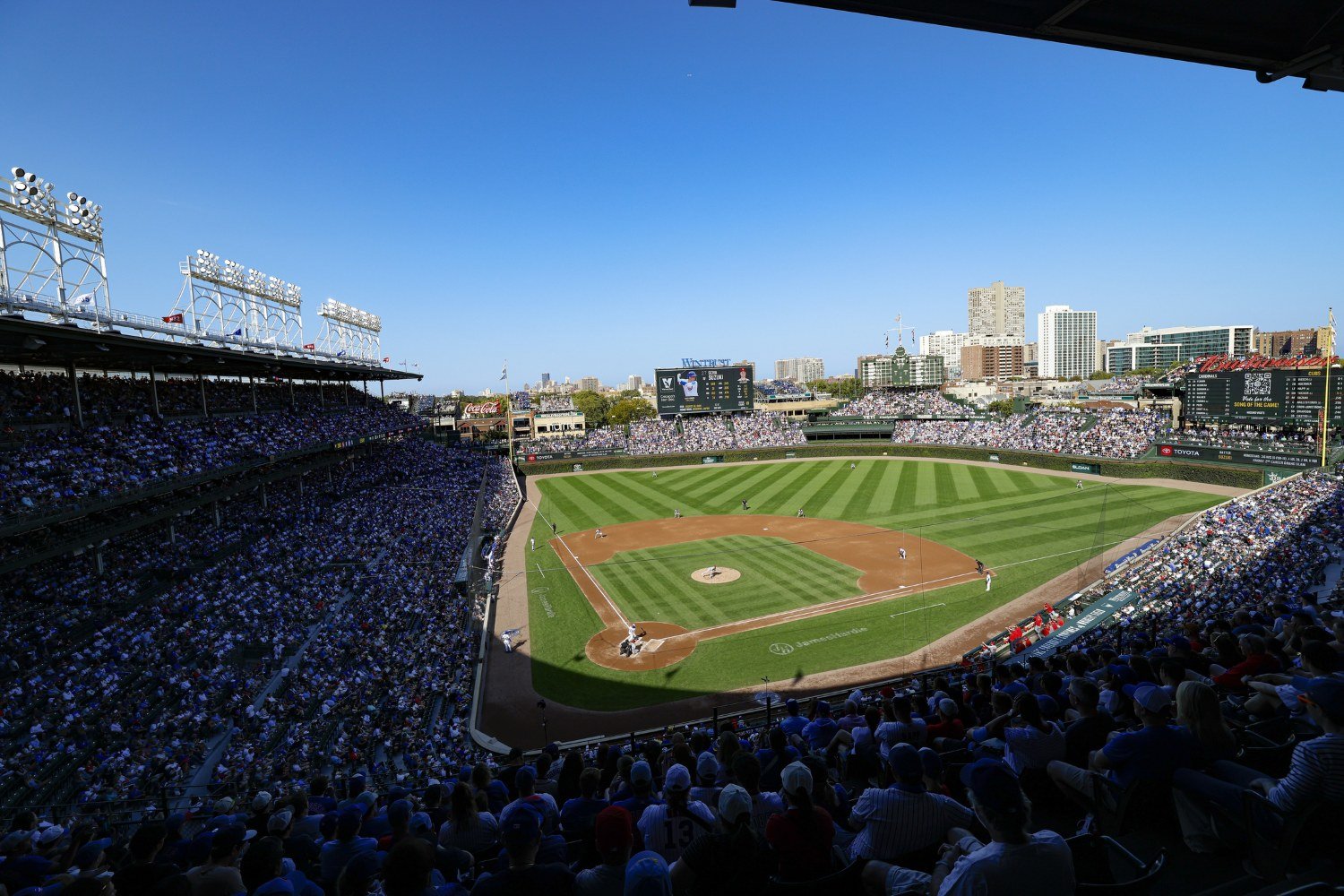
Image courtesy of © David Banks-Imagn Images The nervousness that creeps into Wrigley Field when the playoffs start to go wrong in the playoffs is familiar, and it makes a seasoned Cubs fan's skin crawl. Everything feels slightly wrong; you become aware of your socks. There have been too many near-misses and deflating setbacks crowded into the Friendly Confines over the decades. Those moments shoulder in and take standing-room places amid the present; the quiet of a loss settles over the crowd before the loss even has to be real. It was starting to get that way in the fifth inning Tuesday. The Cubs allowed just one quick, cheap run, in the second inning, when Matthew Boyd yielded a bloop double to Jackson Merrill and then a scalded line-drive two-bagger to Xander Bogaerts. By the bottom of the fifth, though, it began to feel like that might stand up. Nick Pivetta was cruising, with a fastball that was beating the Cubs' barrels so consistently he hardly went away from it. Chicago batters tried to sit on his breaking ball, at times, and when they didn't get it, they were lost. Then, like lightning striking twice—like a boxing combo, so sudden and forceful and carefully earned by all involved—the Cubs flipped the game. I mean, they totally flipped it. First, Pivetta made an error. In his first at-bat against Seiya Suzuki, he'd stayed away. He teased him with fastballs, then got him reaching, dipping, for a low curveball. We know that that doesn't work for Suzuki; he hit a lazy flyout. The devilish thing about baseball, though, is you have to get a guy out more than once. The second time he saw the Cubs' No. 5 hitter, Pivetta wanted to show him something different, so he started pounding him inside. It was a case of trying to be too brilliant, with a twist of not having updated the scouting report recently enough. Suzuki did seem to be looking away to start the at-bat, but he quickly cottoned on and shifted his sights to the inner half. That was a major problem for Pivetta, because although Suzuki had a bit of a hole inside for much of the second half, he'd closed it up during the final week of the campaign. If the ball had been above his hands, Pivetta might have been ok. It wasn't, and Suzuki sent a missile deep into the left-field bleachers. The quietude exploded and evaporated, and your socks receded into your subconscious. That brought up Carson Kelly, which should have been good news for Pivetta. Kelly was one of his six strikeout victims through the first four innings, which the hurler accomplished by sticking to a simple plan: fastballs up and away. Kelly really struggles against heaters in that location, especially from righties, and the Padres clearly knew that. If you read our advance scouting guide to the series this morning, even you knew it: Kelly was not a good matchup with Pivetta, from the Cubs' perspective. Chastened by the failed Suzuki experiment, perhaps, Pivetta and catcher Freddy Fermin (working together for the first time, with Pivetta's personal catcher Elias Díaz hurt; it seems a heinous oversight by the Padres not to have gotten the two some game action in tandem during the regular season run-in) decided to go after Kelly the same way they had the first time. And honestly, that should have worked. Kelly is one of those hitters whose swing really loses its juice when the ball gets into the upper third of the zone, and especially above it. He can't hurt you there, most of the time. In fact, until Tuesday's fifth inning, Kelly hadn't hit a high four-seamer from a righty with any real authority all year. To find instances of him doing it, you have to go back to last July. Here's the thing, though: the previous examples should have been warnings. Here's Kelly swatting a very high, backspin fly ball just over the wall for a grand slam against the Twins last summer. MVlENGdfWGw0TUFRPT1fVlFKWVYxTUZWZ0FBWEFRTEJBQUFVbFFIQUZnRld3SUFDbElDVVFJRVZRTUhVd1lE.mp4 That, by the way, came against a pitcher (then-rookie David Festa) not at all unlike Pivetta in terms of pitch mix and approach. Here's a ball from a few weeks later, on which Kelly came up just shy of a scoreboard-flipping late bomb in Toronto. S3d4dnZfWGw0TUFRPT1fRGdaWEFWd05BMVFBV2xFS0FBQUFVd2RSQUFCUUJsWUFBVnhUQVF0WFUxWURWUXBX.mp4 Kelly is in a better position to generate power this season, with alterations to his stance and stride. That's why he had a better year at the plate this year. However, he also has something in him—a little bit of the timid hero. He doesn't swing for the fences at the top of the zone, almost ever. When the moment is biggest, though, he makes little exceptions. And sometimes those become very, very big exceptions. To really understand what a twist that swing is, consider the chart on the left (of all his regular-season homers this year, by pitch location) and on the right (the chart for his at-bat in the fifth Tuesday). Pitch 6, up there on the bar of the top of the zone, is not in his power zone, except when the adrenaline is flowing. Then, he can make it so. That, as it turned out, was the game. The crowd stayed loud; the Cubs created some insurance; the bullpen was magnificent. We'll have more on this contest before the next one tomorrow afternoon, but for now, suffice it to say this: Suzuki and Kelly made excellent adjustments and met the moment in unexpected ways. That's the stuff of which memorable playoff appearances are made. That's what makes a baseball fan's socks roll up and down, without their even noticing. View full article
-
Image courtesy of © Kamil Krzaczynski-Imagn Images For your average, everyday, regular-season series, it would be borderline psychotic to spend hours putting together a comprehensive scouting report on the opposing team. That's what teams do, of course, because it's the only way to be ready to play the increasingly complex modern game. Fans, however, have to be a bit more cavalier. Every game is just one of 162. Even a three-game weekday series is just under 2% of a full season. All that's out the window now. This three-game weekday series might not even go as long as three games, if one team shows up materially more prepared than the other—and for the loser, it will be 100% of the rest of their season. Thus, it's time to spend your morning commute (or coffee break, or suspiciously long on-the-clock dump) tackling some questions you'd barely graze, if this were the regular season. The Padres and the Cubs play two afternoon games this week, at Wrigley Field. What Game 3 of that set might look like, we can't afford to worry about yet. Right now, all that matters is how the first two will go. They're each scheduled for a 2:08 PM CT first pitch, and will be nationally televised. The pitching matchups for each are set, and they're intriguingly similar. It'll be almost (but very definitely not exactly) like playing the same game twice. If one team wins that game both times, the other's season will crash to an end. These are two very good teams, only lightly diminished by injuries and the grind of the long season. How do they match up? Essential Details Game 1: Padres Starter: RHP Nick PIvetta - 31 starts, 181 2/3 innings, 2.92 ERA, 26.4% strikeout rate, 6.9% walk rate, 3.1% home-run rate, 33% ground-ball rate, 93 DRA- Cubs Starter: LHP Matthew Boyd - 31 starts, 179 2/3 innings, 3.21 ERA, 21.4% strikeout rate, 5.8% walk rate, 2.6% home-run rate, 37% ground-ball rate, 96 DRA- Key Personnel Consideration: Elias Díaz is Pivetta's personal catcher, and is likely to play Game 1. Current weather forecast: Sunny, 77°, winds expected to blow in at 8-15 MPH Game 2: Padres Starter: RHP Dylan Cease - 32 GS, 168 IP, 4.55 ERA, 29.8% K, 9.8% BB, 2.9% HR, 36.6% GB, 86 DRA- Cubs Starter: LHP Shota Imanaga - 25 GS, 144 2/3 IP, 3.73 ERA, 20.6% K, 4.6% BB, 5.5% HR, 29.1% GB. 114 DRA- Key Personnel Consideration: In a series full of fly-ball pitchers, Imanaga achieves an extreme even in that crowd. The Cubs need to field their best defensive outfield in this game. Current weather forecast: Overcast, 74°, winds expected to blow in at 8-15 MPH Projected Lineups Because of the similarities in profile (handedness for each pair, pitch mix for Boyd and Imanaga, arm slot for Pivetta and Cease), the optimal lineups for these teams will be nearly identical for the two games. Interestingly, neither lineup will feel especially familiar, because each team has just had injuries shake up their daily corps—and each is facing a set of pitchers that changes what they do a little bit, relative to their default setting. Padres Fernando Tatis Jr. - RF Luis Arraez - DH Manny Machado - 3B Gavin Sheets - LF Xander Bogaerts - SS Jackson Merrill - CF José Iglesias - 2B Ryan O'Hearn - 1B Elias Díaz (G1) / Freddy Fermin (G2) - C Cubs Michael Busch - 1B Ian Happ - LF Kyle Tucker - DH (G1) / RF (G2) Seiya Suzuki - RF (G1) / DH (G2) Pete Crow-Armstrong - CF Dansby Swanson - SS Nico Hoerner - 2B Carson Kelly - C Matt Shaw - 3B The Skinny To topline this thing, you need to know the following: The Cubs brought Kyle Tucker back from the injured list this weekend, but only as a designated hitter. It's not clear whether he'll be able to play right field, and while Seiya Suzuki has been better at avoiding the bad read or the clank-and-drop this year, he's much more prone to the disastrous play than is Tucker. That goes extra on a sunny day, forced to play right field. Whether Tucker can play right field might turn out to matter much more than you would guess, even though he himself has been merely passable with the glove. Nick Pivetta had a career year, after signing a disappointingly team-friendly contract with San Diego over the winter. He'd never had an ERA under 4.00 before, and this season, he got under 3.00. He fills up the strike zone, and can miss bats with his breaking stuff against hitters of both handednesses. Dylan Cease, set to become a free agent this fall, went the opposite way, at least in terms of surface-level numbers. He's better than his ERA reflects, though he's always been somewhat susceptible to this type of season. San Diego lost key contributor and right-handed bat Ramón Laureano to a hand injury during the final week, and he'll miss this series. That's a huge blow for the Padres. At the same time, they got Xander Bogaerts back from a prolonged absence just before the season wrapped, which balances things out somewhat. The Cubs can understand that, of course, with Tucker returning to the lineup at the last minute just as they lost would-be playoff starter Cade Horton. These teams split the season series, but that doesn't tell the full story. In each of the last two years, the Cubs' most painful loss (arguably) was to San Diego, in April. Last year, they lost 9-8 in a game they led 8-0 into the middle innings. This year, they squandered a 7-3 lead in similar, excruciating slow-motion fashion—this time, at home, where they'll play these very games with everything on the line. That's a part of the Padres' identity. Only Atlanta and the Blue Jays won more game than did San Diego (9) when trailing by multiple runs after four innings this year, so if you get ahead of them, you have to keep your foot on their throat. (The Cubs, because you're wondering, won just four such games this season.) San Diego's offense can be dynamic, but they've underachieved. The biggest reason for their comeback ability, arguably, is their remarkable bullpen. With Robert Suarez, Mason Miller and ex-Cub Jeremiah Estrada anchoring a ferocious group, they can shut you down if they get ahead—but they also make it harder to extend a lead, especially in a game that matters enough to justify using their best relievers even while behind. Beyond the batter-pitcher matchups we're about to break down at length, the Cubs have two enormous advantages in this series. One is their defense, which has been worth 83 Defensive Runs Saved (DRS) this year, second-best in MLB. The Padres come in 14th, at 28 DRS, and even that comes mostly from right field and behind the plate. The Cubs are much better at turning balls in play into outs, and the Padres don't specialize in hitting the long ball, the way they used to. The other major advantage lies in the running game. Fermin can be a deterrent and a runner-killing machine behind the plate, but with Díaz and the sometimes-inattentive Pivetta starting Game 1, the Cubs have a chance to run and create runs via small ball—assuming they can get on base. The Padres will have no such opportunities. Boyd and Imanaga are two of the six pitchers (of 500 qualifiers) who hold runners closest, and each has a good pickoff move to make overeager guessers pay. The Advance Scout's Handbook This is the section of this piece to keep open during the games for these two days. We're going to talk about the specific ways individual batters match up with the starters on each team, and talk about how the Cubs need to execute to get the better of matchups that (taken as a whole) do seem to lean in their favor. The Padres Against Lefties With Horton off the board, the Cubs will hand the ball to Boyd in Game 1 and to Imanaga in Game 2. That means two straight days with a southpaw on the mound, who brings with them some funk and whose arsenal has as its key components a four-seam fastball, a fading offspeed pitch, a slider and a curve. Each pitcher adds other wrinkles, and their pitch shapes and velocity bands aren't identical, but Boyd and Imanaga are similar enough that we can study the best way for each to attack the Padres' batters, without significantly differentiating them. Fernando Tatis Jr.: Lefties can get Tatis out with four-seamers up and away. However, if they miss laterally while trying to hit that corner of the zone, they pay a hefty price. Tatis likes the ball up, and wants to turn on it with his fearsome swing. When building a gameplan against a hitter, you have to create some margin for error, so the right way to attack Tatis is to line the bottom of the zone with the fastball, then dip below the zone with the changeup (or, in Imanaga's case, the splitter). Tatis has been worse as a power hitter this year, and lefties have been especially good at stumping him, but he's made up for the loss of punch with much-improved patience. As a result, Imanaga might have to be willing to walk him at times, rather than risk throwing a fastball that catches the wrong pocket of the zone. Boyd, whose changeup stays in the zone much more often and can play off the fastball even when it's landing in close to the same vertical location, has the better answer for what Tatis is doing well in 2025. The key really, truly is to keep the ball down and away; he can't lift the ball when lefties hit their spots right now. Make him beat you with a single and a steal, especially because he's been caught seven times attempting steals this year and the Cubs have pickoff artists on the hill. Luis Arráez: Much more than most hitters, Arráez adapts his swing plane based on pitch type and location. That's the sign of a hitter who's able to recognize pitches earlier than almost anyone, which is why he's such a contact freak. Stunningly, in over 20 swings, he didn't whiff on a curveball from a lefty even once this year. However, he trades bat speed for all that adaptability, so you really just have to pound him low with the fastball. His swing works neatly out away from him and above the belt, but crowd him or hit the bottom rail of the zone with four-seamers and Arráez often gets himself out. Caleb Thielbar is actually a slightly better matchup for Arráez than are Imanaga or Boyd, because whereas they (and Drew Pomeranz) each lean toward elevating the fastball, Thielbar has the ability to dot the bottom line with his; he throws 17.8% of his fastballs in the lower reaches of the zone. You just have to resist the temptation to try to punch Arráez out. Throwing him a changeup or a curve is creating a threat where none exists. Don't do it. Manny Machado: It sounds reductive, but so much of getting Machado out as a left-handed hurler comes down to execution. He's the one Padres hitter who has mashed lefties this year, and we might see Mike Shildt put two lefties behind him in the order to punish any attempt by Counsell to bring on a righty reliever to deal with him. Thus, a game could easily come down to whether Boyd or Imanaga (or Thielbar or Pomeranz) can get Machado out in a key spot. That, in turn, comes down to sequencing and location. Machado uses good anticipation and his plus bat speed to get the barrel to inside fastballs against lefties very well. He slows his bat slightly and tends to clip the ball, leading to line drives to center field rather than long flies to left, but it's a reliable way that he produces hits. To get him out with the heater, you have to elevate. He will whiff up there, especially up and away. Once he reaches a two-strike count, though, Machado makes a major swing adjustment and can line that high heater the other way. The best plan is to start him with high, teasing heaters, then throw your best breaking ball or changeup to get him out with two strikes. That's the standard formula, but it's comforting to know that it works; not every right-handed batter can be gotten out so simply. Running changeups work better against him than the ones with more of a vertical shape, so Imanaga could do well with a strike-to-ball sweeper. Boyd's change suits Machado's weakness better. Each has the tools to avoid letting him hurt them, though. It's just going to hurt a lot if you miss in the middle of the zone to him. Gavin Sheets: Lefties can safely start Sheets with a fastball for a strike. He's passive early in counts, with just 10 swings (and two hits, both ground-ball singles) on first-pitch fastballs from lefties this year. He's seen 39 such pitches, so he's willing to take a strike, and even if he swings, you're not in a ton of danger. Thereafter, crowd him with that heater. Sheets has a very flat swing and wants the ball on the outer half; inside heaters from lefties eat him up. Xander Bogaerts: It's extremely important to pitch Bogaerts backward. He's very dangerous on fastballs from lefties in early and hitter-friendly counts. He's also heavily prone to whiffs on offspeed pitches, though, so as long as you don't leave that pitch on the inner half, it's not terribly hard to get him out. Start Bogaerts with a changeup or splitter away, then finish him with fastballs and be ok with that finish being a lazy fly ball, rather than a strikeout. Jackson Merrill: The follow-up to Merrill's run at the Rookie of the Year Award last year has been underwhelming. He's a more smooth-edged but less toolsy rendition of Crow-Armstrong. The key, especially as a lefty, is to attack Merrill with high fastballs. Miss low, and you'll pay. Even though his numbers are down and his swing speed looks initially unimpressive, he has a uniquely steep swing that makes him lethal when he draws a bead on a low heater. In that way, he's very much like Crow-Armstrong. Don't try to sneak a first-pitch cookie past him, like you can against Sheets. Be willing to nibble, see if he'll chase, and then let him get himself out on a mishit fly ball when you get the fastball up near the letters. José Iglesias: This is, perhaps, Shildt's most interesting lineup decision. He almost has to sit Jake Cronenworth; you can't run five lefty hitters out against a pair of lefty starters. Iglesias isn't as dangerous as Cronenworth can be at his best, but he's a tougher out for a lefty than Cronenworth usually is. He's not going to tap the ball on the first pitch. He has zero balls in play on 18 first-pitch offspeed pitches from lefties this year. He also won't swing at the change if the count goes to 3-2; he didn't offer at any of the four he saw. In between, he'll go for a changeup, but the best plan is to start him with a breaking ball, get strike two on the change, and then go up and away with a fastball for the strikeout. That's a common hole in the swings of righty batters facing lefty pitchers, and given Iglesias's swing plane, his lackluster bat speed exacerbates the problem. Ryan O'Hearn: If Laureano hadn't gotten hurt, O'Hearn might have been the odd man out in the lineup shuffle. All things considered, he'll probably start at least one of the games; he's a terrific defensive first baseman. Against a good lefty, though, he's an easy out. If you can hit your spot on the outer third to him, and you can put any other pitch at all in his head, you can get him out with the fastball. He looks inside for fastballs and lets his bat catch up to anything slow or spinning away from him; he doesn't have the bat speed to cover the outer-half heat with that approach. It's all about making him respect something softer, without actually throwing anything in the zone except the fastball away. Freddy Fermin: Never, ever play with your food—especially in the playoffs. Fermin has an even worse version of the hole in Iglesias's swing. Aim for the upper and outer quadrant, and take care of business. Hitters will adjust if you go to the well too many times that way, of course, but even a modicum of mixing in other stuff to set it up will make a simple fastball an out pitch to Fermin. Elias Díaz: Just don't leave the changeup up, and you'll be fine. Días, who was only very briefly anything else, is purely a mistake hitter at this point in his career. He doesn't have much plate discipline or an adaptable swing. Jake Cronenworth: Unlike almost all his teammates, Cronenworth won't whiff on your lefty fastball. Start him with soft or spin. He tries to get opportunistic early in at-bats, and occasionally, he gets himself out by taking a fastball hack and dribbling a ball somewhere on a slider. Crucially, though, don't double up with the heater deep in a count, when trying to put him away. He's going to hit that hard somewhere. The Cubs Against High-Slot Righties Who Fill Up the Zone Nick Pivetta throws a good-not-great fastball, and a host of other stuff—but really, he's two different two-pitch pitchers, with a few decorations attached to each. Against lefty batters, he leans almost exclusively on the fastball and the curve, with just a few cutters and other baubles mixed in. Against righties, he's a four-seamer/sweeper guy, with a few cutters to keep people honest. It's not hard to identify Pivetta's pitches out of his hand. His curve has that dreaded hump, for lefties. His release angle is different enough to separate the fastball and the sweeper relatively early. You could get yourself a long way down the wrong road, therefore, by assuming that it's easy to lock in on either pitch and tee off. It ain't so. Pivetta's main offerings diverge so much in terms of velocity and movement that, even though hitters will often spot it fairly soon, they struggle to adjust enough to get the good part (or any part, sometimes) of the bat on the ball. Guys often freeze, even, and take a called strike on a fastball right down the middle, having known it was that pitch in that spot but not having pulled the trigger. He gets you moving and thinking, and then you realize you're so far off your visual target that it's not even worth trying. Thus, the key to hitting him is anticipation. You have to mentally eliminate one of his two main offerings to hitters in your batter's box, at least once or twice an at-bat, and just commit to attacking the pitch you think you're getting. It's a bit different with Cease, but because his pitch profile (and the over-the-top look he offers from a similarly tall frame) is so akin to Pivetta's, hitters end up solving the same sets of problems. This is another small advantage for the Cubs in the series. More so than Imanaga and Boyd, Pivetta and Cease almost train hitters to hit the other. The Cubs' batters should feel like they're getting a third and fourth look at Pivetta when they face Cease in Game 2. In fact, that Pivetta essentially ended up in front of Cease in the rotation for a big chunk of the season might be why Cease's numbers don't look good this year. The lineup I sketched for these games reflects the unique challenge of hitting pitchers like these two, and the way that bends things relative to a standard-issue opponent. By a healthy margin, the best hitter on the team against pitchers who share key traits with Pivetta and Cease this year is Busch, so there was no need to shake up the top spot in the order. However, this type of hurler neutralizes Nico Hoerner in a way almost no other pitcher type in the league can. Thus, I have him slid far down the batting order. Benefiting therefrom is, among others, Dansby Swanson, who took Pivetta himself deep earlier this year and has good overall numbers against pitchers like him. TkFkVkJfWGw0TUFRPT1fQUFkVVhGeFJVZ0lBRHdjREFBQUhBdzlVQUFBQ1dnTUFBQUJYVmd0VUExRUhWQVJR.mp4 Ian Happ slots in second, for me, because although he's struggled against pitchers with this general profile, he seems to have really figured out the specific task of hitting Pivetta. He's not good at covering both pitch types he sees from Pivetta; it's not in the nature of his swing. But he's locked in and timed himself for one of the two, and come up with very well-struck hits against Pivetta as recently as April. TkFkVkJfWGw0TUFRPT1fQVFOU0FnSUhBZ0lBRDFZR1h3QUhBRmNDQUFCVFV3VUFVMVZSQmdSUVZRVlhCUXRW.mp4 Because that appears to be a special case of Happ figuring out a pitcher with a tricky pattern, though, if you want to see him slide down the card for Game 2, you'll get no argument from me. Tucker, for what it's worth, is not especially well-suited to hit this kind of pitcher, and didn't have much success against Pivetta this spring. He did hit the ball hard a few times, but always right at someone or with a bit too much loft. That's the risk for his swing path in the area of the zone where Pivetta lives to lefties. He'll make his Cubs legacy, if at all in the series, when he gets a shot at Mason Miller later in games; that's a better fit for his unique brand of brilliance. Otherwise, he might need to settle for a wrong-way single at a key juncture. The other player pushed far down the order—further than he's been since mid-August, in fact—is Kelly. That's because he's even worse than Hoerner against pitchers like Pivetta and Cease. Their stuff is just a nightmare fit for his swing path and his patient approach. The Cubs should, in fact, consider pinch-hitting for Kelly with Moisés Ballesteros and then swapping in Reese McGuire if Kelly's spot comes up in a pivotal situation during the series, with Pivetta or Cease on the mound. A Few Bullpen Thoughts In a series this short, it's not as important to sweat the possible overexposure of particular pitchers that comes from bringing them into multiple games and giving the same hitters multiple looks at them in a short span. On the other hand, there are no off days in this set, either. Fatigue could come into play for the relievers, as well as for starters. Look for both Counsell and Shildt to shield their high-leverage arms from working back-to-back in Games 1 and 2 if at all possible, because they certainly won't want to have to turn to anyone for a third straight day in Game 3. Taylor Rogers will probably only appear if the series goes to a Game 3. Unlike Thielbar, he's not a materially better matchup for any of the Padres than Boyd or Imanaga are, so unless one of those two departs very early, Rogers probably won't be called upon., He could, however, easily be a better matchup for someone than Jameson Taillon is, by the fourth inning of a decisive Game 3. It's in that contest that all hands will truly be on deck. Estrada, though an elite strikeout arm, is too similar to Pivetta and Cease to be a great backup to them. He might be unexpectedly vulnerable to a huge hit late in a game, so don't despair if he comes in to try and protect a thin lead for the visitors. Machado and Tatis are, obviously, the most important bats to target with the Cubs' late-game trio of right-handed relievers. They're neighbors in the lineup, but it's not necessarily the case that the same righty should face them in any given spot. Andrew Kittredge is the best matchup for both players, so mentally, slide him up the reliever hierarchy in your mind. Brad Keller is a bit better an option against the two than is Daniel Palencia, whose stuff should play well against Arráez and Sheets. Benediction This series is going to be a blast. The Cubs are well-positioned to win it, despite the absence of Horton and the uncertain readiness of Tucker. Hopefully, this exhaustive study will make you feel a bit more aware and a bit less anxious during the action. If both sides play a facsimile of their best game, it's the Cubs' that should win out, and we can have another long conversation like this one this weekend as the team travels to Milwaukee. View full article
- 4 replies
-
- 2
-

-
- matthew boyd
- shota imanaga
- (and 4 more)
-
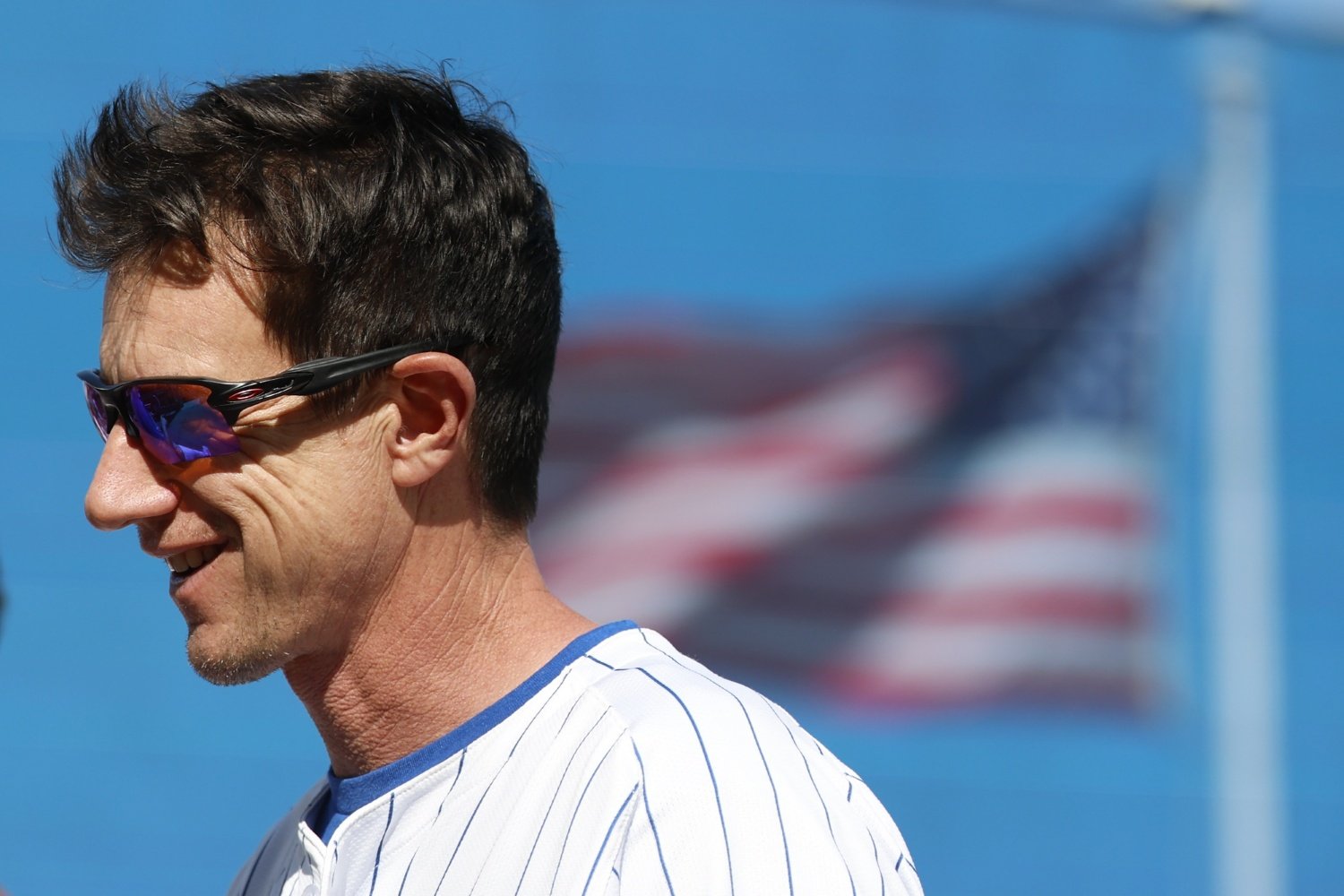
 For your average, everyday, regular-season series, it would be borderline psychotic to spend hours putting together a comprehensive scouting report on the opposing team. That's what teams do, of course, because it's the only way to be ready to play the increasingly complex modern game. Fans, however, have to be a bit more cavalier. Every game is just one of 162. Even a three-game weekday series is just under 2% of a full season. All that's out the window now. This three-game weekday series might not even go as long as three games, if one team shows up materially more prepared than the other—and for the loser, it will be 100% of the rest of their season. Thus, it's time to spend your morning commute (or coffee break, or suspiciously long on-the-clock dump) tackling some questions you'd barely graze, if this were the regular season. The Padres and the Cubs play two afternoon games this week, at Wrigley Field. What Game 3 of that set might look like, we can't afford to worry about yet. Right now, all that matters is how the first two will go. They're each scheduled for a 2:08 PM CT first pitch, and will be nationally televised. The pitching matchups for each are set, and they're intriguingly similar. It'll be almost (but very definitely not exactly) like playing the same game twice. If one team wins that game both times, the other's season will crash to an end. These are two very good teams, only lightly diminished by injuries and the grind of the long season. How do they match up? Essential Details Game 1: Padres Starter: RHP Nick PIvetta - 31 starts, 181 2/3 innings, 2.92 ERA, 26.4% strikeout rate, 6.9% walk rate, 3.1% home-run rate, 33% ground-ball rate, 93 DRA- Cubs Starter: LHP Matthew Boyd - 31 starts, 179 2/3 innings, 3.21 ERA, 21.4% strikeout rate, 5.8% walk rate, 2.6% home-run rate, 37% ground-ball rate, 96 DRA- Key Personnel Consideration: Elias Díaz is Pivetta's personal catcher, and is likely to play Game 1. Current weather forecast: Sunny, 77°, winds expected to blow in at 8-15 MPH Game 2: Padres Starter: RHP Dylan Cease - 32 GS, 168 IP, 4.55 ERA, 29.8% K, 9.8% BB, 2.9% HR, 36.6% GB, 86 DRA- Cubs Starter: LHP Shota Imanaga - 25 GS, 144 2/3 IP, 3.73 ERA, 20.6% K, 4.6% BB, 5.5% HR, 29.1% GB. 114 DRA- Key Personnel Consideration: In a series full of fly-ball pitchers, Imanaga achieves an extreme even in that crowd. The Cubs need to field their best defensive outfield in this game. Current weather forecast: Overcast, 74°, winds expected to blow in at 8-15 MPH Projected Lineups Because of the similarities in profile (handedness for each pair, pitch mix for Boyd and Imanaga, arm slot for Pivetta and Cease), the optimal lineups for these teams will be nearly identical for the two games. Interestingly, neither lineup will feel especially familiar, because each team has just had injuries shake up their daily corps—and each is facing a set of pitchers that changes what they do a little bit, relative to their default setting. Padres Fernando Tatis Jr. - RF Luis Arraez - DH Manny Machado - 3B Gavin Sheets - LF Xander Bogaerts - SS Jackson Merrill - CF José Iglesias - 2B Ryan O'Hearn - 1B Elias Díaz (G1) / Freddy Fermin (G2) - C Cubs Michael Busch - 1B Ian Happ - LF Kyle Tucker - DH (G1) / RF (G2) Seiya Suzuki - RF (G1) / DH (G2) Pete Crow-Armstrong - CF Dansby Swanson - SS Nico Hoerner - 2B Carson Kelly - C Matt Shaw - 3B The Skinny To topline this thing, you need to know the following: The Cubs brought Kyle Tucker back from the injured list this weekend, but only as a designated hitter. It's not clear whether he'll be able to play right field, and while Seiya Suzuki has been better at avoiding the bad read or the clank-and-drop this year, he's much more prone to the disastrous play than is Tucker. That goes extra on a sunny day, forced to play right field. Whether Tucker can play right field might turn out to matter much more than you would guess, even though he himself has been merely passable with the glove. Nick Pivetta had a career year, after signing a disappointingly team-friendly contract with San Diego over the winter. He'd never had an ERA under 4.00 before, and this season, he got under 3.00. He fills up the strike zone, and can miss bats with his breaking stuff against hitters of both handednesses. Dylan Cease, set to become a free agent this fall, went the opposite way, at least in terms of surface-level numbers. He's better than his ERA reflects, though he's always been somewhat susceptible to this type of season. San Diego lost key contributor and right-handed bat Ramón Laureano to a hand injury during the final week, and he'll miss this series. That's a huge blow for the Padres. At the same time, they got Xander Bogaerts back from a prolonged absence just before the season wrapped, which balances things out somewhat. The Cubs can understand that, of course, with Tucker returning to the lineup at the last minute just as they lost would-be playoff starter Cade Horton. These teams split the season series, but that doesn't tell the full story. In each of the last two years, the Cubs' most painful loss (arguably) was to San Diego, in April. Last year, they lost 9-8 in a game they led 8-0 into the middle innings. This year, they squandered a 7-3 lead in similar, excruciating slow-motion fashion—this time, at home, where they'll play these very games with everything on the line. That's a part of the Padres' identity. Only Atlanta and the Blue Jays won more game than did San Diego (9) when trailing by multiple runs after four innings this year, so if you get ahead of them, you have to keep your foot on their throat. (The Cubs, because you're wondering, won just four such games this season.) San Diego's offense can be dynamic, but they've underachieved. The biggest reason for their comeback ability, arguably, is their remarkable bullpen. With Robert Suarez, Mason Miller and ex-Cub Jeremiah Estrada anchoring a ferocious group, they can shut you down if they get ahead—but they also make it harder to extend a lead, especially in a game that matters enough to justify using their best relievers even while behind. Beyond the batter-pitcher matchups we're about to break down at length, the Cubs have two enormous advantages in this series. One is their defense, which has been worth 83 Defensive Runs Saved (DRS) this year, second-best in MLB. The Padres come in 14th, at 28 DRS, and even that comes mostly from right field and behind the plate. The Cubs are much better at turning balls in play into outs, and the Padres don't specialize in hitting the long ball, the way they used to. The other major advantage lies in the running game. Fermin can be a deterrent and a runner-killing machine behind the plate, but with Díaz and the sometimes-inattentive Pivetta starting Game 1, the Cubs have a chance to run and create runs via small ball—assuming they can get on base. The Padres will have no such opportunities. Boyd and Imanaga are two of the six pitchers (of 500 qualifiers) who hold runners closest, and each has a good pickoff move to make overeager guessers pay. The Advance Scout's Handbook This is the section of this piece to keep open during the games for these two days. We're going to talk about the specific ways individual batters match up with the starters on each team, and talk about how the Cubs need to execute to get the better of matchups that (taken as a whole) do seem to lean in their favor. The Padres Against Lefties With Horton off the board, the Cubs will hand the ball to Boyd in Game 1 and to Imanaga in Game 2. That means two straight days with a southpaw on the mound, who brings with them some funk and whose arsenal has as its key components a four-seam fastball, a fading offspeed pitch, a slider and a curve. Each pitcher adds other wrinkles, and their pitch shapes and velocity bands aren't identical, but Boyd and Imanaga are similar enough that we can study the best way for each to attack the Padres' batters, without significantly differentiating them. Fernando Tatis Jr.: Lefties can get Tatis out with four-seamers up and away. However, if they miss laterally while trying to hit that corner of the zone, they pay a hefty price. Tatis likes the ball up, and wants to turn on it with his fearsome swing. When building a gameplan against a hitter, you have to create some margin for error, so the right way to attack Tatis is to line the bottom of the zone with the fastball, then dip below the zone with the changeup (or, in Imanaga's case, the splitter). Tatis has been worse as a power hitter this year, and lefties have been especially good at stumping him, but he's made up for the loss of punch with much-improved patience. As a result, Imanaga might have to be willing to walk him at times, rather than risk throwing a fastball that catches the wrong pocket of the zone. Boyd, whose changeup stays in the zone much more often and can play off the fastball even when it's landing in close to the same vertical location, has the better answer for what Tatis is doing well in 2025. The key really, truly is to keep the ball down and away; he can't lift the ball when lefties hit their spots right now. Make him beat you with a single and a steal, especially because he's been caught seven times attempting steals this year and the Cubs have pickoff artists on the hill. Luis Arráez: Much more than most hitters, Arráez adapts his swing plane based on pitch type and location. That's the sign of a hitter who's able to recognize pitches earlier than almost anyone, which is why he's such a contact freak. Stunningly, in over 20 swings, he didn't whiff on a curveball from a lefty even once this year. However, he trades bat speed for all that adaptability, so you really just have to pound him low with the fastball. His swing works neatly out away from him and above the belt, but crowd him or hit the bottom rail of the zone with four-seamers and Arráez often gets himself out. Caleb Thielbar is actually a slightly better matchup for Arráez than are Imanaga or Boyd, because whereas they (and Drew Pomeranz) each lean toward elevating the fastball, Thielbar has the ability to dot the bottom line with his; he throws 17.8% of his fastballs in the lower reaches of the zone. You just have to resist the temptation to try to punch Arráez out. Throwing him a changeup or a curve is creating a threat where none exists. Don't do it. Manny Machado: It sounds reductive, but so much of getting Machado out as a left-handed hurler comes down to execution. He's the one Padres hitter who has mashed lefties this year, and we might see Mike Shildt put two lefties behind him in the order to punish any attempt by Counsell to bring on a righty reliever to deal with him. Thus, a game could easily come down to whether Boyd or Imanaga (or Thielbar or Pomeranz) can get Machado out in a key spot. That, in turn, comes down to sequencing and location. Machado uses good anticipation and his plus bat speed to get the barrel to inside fastballs against lefties very well. He slows his bat slightly and tends to clip the ball, leading to line drives to center field rather than long flies to left, but it's a reliable way that he produces hits. To get him out with the heater, you have to elevate. He will whiff up there, especially up and away. Once he reaches a two-strike count, though, Machado makes a major swing adjustment and can line that high heater the other way. The best plan is to start him with high, teasing heaters, then throw your best breaking ball or changeup to get him out with two strikes. That's the standard formula, but it's comforting to know that it works; not every right-handed batter can be gotten out so simply. Running changeups work better against him than the ones with more of a vertical shape, so Imanaga could do well with a strike-to-ball sweeper. Boyd's change suits Machado's weakness better. Each has the tools to avoid letting him hurt them, though. It's just going to hurt a lot if you miss in the middle of the zone to him. Gavin Sheets: Lefties can safely start Sheets with a fastball for a strike. He's passive early in counts, with just 10 swings (and two hits, both ground-ball singles) on first-pitch fastballs from lefties this year. He's seen 39 such pitches, so he's willing to take a strike, and even if he swings, you're not in a ton of danger. Thereafter, crowd him with that heater. Sheets has a very flat swing and wants the ball on the outer half; inside heaters from lefties eat him up. Xander Bogaerts: It's extremely important to pitch Bogaerts backward. He's very dangerous on fastballs from lefties in early and hitter-friendly counts. He's also heavily prone to whiffs on offspeed pitches, though, so as long as you don't leave that pitch on the inner half, it's not terribly hard to get him out. Start Bogaerts with a changeup or splitter away, then finish him with fastballs and be ok with that finish being a lazy fly ball, rather than a strikeout. Jackson Merrill: The follow-up to Merrill's run at the Rookie of the Year Award last year has been underwhelming. He's a more smooth-edged but less toolsy rendition of Crow-Armstrong. The key, especially as a lefty, is to attack Merrill with high fastballs. Miss low, and you'll pay. Even though his numbers are down and his swing speed looks initially unimpressive, he has a uniquely steep swing that makes him lethal when he draws a bead on a low heater. In that way, he's very much like Crow-Armstrong. Don't try to sneak a first-pitch cookie past him, like you can against Sheets. Be willing to nibble, see if he'll chase, and then let him get himself out on a mishit fly ball when you get the fastball up near the letters. José Iglesias: This is, perhaps, Shildt's most interesting lineup decision. He almost has to sit Jake Cronenworth; you can't run five lefty hitters out against a pair of lefty starters. Iglesias isn't as dangerous as Cronenworth can be at his best, but he's a tougher out for a lefty than Cronenworth usually is. He's not going to tap the ball on the first pitch. He has zero balls in play on 18 first-pitch offspeed pitches from lefties this year. He also won't swing at the change if the count goes to 3-2; he didn't offer at any of the four he saw. In between, he'll go for a changeup, but the best plan is to start him with a breaking ball, get strike two on the change, and then go up and away with a fastball for the strikeout. That's a common hole in the swings of righty batters facing lefty pitchers, and given Iglesias's swing plane, his lackluster bat speed exacerbates the problem. Ryan O'Hearn: If Laureano hadn't gotten hurt, O'Hearn might have been the odd man out in the lineup shuffle. All things considered, he'll probably start at least one of the games; he's a terrific defensive first baseman. Against a good lefty, though, he's an easy out. If you can hit your spot on the outer third to him, and you can put any other pitch at all in his head, you can get him out with the fastball. He looks inside for fastballs and lets his bat catch up to anything slow or spinning away from him; he doesn't have the bat speed to cover the outer-half heat with that approach. It's all about making him respect something softer, without actually throwing anything in the zone except the fastball away. Freddy Fermin: Never, ever play with your food—especially in the playoffs. Fermin has an even worse version of the hole in Iglesias's swing. Aim for the upper and outer quadrant, and take care of business. Hitters will adjust if you go to the well too many times that way, of course, but even a modicum of mixing in other stuff to set it up will make a simple fastball an out pitch to Fermin. Elias Díaz: Just don't leave the changeup up, and you'll be fine. Días, who was only very briefly anything else, is purely a mistake hitter at this point in his career. He doesn't have much plate discipline or an adaptable swing. Jake Cronenworth: Unlike almost all his teammates, Cronenworth won't whiff on your lefty fastball. Start him with soft or spin. He tries to get opportunistic early in at-bats, and occasionally, he gets himself out by taking a fastball hack and dribbling a ball somewhere on a slider. Crucially, though, don't double up with the heater deep in a count, when trying to put him away. He's going to hit that hard somewhere. The Cubs Against High-Slot Righties Who Fill Up the Zone Nick Pivetta throws a good-not-great fastball, and a host of other stuff—but really, he's two different two-pitch pitchers, with a few decorations attached to each. Against lefty batters, he leans almost exclusively on the fastball and the curve, with just a few cutters and other baubles mixed in. Against righties, he's a four-seamer/sweeper guy, with a few cutters to keep people honest. It's not hard to identify Pivetta's pitches out of his hand. His curve has that dreaded hump, for lefties. His release angle is different enough to separate the fastball and the sweeper relatively early. You could get yourself a long way down the wrong road, therefore, by assuming that it's easy to lock in on either pitch and tee off. It ain't so. Pivetta's main offerings diverge so much in terms of velocity and movement that, even though hitters will often spot it fairly soon, they struggle to adjust enough to get the good part (or any part, sometimes) of the bat on the ball. Guys often freeze, even, and take a called strike on a fastball right down the middle, having known it was that pitch in that spot but not having pulled the trigger. He gets you moving and thinking, and then you realize you're so far off your visual target that it's not even worth trying. Thus, the key to hitting him is anticipation. You have to mentally eliminate one of his two main offerings to hitters in your batter's box, at least once or twice an at-bat, and just commit to attacking the pitch you think you're getting. It's a bit different with Cease, but because his pitch profile (and the over-the-top look he offers from a similarly tall frame) is so akin to Pivetta's, hitters end up solving the same sets of problems. This is another small advantage for the Cubs in the series. More so than Imanaga and Boyd, Pivetta and Cease almost train hitters to hit the other. The Cubs' batters should feel like they're getting a third and fourth look at Pivetta when they face Cease in Game 2. In fact, that Pivetta essentially ended up in front of Cease in the rotation for a big chunk of the season might be why Cease's numbers don't look good this year. The lineup I sketched for these games reflects the unique challenge of hitting pitchers like these two, and the way that bends things relative to a standard-issue opponent. By a healthy margin, the best hitter on the team against pitchers who share key traits with Pivetta and Cease this year is Busch, so there was no need to shake up the top spot in the order. However, this type of hurler neutralizes Nico Hoerner in a way almost no other pitcher type in the league can. Thus, I have him slid far down the batting order. Benefiting therefrom is, among others, Dansby Swanson, who took Pivetta himself deep earlier this year and has good overall numbers against pitchers like him. TkFkVkJfWGw0TUFRPT1fQUFkVVhGeFJVZ0lBRHdjREFBQUhBdzlVQUFBQ1dnTUFBQUJYVmd0VUExRUhWQVJR.mp4 Ian Happ slots in second, for me, because although he's struggled against pitchers with this general profile, he seems to have really figured out the specific task of hitting Pivetta. He's not good at covering both pitch types he sees from Pivetta; it's not in the nature of his swing. But he's locked in and timed himself for one of the two, and come up with very well-struck hits against Pivetta as recently as April. TkFkVkJfWGw0TUFRPT1fQVFOU0FnSUhBZ0lBRDFZR1h3QUhBRmNDQUFCVFV3VUFVMVZSQmdSUVZRVlhCUXRW.mp4 Because that appears to be a special case of Happ figuring out a pitcher with a tricky pattern, though, if you want to see him slide down the card for Game 2, you'll get no argument from me. Tucker, for what it's worth, is not especially well-suited to hit this kind of pitcher, and didn't have much success against Pivetta this spring. He did hit the ball hard a few times, but always right at someone or with a bit too much loft. That's the risk for his swing path in the area of the zone where Pivetta lives to lefties. He'll make his Cubs legacy, if at all in the series, when he gets a shot at Mason Miller later in games; that's a better fit for his unique brand of brilliance. Otherwise, he might need to settle for a wrong-way single at a key juncture. The other player pushed far down the order—further than he's been since mid-August, in fact—is Kelly. That's because he's even worse than Hoerner against pitchers like Pivetta and Cease. Their stuff is just a nightmare fit for his swing path and his patient approach. The Cubs should, in fact, consider pinch-hitting for Kelly with Moisés Ballesteros and then swapping in Reese McGuire if Kelly's spot comes up in a pivotal situation during the series, with Pivetta or Cease on the mound. A Few Bullpen Thoughts In a series this short, it's not as important to sweat the possible overexposure of particular pitchers that comes from bringing them into multiple games and giving the same hitters multiple looks at them in a short span. On the other hand, there are no off days in this set, either. Fatigue could come into play for the relievers, as well as for starters. Look for both Counsell and Shildt to shield their high-leverage arms from working back-to-back in Games 1 and 2 if at all possible, because they certainly won't want to have to turn to anyone for a third straight day in Game 3. Taylor Rogers will probably only appear if the series goes to a Game 3. Unlike Thielbar, he's not a materially better matchup for any of the Padres than Boyd or Imanaga are, so unless one of those two departs very early, Rogers probably won't be called upon., He could, however, easily be a better matchup for someone than Jameson Taillon is, by the fourth inning of a decisive Game 3. It's in that contest that all hands will truly be on deck. Estrada, though an elite strikeout arm, is too similar to Pivetta and Cease to be a great backup to them. He might be unexpectedly vulnerable to a huge hit late in a game, so don't despair if he comes in to try and protect a thin lead for the visitors. Machado and Tatis are, obviously, the most important bats to target with the Cubs' late-game trio of right-handed relievers. They're neighbors in the lineup, but it's not necessarily the case that the same righty should face them in any given spot. Andrew Kittredge is the best matchup for both players, so mentally, slide him up the reliever hierarchy in your mind. Brad Keller is a bit better an option against the two than is Daniel Palencia, whose stuff should play well against Arráez and Sheets. Benediction This series is going to be a blast. The Cubs are well-positioned to win it, despite the absence of Horton and the uncertain readiness of Tucker. Hopefully, this exhaustive study will make you feel a bit more aware and a bit less anxious during the action. If both sides play a facsimile of their best game, it's the Cubs' that should win out, and we can have another long conversation like this one this weekend as the team travels to Milwaukee.
 -
Image courtesy of © Kamil Krzaczynski-Imagn Images Earlier this morning, we talked through the options the Cubs face when constructing a 26-man roster for their upcoming Wild Card Series against the San Diego Padres. In the process, I proposed that the team is likely to carry 15 position players, allowing for the possibilities of injury, ejection and mid-game substitutions, be they tactical or based on the nagging injuries a few key hitters are carrying. Now, it's time to look at the other side of the roster list. If the Cubs do take 15 hitters, they'll have 11 pitchers to work with as Craig Counsell prepares for 81 outs (or a few more, or many fewer) over three days. Let's talk about who they'll be, and who's on the outside looking in. Starters (3) Matthew Boyd Shota Imanaga Jameson Taillon It would be a substantial upset, for me, if the Cubs gave the ball to anyone but the three hurlers named above, or in any other order—should the series go three games. Matthew Boyd pitched Wednesday night against the Mets, and is on full rest, set up nicely for Game 1 of the Wild Card set. That, of course, was the place the team might initially have hoped to reserve for Cade Horton, but Horton cracked a rib somewhere between his final two regular-season starts and is likely out for the year. The news could be worse. Boyd has been wonderful for the Cubs this year, though of course, he's struggled more in the second half after earning an All-Star nod with a brilliant beginning of the campaign. He and Shota Imanaga each give the Padres some tough matchups, because San Diego doesn't hit lefties well. Each also figures to make a relatively short start, but that's ok. If the Cubs can get to the sixth inning with a lead, they'll feel very confident. That will be the task before both Boyd and Imanaga. If the series goes to a decisive third contest, the story might be different with Jameson Taillon, a righty who doesn't match up as nicely with the Padres and who hasn't been as impressive this season as his two southpaw teammates. Relievers (8) Brad Keller Andrew Kittredge Daniel Palencia Caleb Thielbar Drew Pomeranz Michael Soroka Taylor Rogers Colin Rea The closest thing to a controversial call here is that Colin Rea is penciled in as a reliever, rather than as the third starter. Taillon and Rea have been similarly effective this year, all told, and admittedly, this is at least partially a nod to Taillon's greater seniority and heftier contract. Still, Rea is also more compelling as a potential multi-inning reliever, because he has an arsenal that can be pared down and tweaked for maximum effect in the bullpen—and experience doing so, to boot. Rea pitched Friday; Taillon went Saturday. That means that Rea should be available for medium-length relief as soon as Game 1, whereas Taillon won't be ready to go (except in some truncated relief role) until Thursday, when Game 3 would be played. Rea is also the better complement to the pitch profiles of Boyd and Imanaga, so if Counsell ends up needing a bridge from one of his lefty starters to his higher-leverage relievers, Rea is a plausible one; Taillon is less so. Look for Counsell to seek out the left-leaning pockets of the Padres lineup and make aggressive use of both Caleb Thielbar and Drew Pomeranz, but perhaps just one of them in each of the first two games. That should keep any San Diego hitter from getting unduly good looks at them. Once you reach October, the risk of overexposing a reliever to a specific batter from the opposing team becomes real and worrisome. That's why having multiple trusted relievers for each role is so valuable. Brad Keller, Andrew Kittredge and Daniel Palencia have pitched in the same game nine times this year, and (in varying orders) that seems to be the trio Counsell most trusts to close out games. If he can get his starters through five and get some help from one of his lefties, though, he should be able to hold back one of the three (plus Michael Soroka) even if he's protecting a lead in one game. That's valuable. The names who don't appear here are, in a few cases, as compelling as the ones who do. This roster leaves off Aaron Civale, who last pitched for the team on Sept. 24 and could give them a lot of length—but whose stuff hasn't leapt forward since he moved to the bullpen for the first time, and who probably isn't fit for any kind of dangerous work. It excludes Ben Brown and Porter Hodge, as they wind down disappointing seasons. It excludes offseason additions-turned-injury cases Ryan Brasier and Eli Morgan, although if either of them has shown the team something compelling recently in rehab work or a Triple-A Iowa, they could always be tacked on as a 12th arm, squeezing out one of the hitters I project to make the team almost by default. Javier Assad also isn't listed. He made (more or less) a full start Sunday, and appears to be tracking toward making a start or providing bulk innings in a tandem effort should the team reach the NLDS. He's the second-most interesting name not projected to make the cut here whom the team might include, after all. The most interesting: Jaxon Wiggins. It's toweringly unlikely that the Cubs are planning to sneak Wiggins into the back end of their bullpen, with an eye toward him making his big-league debut in the postseason, If they feel they need an infusion of raw stuff, though, Wiggins is the most intriguing way they could do it. Those are all the names worth saying, in this context. Whether the team ultimately goes with 11 or 12 arms, most of these will be there. Counsell will remain cagey and creative, but however he prefers to get from Out No. 1 to Out No. 81, the Cubs have decent pitching depth for this time of year. They're in a good position. Whether that will matter is likely to come down to execution, now. View full article
-
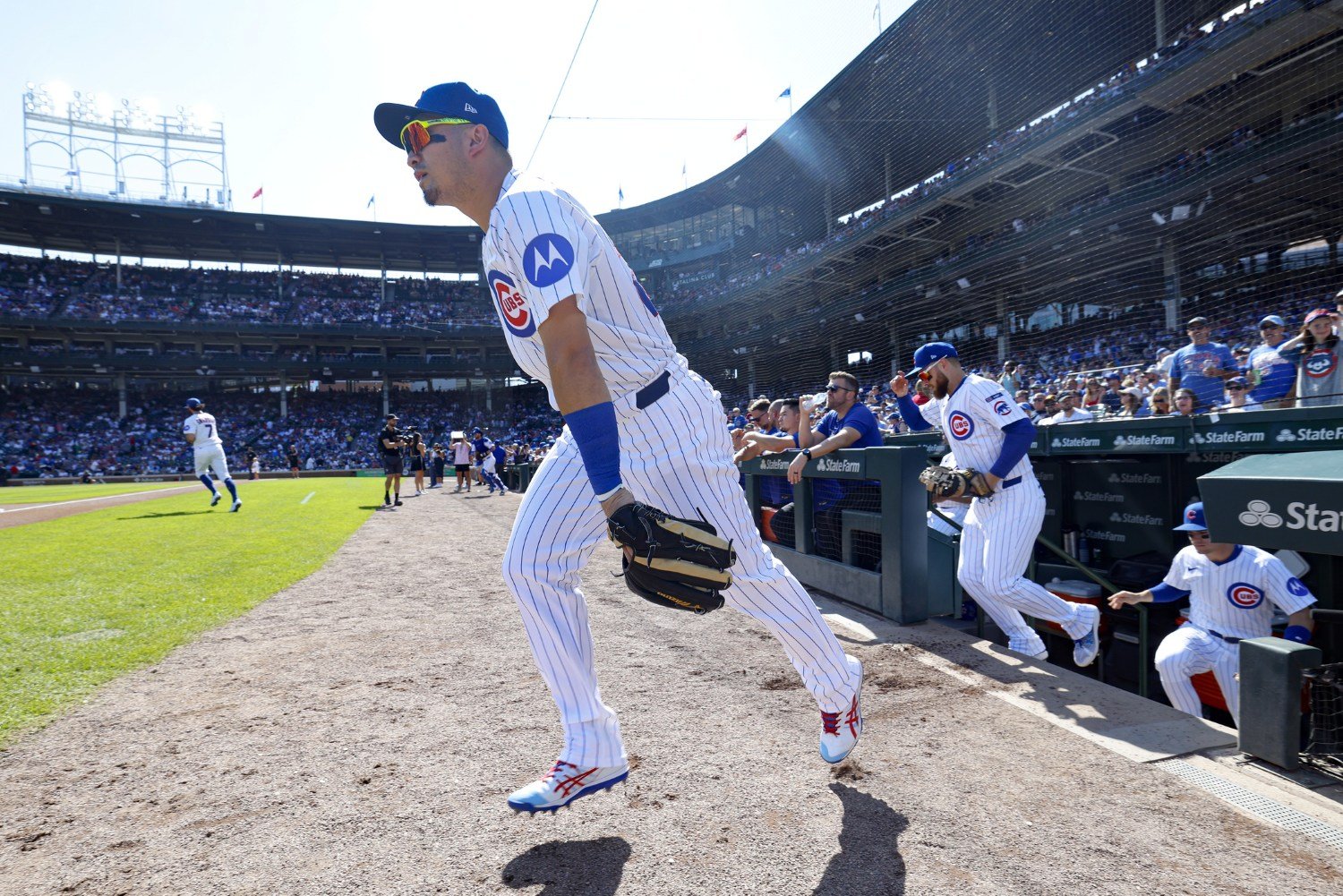
 Earlier this morning, we talked through the options the Cubs face when constructing a 26-man roster for their upcoming Wild Card Series against the San Diego Padres. In the process, I proposed that the team is likely to carry 15 position players, allowing for the possibilities of injury, ejection and mid-game substitutions, be they tactical or based on the nagging injuries a few key hitters are carrying. Now, it's time to look at the other side of the roster list. If the Cubs do take 15 hitters, they'll have 11 pitchers to work with as Craig Counsell prepares for 81 outs (or a few more, or many fewer) over three days. Let's talk about who they'll be, and who's on the outside looking in. Starters (3) Matthew Boyd Shota Imanaga Jameson Taillon It would be a substantial upset, for me, if the Cubs gave the ball to anyone but the three hurlers named above, or in any other order—should the series go three games. Matthew Boyd pitched Wednesday night against the Mets, and is on full rest, set up nicely for Game 1 of the Wild Card set. That, of course, was the place the team might initially have hoped to reserve for Cade Horton, but Horton cracked a rib somewhere between his final two regular-season starts and is likely out for the year. The news could be worse. Boyd has been wonderful for the Cubs this year, though of course, he's struggled more in the second half after earning an All-Star nod with a brilliant beginning of the campaign. He and Shota Imanaga each give the Padres some tough matchups, because San Diego doesn't hit lefties well. Each also figures to make a relatively short start, but that's ok. If the Cubs can get to the sixth inning with a lead, they'll feel very confident. That will be the task before both Boyd and Imanaga. If the series goes to a decisive third contest, the story might be different with Jameson Taillon, a righty who doesn't match up as nicely with the Padres and who hasn't been as impressive this season as his two southpaw teammates. Relievers (8) Brad Keller Andrew Kittredge Daniel Palencia Caleb Thielbar Drew Pomeranz Michael Soroka Taylor Rogers Colin Rea The closest thing to a controversial call here is that Colin Rea is penciled in as a reliever, rather than as the third starter. Taillon and Rea have been similarly effective this year, all told, and admittedly, this is at least partially a nod to Taillon's greater seniority and heftier contract. Still, Rea is also more compelling as a potential multi-inning reliever, because he has an arsenal that can be pared down and tweaked for maximum effect in the bullpen—and experience doing so, to boot. Rea pitched Friday; Taillon went Saturday. That means that Rea should be available for medium-length relief as soon as Game 1, whereas Taillon won't be ready to go (except in some truncated relief role) until Thursday, when Game 3 would be played. Rea is also the better complement to the pitch profiles of Boyd and Imanaga, so if Counsell ends up needing a bridge from one of his lefty starters to his higher-leverage relievers, Rea is a plausible one; Taillon is less so. Look for Counsell to seek out the left-leaning pockets of the Padres lineup and make aggressive use of both Caleb Thielbar and Drew Pomeranz, but perhaps just one of them in each of the first two games. That should keep any San Diego hitter from getting unduly good looks at them. Once you reach October, the risk of overexposing a reliever to a specific batter from the opposing team becomes real and worrisome. That's why having multiple trusted relievers for each role is so valuable. Brad Keller, Andrew Kittredge and Daniel Palencia have pitched in the same game nine times this year, and (in varying orders) that seems to be the trio Counsell most trusts to close out games. If he can get his starters through five and get some help from one of his lefties, though, he should be able to hold back one of the three (plus Michael Soroka) even if he's protecting a lead in one game. That's valuable. The names who don't appear here are, in a few cases, as compelling as the ones who do. This roster leaves off Aaron Civale, who last pitched for the team on Sept. 24 and could give them a lot of length—but whose stuff hasn't leapt forward since he moved to the bullpen for the first time, and who probably isn't fit for any kind of dangerous work. It excludes Ben Brown and Porter Hodge, as they wind down disappointing seasons. It excludes offseason additions-turned-injury cases Ryan Brasier and Eli Morgan, although if either of them has shown the team something compelling recently in rehab work or a Triple-A Iowa, they could always be tacked on as a 12th arm, squeezing out one of the hitters I project to make the team almost by default. Javier Assad also isn't listed. He made (more or less) a full start Sunday, and appears to be tracking toward making a start or providing bulk innings in a tandem effort should the team reach the NLDS. He's the second-most interesting name not projected to make the cut here whom the team might include, after all. The most interesting: Jaxon Wiggins. It's toweringly unlikely that the Cubs are planning to sneak Wiggins into the back end of their bullpen, with an eye toward him making his big-league debut in the postseason, If they feel they need an infusion of raw stuff, though, Wiggins is the most intriguing way they could do it. Those are all the names worth saying, in this context. Whether the team ultimately goes with 11 or 12 arms, most of these will be there. Counsell will remain cagey and creative, but however he prefers to get from Out No. 1 to Out No. 81, the Cubs have decent pitching depth for this time of year. They're in a good position. Whether that will matter is likely to come down to execution, now.
 -
 Building a roster for a win-or-go-home best-of-three series is an entirely different challenge than building one to win 92 games across 162 in a six-month marathon. The Cubs were patient and methodical all year, using their hot start to the 2025 season to accommodate a steady approach the rest of the way. Now, that all comes to an abrupt end. Beginning Tuesday afternoon, the Cubs and the San Diego Padres will play a best-of-three series for the right to advance to the National League Division Series. Every inning, every out, and every pitch will matter; every decision they make between now and Thursday night will matter. The nature of this short a series both raises and lowers the stakes of certain roster choices. Craig Counsell will, of course, only need three starters (at most) this week, and he'll have a fresh set of relievers to turn to behind them. There's no reason for the team to carry more than 12 pitchers, and even that might turn out to be too many. On the other hand, when every pitch matters and there are only three games to play, 14 or 15 position players feels like a bit of an extravagance, too. For a club that tried to stick to a very regular starting nine for most of this season, the bench won't feel especially vital. In a moment, though, those players can become extremely important. There are tactical gambles you take in playoff games that you would eschew in regular-season ones. There are also some injury issues to consider, with this particular team, that make having a deeper corps of position players than would be typical fairly appealing. All that has to be part of the conversation, but broad strokes won't do. Let's get into the specifics of a Cubs playoff roster projection, one roster segment at a time. We'll break this up into two parts, starting with the hitters. Catchers (2) Carson Kelly Reese McGuire It would be lovely to find Miguel Amaya able to contribute to this team after all, but it feels like this round is too soon to even dream of it. If his efforts to demonstrate his readiness go well, he could be sent to the Arizona Fall League to maintain his timing and stay in shape, but he shouldn't take Reese McGuire's job (or even be added as a third backstop) in either the Wild Card round or (should the Cubs get that far) the Division Series. An NLCS return is a more reasonable hope, but even that might be a remote one. Carson Kelly is likely to start every game through at least a round or two, anyway. McGuire has done yeoman's work as an emergency fill-in, but his OBP this season is .239. It's nice that this series will be played in the afternoons; Kelly hit .235/.322/.375 at night but .266/.346/.491 in day games this year. Infielders (6) Michael Busch Nico Hoerner Dansby Swanson Matt Shaw Willi Castro Justin Turner No surprises here, and no controversy. The starting infield will be the same every day during at least this series. There are some circumstances under which Counsell might choose to pinch-hit for Michael Busch with Justin Turner, and if and when that time comes, I implore you to react reasonably. As ugly as his overall numbers are, Turner has been fine since his ice-cold start, and downright solid if you isolate his numbers against lefties. The key development recently is the emergence of Moisés Ballesteros as a secondary lefty bat who can play first base, where the team plugged him in twice over the weekend. After Turner comes in for Busch, in later stages of the game, Ballesteros might come on for Turner against a righty reliever. Castro has struggled mightily in a Cubs uniform, and had struggled in the last few weeks of his tenure with the Minnesota Twins. He rushed back from an oblique strain earlier this year and hasn't been the same; the smart money says he'll appear only as a replacement in cases of injury or ejection. Outfielders (5) Ian Happ Pete Crow-Armstrong Seiya Suzuki Kyle Tucker Kevin Alcántara Which of Kyle Tucker and Seiya Suzuki starts in right field will be worth watching, especially for Shota Imanaga's start in Game 2. Suzuki struggles with the sky during day games and the sun will slant cruelly into the right fielder's eyes during the middle and later innings of each of the first two contests. If Tucker is healthy enough, he's probably better out there. However, should he start games there, it won't be a surprise if he can't end them there. Keeping Kevin Alcántara on the roster is important; he can be a late-game defensive substitution. It probably won't be as simple as swapping Tucker for Alcántara, though. It's more likely that the Cubs would pinch-run for Tucker after he reaches base, then slide Alcántara into his place defensively in the following half-inning. The pinch-runner might be more of a specialist. Tactical Pieces (2) Moisés Ballesteros Billy Hamilton There's no way the Cubs can allow Billy Hamilton to take an at-bat for them. And they won't. However, he can still run. He has baserunning instincts and veteran wile. If he showed them enough in a brief audition with Triple-A Iowa, he could well be the 15th man on the positional side of the roster. Ballesteros will be the 14th, and can serve as a counterpunching pinch-hit option behind Turner. He's also a candidate to take an at-bat from Kelly or Matt Shaw against certain righty hurlers, and in an extreme, do-or-die last at-bat scenario, they might want to have him to take over for Alcántara in a given spot. There are few other candidates for the playoff roster, on the position-player side. Carlos Santana is still with the team, but he didn't show anything to suggest that he can help them on the field in this round. Owen Caissie isn't game-ready. Amaya is the one question mark, but again, he's probably another round or two from truly entering the equation. The dilemma is between having 14 or 15 hitters available. This is a prediction that they'll go with 15. Later today, we'll break down the pitchers who might make up the other side of the sheet.
 -
Image courtesy of © Kamil Krzaczynski-Imagn Images Building a roster for a win-or-go-home best-of-three series is an entirely different challenge than building one to win 92 games across 162 in a six-month marathon. The Cubs were patient and methodical all year, using their hot start to the 2025 season to accommodate a steady approach the rest of the way. Now, that all comes to an abrupt end. Beginning Tuesday afternoon, the Cubs and the San Diego Padres will play a best-of-three series for the right to advance to the National League Division Series. Every inning, every out, and every pitch will matter; every decision they make between now and Thursday night will matter. The nature of this short a series both raises and lowers the stakes of certain roster choices. Craig Counsell will, of course, only need three starters (at most) this week, and he'll have a fresh set of relievers to turn to behind them. There's no reason for the team to carry more than 12 pitchers, and even that might turn out to be too many. On the other hand, when every pitch matters and there are only three games to play, 14 or 15 position players feels like a bit of an extravagance, too. For a club that tried to stick to a very regular starting nine for most of this season, the bench won't feel especially vital. In a moment, though, those players can become extremely important. There are tactical gambles you take in playoff games that you would eschew in regular-season ones. There are also some injury issues to consider, with this particular team, that make having a deeper corps of position players than would be typical fairly appealing. All that has to be part of the conversation, but broad strokes won't do. Let's get into the specifics of a Cubs playoff roster projection, one roster segment at a time. We'll break this up into two parts, starting with the hitters. Catchers (2) Carson Kelly Reese McGuire It would be lovely to find Miguel Amaya able to contribute to this team after all, but it feels like this round is too soon to even dream of it. If his efforts to demonstrate his readiness go well, he could be sent to the Arizona Fall League to maintain his timing and stay in shape, but he shouldn't take Reese McGuire's job (or even be added as a third backstop) in either the Wild Card round or (should the Cubs get that far) the Division Series. An NLCS return is a more reasonable hope, but even that might be a remote one. Carson Kelly is likely to start every game through at least a round or two, anyway. McGuire has done yeoman's work as an emergency fill-in, but his OBP this season is .239. It's nice that this series will be played in the afternoons; Kelly hit .235/.322/.375 at night but .266/.346/.491 in day games this year. Infielders (6) Michael Busch Nico Hoerner Dansby Swanson Matt Shaw Willi Castro Justin Turner No surprises here, and no controversy. The starting infield will be the same every day during at least this series. There are some circumstances under which Counsell might choose to pinch-hit for Michael Busch with Justin Turner, and if and when that time comes, I implore you to react reasonably. As ugly as his overall numbers are, Turner has been fine since his ice-cold start, and downright solid if you isolate his numbers against lefties. The key development recently is the emergence of Moisés Ballesteros as a secondary lefty bat who can play first base, where the team plugged him in twice over the weekend. After Turner comes in for Busch, in later stages of the game, Ballesteros might come on for Turner against a righty reliever. Castro has struggled mightily in a Cubs uniform, and had struggled in the last few weeks of his tenure with the Minnesota Twins. He rushed back from an oblique strain earlier this year and hasn't been the same; the smart money says he'll appear only as a replacement in cases of injury or ejection. Outfielders (5) Ian Happ Pete Crow-Armstrong Seiya Suzuki Kyle Tucker Kevin Alcántara Which of Kyle Tucker and Seiya Suzuki starts in right field will be worth watching, especially for Shota Imanaga's start in Game 2. Suzuki struggles with the sky during day games and the sun will slant cruelly into the right fielder's eyes during the middle and later innings of each of the first two contests. If Tucker is healthy enough, he's probably better out there. However, should he start games there, it won't be a surprise if he can't end them there. Keeping Kevin Alcántara on the roster is important; he can be a late-game defensive substitution. It probably won't be as simple as swapping Tucker for Alcántara, though. It's more likely that the Cubs would pinch-run for Tucker after he reaches base, then slide Alcántara into his place defensively in the following half-inning. The pinch-runner might be more of a specialist. Tactical Pieces (2) Moisés Ballesteros Billy Hamilton There's no way the Cubs can allow Billy Hamilton to take an at-bat for them. And they won't. However, he can still run. He has baserunning instincts and veteran wile. If he showed them enough in a brief audition with Triple-A Iowa, he could well be the 15th man on the positional side of the roster. Ballesteros will be the 14th, and can serve as a counterpunching pinch-hit option behind Turner. He's also a candidate to take an at-bat from Kelly or Matt Shaw against certain righty hurlers, and in an extreme, do-or-die last at-bat scenario, they might want to have him to take over for Alcántara in a given spot. There are few other candidates for the playoff roster, on the position-player side. Carlos Santana is still with the team, but he didn't show anything to suggest that he can help them on the field in this round. Owen Caissie isn't game-ready. Amaya is the one question mark, but again, he's probably another round or two from truly entering the equation. The dilemma is between having 14 or 15 hitters available. This is a prediction that they'll go with 15. Later today, we'll break down the pitchers who might make up the other side of the sheet. View full article
-
Image courtesy of © Charles LeClaire-Imagn Images Depending on whom you asked, Cade Horton was in line to start either Game 1 or Game 2 of the upcoming Wild Card Series for the Chicago Cubs, who hope to be hosting that best-of-three set against the San Diego Padres. Horton has been the team's best starter over the last two months, as he's adjusted to major-league hitters and tapped into the full value of his ever-deepening arsenal and plus command. Unfortunately, now, he's out of those plans entirely—and his season is likely over. The Cubs placed Horton on the 15-day injured list Saturday, with a fractured rib. The righty was lifted after three innings of his start against the Mets early this week, dealing with soreness in his side; subsequent imaging revealed the crack and attempts to work through the pain proved fruitless. The team recalled lefty Jordan Wicks to take Horton's place on the active roster for the weekend, although Wicks is not likely to make the playoff roster. That pretty well locks Matthew Boyd and Shota Imanaga into the first two spots in the team's rotation for the series against San Diego. They make good matchups for the Padres lineup, anyway, especially after San Diego lost right-hitting outfielder Ramón Laureano at least through the Wild Card Series. However, Horton feels like a major loss, because his starts had become such spectacles of efficiency and sheer attitude on the mound. Making do without him will mean stretching the team's pitching depth in some new and creative ways. Craig Counsell will still have options. The starters who look best-positioned to pick up the slack where Horton leaves room are Jameson Taillon and Colin Rea, but the team can (and will) also turn to both Javier Assad and Michael Soroka to make multi-inning appearances, if their run into October goes long enough. That quartet will try to buttress Boyd and Imanaga and form a bridge to the back end of the bullpen, where lefties Caleb Thielbar, Drew Pomeranz and Taylor Rogers will counterbalance righties Brad Keller, Daniel Palencia and Andrew Kittredge. All 12 pitchers are now likely to make the Wild Card roster. It's a relatively deep corps, though a few of them will only be trusted to pitch in perfect matchups or when the situation affords some margin for error. Horton could return if the team advances, especially if they make it as far as the NLCS. However, there are a lot of hard wins to earn between here and there, and Horton has run into this wall (figurative or literal) after throwing 147 innings between Triple-A Iowa and the majors. That's more than twice as many as he threw in 2024. If he can get right, the team will try to bring him back in some role, but it's no longer reasonable even to dream of a full-fledged starting Horton at any point in October. He'll be a minor contributor, if he's a contributor at all. The team also has Aaron Civale, Ben Brown, Porter Hodge, Eli Morgan and Wicks on hand as potential backfillers for the spot being vacated by Horton, but for various reasons, it's unlikely any of them will pitch much in the playoffs. It says a lot that it was Wicks, and not Brown or Hodge, whom the team called up when Horton officially went down. The wild card (so to speak) is righty pitching prospect Jaxon Wiggins, one of the hurlers to whom the team cleaved tightly during negotiations for potential rotation upgrades in July. There's a seasonal workload issue to consider with Wiggins, too, and it's overwhelmingly unlikely that he'll make the playoff roster, but he's the one hurler with an arm of similar promise to Horton's, whom the team might call up in the stead of their star rookie. For now, the club's focus will remain on winning Saturday to sew up home-field advantage over San Diego. If they can do that, they'll worry about how to get the requisite outs to advance. Then, they'll worry about how to overcome the Brewers. At this time of year, it's all about short-term planning. Unfortunately, that means leaving the summer of Cade Horton behind, and facing a fall without him. Fortunately, though, the team has the privilege of worrying about this, as opposed to turning its gaze toward the winter, as most teams have already begun to do. View full article
-
Oof: Cubs Starter Cade Horton Out Indefinitely with Fractured Rib
Matthew Trueblood posted an article in Cubs
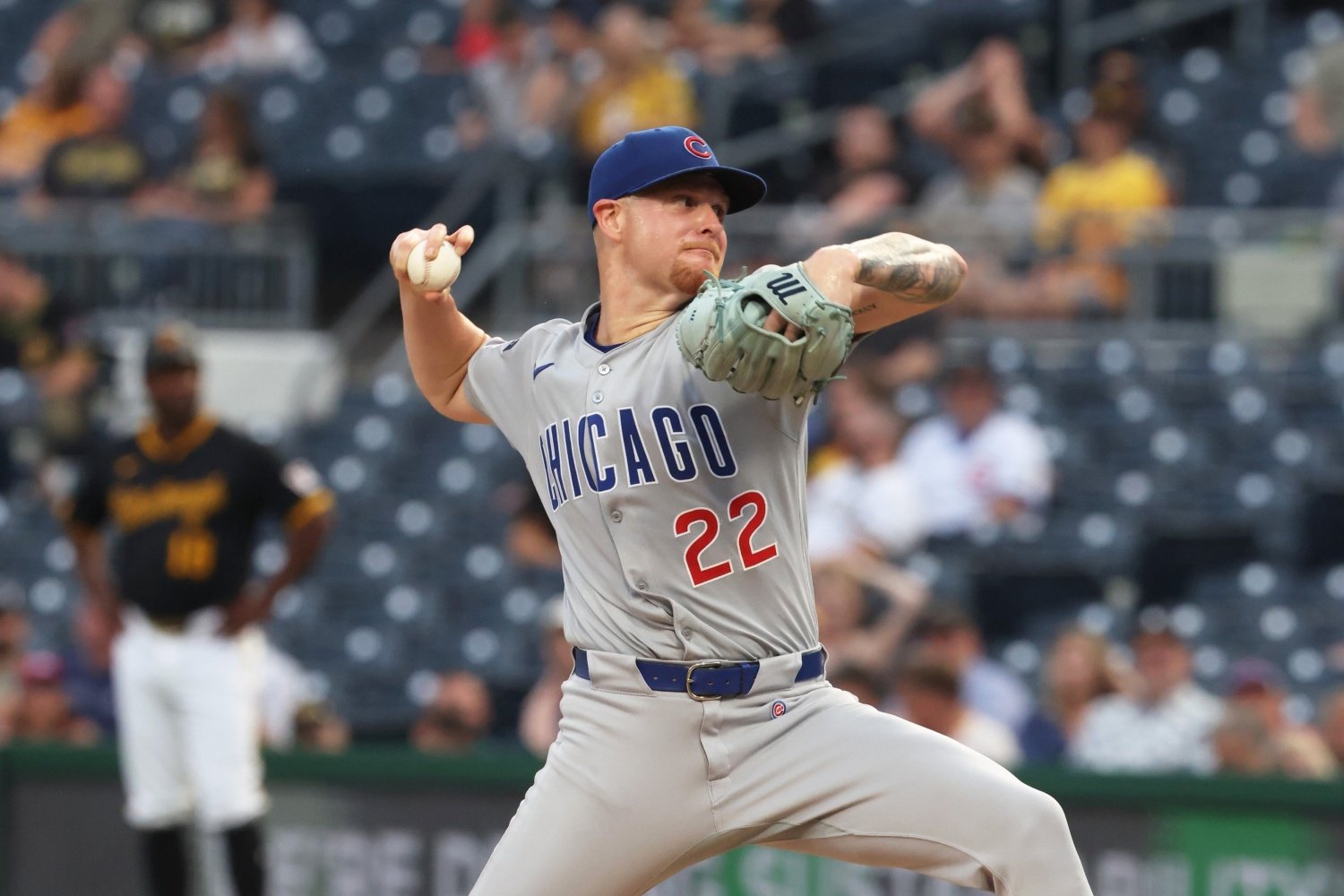 Depending on whom you asked, Cade Horton was in line to start either Game 1 or Game 2 of the upcoming Wild Card Series for the Chicago Cubs, who hope to be hosting that best-of-three set against the San Diego Padres. Horton has been the team's best starter over the last two months, as he's adjusted to major-league hitters and tapped into the full value of his ever-deepening arsenal and plus command. Unfortunately, now, he's out of those plans entirely—and his season is likely over. The Cubs placed Horton on the 15-day injured list Saturday, with a fractured rib. The righty was lifted after three innings of his start against the Mets early this week, dealing with soreness in his side; subsequent imaging revealed the crack and attempts to work through the pain proved fruitless. The team recalled lefty Jordan Wicks to take Horton's place on the active roster for the weekend, although Wicks is not likely to make the playoff roster. That pretty well locks Matthew Boyd and Shota Imanaga into the first two spots in the team's rotation for the series against San Diego. They make good matchups for the Padres lineup, anyway, especially after San Diego lost right-hitting outfielder Ramón Laureano at least through the Wild Card Series. However, Horton feels like a major loss, because his starts had become such spectacles of efficiency and sheer attitude on the mound. Making do without him will mean stretching the team's pitching depth in some new and creative ways. Craig Counsell will still have options. The starters who look best-positioned to pick up the slack where Horton leaves room are Jameson Taillon and Colin Rea, but the team can (and will) also turn to both Javier Assad and Michael Soroka to make multi-inning appearances, if their run into October goes long enough. That quartet will try to buttress Boyd and Imanaga and form a bridge to the back end of the bullpen, where lefties Caleb Thielbar, Drew Pomeranz and Taylor Rogers will counterbalance righties Brad Keller, Daniel Palencia and Andrew Kittredge. All 12 pitchers are now likely to make the Wild Card roster. It's a relatively deep corps, though a few of them will only be trusted to pitch in perfect matchups or when the situation affords some margin for error. Horton could return if the team advances, especially if they make it as far as the NLCS. However, there are a lot of hard wins to earn between here and there, and Horton has run into this wall (figurative or literal) after throwing 147 innings between Triple-A Iowa and the majors. That's more than twice as many as he threw in 2024. If he can get right, the team will try to bring him back in some role, but it's no longer reasonable even to dream of a full-fledged starting Horton at any point in October. He'll be a minor contributor, if he's a contributor at all. The team also has Aaron Civale, Ben Brown, Porter Hodge, Eli Morgan and Wicks on hand as potential backfillers for the spot being vacated by Horton, but for various reasons, it's unlikely any of them will pitch much in the playoffs. It says a lot that it was Wicks, and not Brown or Hodge, whom the team called up when Horton officially went down. The wild card (so to speak) is righty pitching prospect Jaxon Wiggins, one of the hurlers to whom the team cleaved tightly during negotiations for potential rotation upgrades in July. There's a seasonal workload issue to consider with Wiggins, too, and it's overwhelmingly unlikely that he'll make the playoff roster, but he's the one hurler with an arm of similar promise to Horton's, whom the team might call up in the stead of their star rookie. For now, the club's focus will remain on winning Saturday to sew up home-field advantage over San Diego. If they can do that, they'll worry about how to get the requisite outs to advance. Then, they'll worry about how to overcome the Brewers. At this time of year, it's all about short-term planning. Unfortunately, that means leaving the summer of Cade Horton behind, and facing a fall without him. Fortunately, though, the team has the privilege of worrying about this, as opposed to turning its gaze toward the winter, as most teams have already begun to do.
 -
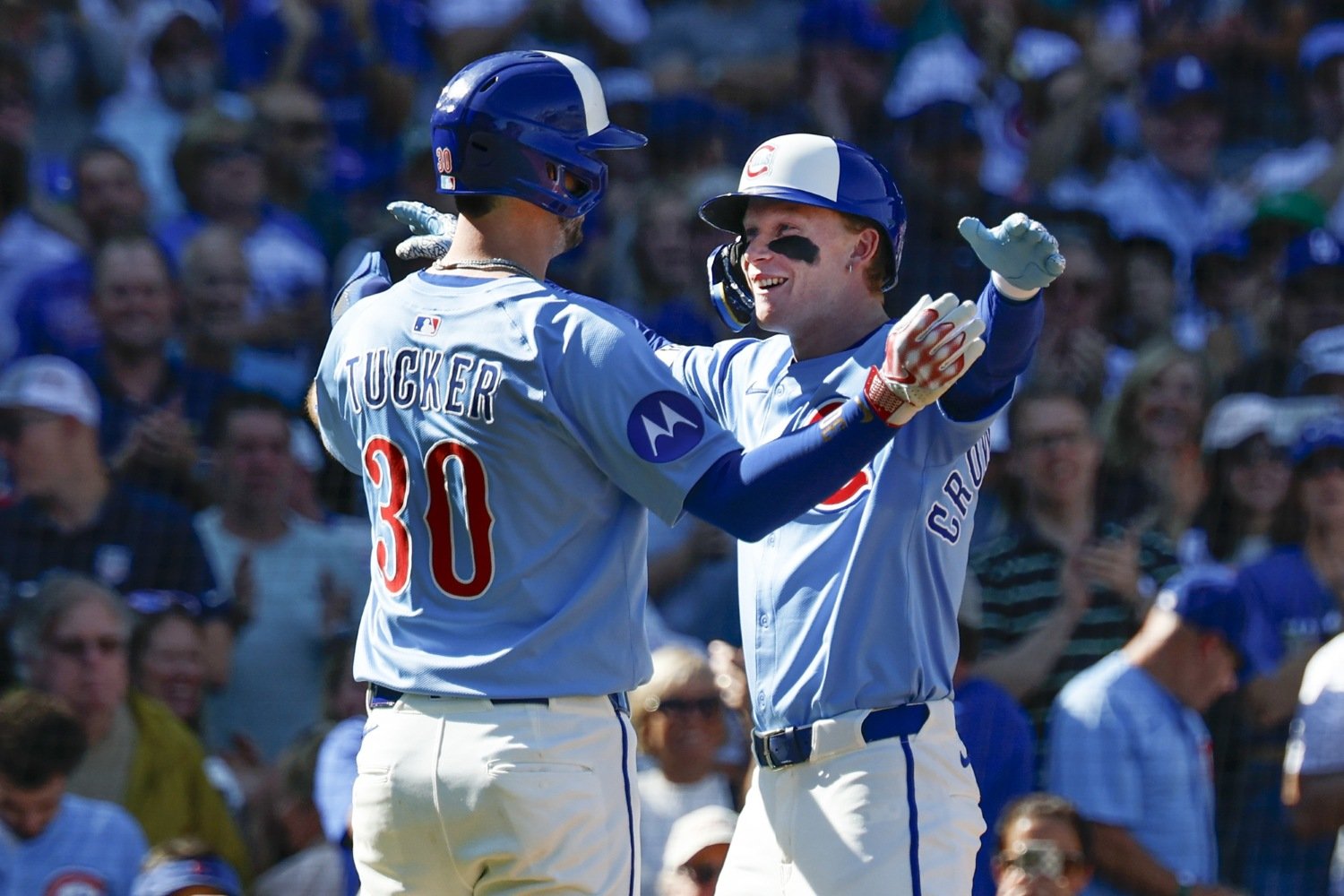 The Cubs' dominant first half was fueled, more than anything else, by the shockingly potent offensive quartet of Kyle Tucker, Pete Crow-Armstrong, Seiya Suzuki and Michael Busch. Those four players hit the All-Star break with a combined 79 doubles, 14 triples, 86 home runs, 233 runs scored, 263 RBIs, and 55 stolen bases in 62 attempts. They were having a season for the ages—the kind of combined offensive onslaught teams only dream of. The second half has been like waking up from that dream. Busch has hit into wretched luck, but he's the one who's managed to stay afloat the best. Suzuki went over six weeks between home runs, as his approach went haywire and he lost touch with his power. Tucker played through a nagging finger injury and slumped badly. then lost most of September to a calf strain just as he began to rediscover his productivity. Crow-Armstrong's overly aggressive approach caught up to him in hideous fashion, and he's been one of the worst hitters in the entire league since the break. The team has had to cobble together rallies and win with improved pitching of late, when they've won at all. Offensively, they've been carried by Ian Happ and Nico Hoerner, rather than the guys who looked to have them on track toward a 900-run season at one early juncture. Just in time for the postseason, though, there's some evidence that the first-half boppers are back. Suzuki's two homers Thursday night were followed, Friday, by a huge grand slam, turning a likely win into a laugher in the seventh inning. That wasn't even one of the two best bits of news of the day, though. First on that list was Tucker returning to the lineup, and having a single and a walk in his first game. Only time will tell how well he's held onto his shored-up swing mechanics or his timing, and he didn't run well at all when he put the ball in play; he might have to serve as the designated hitter even when the playoffs start. However, he looked enough like himself to inspire some real hope. Second on the leaderboard for best news of the day was Crow-Armstrong hitting his 30th home run of the season, a few innings before Suzuki did the same. It looks as though Crow-Armstrong owns Cardinals righty Miles Mikolas, who started Friday and looked as cooked as he has for most of the last two seasons. He won't get to face anyone who offers him such easy succor during the playoffs, no matter whom the Cubs play or when, but that swing looked more like the first-half version of Crow-Armstrong than anything else he's done in the last two months. The ball was gone the moment it left his bat, and you could see the surge of confidence in his bearing and the relief in his face when he got back to the dugout. He's been slowly—very slowly—coming around for the last fortnight, after a month and a half of failure so profound that it was very hard to justify his place in the lineup, even with his elite defense taken into account. He has four extra-base hits in his last 11 games. If he can be even that kind of occasional threat in the playoffs, the Cubs will gladly take it. There were three cherries on the sundae of the game, too. Busch cracked a double, hit a home run and drew a walk. The most games with multiple extra-base hits and a walk by any player this season is six, a leadership shared by Freddie Freeman, Aaron Judge and James Wood. Busch only has four of them, but if it feels like more than that, it's because three have come in the last 11 days. Again, October won't offer pitching as hittable as the Cardinals' hurlers from Friday, but Busch has gotten very hot, very quickly. Take over a game with multiple extra-base hits and draw a walk in any game in the postseason, and you never buy a drink in town again. That's looking more and more possible for Busch. The bullpen trio of Andrew Kittredge, Daniel Palencia and Brad Keller (in that order) got what might well be their last tune-up appearances of the regular season, and they were stellar. The group combined for six strikeouts and zero walks, and allowed just two hits in three innings of work. Palencia's return from a concerning shoulder injury is a huge deal; the bullpen feels miles deeper with him in it. Colin Rea was spectacular, for the second outing in a row. The Cardinals lineup doesn't pose an especially stern test right now, with Willson Contreras and Masyn Winn out for the year with injuries, but Rea sliced through them for 5 2/3 innings of two-hit ball, walking one and fanning seven. Late in August, as he began what has been an annual late-season swoon, I wrote that it was hard to feel good about Rea and his prospects of helping the team in the playoffs. To the immense credit of both Rea and Cubs coaches, he's back on track, having addressed a mechanical issue that emanated from fatigue and was eroding his ability to command his stuff. This version of Rea looks likely to slot into the playoff roster, although he might have to wait and see if they make it past the Padres to get his shot. The Padres came back from an early deficit to beat the Diamondbacks, so the Cubs still need either a win or a San Diego loss this weekend to claim home-field advantage for the Wild Card Series. Winning their own game was huge, though, especially because of the way it unfolded. They also got Moisés Ballesteros into the game as a pinch-hitter, once the rout was on, and had him finish the game at first base—a possible preview of how he could fit into the postseason roster picture, should the team need the DH spot to revert to Suzuki and/or Tucker. Chicago just needs one more good day at Wrigley this weekend to ensure some fun ones this week, and in the particulars of their romp Friday, they gave fans ample reasons to expect just that.
 -
Image courtesy of © Kamil Krzaczynski-Imagn Images The Cubs' dominant first half was fueled, more than anything else, by the shockingly potent offensive quartet of Kyle Tucker, Pete Crow-Armstrong, Seiya Suzuki and Michael Busch. Those four players hit the All-Star break with a combined 79 doubles, 14 triples, 86 home runs, 233 runs scored, 263 RBIs, and 55 stolen bases in 62 attempts. They were having a season for the ages—the kind of combined offensive onslaught teams only dream of. The second half has been like waking up from that dream. Busch has hit into wretched luck, but he's the one who's managed to stay afloat the best. Suzuki went over six weeks between home runs, as his approach went haywire and he lost touch with his power. Tucker played through a nagging finger injury and slumped badly. then lost most of September to a calf strain just as he began to rediscover his productivity. Crow-Armstrong's overly aggressive approach caught up to him in hideous fashion, and he's been one of the worst hitters in the entire league since the break. The team has had to cobble together rallies and win with improved pitching of late, when they've won at all. Offensively, they've been carried by Ian Happ and Nico Hoerner, rather than the guys who looked to have them on track toward a 900-run season at one early juncture. Just in time for the postseason, though, there's some evidence that the first-half boppers are back. Suzuki's two homers Thursday night were followed, Friday, by a huge grand slam, turning a likely win into a laugher in the seventh inning. That wasn't even one of the two best bits of news of the day, though. First on that list was Tucker returning to the lineup, and having a single and a walk in his first game. Only time will tell how well he's held onto his shored-up swing mechanics or his timing, and he didn't run well at all when he put the ball in play; he might have to serve as the designated hitter even when the playoffs start. However, he looked enough like himself to inspire some real hope. Second on the leaderboard for best news of the day was Crow-Armstrong hitting his 30th home run of the season, a few innings before Suzuki did the same. It looks as though Crow-Armstrong owns Cardinals righty Miles Mikolas, who started Friday and looked as cooked as he has for most of the last two seasons. He won't get to face anyone who offers him such easy succor during the playoffs, no matter whom the Cubs play or when, but that swing looked more like the first-half version of Crow-Armstrong than anything else he's done in the last two months. The ball was gone the moment it left his bat, and you could see the surge of confidence in his bearing and the relief in his face when he got back to the dugout. He's been slowly—very slowly—coming around for the last fortnight, after a month and a half of failure so profound that it was very hard to justify his place in the lineup, even with his elite defense taken into account. He has four extra-base hits in his last 11 games. If he can be even that kind of occasional threat in the playoffs, the Cubs will gladly take it. There were three cherries on the sundae of the game, too. Busch cracked a double, hit a home run and drew a walk. The most games with multiple extra-base hits and a walk by any player this season is six, a leadership shared by Freddie Freeman, Aaron Judge and James Wood. Busch only has four of them, but if it feels like more than that, it's because three have come in the last 11 days. Again, October won't offer pitching as hittable as the Cardinals' hurlers from Friday, but Busch has gotten very hot, very quickly. Take over a game with multiple extra-base hits and draw a walk in any game in the postseason, and you never buy a drink in town again. That's looking more and more possible for Busch. The bullpen trio of Andrew Kittredge, Daniel Palencia and Brad Keller (in that order) got what might well be their last tune-up appearances of the regular season, and they were stellar. The group combined for six strikeouts and zero walks, and allowed just two hits in three innings of work. Palencia's return from a concerning shoulder injury is a huge deal; the bullpen feels miles deeper with him in it. Colin Rea was spectacular, for the second outing in a row. The Cardinals lineup doesn't pose an especially stern test right now, with Willson Contreras and Masyn Winn out for the year with injuries, but Rea sliced through them for 5 2/3 innings of two-hit ball, walking one and fanning seven. Late in August, as he began what has been an annual late-season swoon, I wrote that it was hard to feel good about Rea and his prospects of helping the team in the playoffs. To the immense credit of both Rea and Cubs coaches, he's back on track, having addressed a mechanical issue that emanated from fatigue and was eroding his ability to command his stuff. This version of Rea looks likely to slot into the playoff roster, although he might have to wait and see if they make it past the Padres to get his shot. The Padres came back from an early deficit to beat the Diamondbacks, so the Cubs still need either a win or a San Diego loss this weekend to claim home-field advantage for the Wild Card Series. Winning their own game was huge, though, especially because of the way it unfolded. They also got Moisés Ballesteros into the game as a pinch-hitter, once the rout was on, and had him finish the game at first base—a possible preview of how he could fit into the postseason roster picture, should the team need the DH spot to revert to Suzuki and/or Tucker. Chicago just needs one more good day at Wrigley this weekend to ensure some fun ones this week, and in the particulars of their romp Friday, they gave fans ample reasons to expect just that. View full article
-
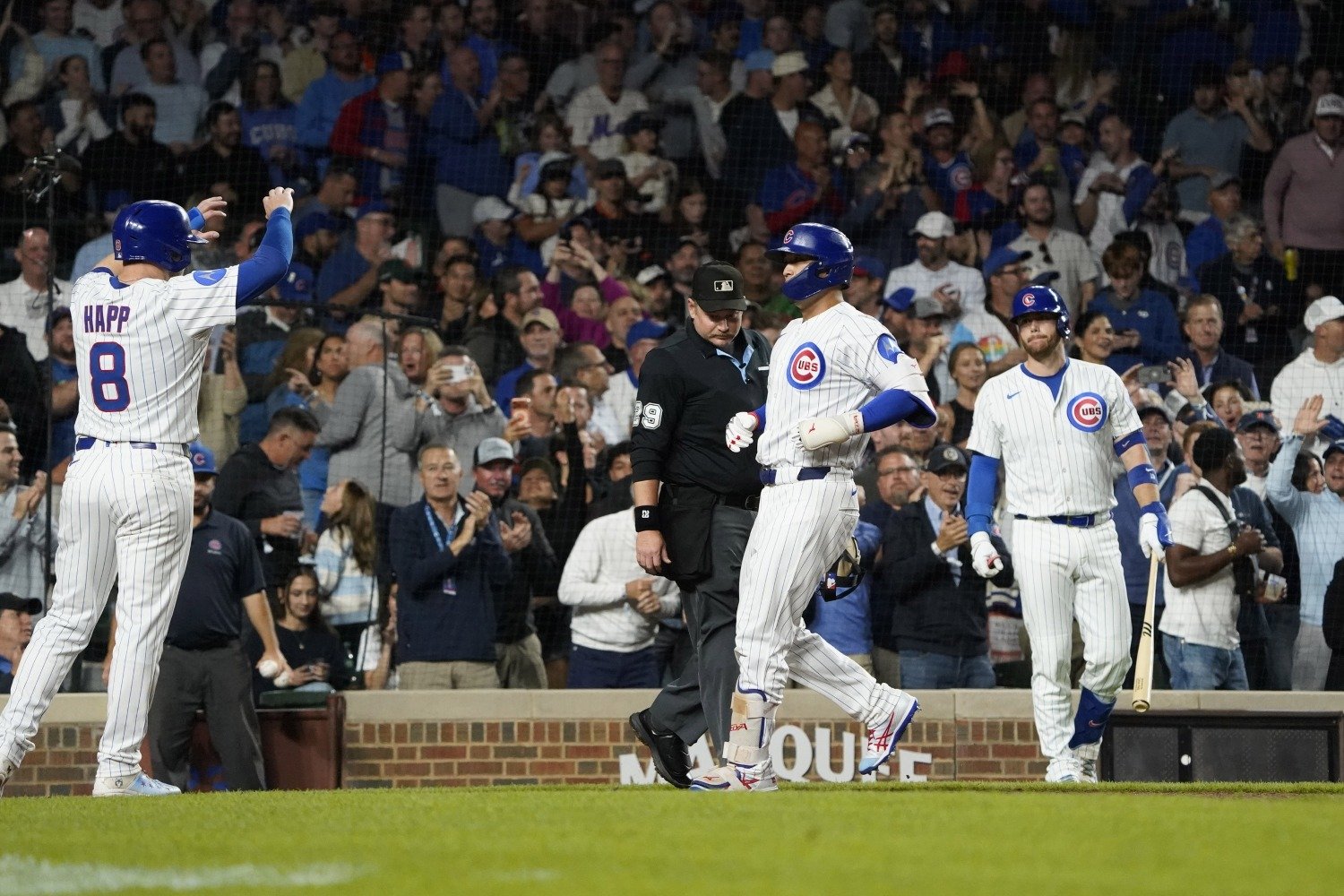 Earlier this week, we talked at length about the specific problems that have led to a massive power outage by Seiya Suzuki in the second half of this season. Suzuki entered Thursday night's game against the Mets having homered just twice since the All-Star break, on July 18 and August 6. As hopeless as the numbers have looked, though, I closed that piece on a relatively hopeful note: Suzuki made that look prescient Thursday night, just in time. In the preantepenultimate game of the regular season, he took the date to which you needed to go back to get two of his home runs in frame from July 18 to September 25, slamming two different pitches from rookie hurler Nolan McLean into the left-field bleachers. Suzuki has been on time all along, but he locked in on two offerings that McLean left in locations he didn't intend, and finally found the elusive match between his best range of swing planes and the pitch shape and location he was getting. The Mets still won the game, 8-5. Other than Suzuki's two bombs (responsible, together, for four runs), the only Cubs offense came courtesy of Dansby Swanson, who hit a homer of his own as he quietly surges through the tape to finish the season. (Quietly, Swanson has gotten to 50 extra-base hits for the second time in his three-year Cubs tenure, and is slugging a robust .442 since August 1.) Shota Imanaga gave up all eight runs, as Craig Counsell tried to get him through a ragged start and ensure that he had the appropriate number of pitches to carry into his down time before pitching in the Wild Card Series. That's bad news, and Imanaga doesn't seem to be at the top of his game. On balance, though, Suzuki's power outburst is more important than anything else that happened. If he can get hot—and particularly if he can be a reliable source of power in the middle of the batting order—the Cubs are suddenly fine, after all. There's been considerable anxiety lately, and it's not unfounded, but the team just needed one or two players to turn around their negative trends in order to take some real optimism into the postseason. This week, they've gotten: Daniel Palencia back onto a big-league mound, with his shoulder and his stuff looking intact; Matthew Boyd pitching more like his first-half self; and Suzuki breaking out of his long power slump with a thunderclap of a game. Friday, they hope to reactivate Kyle Tucker and slot him in as the designated hitter, giving the lineup its greatest sense of completeness in several weeks. One luxury the team afforded itself with their hot start was to meander a bit through September, and although this would have been a costly period of healing and consolidation if the Brewers hadn't run away and hid with the division weeks ago, the real damage done by even four months of uneven play has been relatively limited. The team is walking a highwire into the weekend, needing to keep people healthy, get good news on Cade Horton's prognosis, and see (more) good things from Suzuki and/or Tucker. Already, though, they've had a better week than their record would indicate.
 -
Image courtesy of © David Banks-Imagn Images Earlier this week, we talked at length about the specific problems that have led to a massive power outage by Seiya Suzuki in the second half of this season. Suzuki entered Thursday night's game against the Mets having homered just twice since the All-Star break, on July 18 and August 6. As hopeless as the numbers have looked, though, I closed that piece on a relatively hopeful note: Suzuki made that look prescient Thursday night, just in time. In the preantepenultimate game of the regular season, he took the date to which you needed to go back to get two of his home runs in frame from July 18 to September 25, slamming two different pitches from rookie hurler Nolan McLean into the left-field bleachers. Suzuki has been on time all along, but he locked in on two offerings that McLean left in locations he didn't intend, and finally found the elusive match between his best range of swing planes and the pitch shape and location he was getting. The Mets still won the game, 8-5. Other than Suzuki's two bombs (responsible, together, for four runs), the only Cubs offense came courtesy of Dansby Swanson, who hit a homer of his own as he quietly surges through the tape to finish the season. (Quietly, Swanson has gotten to 50 extra-base hits for the second time in his three-year Cubs tenure, and is slugging a robust .442 since August 1.) Shota Imanaga gave up all eight runs, as Craig Counsell tried to get him through a ragged start and ensure that he had the appropriate number of pitches to carry into his down time before pitching in the Wild Card Series. That's bad news, and Imanaga doesn't seem to be at the top of his game. On balance, though, Suzuki's power outburst is more important than anything else that happened. If he can get hot—and particularly if he can be a reliable source of power in the middle of the batting order—the Cubs are suddenly fine, after all. There's been considerable anxiety lately, and it's not unfounded, but the team just needed one or two players to turn around their negative trends in order to take some real optimism into the postseason. This week, they've gotten: Daniel Palencia back onto a big-league mound, with his shoulder and his stuff looking intact; Matthew Boyd pitching more like his first-half self; and Suzuki breaking out of his long power slump with a thunderclap of a game. Friday, they hope to reactivate Kyle Tucker and slot him in as the designated hitter, giving the lineup its greatest sense of completeness in several weeks. One luxury the team afforded itself with their hot start was to meander a bit through September, and although this would have been a costly period of healing and consolidation if the Brewers hadn't run away and hid with the division weeks ago, the real damage done by even four months of uneven play has been relatively limited. The team is walking a highwire into the weekend, needing to keep people healthy, get good news on Cade Horton's prognosis, and see (more) good things from Suzuki and/or Tucker. Already, though, they've had a better week than their record would indicate. View full article
-
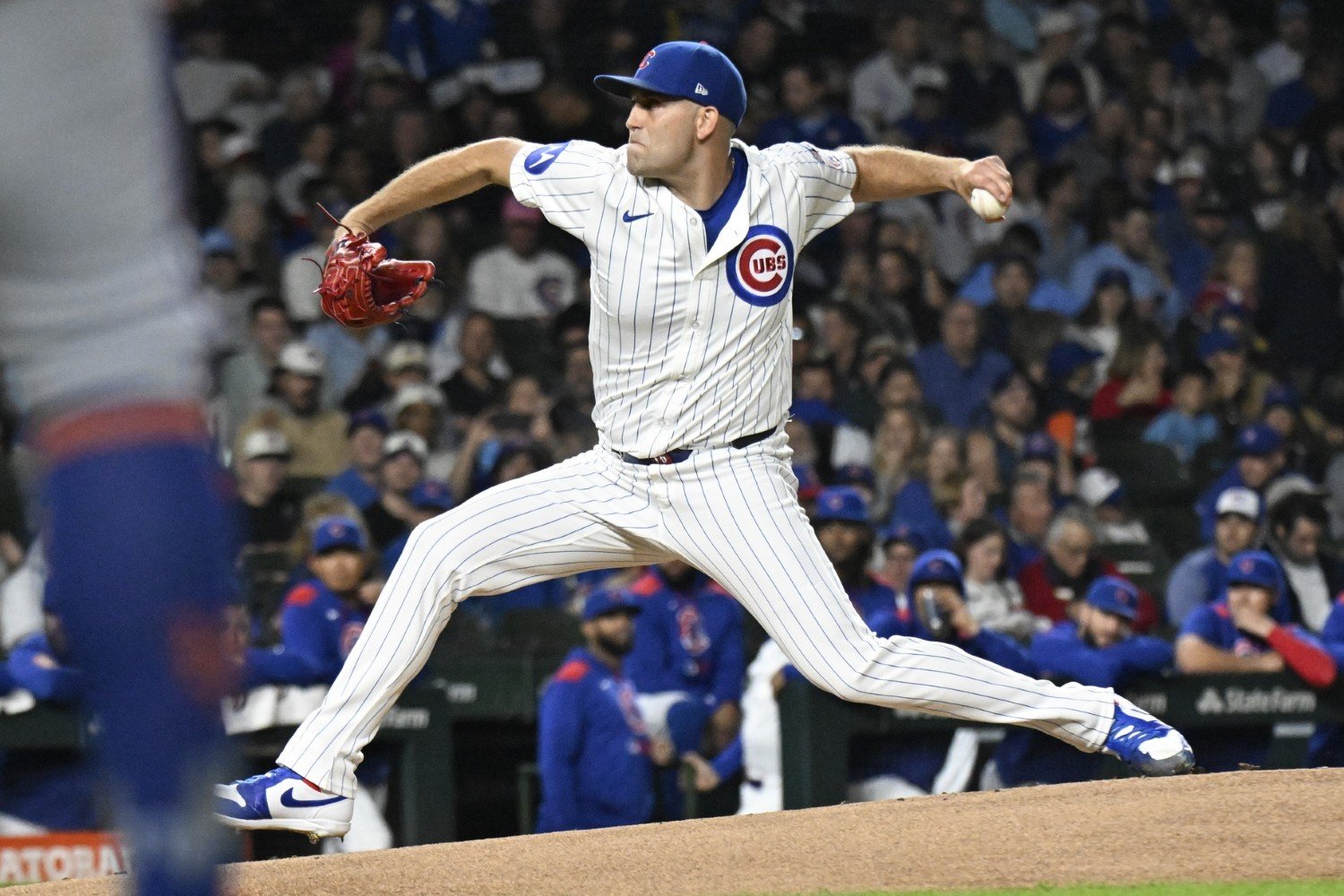 The Cubs' magic number dwindled to 2 Wednesday, as the Brewers beat the Padres in San Diego and Chicago took care of business against the visiting Mets. Arguably, though, there were even more important numbers to be found in the box score, where Matthew Boyd turned in an encouraging start: 5 1/3 innings, two hits, two runs, one walk and three strikeouts. It wasn't the kind of gem to which Cubs fans became accustomed from Boyd early in the year, but it was just the second time in his last seven outings that he pitched well. Boyd's raw stuff was solid, but not exceptional. He induced 12 whiffs, though he only got those three punchouts, and that roughly matches his recent trends: a limited ability to overpower anyone, and a need to locate well if he hoped to succeed. The difference was that, by and large, he did locate well. Here's his pitch chart from a recent rough outing, against the Rays on Sept. 6. The problems there were a lot of sliders left up and a lot of big, arm-side misses with the changeup. When Boyd struggles to execute those pitches, his fastball becomes much more hittable, too. On Wednesday night, he was much better at keeping the ball down, and he filled up the zone with the change. To get swings and misses in two-strike counts, he'd need to be better at leaving the zone, especially with the changeup. That strike-to-ball change that made him devastating in many starts early in the season still isn't there for him. By being able to throw the change in the zone, though, he forced Mets hitters to swing a bit less aggressively against his fastball, and he worked ahead in the count more often. This version of Boyd won't be the frontman for the team's playoff rotation, but he's perfectly viable as a Game 2 or Game 3 starter. Ideally, of course, he'd get back to executing both that changeup and the slider a bit more consistently, and regain the ability to miss bats at a high level. Until late July, he did so. He threw his slider for strikes, letting his sidearm slot on the pitch make hitters balk and freeze. He kept them off the fastball with that slider, then left the zone to get strikeouts with the changeup. Recently, he's had a harder time elevating the heater, but he's especially struggled to land the secondary offerings in the zone. If he can get back just a portion of his command on those pitches in the postseason, he figures to be quite good. That was the case Wednesday night, giving fans renewed hope that it might be true next week, as well.
 -
Image courtesy of © Matt Marton-Imagn Images The Cubs' magic number dwindled to 2 Wednesday, as the Brewers beat the Padres in San Diego and Chicago took care of business against the visiting Mets. Arguably, though, there were even more important numbers to be found in the box score, where Matthew Boyd turned in an encouraging start: 5 1/3 innings, two hits, two runs, one walk and three strikeouts. It wasn't the kind of gem to which Cubs fans became accustomed from Boyd early in the year, but it was just the second time in his last seven outings that he pitched well. Boyd's raw stuff was solid, but not exceptional. He induced 12 whiffs, though he only got those three punchouts, and that roughly matches his recent trends: a limited ability to overpower anyone, and a need to locate well if he hoped to succeed. The difference was that, by and large, he did locate well. Here's his pitch chart from a recent rough outing, against the Rays on Sept. 6. The problems there were a lot of sliders left up and a lot of big, arm-side misses with the changeup. When Boyd struggles to execute those pitches, his fastball becomes much more hittable, too. On Wednesday night, he was much better at keeping the ball down, and he filled up the zone with the change. To get swings and misses in two-strike counts, he'd need to be better at leaving the zone, especially with the changeup. That strike-to-ball change that made him devastating in many starts early in the season still isn't there for him. By being able to throw the change in the zone, though, he forced Mets hitters to swing a bit less aggressively against his fastball, and he worked ahead in the count more often. This version of Boyd won't be the frontman for the team's playoff rotation, but he's perfectly viable as a Game 2 or Game 3 starter. Ideally, of course, he'd get back to executing both that changeup and the slider a bit more consistently, and regain the ability to miss bats at a high level. Until late July, he did so. He threw his slider for strikes, letting his sidearm slot on the pitch make hitters balk and freeze. He kept them off the fastball with that slider, then left the zone to get strikeouts with the changeup. Recently, he's had a harder time elevating the heater, but he's especially struggled to land the secondary offerings in the zone. If he can get back just a portion of his command on those pitches in the postseason, he figures to be quite good. That was the case Wednesday night, giving fans renewed hope that it might be true next week, as well. View full article
-
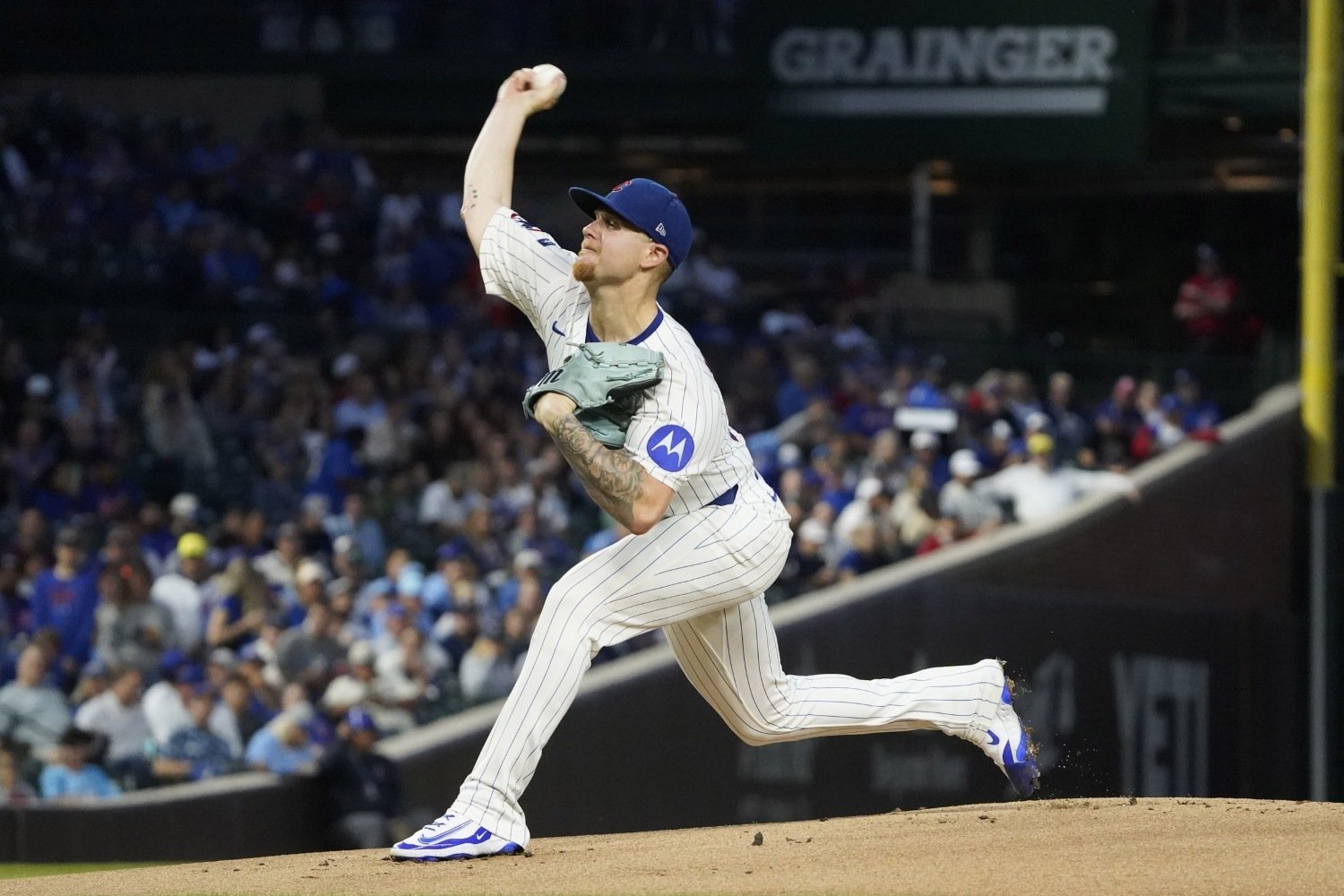 It's been one week since a sweep in Pittsburgh gave the Cubs their 88th win and the certainty that their season would not end after Game 162. That was a very good day. There were smiles, hugs, encomiums and hopeful proclamations about the things that still laid ahead of the team. They partied. The team felt that it had achieved something important, and they expected to do more. Six full days have passed since, and the Cubs are 0-for-6 in their quest for a good one. They've gotten only mixed signals on their key injured players. It sounds like Daniel Palencia and Kyle Tucker will be activated some time this week, giving them each a chance to show that they're healthy before the playoffs begin Tuesday, but it's hard to sustain much confidence in either. Matthew Boyd and Shota Imanaga are healthy, but for fans (and club personnel) hoping to see them each stabilize and have strong starts after some recent struggles, there's been no succor. Nico Hoerner continues to rake, and Ian Happ is doing fine, but Michael Busch can't get untracked. Pete Crow-Armstrong and Seiya Suzuki remain, largely, lost at the plate. Dansby Swanson's defensive decline is a minor but real point of concern. Rookie third baseman Matt Shaw is distracted and unproductive. On Tuesday, even Cade Horton—the most relentless source of positive feeling for this club since mid-July and the team's presumptive Game 1 starting pitcher next week—left his final start of the season after just three innings, dealing with tightness in his back. He hadn't pitched since the previous Tuesday, and has dealt with illness between appearances. It's possible the balky back was purely the result of the cough and shortness of breath he's dealt with for days, but that's only reassuring in a medium-term sort of way. If a week between starts didn't have him fresh and fired up for this one, who's to say whether another week will be enough to make him ready for that playoff appearance? All of these things are real sources of concern, if your focus has swung toward the postseason, but in a funny way, you could compartmentalize them and worry less about them, if only the team would win a game or two. A successful regular season, for this team, was never going to be 162 games long. It was going to be 90 wins long. The difference matters. The grind gets rougher when the time between wins stretches out and a team has to endure the difficulty of playing the game without the reward of coming out on top. Even amid huge questions about how the team will score enough runs or find enough quality starting pitching to play deep into next month, if they'd won one or two of the last five games, it would be easy to shrug and fix one's vision on the horizon. Instead, after being within four positive results of securing home-field advantage for the Wild Card Series at the end of Friday's games, the Cubs have lived four long days without seeing that magic number come down at all. They have five games left; the Padres have four. If six of those nine games break against Chicago, it will be San Diego who hosts the nearly inevitable series between the two next week. That would be a bleak outcome. It'd be hard to imagine the stumbling Cubs coming out of it with two wins in the best-of-three. This isn't supposed to happen to this team. Their identity has been tied up in this not happening. Jed Hoyer built one of the oldest rosters in baseball and paid Craig Counsell the (then-)highest salary among big-league managers to prevent lapses of focus and streaks of poor play at just the wrong times. Until Sunday, the team hadn't lost four games in a row all year. Now, they've lost five in a row. They have Justin Turner and Carlos Santana so that this doesn't happen. They have Drew Pomeranz and Caleb Thielbar and Boyd so that it doesn't happen. They paid Swanson $177 million and Jameson Taillon $68 million so that it doesn't happen. Now, they're dealing with a multi-system failure on the eve of the test on which their whole season will be judged. Some of that is bad luck. Even more of it is just fluff. They could, after all, lose out and still make the postseason, and sneak past the Padres and heat up against the Brewers and make everyone forget that they finished the regular campaign in a two-week fugue state. One benefit of having so many superannuated veterans around is that they can counsel everyone not to worry much about the natural letdown after a team achieves something they fought so long and fiercely to win. The playoffs are not fully random, as some would have you believe, but they're highly susceptible to randomness, and one form of that randomness is the sudden turn from slump to streak for an entire team. It happens. On the other hand, this doesn't feel like a normal set of hiccups. They don't have a hot power hitter for the middle of their lineup right now. They've been batting Carson Kelly cleanup again lately; Kelly has a .669 OPS since Miguel Amaya got hurt in late May. The vaunted bullpen is hitting some very normal and generally non-worrisome speed bumps, but their offense, their starting rotation and even their fielding are faltering, exposing the degree to which they've been overly reliant on that pen as they've treaded water over two-thirds of the season. After a June 3 win in Washington, the Cubs were 38-22, and had outscored their opponents by a whopping 102 runs. Since then, they're 50-47, and have outscored opponents by just 21 runs. They heated up impressively from mid-August through that clinching win in Pittsburgh, but a week's worth of lousy play since only underscores that this once mightily consistent team has gotten streaky lately—and not always in a good way. When you visit their Baseball Reference page, it's hard not to be awed by the collection of full-season numbers listed, especially in the WAR column—but that hides some ugly truths about this team. Tucker, Crow-Armstrong, Kelly, Busch, Suzuki, and Boyd all were so good in the first half that their stat lines disguise how poorly they've played of late. Shaw, Imanaga, Swanson, Happ and Palencia took over to carry the team for various segments as the first group sagged, but three of those five now look to be slumping or hurt. Only Hoerner and Horton seem to be fully in stride at just the right time, and now, even that is in doubt. There's an imbalance here that you can see in the full-season data (for instance, Cubs position players are far and away the best in baseball in Runs Above Average, according to Baseball Reference, but Cubs pitchers are fourth-worst in the league), but which gets distorted along the way. Really, the imbalance isn't between any two units or based on any kind of matchup, but between the first- and second-half Cubs, or the Cubs before and after Tucker began to be diminished by nagging injuries. At some point, this was a great baseball team—or it had the chance to be, anyway. At this moment, this is barely even a good baseball team. That's unfortunate, because this is the moment that matters. As much as they might have felt they had while the champagne was spraying, the 2025 Cubs haven't yet achieved anything important. Winning one's division validates a season, on its own, but crawling across the finish line as a Wild Card entrant—a distant second to the Brewers, again, in the Central—doesn't do so. The Cubs failed to deliver a regular season that makes their season a success, so they have to prove themselves by winning at least one series in the playoffs. Their veterans need to communicate that. Their young players need to internalize that, and work hard to make themselves ready for the task ahead. The coaching and medical staffs need to make clear choices about the viability of their injured would-be contributors and plunge forward, with or without them. To shake off the fug of a post-celebration losing streak and a lousy off-field storyline and a star going outside the organization for treatment of what seems like a routine injury, the team needs to get back to winning. They need to go out and win a few of their final five games, get that home-field advantage, and remind themselves what it feels like to be the best version of themselves. Unfortunately, that won't guarantee anything. They're still an old team, and it still feels like the best version of them might be unreachable—lost in the magic of that first-half power binge from Crow-Armstrong or the impossible efficiency of first-half Boyd. Still, it feels important. Five games from the regular season's conclusion, this team needs something to vault them forward and give them a running start on the postseason—or they might be beaten before they get up to speed.
 -
Image courtesy of © David Banks-Imagn Images It's been one week since a sweep in Pittsburgh gave the Cubs their 88th win and the certainty that their season would not end after Game 162. That was a very good day. There were smiles, hugs, encomiums and hopeful proclamations about the things that still laid ahead of the team. They partied. The team felt that it had achieved something important, and they expected to do more. Six full days have passed since, and the Cubs are 0-for-6 in their quest for a good one. They've gotten only mixed signals on their key injured players. It sounds like Daniel Palencia and Kyle Tucker will be activated some time this week, giving them each a chance to show that they're healthy before the playoffs begin Tuesday, but it's hard to sustain much confidence in either. Matthew Boyd and Shota Imanaga are healthy, but for fans (and club personnel) hoping to see them each stabilize and have strong starts after some recent struggles, there's been no succor. Nico Hoerner continues to rake, and Ian Happ is doing fine, but Michael Busch can't get untracked. Pete Crow-Armstrong and Seiya Suzuki remain, largely, lost at the plate. Dansby Swanson's defensive decline is a minor but real point of concern. Rookie third baseman Matt Shaw is distracted and unproductive. On Tuesday, even Cade Horton—the most relentless source of positive feeling for this club since mid-July and the team's presumptive Game 1 starting pitcher next week—left his final start of the season after just three innings, dealing with tightness in his back. He hadn't pitched since the previous Tuesday, and has dealt with illness between appearances. It's possible the balky back was purely the result of the cough and shortness of breath he's dealt with for days, but that's only reassuring in a medium-term sort of way. If a week between starts didn't have him fresh and fired up for this one, who's to say whether another week will be enough to make him ready for that playoff appearance? All of these things are real sources of concern, if your focus has swung toward the postseason, but in a funny way, you could compartmentalize them and worry less about them, if only the team would win a game or two. A successful regular season, for this team, was never going to be 162 games long. It was going to be 90 wins long. The difference matters. The grind gets rougher when the time between wins stretches out and a team has to endure the difficulty of playing the game without the reward of coming out on top. Even amid huge questions about how the team will score enough runs or find enough quality starting pitching to play deep into next month, if they'd won one or two of the last five games, it would be easy to shrug and fix one's vision on the horizon. Instead, after being within four positive results of securing home-field advantage for the Wild Card Series at the end of Friday's games, the Cubs have lived four long days without seeing that magic number come down at all. They have five games left; the Padres have four. If six of those nine games break against Chicago, it will be San Diego who hosts the nearly inevitable series between the two next week. That would be a bleak outcome. It'd be hard to imagine the stumbling Cubs coming out of it with two wins in the best-of-three. This isn't supposed to happen to this team. Their identity has been tied up in this not happening. Jed Hoyer built one of the oldest rosters in baseball and paid Craig Counsell the (then-)highest salary among big-league managers to prevent lapses of focus and streaks of poor play at just the wrong times. Until Sunday, the team hadn't lost four games in a row all year. Now, they've lost five in a row. They have Justin Turner and Carlos Santana so that this doesn't happen. They have Drew Pomeranz and Caleb Thielbar and Boyd so that it doesn't happen. They paid Swanson $177 million and Jameson Taillon $68 million so that it doesn't happen. Now, they're dealing with a multi-system failure on the eve of the test on which their whole season will be judged. Some of that is bad luck. Even more of it is just fluff. They could, after all, lose out and still make the postseason, and sneak past the Padres and heat up against the Brewers and make everyone forget that they finished the regular campaign in a two-week fugue state. One benefit of having so many superannuated veterans around is that they can counsel everyone not to worry much about the natural letdown after a team achieves something they fought so long and fiercely to win. The playoffs are not fully random, as some would have you believe, but they're highly susceptible to randomness, and one form of that randomness is the sudden turn from slump to streak for an entire team. It happens. On the other hand, this doesn't feel like a normal set of hiccups. They don't have a hot power hitter for the middle of their lineup right now. They've been batting Carson Kelly cleanup again lately; Kelly has a .669 OPS since Miguel Amaya got hurt in late May. The vaunted bullpen is hitting some very normal and generally non-worrisome speed bumps, but their offense, their starting rotation and even their fielding are faltering, exposing the degree to which they've been overly reliant on that pen as they've treaded water over two-thirds of the season. After a June 3 win in Washington, the Cubs were 38-22, and had outscored their opponents by a whopping 102 runs. Since then, they're 50-47, and have outscored opponents by just 21 runs. They heated up impressively from mid-August through that clinching win in Pittsburgh, but a week's worth of lousy play since only underscores that this once mightily consistent team has gotten streaky lately—and not always in a good way. When you visit their Baseball Reference page, it's hard not to be awed by the collection of full-season numbers listed, especially in the WAR column—but that hides some ugly truths about this team. Tucker, Crow-Armstrong, Kelly, Busch, Suzuki, and Boyd all were so good in the first half that their stat lines disguise how poorly they've played of late. Shaw, Imanaga, Swanson, Happ and Palencia took over to carry the team for various segments as the first group sagged, but three of those five now look to be slumping or hurt. Only Hoerner and Horton seem to be fully in stride at just the right time, and now, even that is in doubt. There's an imbalance here that you can see in the full-season data (for instance, Cubs position players are far and away the best in baseball in Runs Above Average, according to Baseball Reference, but Cubs pitchers are fourth-worst in the league), but which gets distorted along the way. Really, the imbalance isn't between any two units or based on any kind of matchup, but between the first- and second-half Cubs, or the Cubs before and after Tucker began to be diminished by nagging injuries. At some point, this was a great baseball team—or it had the chance to be, anyway. At this moment, this is barely even a good baseball team. That's unfortunate, because this is the moment that matters. As much as they might have felt they had while the champagne was spraying, the 2025 Cubs haven't yet achieved anything important. Winning one's division validates a season, on its own, but crawling across the finish line as a Wild Card entrant—a distant second to the Brewers, again, in the Central—doesn't do so. The Cubs failed to deliver a regular season that makes their season a success, so they have to prove themselves by winning at least one series in the playoffs. Their veterans need to communicate that. Their young players need to internalize that, and work hard to make themselves ready for the task ahead. The coaching and medical staffs need to make clear choices about the viability of their injured would-be contributors and plunge forward, with or without them. To shake off the fug of a post-celebration losing streak and a lousy off-field storyline and a star going outside the organization for treatment of what seems like a routine injury, the team needs to get back to winning. They need to go out and win a few of their final five games, get that home-field advantage, and remind themselves what it feels like to be the best version of themselves. Unfortunately, that won't guarantee anything. They're still an old team, and it still feels like the best version of them might be unreachable—lost in the magic of that first-half power binge from Crow-Armstrong or the impossible efficiency of first-half Boyd. Still, it feels important. Five games from the regular season's conclusion, this team needs something to vault them forward and give them a running start on the postseason—or they might be beaten before they get up to speed. View full article
-
Image courtesy of © Katie Stratman-Imagn Images The Chicago Cubs need something more than an offensive spark. Here and there, over the last month and change, they have found a spark, with Dansby Swanson, Ian Happ and Nico Hoerner passing in and out of hot streaks that have helped the team push across just enough runs to win some games and lock up a playoff spot. However, the heart-of-the-order hammer they need to consistently outslug teams has remained stubbornly absent. Kyle Tucker hasn't been able to fill that role (on any more than a brief, fleeting basis) since he suffered a finger injury at the start of June. Pete Crow-Armstrong is reaping what his approach has been sowing all along. Michael Busch has hit into bad luck for weeks. And Seiya Suzuki is, simply, seeing the wrong side of the ball. In the first half, Suzuki was the beneficiary and the benefactor of the team's offense. With Tucker and Crow-Armstrong often sandwiching him in the batting order, teams rarely had the chance to pitch to Suzuki with the bases clear, and he became adept at punishing hurlers who tried to attack him within the strike zone. Suzuki made some swing adjustments this year, especially focusing on going and getting the ball farther in front of his body. That helped him cover more of the strike zone with an authoritative stroke and generate more hard contact. Even with those tweaks on board, though, he's a high-ball hitter. That's always been true of him. His swing is fast, and it's fairly flat. He finds the ball with the barrel best when he's able to get his arms extended, rotate with his front shoulder, and sweep the bat fairly level through the hitting zone. Thus, he does best when he can see the ball up and maintain his bat speed through contact. When he has to make a late adjustment, it's usually a dip of the bat to reach a ball that's lower than he expected. The result is rarely impressive. In the first half, even as he sought to cover the bottom half of the zone a bit better than he had in the past, he was doing all of the above well. His earlier swing decisions led to more balls pulled in the air, and although he was giving up a bit of the ability to make contact and draw walks that he'd shown in the past, he more than made up for it with superb power output. In fact, that continued straight through into the early stages of the second half. Trouble began in the first week of August, or so. Suzuki hit his last home run on August 6. Through that game, he was batting .251/.318/.513, with 127 strikeouts, 45 walks and 55 extra-base hits in 478 plate appearances. Since then, he's hitting a paltry .213/.342/.254. In 149 trips to the plate, he's drawn an admirable 24 walks and only punched out 32 times, but he's also only mustered five extra-base hits—all of them doubles. It's an extraordinary (and, obviously, unacceptable) power outage from the team's best first-half power threat. Given that, you'd expect to see some significant differences in his key swing metrics. Those expectations, though, would be confounded. Segment Bat Speed (mph) Swing Length (ft) Swing Tilt Attack Angle Attack Direction Contact Pt. (in) Through 8/6 74 7.2 31° 7° 2° Pull 34.2 Since 74 7.2 32° 7° 2° Pull 33.9 You couldn't ask for much more consistency. Most hitters are pretty consistent in most of these regards, but it's not uncommon to see someone's swing speed vary widely within a season. In the cases of players who go through big changes in outcomes, you'll often see a concomitant shift in their attack angle or direction, which tell us a lot about timing. Suzuki is practically a clone from one sample to the other, but his production has gone from terrific to non-existent. His average exit velocity through August 6 was 92.6 miles per hour; it's plunged to 89.1 mph since then. As you might guess, his approach has changed a bit. In the first sample, he swung competitively at 59.7% of pitches within the zone, which is very patient, already. In the second, that rate is down to 57.0%, which walks over to the line between patience and passivity and does a lethal little tapdance on it. Even more tellingly, though, we can focus in on pitches low in the zone and near the top of it. Segment Swing Rate - Pitches Up Swing Rate - Pitches Down Through 8/6 63 43.3 Since 60.7 48.8 Aha. Now, we're onto something. See, when he's seeing the ball right, Suzuki swings more when the ball is elevated, and he's more willing to lay off the ball at the bottom of the zone—even if it's in the zone. He's made some adjustments to that approach over the years, to better handle the way big-league pitchers attack him and the way umpires call the zone when he takes his natural tack, but in broad strokes, it's still true. Crucially. this year, he got especially good at telling when the ball was going to stay up a bit. Here's an example of that very thing. As it happens, this is that last home run he hit, off the Reds' Andrew Abbott. QndvOVZfWGw0TUFRPT1fQUFnRVYxTUZBZ0FBQzFjR1V3QUhCd05UQUFOVEJRUUFWRlpXQUFkV0JnUlNWZ0Jm.mp4 If this is a bit sharper of a downer, Abbott probably gets Suzuki out, but note the way he's able to whip the bat through the zone. His hands get away from his body early, and as he recognizes the pitch, they're already in position to facilitate a flat flick through the ball. Compare that swing to this one, on a very similar breaking ball from the Pirates' Evan Sisk, last week. dnZiVldfWGw0TUFRPT1fVlZJSFhRWUdWd29BQ2dFSFVnQUhCZzVSQUFBRVZsRUFBRndNQmxCVEJnQlhDQXND.mp4 This is a great illustration of how hard hitting is, isn't it? You can't get two pitches that are much more alike, and you can't put much more similar swings on them. Yet, one ball streaked out of the park with a vapor trail, and the other (while well-struck) became a lazy fly ball. To understand why, let's look at one more swing, featuring a bit more of an exaggerated example of what's changed. ZU44TjZfWGw0TUFRPT1fQVZOUlVRSUNVUUVBQ1ZSV0J3QUhDQUZUQUZoVFVsUUFBVlpXVWdBRkJ3QlhBd29E.mp4 Suzuki is having a harder time anticipating the movement of pitches down in the zone lately. He's also, relatedly, having a harder time laying off them. He has great hand-eye coordination, so the well-honed, altered swing he's still putting on the ball is making late adjustments and generating contact, but he's not hitting it nearly as squarely. Maybe that has to do with a change in how pitchers are attacking him; maybe it's a matter of the grind doing its annual work and making it harder to maintain excellent discipline or plate vision. Either way, Suzuki is getting much less exit velocity out of the same swing speed, a product of more slightly misread pitches on which he's dipping late and catching the ball wrong. The good news, here, is that Suzuki is still generally on time in the box, and that his swing is physically intact. He needs to change something in his in-the-moment preparation, to see or anticipate the pitch better and catch it flush more consistently. That's no easy tweak, as the nearness of the first miss above shows. Hitting requires a high-speed precision that can sometimes feel superhuman. However, the change needed here is minute, and Suzuki might well be on the cusp of breaking out of this funk at just the right time, in a very big way. View full article
-
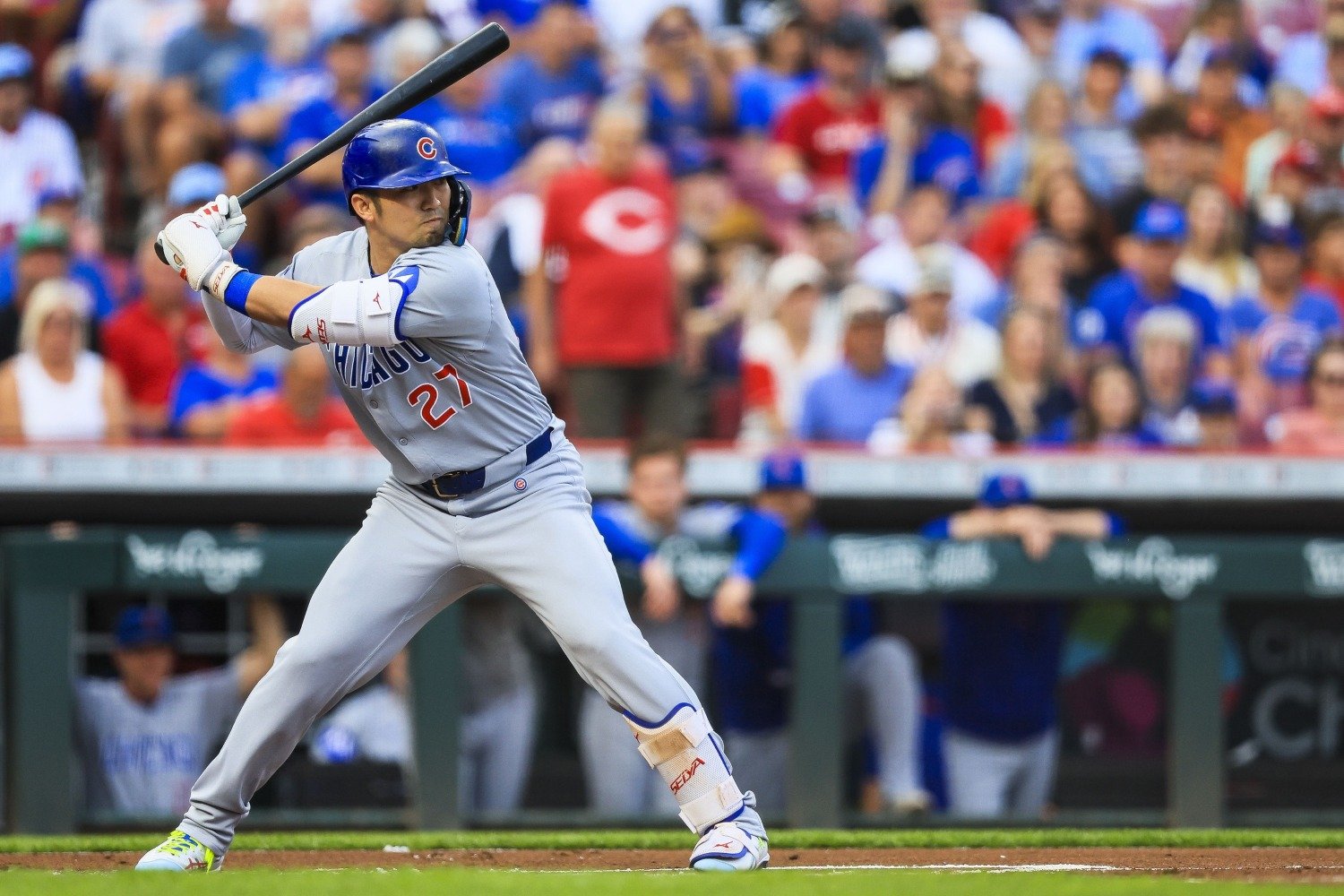 The Chicago Cubs need something more than an offensive spark. Here and there, over the last month and change, they have found a spark, with Dansby Swanson, Ian Happ and Nico Hoerner passing in and out of hot streaks that have helped the team push across just enough runs to win some games and lock up a playoff spot. However, the heart-of-the-order hammer they need to consistently outslug teams has remained stubbornly absent. Kyle Tucker hasn't been able to fill that role (on any more than a brief, fleeting basis) since he suffered a finger injury at the start of June. Pete Crow-Armstrong is reaping what his approach has been sowing all along. Michael Busch has hit into bad luck for weeks. And Seiya Suzuki is, simply, seeing the wrong side of the ball. In the first half, Suzuki was the beneficiary and the benefactor of the team's offense. With Tucker and Crow-Armstrong often sandwiching him in the batting order, teams rarely had the chance to pitch to Suzuki with the bases clear, and he became adept at punishing hurlers who tried to attack him within the strike zone. Suzuki made some swing adjustments this year, especially focusing on going and getting the ball farther in front of his body. That helped him cover more of the strike zone with an authoritative stroke and generate more hard contact. Even with those tweaks on board, though, he's a high-ball hitter. That's always been true of him. His swing is fast, and it's fairly flat. He finds the ball with the barrel best when he's able to get his arms extended, rotate with his front shoulder, and sweep the bat fairly level through the hitting zone. Thus, he does best when he can see the ball up and maintain his bat speed through contact. When he has to make a late adjustment, it's usually a dip of the bat to reach a ball that's lower than he expected. The result is rarely impressive. In the first half, even as he sought to cover the bottom half of the zone a bit better than he had in the past, he was doing all of the above well. His earlier swing decisions led to more balls pulled in the air, and although he was giving up a bit of the ability to make contact and draw walks that he'd shown in the past, he more than made up for it with superb power output. In fact, that continued straight through into the early stages of the second half. Trouble began in the first week of August, or so. Suzuki hit his last home run on August 6. Through that game, he was batting .251/.318/.513, with 127 strikeouts, 45 walks and 55 extra-base hits in 478 plate appearances. Since then, he's hitting a paltry .213/.342/.254. In 149 trips to the plate, he's drawn an admirable 24 walks and only punched out 32 times, but he's also only mustered five extra-base hits—all of them doubles. It's an extraordinary (and, obviously, unacceptable) power outage from the team's best first-half power threat. Given that, you'd expect to see some significant differences in his key swing metrics. Those expectations, though, would be confounded. Segment Bat Speed (mph) Swing Length (ft) Swing Tilt Attack Angle Attack Direction Contact Pt. (in) Through 8/6 74 7.2 31° 7° 2° Pull 34.2 Since 74 7.2 32° 7° 2° Pull 33.9 You couldn't ask for much more consistency. Most hitters are pretty consistent in most of these regards, but it's not uncommon to see someone's swing speed vary widely within a season. In the cases of players who go through big changes in outcomes, you'll often see a concomitant shift in their attack angle or direction, which tell us a lot about timing. Suzuki is practically a clone from one sample to the other, but his production has gone from terrific to non-existent. His average exit velocity through August 6 was 92.6 miles per hour; it's plunged to 89.1 mph since then. As you might guess, his approach has changed a bit. In the first sample, he swung competitively at 59.7% of pitches within the zone, which is very patient, already. In the second, that rate is down to 57.0%, which walks over to the line between patience and passivity and does a lethal little tapdance on it. Even more tellingly, though, we can focus in on pitches low in the zone and near the top of it. Segment Swing Rate - Pitches Up Swing Rate - Pitches Down Through 8/6 63 43.3 Since 60.7 48.8 Aha. Now, we're onto something. See, when he's seeing the ball right, Suzuki swings more when the ball is elevated, and he's more willing to lay off the ball at the bottom of the zone—even if it's in the zone. He's made some adjustments to that approach over the years, to better handle the way big-league pitchers attack him and the way umpires call the zone when he takes his natural tack, but in broad strokes, it's still true. Crucially. this year, he got especially good at telling when the ball was going to stay up a bit. Here's an example of that very thing. As it happens, this is that last home run he hit, off the Reds' Andrew Abbott. QndvOVZfWGw0TUFRPT1fQUFnRVYxTUZBZ0FBQzFjR1V3QUhCd05UQUFOVEJRUUFWRlpXQUFkV0JnUlNWZ0Jm.mp4 If this is a bit sharper of a downer, Abbott probably gets Suzuki out, but note the way he's able to whip the bat through the zone. His hands get away from his body early, and as he recognizes the pitch, they're already in position to facilitate a flat flick through the ball. Compare that swing to this one, on a very similar breaking ball from the Pirates' Evan Sisk, last week. dnZiVldfWGw0TUFRPT1fVlZJSFhRWUdWd29BQ2dFSFVnQUhCZzVSQUFBRVZsRUFBRndNQmxCVEJnQlhDQXND.mp4 This is a great illustration of how hard hitting is, isn't it? You can't get two pitches that are much more alike, and you can't put much more similar swings on them. Yet, one ball streaked out of the park with a vapor trail, and the other (while well-struck) became a lazy fly ball. To understand why, let's look at one more swing, featuring a bit more of an exaggerated example of what's changed. ZU44TjZfWGw0TUFRPT1fQVZOUlVRSUNVUUVBQ1ZSV0J3QUhDQUZUQUZoVFVsUUFBVlpXVWdBRkJ3QlhBd29E.mp4 Suzuki is having a harder time anticipating the movement of pitches down in the zone lately. He's also, relatedly, having a harder time laying off them. He has great hand-eye coordination, so the well-honed, altered swing he's still putting on the ball is making late adjustments and generating contact, but he's not hitting it nearly as squarely. Maybe that has to do with a change in how pitchers are attacking him; maybe it's a matter of the grind doing its annual work and making it harder to maintain excellent discipline or plate vision. Either way, Suzuki is getting much less exit velocity out of the same swing speed, a product of more slightly misread pitches on which he's dipping late and catching the ball wrong. The good news, here, is that Suzuki is still generally on time in the box, and that his swing is physically intact. He needs to change something in his in-the-moment preparation, to see or anticipate the pitch better and catch it flush more consistently. That's no easy tweak, as the nearness of the first miss above shows. Hitting requires a high-speed precision that can sometimes feel superhuman. However, the change needed here is minute, and Suzuki might well be on the cusp of breaking out of this funk at just the right time, in a very big way.
 -
Image courtesy of © Katie Stratman-Imagn Images For the first month of the second half, Matt Shaw's bat was almost carrying a limping Cubs lineup. Craig Counsell stubbornly resisted the temptation to move Shaw up to the middle of the batting order, but even though he was getting fewer plate appearances than any other regular, Shaw was a vital cog in the offense. Over 34 games from the start of the second half through August 24, he batted .298/.343/.691 in 102 plate appearances. He did it by leaning into an extreme approach, pulling the ball at an exceptional rate. With a flat bat path, Shaw's attack direction is changing faster than his attack angle when he reaches the contact point. His insight at the outset of the second half was that he could tap into his power by taking an aggressive, pull-focused approach and getting around the ball. However, he's taken that much too far. To see how, consider his production and his key swing metrics for the three major segments of his rookie campaign: First Half: 63 G, 232 PA, .198/.276/.280, 69.4 mph swing speed, 9° attack angle, 4° opposite-field attack direction July 18-August 24: 34 G, 102 PA, .298/.343/.691, 69.8 mph, 13° attack angle, 6° pull-field attack direction August 26-Present: 24 G, 84 PA, .200/.274/.293, 69.9 mph, 12° attack angle, 10° pull-field attack direction His average contact point in April and May was about 25 inches in front of his center of mass. In June and July, it moved out to about 30 inches. In August, it swept out past 35 inches. This month, his average contact point (sometimes hypothetical, as he's been swinging and missing much more often lately) is out to 37.8 inches in front of his body. Some hitters can have a modicum of success when contacting the ball that far out, and when their bat is swung about 10° around to their pull field by the time they make contact. Shaw, however, is not one of those players. He's too small to be reaching that far, and thus, being that early is only leading to lots of medium-strength, utterly unthreatening contact. You can see this visually, by locking in on the attack direction. Here's a rolling 75-swing average of his attack direction for the full season. This is a classic overbalancing. It's not uncommon from a rookie. Shaw has leaned too far in one direction; he's let success steer him into failure. He's gotten too attached to one idea at the plate; he needs to recalibrate and find a better balance. The Cubs' other key hitters are in similar states of confusion or disrepair. To go anywhere in October, they'll need Shaw to get back to what was working for him—but that means being open to yet another set of changes. He has to let the ball travel a bit more and open up the center of the diamond a bit. When he's been available, Shaw has been an asset in the field and on the bases, even during this prolonged slump. However, he can only deliver that value when he's good and trustworthy enough to be written into Counsell's lineup. The Cubs are running short on time to assess his utility to the team in the postseason. He showed some signs of returning to form during the team's road trip to Pittsburgh and Cincinnati, not only homering in one game against the Reds but squaring the ball up better in Wednesday's tilt against the Pirates. With Willi Castro available as an alternative, though, the team should evenly divide the duties at third base over their final six games. Castro has a .370 on-base percentage in September. He's not the same dynamic upside play as Shaw, but Shaw needs to prove he can get back on time in order to earn his place once the bunting is hung from the railings. So far, Shaw's summer spree looks a bit more like a hiccup than a sustainable improvement, at least for this year. He was incredibly productive, but that success is now sandwiched between long stretches of failure. View full article
-
 For the first month of the second half, Matt Shaw's bat was almost carrying a limping Cubs lineup. Craig Counsell stubbornly resisted the temptation to move Shaw up to the middle of the batting order, but even though he was getting fewer plate appearances than any other regular, Shaw was a vital cog in the offense. Over 34 games from the start of the second half through August 24, he batted .298/.343/.691 in 102 plate appearances. He did it by leaning into an extreme approach, pulling the ball at an exceptional rate. With a flat bat path, Shaw's attack direction is changing faster than his attack angle when he reaches the contact point. His insight at the outset of the second half was that he could tap into his power by taking an aggressive, pull-focused approach and getting around the ball. However, he's taken that much too far. To see how, consider his production and his key swing metrics for the three major segments of his rookie campaign: First Half: 63 G, 232 PA, .198/.276/.280, 69.4 mph swing speed, 9° attack angle, 4° opposite-field attack direction July 18-August 24: 34 G, 102 PA, .298/.343/.691, 69.8 mph, 13° attack angle, 6° pull-field attack direction August 26-Present: 24 G, 84 PA, .200/.274/.293, 69.9 mph, 12° attack angle, 10° pull-field attack direction His average contact point in April and May was about 25 inches in front of his center of mass. In June and July, it moved out to about 30 inches. In August, it swept out past 35 inches. This month, his average contact point (sometimes hypothetical, as he's been swinging and missing much more often lately) is out to 37.8 inches in front of his body. Some hitters can have a modicum of success when contacting the ball that far out, and when their bat is swung about 10° around to their pull field by the time they make contact. Shaw, however, is not one of those players. He's too small to be reaching that far, and thus, being that early is only leading to lots of medium-strength, utterly unthreatening contact. You can see this visually, by locking in on the attack direction. Here's a rolling 75-swing average of his attack direction for the full season. This is a classic overbalancing. It's not uncommon from a rookie. Shaw has leaned too far in one direction; he's let success steer him into failure. He's gotten too attached to one idea at the plate; he needs to recalibrate and find a better balance. The Cubs' other key hitters are in similar states of confusion or disrepair. To go anywhere in October, they'll need Shaw to get back to what was working for him—but that means being open to yet another set of changes. He has to let the ball travel a bit more and open up the center of the diamond a bit. When he's been available, Shaw has been an asset in the field and on the bases, even during this prolonged slump. However, he can only deliver that value when he's good and trustworthy enough to be written into Counsell's lineup. The Cubs are running short on time to assess his utility to the team in the postseason. He showed some signs of returning to form during the team's road trip to Pittsburgh and Cincinnati, not only homering in one game against the Reds but squaring the ball up better in Wednesday's tilt against the Pirates. With Willi Castro available as an alternative, though, the team should evenly divide the duties at third base over their final six games. Castro has a .370 on-base percentage in September. He's not the same dynamic upside play as Shaw, but Shaw needs to prove he can get back on time in order to earn his place once the bunting is hung from the railings. So far, Shaw's summer spree looks a bit more like a hiccup than a sustainable improvement, at least for this year. He was incredibly productive, but that success is now sandwiched between long stretches of failure.
 -
The problem with that, as I mentioned above, is the looming lockout. I don't think *anyone*, team or player, is feeling good about the matchup of interests between teams and players in free agency between 2026 and 2027. It's gonna be a mess—and unlike Correa or Bellinger, this would be Tucker playing his age-29 season and then plunging into that situation of extreme uncertainty ahead of age 30. I don't think it's likely AT ALL that he goes for that structure. Timing's just all wrong for it.
-
Kyle Tucker's Price Tag is Plunging, But Cubs Still Shouldn't Pay It
Matthew Trueblood posted an article in Cubs
 There was a movement, perhaps 20 or 30 years ago, to banish the notion of players being 'injury-prone' from discourse around baseball. It emanated, at least in part, from an admirable desire to thwart owners and front offices who sought to deflate players' earning power by slapping that label on them. There was also some reasonably well-founded doubt about where the lines are between actual trends and perceived ones, and about how well we can really know whether a given injury is part of a wider pattern or just a freak accident. The movement has actually been fairly successful. Everyone knows that certain pitchers will get hurt repeatedly, but when it comes to position players, most injuries now get treated as isolated incidents of bad luck. I wish that were true, but it isn't. Health is a skill. That's one of the more important truths about baseball, and about sport more specifically. Because it's a truth convenient only to trolls and billionaires, we've all tried to ignore or deny it. Nonetheless, it's so. Specifically, in fact, there are three aspects or elements of the skill of health: The ability to avoid major acute injuries (or mitigate them) with last-second adjustments ahead of collisions or smoother-than-average changes of speed or direction; The absence of an underlying physical limitation or a bad habit that will beget chronic/overuse injuries; and The ability to play well at less than 100%, and even considerably less than 100%. You don't want players trying to play through significant injuries, but it's utterly unrealistic—disconnected from the reality of playing high-level professional sports, and reflective of a failure to understand the demands thereof—to hope that a player will feel their best all year. Guys will pick up sore obliques, bruised kneecaps, and stiffness in their back. Most players play with some degree of meaningful discomfort for at least a third of the season, and playing your best baseball when your body is at far less than its best is an indispensable skill. Of the elements of baseball health I laid out there, you have to be good at at least two to be a championship-caliber player over the long haul—especially in your 30s. Even if you're not good at two of them, you can emerge as a superstar for a short time, because there are astoundingly talented players who can do extraordinary things at their very best. In your early and mid-20s, you're at your very best. Maybe you have a mechanical habit that will eventually lead to trouble, and maybe you're not as good at avoiding damaging collisions as would be ideal, but your body recovers exceptionally well and your physical talent is at its peak. You can work around things on one side of (say) 26 or 27, when most players have their peak seasons, that you can't work around in your late 20s or throughout your 30s. That's important to know, because Kyle Tucker has shown the talent to be a great player, but he'll turn 29 years old this offseason—and he doesn't pass the test laid out above. He doesn't have an obviously deleterious limitation or habit in the way he plays (aspect No. 2), so although his overall athleticism is a bit less than you might prefer, he clears the bar there. However, he doesn't avoid or mitigate acute injuries well, and he doesn't play nearly as well when he's carrying even a slight injury as other players do. Cubs fans have watched that all unfold this year, and surely, they're feeling a great deal of frustration—especially because it's a familiar issue. Tucker has what one might call the Kris Bryant Problem. Bryant was a great player, too, with the same uniquely thrilling combination of smooth swing, great baseball skill, and gawky athleticism Tucker has displayed throughout his career to date. Through the typical ballplayer's peak, both Tucker and Bryant were phenomenal players. Over time, though, each of them also started to show the cracks in their health skill profile. Bryant had one that Tucker doesn't, because he also didn't clear the second standard; his unique swing put tremendous strain on his front shoulder. That started to erode his performance especially quickly, as he tried to navigate the other injuries that crept in. Tucker doesn't do anything on the field that would eventually cause problems even if there were no one and nothing to run into on the field, the way Bryant's does. Still, he has plenty of trouble to deal with in items 1 and 3 on the above list. Awkward slides are commonplace; he doesn't move well in the small spaces around bases or when going into the wall to play fly balls in the outfield. Part of it is that he's so big (not just in terms of sheer size, but proportionally; he has long limbs and big hands and feet), in a way that makes one a good general athlete but not always a well-suited baseball athlete. Still, it's true. Tucker also made a significant change in swing plane and approach in 2024, which helped him unlock a great deal of power. However, it also led directly to the injury that ruined his final season in Houston. He swung faster and flatter than in the past and went after more pitches down and in. For any player, that leads to an increased likelihood of a hard foul ball off one's own leg. That very thing led to a fracture in his shin and sidelined him for half of last season. We've also seen him pick up bad bruises on similar foul balls this season. If Tucker were good at playing through dings of various kinds, that would be ok. Such players exist. In fact, there are lots of them. It's only a slight exaggeration to say that the players you think stay healthy every year are really just the ones who play best when hurt. Plenty of players would have avoided whatever damage Tucker did to his hand on that slide into second on June 1 (and on a couple of similar slides since), but more of them would simply be less diminished by that injury than he was. The calf strain that currently has him on the injured list is not fake or unimportant, but plenty of players throughout the league have strains in their calf, hamstring, quad, hip, oblique, shoulder or elsewhere right now, and are on the field, playing fine. This isn't about a lack of toughness or work ethic. It's not a moral failing. It might be more precise to say that health is an aspect of talent, rather than a skill; it takes some of the sting of implied criticism of players who lack it out of the air. Still, this is a hugely important variable for a team to consider, when building a roster each year but (even more so) when deciding how much they're willing to invest in a player for the long term. We've all seen how things have gone for Bryant since his late 20s. Starting at age 28, in 2020, he went into a steep decline. He had a good year in 2021, though even that one was down from his previous heights, but he has a 99 OPS+ over the last six seasons—during which time he's played in well under half of his teams' games. Tucker is likely to age better than that, but probably not all that much better. Despite the overheated talk in the spring, he was never in line for a payday akin to those of Juan Soto and Shohei Ohtani. He's not a unicorn, like Ohtani, and he's not 26, like Soto. He's not an especially multidimensional player, although he's certainly good enough to have a positive impact in each facet of the game when he is healthy. Soto's youth helped set him apart, but so did his durability. Ohtani has gotten hurt repeatedly while pitching, but when he's available, he can affect the game in a wider spectrum of ways than anyone in the history of the game. Tucker isn't like those two. After this compromised season, Tucker isn't even all that likely to make $400 million this winter. He could sign a deal with an exceptionally high annual value over a short term, with an opt-out after 2026, but the possibility of a lockout will make that harder for him and his agency to accept. He's more likely to go for the biggest long-term guarantee he can get, and that's likely to be something like 10 years and $360 million. That's not an unimaginable expenditure, in the modern game, even for the Ricketts family. The Cubs, though, should steer clear. Some guys have the knack for staying healthy or playing effectively when they're not; some don't. The world is cruel that way. We can wish Tucker belonged to the first group all we want, but he doesn't. Chicago can get a useful extra draft pick by letting him sign elsewhere, and the money some other team spends on him will turn out to be better spent in other ways. Jed Hoyer needs to be aggressive this winter, but it shouldn't take the form of locking up Tucker for the long term. That would be a more expensive version of the mistake the Rockies made when they signed Bryant after 2021.
 -
Image courtesy of © Ron Chenoy-Imagn Images There was a movement, perhaps 20 or 30 years ago, to banish the notion of players being 'injury-prone' from discourse around baseball. It emanated, at least in part, from an admirable desire to thwart owners and front offices who sought to deflate players' earning power by slapping that label on them. There was also some reasonably well-founded doubt about where the lines are between actual trends and perceived ones, and about how well we can really know whether a given injury is part of a wider pattern or just a freak accident. The movement has actually been fairly successful. Everyone knows that certain pitchers will get hurt repeatedly, but when it comes to position players, most injuries now get treated as isolated incidents of bad luck. I wish that were true, but it isn't. Health is a skill. That's one of the more important truths about baseball, and about sport more specifically. Because it's a truth convenient only to trolls and billionaires, we've all tried to ignore or deny it. Nonetheless, it's so. Specifically, in fact, there are three aspects or elements of the skill of health: The ability to avoid major acute injuries (or mitigate them) with last-second adjustments ahead of collisions or smoother-than-average changes of speed or direction; The absence of an underlying physical limitation or a bad habit that will beget chronic/overuse injuries; and The ability to play well at less than 100%, and even considerably less than 100%. You don't want players trying to play through significant injuries, but it's utterly unrealistic—disconnected from the reality of playing high-level professional sports, and reflective of a failure to understand the demands thereof—to hope that a player will feel their best all year. Guys will pick up sore obliques, bruised kneecaps, and stiffness in their back. Most players play with some degree of meaningful discomfort for at least a third of the season, and playing your best baseball when your body is at far less than its best is an indispensable skill. Of the elements of baseball health I laid out there, you have to be good at at least two to be a championship-caliber player over the long haul—especially in your 30s. Even if you're not good at two of them, you can emerge as a superstar for a short time, because there are astoundingly talented players who can do extraordinary things at their very best. In your early and mid-20s, you're at your very best. Maybe you have a mechanical habit that will eventually lead to trouble, and maybe you're not as good at avoiding damaging collisions as would be ideal, but your body recovers exceptionally well and your physical talent is at its peak. You can work around things on one side of (say) 26 or 27, when most players have their peak seasons, that you can't work around in your late 20s or throughout your 30s. That's important to know, because Kyle Tucker has shown the talent to be a great player, but he'll turn 29 years old this offseason—and he doesn't pass the test laid out above. He doesn't have an obviously deleterious limitation or habit in the way he plays (aspect No. 2), so although his overall athleticism is a bit less than you might prefer, he clears the bar there. However, he doesn't avoid or mitigate acute injuries well, and he doesn't play nearly as well when he's carrying even a slight injury as other players do. Cubs fans have watched that all unfold this year, and surely, they're feeling a great deal of frustration—especially because it's a familiar issue. Tucker has what one might call the Kris Bryant Problem. Bryant was a great player, too, with the same uniquely thrilling combination of smooth swing, great baseball skill, and gawky athleticism Tucker has displayed throughout his career to date. Through the typical ballplayer's peak, both Tucker and Bryant were phenomenal players. Over time, though, each of them also started to show the cracks in their health skill profile. Bryant had one that Tucker doesn't, because he also didn't clear the second standard; his unique swing put tremendous strain on his front shoulder. That started to erode his performance especially quickly, as he tried to navigate the other injuries that crept in. Tucker doesn't do anything on the field that would eventually cause problems even if there were no one and nothing to run into on the field, the way Bryant's does. Still, he has plenty of trouble to deal with in items 1 and 3 on the above list. Awkward slides are commonplace; he doesn't move well in the small spaces around bases or when going into the wall to play fly balls in the outfield. Part of it is that he's so big (not just in terms of sheer size, but proportionally; he has long limbs and big hands and feet), in a way that makes one a good general athlete but not always a well-suited baseball athlete. Still, it's true. Tucker also made a significant change in swing plane and approach in 2024, which helped him unlock a great deal of power. However, it also led directly to the injury that ruined his final season in Houston. He swung faster and flatter than in the past and went after more pitches down and in. For any player, that leads to an increased likelihood of a hard foul ball off one's own leg. That very thing led to a fracture in his shin and sidelined him for half of last season. We've also seen him pick up bad bruises on similar foul balls this season. If Tucker were good at playing through dings of various kinds, that would be ok. Such players exist. In fact, there are lots of them. It's only a slight exaggeration to say that the players you think stay healthy every year are really just the ones who play best when hurt. Plenty of players would have avoided whatever damage Tucker did to his hand on that slide into second on June 1 (and on a couple of similar slides since), but more of them would simply be less diminished by that injury than he was. The calf strain that currently has him on the injured list is not fake or unimportant, but plenty of players throughout the league have strains in their calf, hamstring, quad, hip, oblique, shoulder or elsewhere right now, and are on the field, playing fine. This isn't about a lack of toughness or work ethic. It's not a moral failing. It might be more precise to say that health is an aspect of talent, rather than a skill; it takes some of the sting of implied criticism of players who lack it out of the air. Still, this is a hugely important variable for a team to consider, when building a roster each year but (even more so) when deciding how much they're willing to invest in a player for the long term. We've all seen how things have gone for Bryant since his late 20s. Starting at age 28, in 2020, he went into a steep decline. He had a good year in 2021, though even that one was down from his previous heights, but he has a 99 OPS+ over the last six seasons—during which time he's played in well under half of his teams' games. Tucker is likely to age better than that, but probably not all that much better. Despite the overheated talk in the spring, he was never in line for a payday akin to those of Juan Soto and Shohei Ohtani. He's not a unicorn, like Ohtani, and he's not 26, like Soto. He's not an especially multidimensional player, although he's certainly good enough to have a positive impact in each facet of the game when he is healthy. Soto's youth helped set him apart, but so did his durability. Ohtani has gotten hurt repeatedly while pitching, but when he's available, he can affect the game in a wider spectrum of ways than anyone in the history of the game. Tucker isn't like those two. After this compromised season, Tucker isn't even all that likely to make $400 million this winter. He could sign a deal with an exceptionally high annual value over a short term, with an opt-out after 2026, but the possibility of a lockout will make that harder for him and his agency to accept. He's more likely to go for the biggest long-term guarantee he can get, and that's likely to be something like 10 years and $360 million. That's not an unimaginable expenditure, in the modern game, even for the Ricketts family. The Cubs, though, should steer clear. Some guys have the knack for staying healthy or playing effectively when they're not; some don't. The world is cruel that way. We can wish Tucker belonged to the first group all we want, but he doesn't. Chicago can get a useful extra draft pick by letting him sign elsewhere, and the money some other team spends on him will turn out to be better spent in other ways. Jed Hoyer needs to be aggressive this winter, but it shouldn't take the form of locking up Tucker for the long term. That would be a more expensive version of the mistake the Rockies made when they signed Bryant after 2021. View full article
-
Image courtesy of © Matt Marton-Imagn Images To some extent, Andrew Kittredge is your standard-issue 2025 relief pitcher. He's big and hirsute and a sinker-slider guy. Specifically, before the Cubs dealt for him at the end of July, he was a "95-and-a-slider" guy, which is the get-in cost for a modern high-leverage arm. Everyone throws 95 and has a slider. What makes you special? Historically, Kittredge's answer to that question has been control. He hasn't often stood out from the crowd, in truth, but in his best years (2021, 2024), he's stayed healthy enough to be a reliable arm; walked very few batters; kept the ball in the park; and missed just enough bats to earn late-inning looks. He's been good more often than he's been great, and hurt more often than he's been good, but he's got 95 and a slider and the ability to locate each fairly well. Once the Cubs got hold of him, though, everything about Kittredge glowed up a bit. Ok, he's still beardy and old-looking, but in terms of performance, there's been a tangible change. While with the Orioles, this year, his sinker averaged 94.9 miles per hour, and his slider sat at 88.8. Since coming to the Cubs, the sinker is up to 95.7—and the slider is sizzling even more, relatively speaking, at 89.9. A slider that hard is a true out pitch. Assuming it still has some movement (and his movement numbers are essentially unchanged from one place to the other), a slider at 90 makes you stand out from the crowd in a big way. It makes a huge difference to add a tick to both one's fastball and one's slider. That's why, on the whole, Stuff+ likes Kittredge's arsenal better since he changed laundry. Stuff+ Pitch Type Team Sinker Slider Four-Seamer Orioles 100 102 89 Cubs 104 107 93 It might be tempting to think that that, alone, explains why Kittredge has been so good with the Cubs thus far. He has been tremendous, with a 2.89 ERA, 0.9 Win Probability Added (WPA), 37.7% strikeout rate and 4.3% walk rate in 69 batters faced. But is that just because he's throwing harder, and a slider plays up that much once you crank it into the 90s? No. Location+ Pitch Type Team Sinker Slider Four-Seamer Orioles 91 109 117 Cubs 115 122 112 Although the extra velocity he's found does matter, it's where he's throwing it that has turned Kittredge into the Cubs' latest super-weapon in relief. Since the deadline, 417 pitchers have thrown at least 10 innings in the majors. Kittredge has the sixth-best Location+ in that group, and of the five ahead of him, only one—emerging stud Reid Detmers, converted to the pen this year after flaming out as a starter with the Angels—has a better Stuff+ than Kittredge's. If you're looking for the combination of sheer nastiness and pinpoint location, Kittredge is where you're most likely to find it this October. That assumes, of course, that he can keep this up. To determine whether he can, we had better get some sense of how he's done it. So, first of all, here's where he threw his sinker before the trade, and after it. Notice, here, that he was a one-plan man when it came to the sinker in Baltimore. He tried to throw it, almost exclusively, to the third-base side of home plate. That makes plenty of sense, because his sinker is more of a runner than a true bowling-ball offering. It has heavy action at the bottom of the zone, but it's easier for him to run it sideways than to sink it all that much. With the Cubs, as you can see, there's a big blob of red in the middle of the plate. That's because Kittredge is embracing a more bifurcated plan of attack with the pitch, based on handedness. If I were to split these locations out by handedness (I don't want to oversaturate you with these images, so just imagine, with me), you'd see a lot of his sinkers in the heart of the zone to righties, while they mostly cluster in the lower, outer corner to lefties. To understand fully why that's important, we'll circle back shortly. Let's talk sliders. Between these two pairs of images, one theme that jumps out is how much better Kittredge is keeping the ball down since coming to the Cubs. The slider is just never far above the knees now, whereas it wandered up into a liftable area of the zone more with Baltimore. He's also driving the sinker into the lower reaches of the zone more often since the trade. As I already mentioned, though, that's not a result of a big change in movement data on the pitch. Nor has he materially changed his arm slot or release angle. It's time to talk about how the hurler's two main pitches interact with one another. (He also throws a four-seamer, and he toyed with a splitter earlier this year, but he's basically sinker-slider; we're going to put our focus there.) While with Baltimore, Kittredge had a very traditional plan for attacking righties. The slider started in the middle of the plate and spun down and away from the batter; the sinker started in the same place and bore down and in on them. As we discussed, the sinker didn't always turn down as well as it veered right, but it still worked toward that inner third. The slider would twist toward the low-and-away space, though not always quite get there. The Cubs' innovation with Kittredge has been to have him start everything away from the righties, instead of starting in the middle of anything. Given all the run on that sinker, starting it around the middle of the plate often meant he was losing it off the dish, and batters would be too busy dodging the pitch to swing at it, so it often went for a ball. Meanwhile, his slider is so hard and tight a pitch that it wouldn't always get as low or as away as he wanted. In an attempt to create a tunnel that maximized deception for the hitter, he was trying to get them thinking 'swing' every time, but the ball wasn't always going where it actually needed to go. By aiming at the lower, outer quadrant to righties, he's now ending up with a lot of sinkers that have white on both sides of them. That sounds dangerous, but half the time, the batter gives up on that pitch and takes it for an embarrassingly "hittable" called strike. The other half the time, they're trying to contend with a pitch sitting 96 and running hard toward them; they're not finding the barrel with it. Meanwhile, the slider is dipping out of the zone more often, but he's set the hitter up to be defensive about the zone, and they're chasing it at a good rate. Because of the mental starting point for the pitch, even a slight miss isn't going to get him hurt at all. To lefties, the story is a bit different. Kittredge's plan with them was to throw that sinker on the outer part, but also to start the slider far away from them and nip at the backdoor corner. That's pitching scared, and the Cubs have convinced him to abandon it. The sinker still goes to that outer edge, but starts in the middle of the plate. The slider, meanwhile, is dipping more toward them, and just below the zone. Kittredge's location plan for his stuff to righties while in Baltimore has essentially become his plan to lefties with Chicago, although he's getting everything down just a tiny bit more. To righties, meanwhile, he's devised this whole new way to use the same pitch shapes and interactions. Daniel Palencia will get some rehab work with Triple-A Iowa this weekend. Brad Keller remains an impressive specimen and at least a co-closer in Palencia's absence. As Kittredge has settled into his role with the Cubs, though, he's made a strong case to become the relief ace of this team as it heads into the postseason. His presence gives their bullpen the depth to seriously ponder a deep run into October. Ryan Pressly failed, but the team still found a right-handed graybeard who can anchor their pen with plus stuff and a lot of veteran savvy. View full article