.jpg.900f6d1bc80a5a156f3ba09ea0e4b3d7.jpg)

Jason Ross
-
Posts
8,153 -
Joined
-
Last visited
-
Days Won
74
Content Type
Profiles
Joomla Posts 1
Chicago Cubs Videos
Chicago Cubs Free Agent & Trade Rumors, Notes, & Tidbits
2026 Chicago Cubs Top Prospects Ranking
News
2023 Chicago Cubs Draft Picks
Guides & Resources
2024 Chicago Cubs Draft Picks
The Chicago Cubs Players Project
2025 Chicago Cubs Draft Pick Tracker
2026 Chicago Cubs Draft Tracker: Picks & Bonuses
Blogs
Events
Forums
Store
Gallery
Everything posted by Jason Ross
-
Transactions page on the official site lists it as Kevin headed to Iowa. Which surprised me a bit! But I guess he's a better runner and a bit more versatile. So small quibbles.
-
-
The Cubs are buyers: who are your three trade targets?
Jason Ross replied to Brock Beauchamp's topic in Chicago Cubs Talk
It takes two sides to dance. Notice how no trades of consequences across the league have been completed? By this logic, all 30 teams are perfectly fine with their situation and no team is looking to sell anyone or improve. We're at the leadup to the deadline where players like Aaron Civale and Seth Halvorsen are available for okay prices but many teams have to be pushed off their position until they get closer to August 3rd. The Cubs won't trade for Skubal, and they might not pay top-dollar, but I'd be surprised if they didn't make a few trades to improve the team. -
Just completed year-15 and headed onto 16. I'm around 50% of the way to retirement age in Kentucky. And honestly? It's not too bad. Teenagers are...finicky. But once you realize that the opinion and validation of a 13-year-old isn't what I need, it becomes a lot easier to let their jackassery roll off your back. "Oh? You don't want to write a paragraph? Bummer, dude. Does sound like a you problem, however."
-
Didn't think you were. Just explaining my rationale! Especially in the summer when I don't have 125 teenagers spouting whatever the newest brainrot is at me, I've got nothing else to do at 8am than explain my thought process on xERA or xFIP. It's either that or watch some trashy 26 year old movie where they send Val Kilmer and Tom Sizemore to Mars that I know my wife doesn't want to watch when she's around.
-
First off an 8 point difference in wOBA to xwOBA is entirely a non-factor. That's essentially the same thing. It's like thinking a .280 batting average is different than a .288. Worry about big differences. Then once again, worry about the why. Secondly, as stated, I prefer a broad spectrum look. I said that for a reason; when we pick a statistic we like more, we get blinded. When we pull up fangraphs, all those datapoints are right next to each other, there's no reason to stare at one over another. I prefer each in different situations. So I don't have an answer as to which I prefer. It's best to look at everything in conjunction. Pitching, especially, is just not as easily boiled down to a single data point. I'm far more willing to "silver-bullet" approach offense down to wRC+. I think offense is just easier to track, it's ahead of pitching in terms of statistics, and I think it's far less nebulous. As well, it's got a massive sample size that evens things out a bit more.
-
ERA and FIP are ultimately attempting to do the same thing but are doing it differently foundationally. Fundamentally, the belief of FIP is in it's name: Fielding Independent Pitching. It's belief is that once the ball makes contact with the bat, the pitcher no longer controls the outcome if it lands in the field of play (home runs are a pitcher's fault in FIP). It's belief is that a pitcher shouldn't benefit statistically from Dansby Swanson at SS much like a pitcher shouldn't be penalized for having the Mets' infield. xERA has a different belief: it suggests pitchers do control the quality of contact against them. It takes statcast data into account. Which may not necessarily give a pitcher credit for their defense, but does take the damage done against that pitcher some consideration. Understanding what each is attempting to do is key in understanding what it's attempting to show us. I prefer a broad spectrum look; if you pick one data point you tend to ignore the full picture. There are ways to beat xERA and xFIP. Defined ways. A good way to beat xFIP? Get a lot of ground balls and don't walk guys. xFIP loves a strikeout but a good way to eliminate runs is to keep the ball on the ground and kill two with one swing. We know that pitchers can control ground ball rates and this is a relative blind spot for xFIP which is concerned with strikeouts, walks and home runs. It's why I posted ERA, xERA, FIP and xFIP. You get a look at raw data (ERA, FIP) and then we can add in the x which adds league data to contextualize. When things are in relative agreement it's a good sign things are going well and that there isn't funny business going in. If one data point is sticking out, we can dive deeper to figure out why. Is it trying to tell the real story or is it seeing ghosts? Where do I sit? Kind of in the middle. I do think there are ways to beat xFIP as I do think there are ways pitchers can control some of the quality of contact they give up. If you induce a lot of chase you can induce a lot of weak contact. It's a risky profile as it requires you to throw not-strikes but get hitters to swing and make contact with a lot of not-strikes. If you start throwing a lot of strikes it can go sideways quick. If you don't get guys to chase as much (loss of shape, lack of command) it goes sideways quick, But there are pitchers like Tyler Rogers who have made a career of it.
-
Posted this in the Triantos thread as well, but per the Cubs transactions page: - Triantos recalled to Chicago - Alcantara optioned to Iowa - Pomeranz assigned to Iowa
-
According to the Cubs' transaction logs: - James Triantos has been recalled to the Cubs - Kevin Alcantara has been optioned to Iowa - Drew Pomeranz has been assigned to Iowa That should clear this up.
-
To be fair to Hoyer he has won bidding before. He got the Parades deal over the line, he got the Tucker deal over the line and he's gotten the Cabrera deal over the line. Many people here were upset about losing Tucker in free agency and how Hoyer traded Cam Smith for one year of him. The Cubs weren't the only teams interested in those players and he got them all. He did wait for the offseason to get Cabrera, to be fair, but he still didn't get him for free or anything. He won't win every war, and he certainly has limits, but I do think the narrative of "Hoyer won't make a big trade" like this kind of falls flat. I'd have a pretty decent confidence in him getting a Hancock or a Detmers at some point between 2027 Opening Day. I do wonder if he has the ability to really throw the prospect capital at a killer, Preller-level deal, though.
-
Here's the thing: if you sit around and wait for the perfect pitcher, you'll be waiting forever. How often do you find a combination of a team looking to trade controlled starting pitching that doesn't have some question mark attached to it? It's going to be something; they'll have had an injury, or they'll have to be worked on to get their best out of them or they'll be a rental. We can find a flaw in anyone. And let's be fair to Hancock: he's rocking a 3.83 xFIP, a 3.72 FIP, a 23.4 K%, a career high in velocity and was a 6th overall pick out of college. He's not bad as is. If you think you can get that strikeout rate above 25%? He's probably pretty damn good. I'm not saying to spend like you hope him to be, but at some point the Cubs are going to have to pick a bit of their poison when it comes to acquiring a starting pitcher, and I could see the poison being "we trust the guy we promoted as head of pitching to get the best out of him". I'm not even sure Zombro likes Hancock, only that I can see the team finding aspects of him they do like. In the end, I'd probably shoot higher than Hancock myself. From afar, I think Detmers is who I'd rather have. But he's got a bit of that aspect too; the poison there is that he's just not done it very long at this level we're seeing from him this year.
-
Was thinking a bit on Hancock and while I know the general consensus is "I wonder what the real ceiling is here" I can see Tyler Zombro getting excited. He's a low-slot, high fastball type who has a lot of horizontal movers. He fits the mold of pitchers that he's tended to like.
-
There's also an aspect of "found money" with Ayers, as well. Four months ago if you said the Cubs could potentially acquire a guy with a top-15 xFIP on the season, and control for Owen Ayers, people would have thought you were crazy. That's kind of missing context, but general idea-wise...pretty wild. We shouldn't devalue him, but it's kind of a crazy journey from 19th round pick to where we are.
-
Per the Athletic:
-
I know people think it's an Alcantara swap, but it doesn't really make sense. Alcantara has been used as the RHH compliment in the OF off the bench. Pedro Ramirez is a good deal better against RHP and this year Triantos has a sub .300 wOBA against lefties, too. Maybe they just want to get him work in Iowa and don't mind if Triantos is here to be here and hang out, but it'd be a weird swap on paper in terms of why Alcantara was here to begin with. I'd guess Ramirez injury or trade, with a lean towards the former. He had that awkward swing and we haven't seen him since.
-
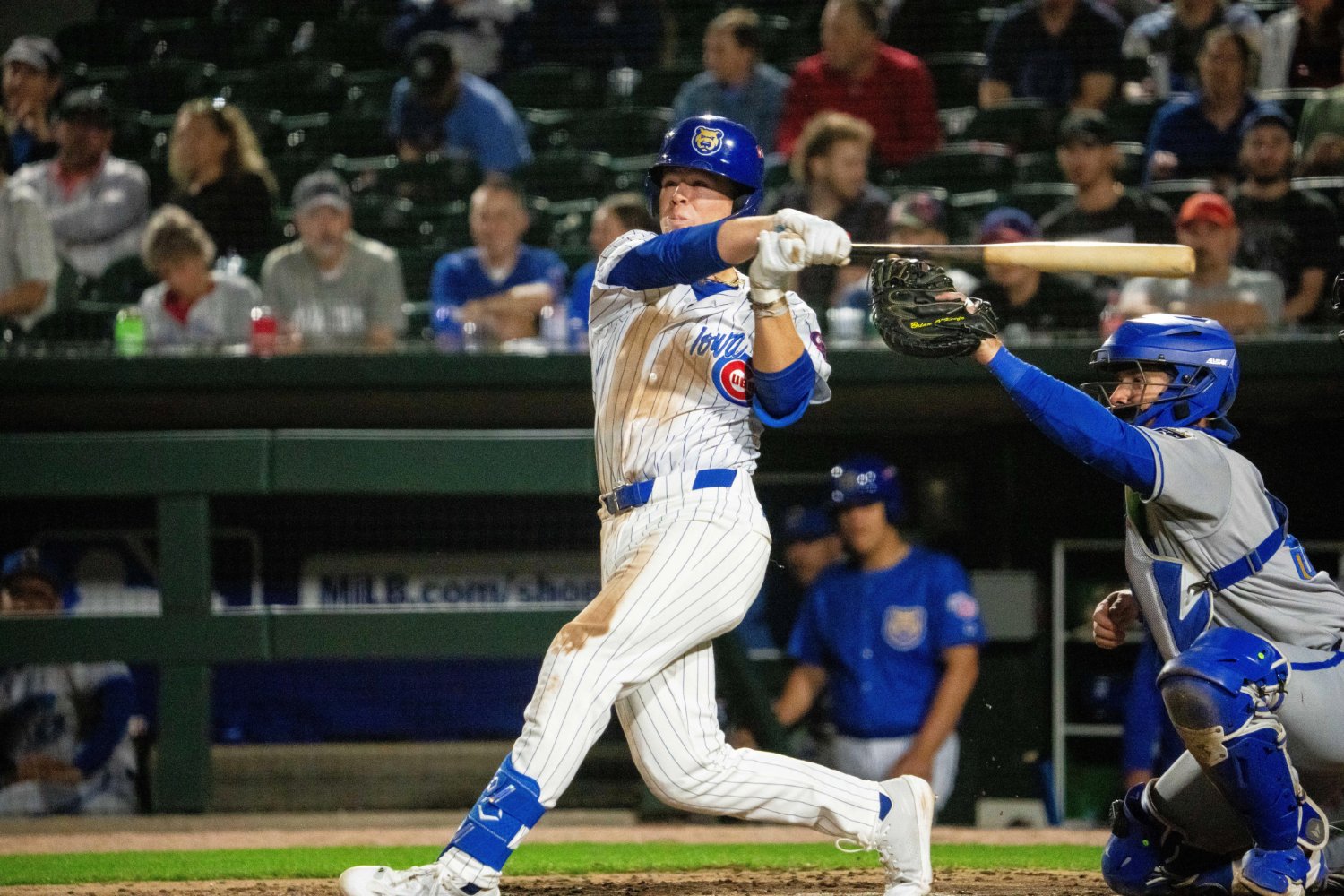 On Thursday, the Chicago Cubs reportedly called up James Triantos, their second-round pick in the 2021 draft. Triantos, 23, was ranked 12th on North Side Baseball's most recent top prospect list. The utility fielder has worked his way up through the minor-league system, most recently playing in Iowa where he slashed .306/.344/.440, which was good for a 96 wRC+. What should we expect out of the newest member of the Cubs? Strengths The best tool in James Triantos' bag is on his bat-to-ball skills. He possess a K% in the 96th percentile and a zone-contact rate in the 92nd in Iowa this season. This helps him maintain a strikeout rate of 11.6%, which is quite excellent. There is little doubt even at the next level that he's going to make contact with the baseball a good amount of the time. He also has no obvious issues with fastballs or breaking pitches in this regard, as his whiff rate on those pitches were 11.3% and 21.9%, respectively. It's safe to assume most of that will carry over at any where he plays at. Another one of the skills Triantos presents is his above-average athleticism and speed. The infielder is a general menace on the basepaths, swiping 31 bags in 110 games last year and has kept up the pace this year with 18 in 88 contests. While he's been caught around 10 times each year, he's on pace for being caught less in 2026, making him much more efficient. This will be another part of his game you can feel strongly about as he is called up. One last skill we can bank on: he's got versatility. While his defensive skills are likely "average" at most places and will rarely wow you, he can play across the diamond fairly reliably. He's logged games in Iowa this year alone at second, third, left field, center field and right field, which gives him a lot of pathways to playing time. Overall, Triantos is probably a pretty high-floor prospect in that it's not terribly hard to see what he does best transitioning to the top level in some fashion. His ability to hit the ball and play versatile defense give him a few ways to impact a team and a game. It's reasonable to expect him to find a role on an MLB bench at the very least. Weakness As with many contact-first hitters, there is usually a trade-off to having so much bat-to-ball focus, and that is in the power department. Triantos does not wow with pop; his .134 ISO in the International League (a very hitter-friendly environment) hardly is worth writing home about. The good news is that he's displayed a different swing this year and I do believe there's some power gained from it. The bad news is that his high-end exit velocities are pretty low; his Max EV is in the sixth percentile and his barrel rate in the 14th, meaning his hardest hits aren't of the highlight variety. He's gotten better in this department, but it's also looking like there's a pretty low ceiling on the power potential here. The power concerns aren't the only thing to note, as Triantos is a very free swinger. His swing% is in the 90th percentile in Triple-A, while he runs a bottom-of-the-barrel walk rate. He makes a lot of contact, but it's a lot of bad contact. When you couple that with his exit velocities, you have to wonder if his plate discipline will be the limiting function in his game. It wouldn't be surprising, especially initially as he learns the lesson of "just because you can hit it, doesn't mean you have to." Expectations Without knowing a corresponding move yet, it's hard to know what will be his exact role. For example, if Pedro Ramirez has an injury or if it's the Cubs deciding to send down Kevin Alcantara, what Triantos will be asked to do may be different in terms of playing time. He won't be getting called up to start, however, either way. It's also likely that his playing time will be limited. But don't worry about that; he's not at a point of his career where you really need to give him playing time. He's already logged 200 games in Iowa and almost 800 plate appearances. He's been in the system since 2021 and there's probably a fair bit of confidence in the projections. What he is now is someone who can probably help the Cubs on the bases or with his versatility today. He's got the kind of game that's infectious, and he should provide a fun bench option that will give the team some value as a pinch runner late in the game or a defensive sub at a litany of positions. He probably won't pick up more than a token start here or there, but should be able to find ways to make a mark on the team regardless. What do you think of James Triantos? Do you think he'll play a lot? What are your expectations? Let us know in the comments below!
 -
Image courtesy of © Cody Scanlan/The Register / USA TODAY NETWORK via Imagn Images On Thursday, the Chicago Cubs reportedly called up James Triantos, their second-round pick in the 2021 draft. Triantos, 23, was ranked 12th on North Side Baseball's most recent top prospect list. The utility fielder has worked his way up through the minor-league system, most recently playing in Iowa where he slashed .306/.344/.440, which was good for a 96 wRC+. What should we expect out of the newest member of the Cubs? Strengths The best tool in James Triantos' bag is on his bat-to-ball skills. He possess a K% in the 96th percentile and a zone-contact rate in the 92nd in Iowa this season. This helps him maintain a strikeout rate of 11.6%, which is quite excellent. There is little doubt even at the next level that he's going to make contact with the baseball a good amount of the time. He also has no obvious issues with fastballs or breaking pitches in this regard, as his whiff rate on those pitches were 11.3% and 21.9%, respectively. It's safe to assume most of that will carry over at any where he plays at. Another one of the skills Triantos presents is his above-average athleticism and speed. The infielder is a general menace on the basepaths, swiping 31 bags in 110 games last year and has kept up the pace this year with 18 in 88 contests. While he's been caught around 10 times each year, he's on pace for being caught less in 2026, making him much more efficient. This will be another part of his game you can feel strongly about as he is called up. One last skill we can bank on: he's got versatility. While his defensive skills are likely "average" at most places and will rarely wow you, he can play across the diamond fairly reliably. He's logged games in Iowa this year alone at second, third, left field, center field and right field, which gives him a lot of pathways to playing time. Overall, Triantos is probably a pretty high-floor prospect in that it's not terribly hard to see what he does best transitioning to the top level in some fashion. His ability to hit the ball and play versatile defense give him a few ways to impact a team and a game. It's reasonable to expect him to find a role on an MLB bench at the very least. Weakness As with many contact-first hitters, there is usually a trade-off to having so much bat-to-ball focus, and that is in the power department. Triantos does not wow with pop; his .134 ISO in the International League (a very hitter-friendly environment) hardly is worth writing home about. The good news is that he's displayed a different swing this year and I do believe there's some power gained from it. The bad news is that his high-end exit velocities are pretty low; his Max EV is in the sixth percentile and his barrel rate in the 14th, meaning his hardest hits aren't of the highlight variety. He's gotten better in this department, but it's also looking like there's a pretty low ceiling on the power potential here. The power concerns aren't the only thing to note, as Triantos is a very free swinger. His swing% is in the 90th percentile in Triple-A, while he runs a bottom-of-the-barrel walk rate. He makes a lot of contact, but it's a lot of bad contact. When you couple that with his exit velocities, you have to wonder if his plate discipline will be the limiting function in his game. It wouldn't be surprising, especially initially as he learns the lesson of "just because you can hit it, doesn't mean you have to." Expectations Without knowing a corresponding move yet, it's hard to know what will be his exact role. For example, if Pedro Ramirez has an injury or if it's the Cubs deciding to send down Kevin Alcantara, what Triantos will be asked to do may be different in terms of playing time. He won't be getting called up to start, however, either way. It's also likely that his playing time will be limited. But don't worry about that; he's not at a point of his career where you really need to give him playing time. He's already logged 200 games in Iowa and almost 800 plate appearances. He's been in the system since 2021 and there's probably a fair bit of confidence in the projections. What he is now is someone who can probably help the Cubs on the bases or with his versatility today. He's got the kind of game that's infectious, and he should provide a fun bench option that will give the team some value as a pinch runner late in the game or a defensive sub at a litany of positions. He probably won't pick up more than a token start here or there, but should be able to find ways to make a mark on the team regardless. What do you think of James Triantos? Do you think he'll play a lot? What are your expectations? Let us know in the comments below! View full article
-
Could be. My only hesitancy on that is Pedro is worse from the right side and Triantos is rocking a .291 wOBA against lefties this year. Neither feels super strong as a "guy who hits lefties".
-
I missed last night's game so if there was an injury that was apparent everyone will have to excuse me: but I do wonder if someone like Ramirez tweaked something (I remember them worrying about a swing of his) or if because of a trade... (I'll guess the former however)
-
👀
-
One of these is Edwin Cabrera last year, and the other is Reid Detmers now: Player A: 27.6 % K%, 7.5 BB%, 4.05 ERA, 3.32 xERA, 3.27 FIP, 3.67 xFIP Player B: 25.8 K%, 8.3 BB%, 3.53 ERA, 4.05 xERA, 3.83 FIP, 3.62 xFIP And just for comparison, here is Joe Ryan this year: 27.8 K%, 5.3 BB%, 3.38 ERA, 3.47 xERA, 3.42 FIP, 3.42 xFIP The numbers these guys put up in 2026 for Cabrera and Detmers now are shockingly close to Joe Ryan, a pitcher we should all love to get our hands on. Now, you'd be correct in pointing out the glaring difference: Ryan does this consistently and we haven't seen the same consistency from the other 2 or even close to it. It's why Ryan is the better bet and would cost more. But the way you're talking about Cabrera, you'd think he was on the level of the guy you coupled him with: Michael Soroka. Detmers is 26 and has started 97 games with up and down ability while at the time of acquiring Cabrera, he was 27 and had 82 starts. They've had shockingly similar careers; highly touted prospects who were with organizations not known for pitching development (Miami's perception is in the process of changing, LAA's isn't) that flashed high end production from time to time but struggled to be consistent all the time. Let's not play the "Cabrera isn't and never was a #2" game. I won't debate with you "what a #2 is and isn't" because it's a dumb debate that revolves entirely over subjectiveness. Instead, let's acknowledge that their xFIPs would both be top-25 this year and last year would have been top-15. Everything Cabrera did last year would make you very comfortable with him being a lead in your rotation if it kept up (same argument for Detmers) and if he stayed healthy. Obviously 2026 hasn't been as kind to Cabrera! It's why Detmers won't be as costly as Joe Ryan: you can bank on Ryan and you can't on Detmers and can't on Cabrera. But when the Cubs got him, he was absolutely better than you're acting. I also agree they didn't get a controlled pitcher last year. They may not this year. But they have every reason to explore it. And I'd argue are in a better position to make it happen this year. And the kind of trade that would be out there for controlled SP's would be very similar to how the Cubs acquired Cabrera in the offseason; it's not a unicorn. We literally did it six months ago.
-
Draft Pick Signings
Jason Ross replied to CaliforniaRaisin's topic in MLB Draft, International Signings, Amateur Baseball
My thought on this is simple: you don't invest in Tyler Zombro and then don't give him the keys to oversee the kingdom. You brought him in. You promoted him. You're invested. You clearly believed in him to that point. It's exciting that they're going in this direction. I think the Cubs pitching development gets horsefeathers on a little excessively (guys like Justin Steele and Cade Horton and Jaxon Wiggins didn't come from nowhere) but it's obviously just not been enough (investment and development). If you're going to go in on pitching, and you've got Zombro, all of this makes perfect sense. -
Again, the market isn't moving right now. Prices, whether rental or non-rental, are incredibly high as teams like the Tigers, Twins, Padres...decide whether or not they're selling or not. As it pertains to a "unicorn controlled pitcher" the Cubs literally acquired one of those in the winter (it hasn't worked out as well as you may have hoped) so this idea that it's impossible like you're presenting it ("unicorn") falls apart. As well, players like Reid Detmers who sit in that same territory are likely available in some fashion, but the rental market will likely have to kick up to force action. Whether today or the offseason, the Cubs need pitching in 2027. They have a very good reason to shop the controlled market. If you believe there will be a work stoppage this winter (and while I believe the 2027 season will mostly happen, I do expect a truncated and shortened offseason because of a lockout) it's going to condense the amount of time the team has to shop. So getting shopping done before then has tons of merits. It's going to be something that we're all going to have to wait until closer to August 3rd, if not the 3rd, to see really kick off. Be mad on August 4th if they bring in a Soroka type as the fix or less. Until then, patience is the only thing we can have as the market is incredibly difficult until teams agree they're selling.
-
All you have to do is when we open up voting, just figure out your personal top-20, and if we're missing a name you want to add, just post it in the thread. Brock will add those names. That way we don't add too many niche names that no one will use at all. For example, I noticed Derniche Valdez had been removed. I wanted to add him back due to his breakout with post-glasses. Brock got him right away for me! That simple. We'll get anyone added up you want. We also don't want an unwieldly list of guys no one will list. It's drag-and-drop and it gets a little finicky. So if we're missing some guys you need for your 20, just ask to add 'em! And appreciate it. I enjoy prospects and prognostication. I try to give my logic and top-20 thought and effort. If I'm going to write and podcast for the site, it's only fair I give a real honest effort! We appreciate you being involved too. Caring about what an 18 year old kid in the Complex League is a niche and frankly, dorky-ass thing. But it's a dorky-ass thing I love.
-
I would think he's a pretty high candidate. They've not been shy about DFA'ing arms around this time that just aren't hacking it, and under the hood there just isn't much to make me feel like he's worth a roster spot. The velo isn't bouncing back. He's giving up tons of hard contact and home runs. He doesn't feel like he'd fit in a BP role. He's in the last year of his deal. Maybe he shows something in his next start or two that makes you think "ahhh...maybe?" but if I'm adding three pitchers to this roster between today and August 4th, and one of them is a starter, then he's probably atop my list of goodbyes.