.jpg.900f6d1bc80a5a156f3ba09ea0e4b3d7.jpg)

Jason Ross
-
Posts
8,154 -
Joined
-
Last visited
-
Days Won
74
Content Type
Profiles
Joomla Posts 1
Chicago Cubs Videos
Chicago Cubs Free Agent & Trade Rumors, Notes, & Tidbits
2026 Chicago Cubs Top Prospects Ranking
News
2023 Chicago Cubs Draft Picks
Guides & Resources
2024 Chicago Cubs Draft Picks
The Chicago Cubs Players Project
2025 Chicago Cubs Draft Pick Tracker
2026 Chicago Cubs Draft Tracker: Picks & Bonuses
Blogs
Events
Forums
Store
Gallery
Everything posted by Jason Ross
-
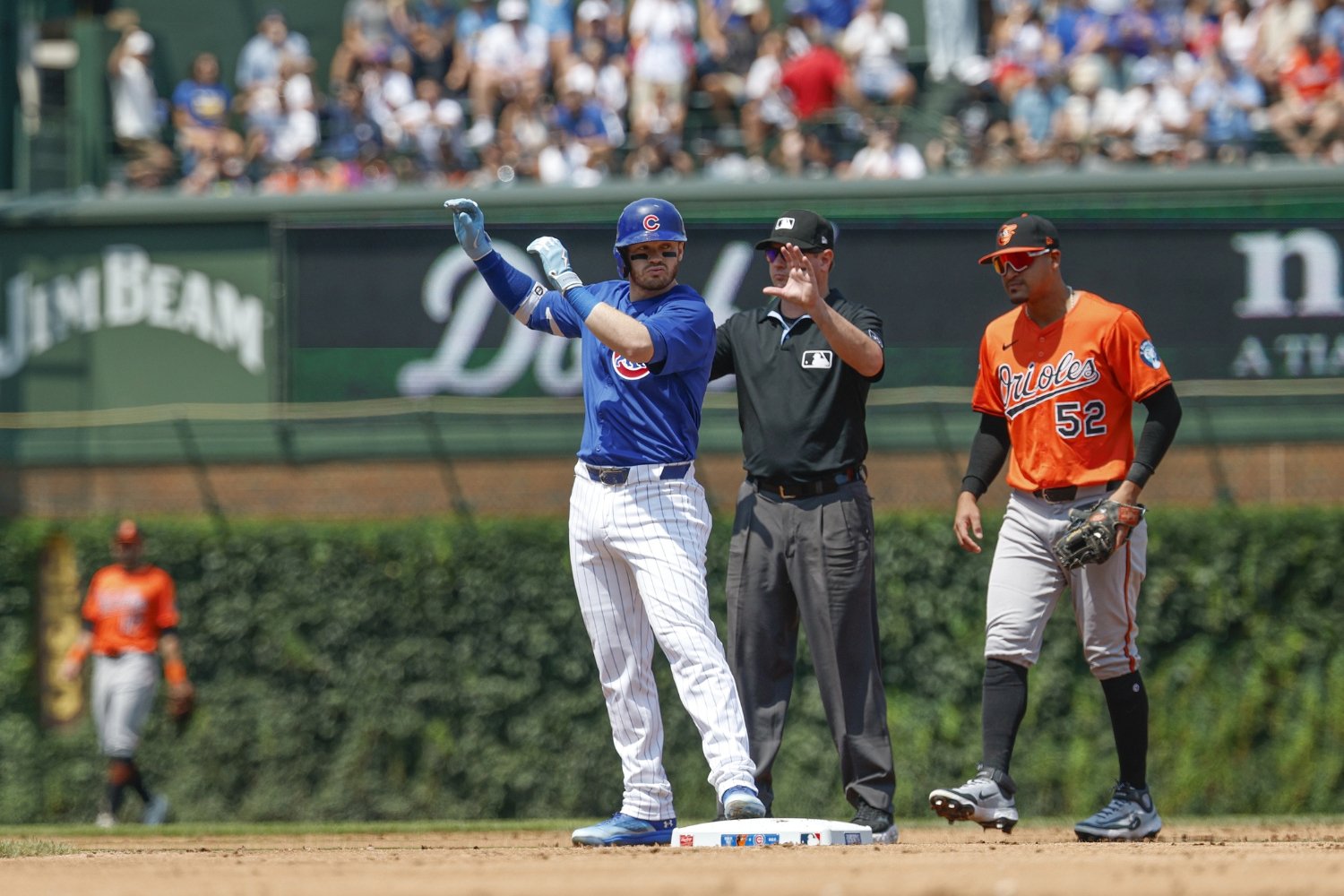 Right now, optimism is in spare supply here in Cub-land, I know. The Brewers seem like they may never lose again, the Cubs offense hasn't been quite as dominating as they had been early in the year, the deadline brought little excitement (and with Michael Soroka's injury, more disappointment than intended); it's just pretty easy to see the negatives right now. With that said, let me offer up some good news; Ian Happ is fine and seems to be the guy we want him to be once again. In fact, he's been fine for a while, though the stats lied to you for a while. They played a rude trick on us, so let's figure out just how they did it, and hopefully, how to prevent this from happening again. To begin to pull the curtains back on Happ's data, we need to take a quick journey to the recent past before we jump to look at the current day Happ; back to just a few weeks ago. The Wrigley Wire, a Twitter/X account, had a post that found a decent amount of traction, making enough waves across the internet that it appeared in a very popular reddit post and even on our own North Side Baseball forums. The tweet consisted of a breakdown of Ian Happ's recent games. showing his poor slash lines over a handful of of different time spans. These numbers caused a lot of ruckus in these circles and people got their pitchforks out directing even more ire towards the Cubs left fielder. I've noticed over the years, Happ tends to be a bit of a lightening rod for Cubs fans, which is likely why this tweet caught fire in social media circles. My theory on this is that he's just not very flashy; he's a good hitter, but just "good". He's a good (for a left fielder) glove man, but doesn't make a lot of flashy or notable "web-gems". He's a good base runner, but not a speed demon. And because of these good-not-great skills, his skills in the aggregate can be easy to sleep on. Many probably don't realize that since 2022, he's accrued the 12th most fWAR in the league at the OF positions (more than Fernando Tatis Jr., Mike Trout, Byron Buxton, Cody Bellinger and Michael Harris II). He's almost always available, and he's incredibly consistent. Getting back to the original tweet, it's important to note that while the above numbers as posted by the Wrigley Wire are accurate, they lack context. Slash lines just report back to us what happened, but never tell us the process behind how we got there and that process is the key to unlocking the lie; it's in the process that we can better tell the future. I know that feels counterintuitive to us and that his "results" (or in other words, his triple-slash-line) matter, but in a way, they don't help us predict the future very well. You can think of it this way: If I flip a coin ten times and get seven heads, it doesn't mean that the 11th time I flip it, I suddenly have a 70% chance of getting heads—it's still 50%. The results don't inform the next flip. But, if I was using a specific way to flip the coin that was resulting in more heads, now that would inform the next flip. The way we do things matters more than results in this case, and they do for the protagonist of our article, as well. To add some of that context to Happ's numbers, I've compiled a chart looking beyond just his triple-slash lines to attempt to diagnose the issues Happ had been having. Is he making bad swing choices? Is it a mechanical error? Maybe his contact quality has dropped off? To get there, we have to go to the predictive portion of his numbers, his processes, his batted ball data, and his approach. And when those curtains were peeled back, the trick had been revealed; Ian Happ was having a good season. Compared to his career line, nothing over that 37 game strand suggests an issue, instead he was playing better than normal Ian Happ plays! He was making more contact and chasing less, so it wasn't an approach issue where he was swinging at poor pitches. He was also making more hard contact, had better exit velocities, and was finding more barrels than normal, so his batted ball quality wasn't an issue. He wasn't inflating his hard-hit% or his exit velocities with hard ground balls that were unlikely to land as hits. He was hitting more fly balls and converting more of those into home runs, suggesting his power was just fine. Then, you get to the BABIP... a nearly .120 split between his career BABIP and his BABIP over that span. Ta-da! The ruse has been revealed, it was bad luck all along! I know, I know, the "it was bad luck" explanation is the equivalent of the magician's gimmicked prop failing in real time in front of the audience, but sometimes, it really is just bad luck. Happ had the fourth lowest BABIP in that 37-game span of any hitter in baseball and he hadn't been playing like a guy who deserved that outcome. Had he been making poor contact, you could convince me that the low BABIP numbers were earned, but this felt like bad variance. What Ian Happ was doing should have matched his production. In a way, you could even argue that Ian Happ was having one of his best seasons ever from an expected data point of view. Between 2022 and present, his wOBA over that span is .337. Despite his wOBA this season only being .319, his expected wOBA is .350, the second-best figure of his career. There were always enough signs that Happ was playing pretty well, but because we tend to live in a results-driven world, it was sometimes hard to see. This brings us to the All-Star Break and beyond. Over his last 70 PA's, Happ has posted a 134 wRC+. The 30-year-old-left-fielder has a 121 wRC+ from 2022-2024, so this is a great start for him on the second half of the year. When I add his current batted ball data into the chart, it becomes a little obvious that he's probably playing a bit better than we should expect moving forward; he's making a little more contact than normal and finding a few more barrels, but he's also very close on a lot of his career numbers, too. This feels like a great lesson in context. I don't mean to sound holier-than-thou here—we can all get caught up in the moment and I have been guilty of it myself—but context matters. Happ's batted ball data was trying to tell us not to panic, that as long as Ian Happ kept doing what he was doing, he'd probably be the guy he's been. And, go figure, his triple-slash "results" (though, to be fair, his exit velocities, barrels, and the like are all results in their own right, though that is an argument for another article) are matching the batted ball data again. It's easy to focus on the results, and it's a lot harder to go deeper into the "why", but this is what good organizations do—they ignore the noise. As fans, we have more access to these things than ever ourselves, and doing the hard thing can help inform us. Right now, everything feels gross and doing that probably feels harder than ever. Nothing feels right on the North Side and Milwaukee feels like they are going to run away with the division. There's still a lot of baseball left to play and there's a lot of time to change that. But, if we can leave the crushing pessimism in the bag for a minute, we can see that things with Ian Happ are starting to balance back out. Sometimes the data lies to us; it performs magic tricks and we have to look deeper to find how the trick is performed. Sometimes, it really is just a streak of bad beats. As the Cubs look to put things together over the next few weeks, Ian Happ's "resurgence" (though I'd argue he's been fine for a while) will certainly help. If the Cubs can get a few other hitters back (like Kyle Tucker, Seiya Suzuki and Michael Busch) the team will be able to give the Brewers hell down the stretch. Maybe, just maybe, if the Cubs' oft-maligned left fielder can get the results he deserves (or even a little positive luck!) he will be seen as a catalyst over the next two months instead of an anchor. Don't let the volatility trick you, Ian Happ is a great player. He might never be Juan Soto, but he doesn't have to be; he just needs to be Ian Happ to be enough. What do you think of Ian Happ's 2025 season? Do you think he has had a good season? Let us know in the comment section below!
 -
Image courtesy of © Kamil Krzaczynski-Imagn Images Right now, optimism is in spare supply here in Cub-land, I know. The Brewers seem like they may never lose again, the Cubs offense hasn't been quite as dominating as they had been early in the year, the deadline brought little excitement (and with Michael Soroka's injury, more disappointment than intended); it's just pretty easy to see the negatives right now. With that said, let me offer up some good news; Ian Happ is fine and seems to be the guy we want him to be once again. In fact, he's been fine for a while, though the stats lied to you for a while. They played a rude trick on us, so let's figure out just how they did it, and hopefully, how to prevent this from happening again. To begin to pull the curtains back on Happ's data, we need to take a quick journey to the recent past before we jump to look at the current day Happ; back to just a few weeks ago. The Wrigley Wire, a Twitter/X account, had a post that found a decent amount of traction, making enough waves across the internet that it appeared in a very popular reddit post and even on our own North Side Baseball forums. The tweet consisted of a breakdown of Ian Happ's recent games. showing his poor slash lines over a handful of of different time spans. These numbers caused a lot of ruckus in these circles and people got their pitchforks out directing even more ire towards the Cubs left fielder. I've noticed over the years, Happ tends to be a bit of a lightening rod for Cubs fans, which is likely why this tweet caught fire in social media circles. My theory on this is that he's just not very flashy; he's a good hitter, but just "good". He's a good (for a left fielder) glove man, but doesn't make a lot of flashy or notable "web-gems". He's a good base runner, but not a speed demon. And because of these good-not-great skills, his skills in the aggregate can be easy to sleep on. Many probably don't realize that since 2022, he's accrued the 12th most fWAR in the league at the OF positions (more than Fernando Tatis Jr., Mike Trout, Byron Buxton, Cody Bellinger and Michael Harris II). He's almost always available, and he's incredibly consistent. Getting back to the original tweet, it's important to note that while the above numbers as posted by the Wrigley Wire are accurate, they lack context. Slash lines just report back to us what happened, but never tell us the process behind how we got there and that process is the key to unlocking the lie; it's in the process that we can better tell the future. I know that feels counterintuitive to us and that his "results" (or in other words, his triple-slash-line) matter, but in a way, they don't help us predict the future very well. You can think of it this way: If I flip a coin ten times and get seven heads, it doesn't mean that the 11th time I flip it, I suddenly have a 70% chance of getting heads—it's still 50%. The results don't inform the next flip. But, if I was using a specific way to flip the coin that was resulting in more heads, now that would inform the next flip. The way we do things matters more than results in this case, and they do for the protagonist of our article, as well. To add some of that context to Happ's numbers, I've compiled a chart looking beyond just his triple-slash lines to attempt to diagnose the issues Happ had been having. Is he making bad swing choices? Is it a mechanical error? Maybe his contact quality has dropped off? To get there, we have to go to the predictive portion of his numbers, his processes, his batted ball data, and his approach. And when those curtains were peeled back, the trick had been revealed; Ian Happ was having a good season. Compared to his career line, nothing over that 37 game strand suggests an issue, instead he was playing better than normal Ian Happ plays! He was making more contact and chasing less, so it wasn't an approach issue where he was swinging at poor pitches. He was also making more hard contact, had better exit velocities, and was finding more barrels than normal, so his batted ball quality wasn't an issue. He wasn't inflating his hard-hit% or his exit velocities with hard ground balls that were unlikely to land as hits. He was hitting more fly balls and converting more of those into home runs, suggesting his power was just fine. Then, you get to the BABIP... a nearly .120 split between his career BABIP and his BABIP over that span. Ta-da! The ruse has been revealed, it was bad luck all along! I know, I know, the "it was bad luck" explanation is the equivalent of the magician's gimmicked prop failing in real time in front of the audience, but sometimes, it really is just bad luck. Happ had the fourth lowest BABIP in that 37-game span of any hitter in baseball and he hadn't been playing like a guy who deserved that outcome. Had he been making poor contact, you could convince me that the low BABIP numbers were earned, but this felt like bad variance. What Ian Happ was doing should have matched his production. In a way, you could even argue that Ian Happ was having one of his best seasons ever from an expected data point of view. Between 2022 and present, his wOBA over that span is .337. Despite his wOBA this season only being .319, his expected wOBA is .350, the second-best figure of his career. There were always enough signs that Happ was playing pretty well, but because we tend to live in a results-driven world, it was sometimes hard to see. This brings us to the All-Star Break and beyond. Over his last 70 PA's, Happ has posted a 134 wRC+. The 30-year-old-left-fielder has a 121 wRC+ from 2022-2024, so this is a great start for him on the second half of the year. When I add his current batted ball data into the chart, it becomes a little obvious that he's probably playing a bit better than we should expect moving forward; he's making a little more contact than normal and finding a few more barrels, but he's also very close on a lot of his career numbers, too. This feels like a great lesson in context. I don't mean to sound holier-than-thou here—we can all get caught up in the moment and I have been guilty of it myself—but context matters. Happ's batted ball data was trying to tell us not to panic, that as long as Ian Happ kept doing what he was doing, he'd probably be the guy he's been. And, go figure, his triple-slash "results" (though, to be fair, his exit velocities, barrels, and the like are all results in their own right, though that is an argument for another article) are matching the batted ball data again. It's easy to focus on the results, and it's a lot harder to go deeper into the "why", but this is what good organizations do—they ignore the noise. As fans, we have more access to these things than ever ourselves, and doing the hard thing can help inform us. Right now, everything feels gross and doing that probably feels harder than ever. Nothing feels right on the North Side and Milwaukee feels like they are going to run away with the division. There's still a lot of baseball left to play and there's a lot of time to change that. But, if we can leave the crushing pessimism in the bag for a minute, we can see that things with Ian Happ are starting to balance back out. Sometimes the data lies to us; it performs magic tricks and we have to look deeper to find how the trick is performed. Sometimes, it really is just a streak of bad beats. As the Cubs look to put things together over the next few weeks, Ian Happ's "resurgence" (though I'd argue he's been fine for a while) will certainly help. If the Cubs can get a few other hitters back (like Kyle Tucker, Seiya Suzuki and Michael Busch) the team will be able to give the Brewers hell down the stretch. Maybe, just maybe, if the Cubs' oft-maligned left fielder can get the results he deserves (or even a little positive luck!) he will be seen as a catalyst over the next two months instead of an anchor. Don't let the volatility trick you, Ian Happ is a great player. He might never be Juan Soto, but he doesn't have to be; he just needs to be Ian Happ to be enough. What do you think of Ian Happ's 2025 season? Do you think he has had a good season? Let us know in the comment section below! View full article
-
Boras is not Kyle Tucker's agent. His agent is Casey Close of Excel Management Group. On the "good business front" I could not disagree more. Parades has been good, but also is tailor made for Houston, not Chicago, due to their fields. Cam Smith has been generally bad so far, posting a 95 wRC+. He's been brutally bad since the Cubs series and hasnt hit RHP all year. He may eventually be a good MLB player, but right now looks like a bit of a mess. And unlike when Shaw was struggling, under the hood stuff does not like where he is headed. He is in a spot where it is hard to pin point a real green flag; his K% is spiking and his BABIP is fine, meaning he isnt the recipient of bad luck; he has just been bad for a while. On the backend the Cubs got a hitter who has been performing like a top-15 hitter even with the bad run. Kyle Tucker is an elite baseball player. Parades is fine. Bellinger is fine. Cam Smith might be fine, or better. But only one of those *is* an elite player without a shadow of a doubt and we have got to stop worrying about trading good players to get elite ones.
-
Kyle Tucker - 142 wRC+ Cody Bellinger - 121 wRC+ Kyle Tucker - 4.3 fWAR Cody Bellinger - 3.2 fWAR Kyle Tucker has been 20% better offensively and been worth a full win more. The only reason it is this close is because Kyle Tucker has gone cold for a bit. In all of his full seasons, Kyle Tucker averages a 142 wRC+. which is what he's done this year. Cody Bellinger hasn't had a 142 wRC+ season since 2019, and he did it one time. Since his resurgence he has had a 122 wRC+, so these are pretty standard numbers. It should also be noted that Kyle Tucker has had bad batted ball luck. Bellinger has outhit his xData. This means moving forward we should expect Tucker to be better than he's been and Bellinger to be worse. Kyle Tucker wOBA vs xwOBA - .370 vs .390 Cody Bellinger wOBA vs xwOBA - .348 vs ,331 If Tucker had a .390 wOBA like his xwOBA suggests, he would be the 7th best hitter in baseball tied with Cal Raleigh. As is he is tied for 14th. Cody Bellinger is 48th, however if he had his xwOBA, he would be the 78th best hitter in baseball. Pay. Kyle. Tucker. It is not close between Cody Bellinger and Kyle Tucker. One of these players is an elite baseball player who has had bad variance and the other is a fine baseball player who has had good variance.
-
Cam Smith - 95 wRC+ Matt Shaw - 91 wRC+ Just leaving this here.
-
It wasnt as crazy, but I was a Dodgers/Phillies game back in 2002 that felt similar. Final score was 10-8. Both teams had multiple 3+ run innings throughout the game. Was a really fun affair, especially for someone attending who was neither a Phillies or a Dodgers fan.
-
Reds (Abbott) vs Cubs (Horton): 8/6/25, 1:20pm
Jason Ross replied to Brandon Glick's topic in Fred Hornkohl Game Thread Forum
Horton has barely pitched 250 innings combined with his senior year through today. He's far short of 150 IP in any single season. -
Reds (Abbott) vs Cubs (Horton): 8/6/25, 1:20pm
Jason Ross replied to Brandon Glick's topic in Fred Hornkohl Game Thread Forum
Palencia only has 2 innings in August and four since July 22nd. There's rest and rust. Cubs probably just wanted to get him an inning, -
Reds (Abbott) vs Cubs (Horton): 8/6/25, 1:20pm
Jason Ross replied to Brandon Glick's topic in Fred Hornkohl Game Thread Forum
His fastball placement and the splitting of the four-seam with cut (now thrown to LHH) and the sinker (thrown to RHH) feels like it was such an important catalyst for this. Once he can spot up the slider a little more, he's got legitimate top-rotation stuff. Very exciting. -
Reds (Abbott) vs Cubs (Horton): 8/6/25, 1:20pm
Jason Ross replied to Brandon Glick's topic in Fred Hornkohl Game Thread Forum
No hitters are always cool. -
Reds (Abbott) vs Cubs (Horton): 8/6/25, 1:20pm
Jason Ross replied to Brandon Glick's topic in Fred Hornkohl Game Thread Forum
Horton looks awesome so far today. Three really strong innings. -
Reds (Abbott) vs Cubs (Horton): 8/6/25, 1:20pm
Jason Ross replied to Brandon Glick's topic in Fred Hornkohl Game Thread Forum
Welcome! Justin Turner has a 125 wRC+ against LHP. Abbott is LHP. This is not nearly as problematic as you are suggesting as league RHH are hitting 99 wRC+ against LHP. Willi Castro has 107 wRC+ and has been worth 6.5 fWAR through his last 2 and 2/3rds season. He's been an above average starting player. Him playing every is not problematic either. He's also very good against LHP, with a 130 wRC+. -
Stephan was ranked #80 on fangraphs page and was getting back end top-100 (or honorable mention) love on most industry rankings. He was most comparable to Jaxon Wiggins who has been getting similarly treated, either sneaking on to top-100's at the bottom or being among the HM list. Maybe one team is higher on Wiggins, another on Stephan, but using industry rankings, Wiggins and Stephan were very similarly viewed on the aggregate. It's very fair to say that Bieber would have cost a prospect in a similar vein to Wiggins based on that.
-
To go back to the 83-win-Cardinals World Series run, the Cards lost 10 of their last 12. I am sure Cardinal fans were not optimistic of winning much that year. Fan optimism only goes so far - hell, the general vibe around here has been close to jumping off of a ledge and the Cubs haven't been an entire dumpster fire, at least not as much as you'd probably assume based on the reactions. Fans are fickle and optimism only reflects recency. It's easy to be down in the dumps about the roster right now. The bullpen is giving up a lot of home runs, the Cubs didn't get an exciting starting pitcher at the deadline, and the offense is scuffling. But all of these things are at their low point and it's unlikely that they will remain this low. Even if you're not super high on the pitching, I think we know the BP isn't going to serve up this many homeruns. It'll probably balance a little. Things will be better. Maybe it'll be today.
-
Just to get Elly who's much, much less potent against LHP (79 wRC) than RHP (149 wRC+)
-
I looked into some of the statcast. My best guess, just peeking at data is that he's just fighting himself right now. All of his approach stuff is fine, so he's not chasing, expanding, or whatever. His angle of attack is shallow, and he's hitting things to centerfield over pulling it. I think he's second guessing himself on good pitches right now. Slow to react.
-
Yeah, it was a bit of an odd move. Especially with how Parades isn't going to be dead forever, nor is Correa gone any time soon. I think it says how they view his defense on the overall. Though, he is a +9 DRS and +3 OAA, so he's been a positive defender in RF.
-
Smith has been something awful since the Cubs series. 54 wRC+ since then. K% over 30%. On the year his wRC+ is down to 98 where as Shaw is now at 84.
-
The Prince Who Was Promised ties the game.
-
If there's one positive of the innings in which the Cubs hit - Gives me a chance to do all of the housework I need to catch up on before my partner gets home tomorrow and sees the state of squaller I have been living in for the week she's been gone. Not like I'm missing much else.
-
I wasn't talking about the White Sox game in particular. His fastball placement has been terrible all season. But he's rocking 6 whiffs on the pitch today and generally getting it up. He's been more consistent with how he's thrown that pitch and that's such an important pitch for him. He's almost entirely avoided the heart of the plate with it today - this is good to see.
-
Shota Ohtani.
-
Pretty sure I made that hustle double happen. You're welcome.
-
Here's some positivity; Shota seems fixed. So...like...that's cool.