


Cubs Video
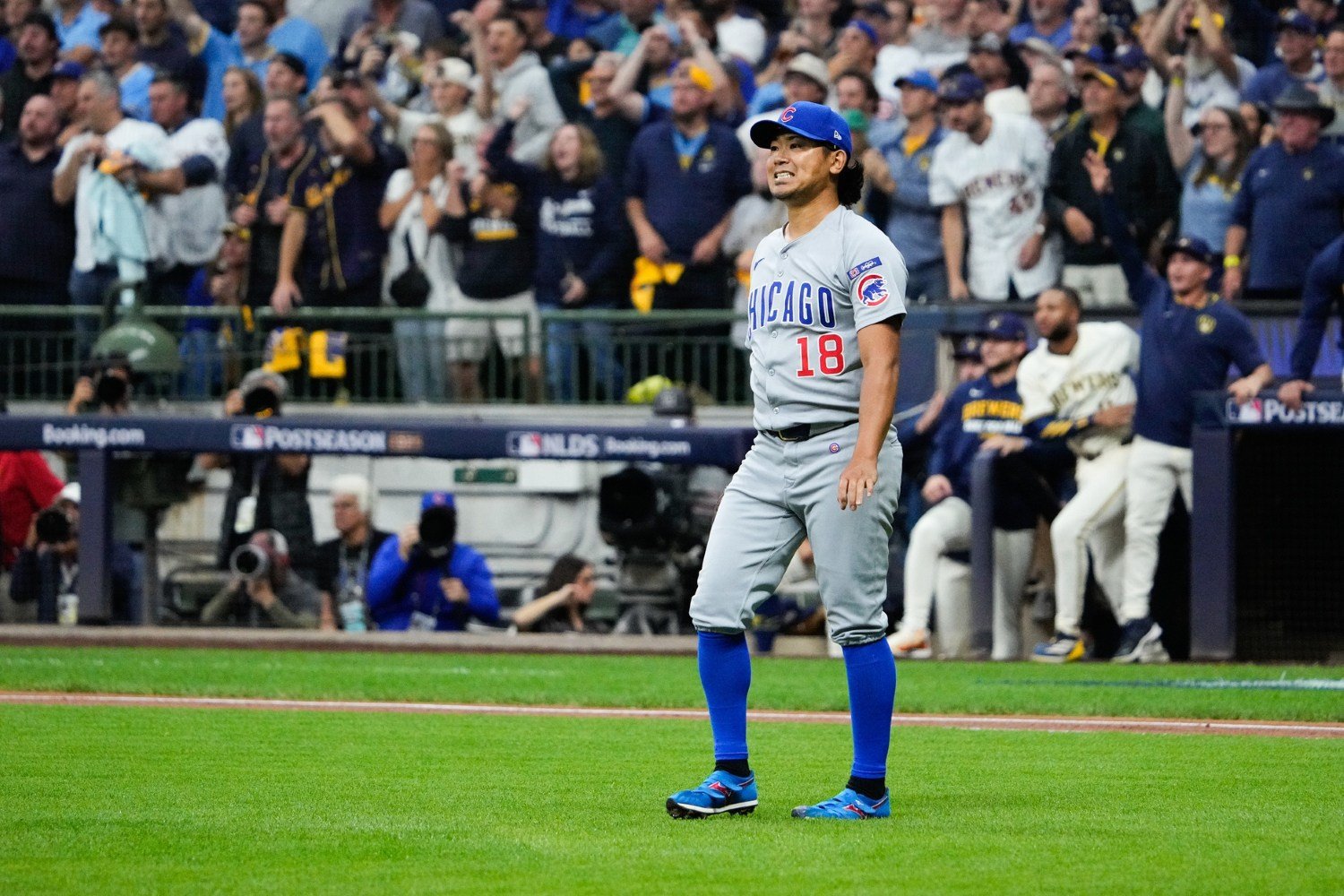
Unless the Cubs force a decisive Game 5 in their National League Division Series showdown with the Milwaukee Brewers, they won't give the ball to Shota Imanaga again this season. It's been an uneven second season on the North Side for Imanaga, who was their ace for much of 2024 and was shaping up to fill the same role for them early this year—but who has been less consistent and more vulnerable to home runs since returning to the rotation at midseason. His overall numbers look good, but he's given up 18 home runs in his last 11 starts, and his strikeout rate is dramatically lower than it was last year.
The timing of that significant regression is awful, because this fall marks a major decision point for the Cubs with regard to Imanaga. The terms of the contract to which the two parties agreed in January 2024 are complicated, but in short:
- Imanaga made $23 million over these first two seasons of his Cubs career
- This fall, the Cubs have to decide whether to exercise a three-year, $57-million option for the next three seasons, paying Imanaga $20 million in each of the next two years and $17 million in 2028.
- Should the Cubs decline that option, Imanaga will have a $15-million player option for 2026.
Another version of the same dance would ensue next fall, if Imanaga exercises that option. The Cubs would have to decide on two years and $42 million, at that point, amounting to the same total payout through 2028, or allow Imanaga to decide on another $15-million player option for 2027.
For the majority of the time between Imanaga's signing and now, the first Cubs option felt like a no-brainer. Triggering it would push the total value of Imanaga's deal to $80 million over five years, but that's a relative bargain for the No. 2-caliber starter he's appeared to be for most of the last two years. Alas, at this moment, it feels more like a no-brainer in the opposite direction. Imanaga is 32 years old. His stuff is diminished, and he suffered a hamstring injury this year of which there's roughly a 25% chance of reinjury in the future—which doesn't reduce the baseline risks of injury to his elbow, shoulder or other more traditionally pitching-specific things. It's hard to justify anything close to $57 million in newly guaranteed money to such a pitcher, coming off the stretch he's been on since mid-August.
If they don't exercise their side of the option, the Cubs could well retain Imanaga, anyway. He's in position to make more than $15 million in guaranteed money this winter, but he probably won't top $15 million for 2026 alone. Given that there's another $15 million (with $42 million over two years as the upside) waiting for him in 2027 if he sticks with this deal, he probably won't receive an offer this winter that beats the combination of earning power and security the current contract gives him. It would take a lot of self-belief on Imanaga's part to plunge back into the market, but if what he wants is certainty about where he'll pitch for the next three or four years, he's only likely to find it there.
Let's say, though, that the Cubs turn down their half of the option and Imanaga turns down his. There would still be one more path to reunion between the two, at that point—if the Cubs are feeling spendy as the offseason gets underway. Should Imanaga eschew the $15-million option, the Cubs could extend a qualifying offer to tether Imanaga to them as he enters free agency. That offer is likely to be somewhere around $22 million, and if the Cubs attach it to him, Imanaga's market would be deflated so much that he'd probably retreat and accept the offer.
For the Cubs, that makes declining the option an even more obvious choice. Instead of committing to three more years of his services and paying him $20 million in 2026 alone, they'd get him for an incrementally increased cost next year but avoid having money tied up beyond that. On balance, it's still very likely that Imanaga is back with Chicago next season—or at least, that he stays with the organization initially. There could always be an unforeseen winter trade, but the smart money says Imanaga will exercise his half of the option this fall.
From a pitching depth perspective, it would be great to have Imanaga back as part of the rotation mix in 2026. It would also be a bit of a relief, because as engaging and endearing as he has been throughout his stay with the team, this would be a sad way for the relationship to end. Imanaga remains a valuable starter, and the Cubs aren't awash in good options as they enter the offseason. Even if they do retain him, though, they need to be active in the market this winter, to further bolster their staff.





Recommended Comments
Create an account or sign in to comment
You need to be a member in order to leave a comment
Create an account
Sign up for a new account in our community. It's easy!
Register a new accountSign in
Already have an account? Sign in here.
Sign In Now