Brandon Glick
-
Posts
1,153 -
Joined
-
Last visited
Content Type
Profiles
Joomla Posts 1
Chicago Cubs Videos
Chicago Cubs Free Agent & Trade Rumors, Notes, & Tidbits
2026 Chicago Cubs Top Prospects Ranking
News
2023 Chicago Cubs Draft Picks
Guides & Resources
2024 Chicago Cubs Draft Picks
The Chicago Cubs Players Project
2025 Chicago Cubs Draft Pick Tracker
2026 Chicago Cubs Draft Tracker: Picks & Bonuses
Blogs
Events
Forums
Store
Gallery
Everything posted by Brandon Glick
-
Another Cy Young of yesteryear goes against the Cubs today. For what it's worth, both Kyle Tucker (1.555 OPS in nine at-bats) and Justin Turner (.895 OPS in 43 at-bats) have crushed Ray in their careers. Also, can we just fire the bullpen into the sun?

-
Crazy times when you'd rather have Colin Rea on the mound than Justin Verlander...
-
Cinco de Mayo. Baseball. Matthew Boyd. Happy Monday, everyone.
-
Should be one heck of a pitching matchup in the series finale.
-
Bryan LaHair spent three seasons in Major League Baseball and 14 years in the professional ranks, including two seasons with the Chicago Cubs. I'm pretty sure most of us around here remember LaHair, who famously won the first base job over Anthony Rizzo at the start of the 2012 season. We'll dig into that campaign shortly, but first a quick recap of how we got to that point. LaHair was drafted in the 39th round of the 2002 MLB Draft by the Seattle Mariners out of Saint Petersburg College. From there, he gradually climbed the minor league ranks, first making it to Triple-A in 2006. That's where he would spend the better part of the next six(!) seasons, only getting brief stops at the big league level in 2008 (with the Mariners) and 2011 (with the Cubs). At the conclusion of the 2009 season, LaHair chose not to re-sign in Seattle, recognizing better opportunities surely awaited him elsewhere. He signed a minor league deal with the Cubs in January 2010, though he remained stuck in Triple-A for most of the next two years, winning the Pacific Coast League Most Valuable Player Award and Joe Bauman Home Run Award in 2011. He finally got the call to Chicago when rosters expanded in September, garnering 69 plate appearances and slashing .288/.377/.508 in his cup of coffee. Thus, we arrive at 2012. At that point, LaHair was practically the poster child for the "Quadruple-A" player, as someone who routinely crushed Triple-A pitching but couldn't get over the big league hump. However, under pressure from new President of Baseball Operations Theo Epstein, manager Dale Sveum named LaHair the starting first baseman out of spring training, and he rewarded the team with an All-Star campaign... technically. Look, LaHair was good in 2012. In fact, in the first half of the season, he slashed .286/.364/.519 with 14 home runs (and 30 RBIs, lol). That's really solid production, especially when you consider that every other first baseman in the National League not named Joey Votto was hurt at the time (David Freese had to play first base in the All-Star Game that year because of how thin the depth was). But, in hindsight, he did not deserve to be an All-Star. He wasn't even the Cubs' "mandatory" selection, since Starlin Castro was named to his second consecutive consecutive Midsummer Classic that year. The Cubs were 33-52 at the break and had a literal 0% chance of making the playoffs at that point. Did they deserve two All-Star representatives? Probably not, but the fact that LaHair's career all but ended afterward at least makes him one of the coolest stories of an otherwise forgettable season in Cubs lore. In the second half of that season, LaHair hit just .202/.269/.303 with two homers, eventually losing his job to Anthony Rizzo and getting banished to right field. In what would end up being his final big league at-bat, LaHair hit a walk-off single against the Houston Astros in the final game of the 2012 season. LaHair kept playing after that, including stints in NPB, MiLB, and various independent leagues, but he never made it back to the bigs. He retired in 2018 and is now a coach in the minor leagues. View full player
-
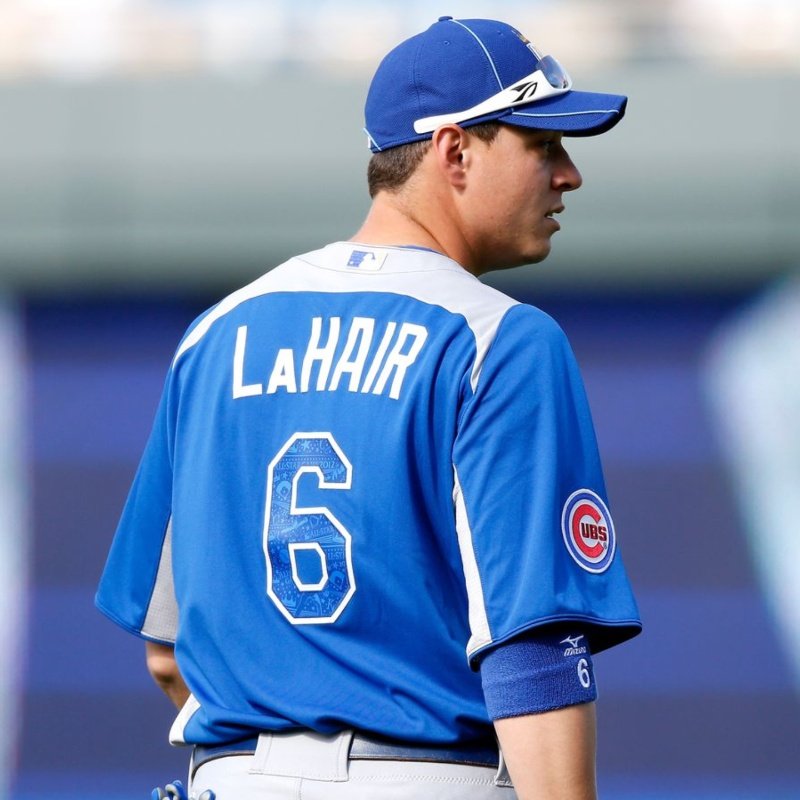 Bryan LaHair spent three seasons in Major League Baseball and 14 years in the professional ranks, including two seasons with the Chicago Cubs. I'm pretty sure most of us around here remember LaHair, who famously won the first base job over Anthony Rizzo at the start of the 2012 season. We'll dig into that campaign shortly, but first a quick recap of how we got to that point. LaHair was drafted in the 39th round of the 2002 MLB Draft by the Seattle Mariners out of Saint Petersburg College. From there, he gradually climbed the minor league ranks, first making it to Triple-A in 2006. That's where he would spend the better part of the next six(!) seasons, only getting brief stops at the big league level in 2008 (with the Mariners) and 2011 (with the Cubs). At the conclusion of the 2009 season, LaHair chose not to re-sign in Seattle, recognizing better opportunities surely awaited him elsewhere. He signed a minor league deal with the Cubs in January 2010, though he remained stuck in Triple-A for most of the next two years, winning the Pacific Coast League Most Valuable Player Award and Joe Bauman Home Run Award in 2011. He finally got the call to Chicago when rosters expanded in September, garnering 69 plate appearances and slashing .288/.377/.508 in his cup of coffee. Thus, we arrive at 2012. At that point, LaHair was practically the poster child for the "Quadruple-A" player, as someone who routinely crushed Triple-A pitching but couldn't get over the big league hump. However, under pressure from new President of Baseball Operations Theo Epstein, manager Dale Sveum named LaHair the starting first baseman out of spring training, and he rewarded the team with an All-Star campaign... technically. Look, LaHair was good in 2012. In fact, in the first half of the season, he slashed .286/.364/.519 with 14 home runs (and 30 RBIs, lol). That's really solid production, especially when you consider that every other first baseman in the National League not named Joey Votto was hurt at the time (David Freese had to play first base in the All-Star Game that year because of how thin the depth was). But, in hindsight, he did not deserve to be an All-Star. He wasn't even the Cubs' "mandatory" selection, since Starlin Castro was named to his second consecutive consecutive Midsummer Classic that year. The Cubs were 33-52 at the break and had a literal 0% chance of making the playoffs at that point. Did they deserve two All-Star representatives? Probably not, but the fact that LaHair's career all but ended afterward at least makes him one of the coolest stories of an otherwise forgettable season in Cubs lore. In the second half of that season, LaHair hit just .202/.269/.303 with two homers, eventually losing his job to Anthony Rizzo and getting banished to right field. In what would end up being his final big league at-bat, LaHair hit a walk-off single against the Houston Astros in the final game of the 2012 season. LaHair kept playing after that, including stints in NPB, MiLB, and various independent leagues, but he never made it back to the bigs. He retired in 2018 and is now a coach in the minor leagues.
 -
Is it just me, or does Jameson only start on the road this year? I feel like he's literally never pitching in Wrigley. Oh, and we face Quintana tonight. That's fun.
-
It's those pesky Brewers again, though they actually haven't been quite so pesky in 2025, sitting at just 16-16 going into the series. The Cubs could really open up a gap in the division this weekend.
-
No matter what happens today, the Cubs will end April in first place in the NL Central.
-
The best lefty in the National League faces Shota Imanaga tonight... no, seriously, Andrew Heaney is on a heater right now. At least the Pirates still can't hit.
-
The Cubs' other starting catcher is off to a historic start in 2025. Just how good has Carson Kelly been? View full video
-
The Cubs' other starting catcher is off to a historic start in 2025. Just how good has Carson Kelly been?
-
Nola's career stats. It's like the 2010-2016 Giants. Just an unexplainable phenomenon.
-
The Cubs get another Sunday Night Baseball game, this time against the Phillies. And, good news on that front: Aaron Nola is continuing his insane and bizarre even year-odd year oscillation between being a Cy Young contender and being bad. Let's hope he doesn't turn around his 2025 season tonight.
-
The Cubs' right-hander aggravated his oblique injury and won't return for a while. What does Assad's prolonged absence mean for the rotation?
-
The Cubs' right-hander aggravated his oblique injury and won't return for a while. What does Assad's prolonged absence mean for the rotation? View full video
-
Cubs offseason trade target Jesús Luzardo is dealing for the Phillies this year. I still feel pretty good about this matchup.
-
Dave Martinez is a former MLB outfielder and current manager who spent parts of four seasons with the Chicago Cubs as a player and three years as bench coach. Martinez was originally a 40th-round draft pick of the Texas Rangers, though after returning to school, the Cubs snagged him in the third round of the 1983 MLB January Draft-Secondary Phase from Valencia Community College. After spending a few years honing his game in the minor leagues, Martinez finally got the call to the big leagues in 1986 as a replacement for the injured Bob Dernier. Outside of a 90-game stretch in 1988 where he was worth 2.5 WAR, Martinez mostly struggled in his first go-round with the Cubs, eventually getting traded at 23 years old to the Montreal Expos for Mitch Webster. He would go on to spend plenty of time with the Expos, Cincinnati Reds, San Francisco Giants, and Chicago White Sox before becoming the first ever player traded by the Tampa Bay Devil Rays organization in 2000 (in exchange for Cubs southpaw reliever Mark Guthrie). Martinez again struggled in the Windy City, slashing just .185/.214/.241 in 18 games. Across all four of his seasons on the North Side (288 games), the outfielder was worth just 0.7 WAR and posted an OPS of .683. That second tenure did not last long, as later in that same season, the Cubs flipped Martinez to the Texas Rangers in a three-team trade that sent Chuck Smith from the Florida Marlins to the Rangers and Brant Brown from the Marlins to the Cubs. Then, for the third time(!) in the 2000 season, Martinez was traded, this time from the Rangers to the Blue Jays. By playing for four big league teams in the same calendar year, Martinez tied the MLB record, which is also held by Frank Huelsman (1904), Willis Hudlin (1940), Paul Lehner (1951), Wes Covington (1961), Mike Kilkenny (1972), Dave Kingman (1977), Dan Miceli (2003), and José Bautista (2004). Martinez played for the Atlanta Braves in 2001 before an injury ended his playing career. Of course, Martinez's legacy with the Cubs wasn't strictly limited to his on-the-field play. A longtime disciple of Joe Maddon, Martinez was the Rays' bench coach from 2008-14 before defecting alongside Maddon to Chicago. He was the team's bench coach from 2015-17, arguably the best three-year stretch in franchise history. Of course, the Cubs won it all in 2016, and Martinez was a beloved figure in the dugout. His departure for the Washington Nationals' top job prior to 2018 pre-dated Maddon's by two years, but I'll always remember how bittersweet it was to finally watch the Cubs become the envy of other teams as their top brass was poached. With the benefit of hindsight, it's easy to say Martinez's departure was the beginning of the end for that brilliant, championship-winning core. I'd be remiss not to note that Martinez won it all as the Nationals' manager in 2019, though his tenure has been rocky since as the club has undergone a systematic overhaul. Also, Martinez's replacement on the Cubs, Brandon Hyde, was similarly hired as a manger (of the Baltimore Orioles) one year later. Clearly, those Cubs teams had the coaching prowess to match the player talent. View full player
-
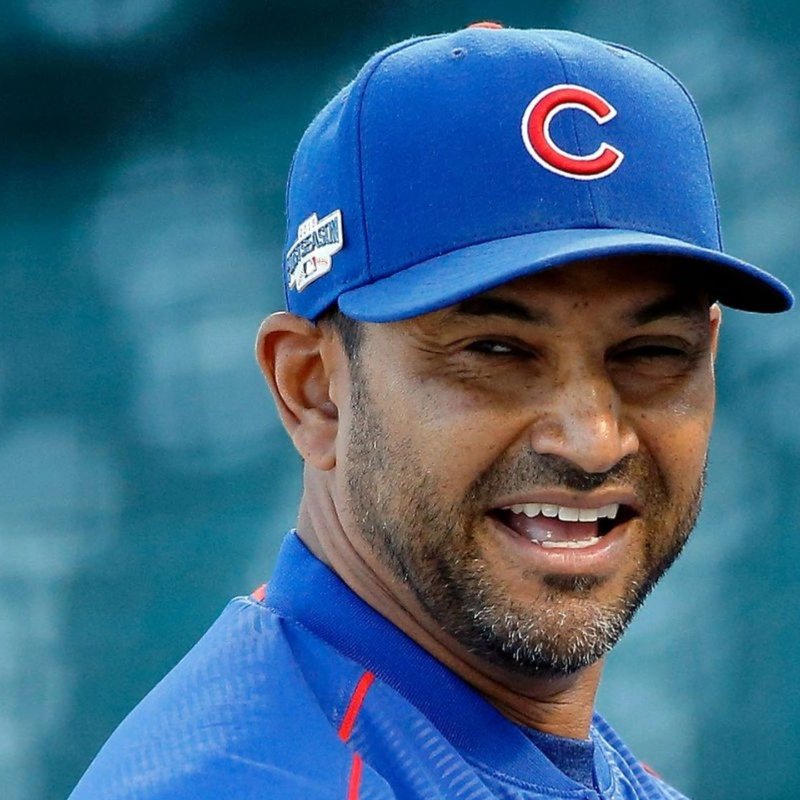 Dave Martinez is a former MLB outfielder and current manager who spent parts of four seasons with the Chicago Cubs as a player and three years as bench coach. Martinez was originally a 40th-round draft pick of the Texas Rangers, though after returning to school, the Cubs snagged him in the third round of the 1983 MLB January Draft-Secondary Phase from Valencia Community College. After spending a few years honing his game in the minor leagues, Martinez finally got the call to the big leagues in 1986 as a replacement for the injured Bob Dernier. Outside of a 90-game stretch in 1988 where he was worth 2.5 WAR, Martinez mostly struggled in his first go-round with the Cubs, eventually getting traded at 23 years old to the Montreal Expos for Mitch Webster. He would go on to spend plenty of time with the Expos, Cincinnati Reds, San Francisco Giants, and Chicago White Sox before becoming the first ever player traded by the Tampa Bay Devil Rays organization in 2000 (in exchange for Cubs southpaw reliever Mark Guthrie). Martinez again struggled in the Windy City, slashing just .185/.214/.241 in 18 games. Across all four of his seasons on the North Side (288 games), the outfielder was worth just 0.7 WAR and posted an OPS of .683. That second tenure did not last long, as later in that same season, the Cubs flipped Martinez to the Texas Rangers in a three-team trade that sent Chuck Smith from the Florida Marlins to the Rangers and Brant Brown from the Marlins to the Cubs. Then, for the third time(!) in the 2000 season, Martinez was traded, this time from the Rangers to the Blue Jays. By playing for four big league teams in the same calendar year, Martinez tied the MLB record, which is also held by Frank Huelsman (1904), Willis Hudlin (1940), Paul Lehner (1951), Wes Covington (1961), Mike Kilkenny (1972), Dave Kingman (1977), Dan Miceli (2003), and José Bautista (2004). Martinez played for the Atlanta Braves in 2001 before an injury ended his playing career. Of course, Martinez's legacy with the Cubs wasn't strictly limited to his on-the-field play. A longtime disciple of Joe Maddon, Martinez was the Rays' bench coach from 2008-14 before defecting alongside Maddon to Chicago. He was the team's bench coach from 2015-17, arguably the best three-year stretch in franchise history. Of course, the Cubs won it all in 2016, and Martinez was a beloved figure in the dugout. His departure for the Washington Nationals' top job prior to 2018 pre-dated Maddon's by two years, but I'll always remember how bittersweet it was to finally watch the Cubs become the envy of other teams as their top brass was poached. With the benefit of hindsight, it's easy to say Martinez's departure was the beginning of the end for that brilliant, championship-winning core. I'd be remiss not to note that Martinez won it all as the Nationals' manager in 2019, though his tenure has been rocky since as the club has undergone a systematic overhaul. Also, Martinez's replacement on the Cubs, Brandon Hyde, was similarly hired as a manger (of the Baltimore Orioles) one year later. Clearly, those Cubs teams had the coaching prowess to match the player talent.
 -
Does anyone else remember when Taijuan Walker was an up-and-coming arm for the Seattle Mariners? Where did the time go...
-
Mark Guthrie is a former MLB relief pitcher who spent 15 seasons in the big leagues, including parts of three campaigns with the Chicago Cubs. Originally drafted by the St. Louis Cardinals in the fourth round of the 1986 MLB Draft, Guthrie returned to LSU for his senior season, ultimately falling to the seventh round in the following year's selection cycle before the Minnesota Twins scooped him up. Winning had a way of following Guthrie, as LSU won its first ever College World Series appearance with him atop the pitching staff in 1986. The Twins then won the World Series in 1987 after drafting him (while Guthrie was still in the minor leagues), and finally, the stars aligned, as Guthrie and the Twins won the 1991 World Series, the same year his alma mater won its first National Championship. Guthrie lasted parts of seven seasons in Minneapolis, converting from a starter to a reliever by the end of his tenure. Then, during the 1995 season, Guthrie was traded to the Los Angeles Dodgers, where he would serve primarily as the set-up man to two-time All-Star closer Jeff Shaw. Guthrie then headed to Boston in free agency, ultimately lasting just 46 games with the Red Sox before finding himself in Chicago in exchange for Rod Beck. Hand up, I legitimately did not remember that Guthrie pitched for the Cubs in 1999 and 2000. In fairness to myself, he only made 30 appearances during his first stop on the North Side before being traded to the Tampa Bay Devil Rays in the first trade in that franchise's history (the Cubs received outfielder Dave Martinez in return). After a brief tour of the country with the Rays, Toronto Blue Jays, Oakland Athletics, and New York Mets, Guthrie returned to the Cubs on a one-year deal, and this time, his tenure in Chicago was far more memorable. In 42 2/3 regular season innings for the Cubs in 2003, Guthrie authored a 2.74 ERA, somehow finding a way to shut opposing hitters down despite a 24-22 strikeout-to-walk ratio. Alongside Kyle Farnsworth (19 holds) and Mike Remlinger (17 holds), Guthrie (10 holds) served as a set-up man for closer Joe Borowski. It was a really strong quartet to have in the back-end of the bullpen... at least until the playoffs. Guthrie deserves plenty of credit for a brilliant final season with the Cubs, but he was disastrous in the playoffs, surrendering two home runs in just 1 2/3 innings pitched. Of course, nothing mattered more than the pinch-hit home run he surrendered to Mike Lowell in Game 1 of the 2003 NLCS, which gave the Marlins a crucial 9-8 victory. After that 2003 season, Guthrie signed a minor league deal with the Pittsburgh Pirates, but the writing was on the wall. After failing to make the roster out of spring training, Guthrie officially retired from Major League Baseball in 2004. View full player
-
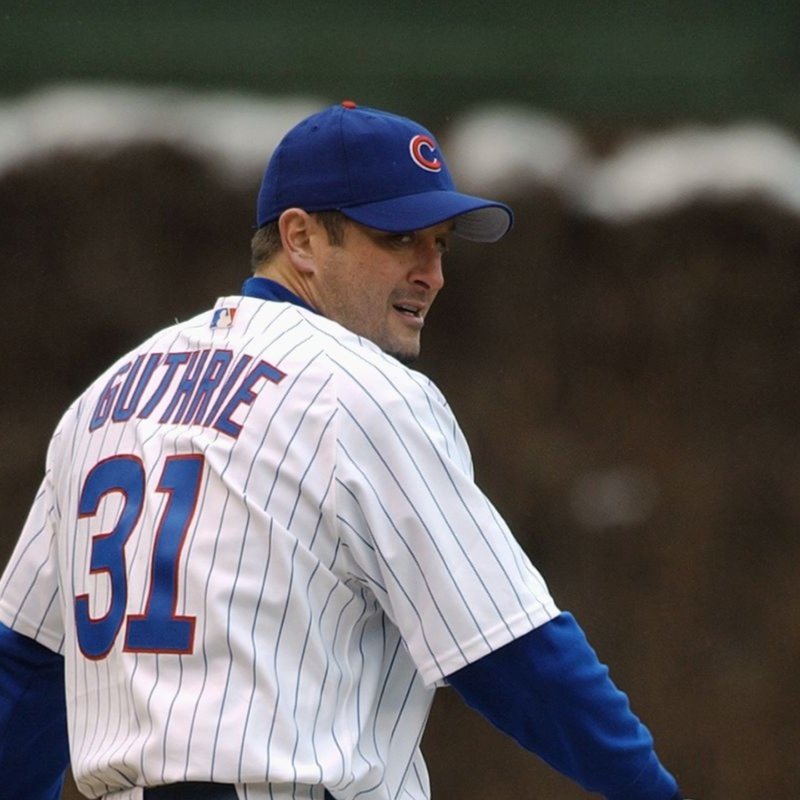 Mark Guthrie is a former MLB relief pitcher who spent 15 seasons in the big leagues, including parts of three campaigns with the Chicago Cubs. Originally drafted by the St. Louis Cardinals in the fourth round of the 1986 MLB Draft, Guthrie returned to LSU for his senior season, ultimately falling to the seventh round in the following year's selection cycle before the Minnesota Twins scooped him up. Winning had a way of following Guthrie, as LSU won its first ever College World Series appearance with him atop the pitching staff in 1986. The Twins then won the World Series in 1987 after drafting him (while Guthrie was still in the minor leagues), and finally, the stars aligned, as Guthrie and the Twins won the 1991 World Series, the same year his alma mater won its first National Championship. Guthrie lasted parts of seven seasons in Minneapolis, converting from a starter to a reliever by the end of his tenure. Then, during the 1995 season, Guthrie was traded to the Los Angeles Dodgers, where he would serve primarily as the set-up man to two-time All-Star closer Jeff Shaw. Guthrie then headed to Boston in free agency, ultimately lasting just 46 games with the Red Sox before finding himself in Chicago in exchange for Rod Beck. Hand up, I legitimately did not remember that Guthrie pitched for the Cubs in 1999 and 2000. In fairness to myself, he only made 30 appearances during his first stop on the North Side before being traded to the Tampa Bay Devil Rays in the first trade in that franchise's history (the Cubs received outfielder Dave Martinez in return). After a brief tour of the country with the Rays, Toronto Blue Jays, Oakland Athletics, and New York Mets, Guthrie returned to the Cubs on a one-year deal, and this time, his tenure in Chicago was far more memorable. In 42 2/3 regular season innings for the Cubs in 2003, Guthrie authored a 2.74 ERA, somehow finding a way to shut opposing hitters down despite a 24-22 strikeout-to-walk ratio. Alongside Kyle Farnsworth (19 holds) and Mike Remlinger (17 holds), Guthrie (10 holds) served as a set-up man for closer Joe Borowski. It was a really strong quartet to have in the back-end of the bullpen... at least until the playoffs. Guthrie deserves plenty of credit for a brilliant final season with the Cubs, but he was disastrous in the playoffs, surrendering two home runs in just 1 2/3 innings pitched. Of course, nothing mattered more than the pinch-hit home run he surrendered to Mike Lowell in Game 1 of the 2003 NLCS, which gave the Marlins a crucial 9-8 victory. After that 2003 season, Guthrie signed a minor league deal with the Pittsburgh Pirates, but the writing was on the wall. After failing to make the roster out of spring training, Guthrie officially retired from Major League Baseball in 2004.
 -
Ahem. Today is the FINAL time the Cubs have to play the Dodgers in the regular season. AND if they win, they win the season series 4-3. So, uh, who's down for a sweep?
-
Happy Tuesday! It's... another game against the Dodgers. Yay. At least Shota is on the mound.
-
It's an Easter clash between the Cubs and D-Backs. A series sweep here would be sweet.