Brandon Glick
-
Posts
1,153 -
Joined
-
Last visited
Content Type
Profiles
Joomla Posts 1
Chicago Cubs Videos
Chicago Cubs Free Agent & Trade Rumors, Notes, & Tidbits
2026 Chicago Cubs Top Prospects Ranking
News
2023 Chicago Cubs Draft Picks
Guides & Resources
2024 Chicago Cubs Draft Picks
The Chicago Cubs Players Project
2025 Chicago Cubs Draft Pick Tracker
2026 Chicago Cubs Draft Tracker: Picks & Bonuses
Blogs
Events
Forums
Store
Gallery
Everything posted by Brandon Glick
-
The Cubs demoted their top hitting prospect in order to make room for Ian Happ in left field. Was Ballesteros' MLB debut encouraging?
-
The Cubs demoted their top hitting prospect in order to make room for Ian Happ in left field. Was Ballesteros' MLB debut encouraging? View full video
-
What would constitute a good outing for Cade Horton tonight? A quality start? A no-hitter? Personally, I'd settle for a "Maddux".

-
I'm not saying it means anything, but in two at-bats versus Jameson Taillon, Kyle Stowers (who has been really good this year) has two home runs. Might wanna pitch around him tonight.
-
Marlins-White Sox-Marlins is a nice reprieve after all those NL West series in April, huh? And good news! The next three series are Reds-Rockies-Reds. Got a good chance to create some distance here.
-
The Cubs have been shockingly bad in potential sweep games this year. No better time than the present to change that.
-
The Cubs have opened up a gap in the NL Central. Can they establish themselves as an NL frontrunner? View full video
-
The Cubs have opened up a gap in the NL Central. Can they establish themselves as an NL frontrunner?
-
With their starting left fielder down, the Cubs have turned to their best pure hitting prospect since Kyle Schwarber. View full video
-
With their starting left fielder down, the Cubs have turned to their best pure hitting prospect since Kyle Schwarber.
-
Cade Horton makes his first MLB start today! Couldn't have drawn a better matchup...
-
A fun win last night, though Ballesteros was pretty disappointing in his debut, which is understandable. I doubt he gets the start tonight against a lefty.
-
So, uh, I guess Moises Ballesteros is on debut watch tonight? Bellozo is a righty, and it's hard for me to imagine Counsell wants Turner or Lopez in there more often than they have to be. I thoroughly expect Ballesteros to start at DH tonight.
-
I cannot believe Cal Quantrill is still in the league.
-
Pope Leo XIV is a Chicago-born native and the first American to ever be elected as Pope. He's also supposedly a baseball fan. Team of destiny, anyone?
-
Pope Leo XIV is a Chicago-born native and the first American to ever be elected as Pope. He's also supposedly a baseball fan. Team of destiny, anyone? View full video
-
Nothing like Mother's Day morning baseball.
-
The Cubs are in desperate need of a new ninth-inning man as they try to navigate the downfall of Pressly. View full video
-
The Cubs are in desperate need of a new ninth-inning man as they try to navigate the downfall of Pressly.
-
So, Cade Horton is NOT starting tonight. That being said, I'd expect him to get a piggyback appearance, assuming Keller doesn't get annihilated in the first two innings. We shall see.
-
The Cubs' best pitcher went down with a hamstring injury, but their top prospect is gearing up for his MLB debut in Imanaga's stead. View full video
-
The Cubs' best pitcher went down with a hamstring injury, but their top prospect is gearing up for his MLB debut in Imanaga's stead.
-
The best of the East and Central clash tonight.
-
Image courtesy of Thieres Rabelo The Cubs were one of the best teams in baseball in April, despite losing the first two games of the year against the Dodgers in Tokyo. While their MLB-leading offense had plenty to do with that, their pitching staff also deserves a lot of love for some impressive performances against the hardest schedule in baseball by a significant margin. You won't see any honorable mentions here, nor will you see any members of the team's much-maligned bullpen. There were three starters who carried the heaviest load in March and April, and they are the ones who we'll be shining the spotlight on here. #3: Shota Imanaga March/April Stats: 39.0 IP, 2.77 ERA, 4.88 FIP, 18.9% K-rate, 8.2% BB-rate, .305 wOBA allowed It was just another ho-hum month for the best pitcher on the Cubs. After finishing fifth in Cy Young voting as a "rookie" last year, the 31-year-old Imanaga continued to dominate hitters in the first month of the 2025 season despite drawing the Dodgers (twice), Diamondbacks, Padres (twice), and Rangers. His splitter remains one of the most valuable pitches in baseball, even as his fastball struggles to get by hitters at 91.2 mph. His 4.88 FIP is worrisome, and that can be attributed to his declining fastball and awful ground-ball rate (26.3%). He's always been a fly ball pitcher, which is why he must improve on his strikeout and walk rates (both of which are far worse than 2024) if he hopes to limit the damage in the summer. Still, as the schedule eases up, Imanaga should remain the Cubs' best pitcher (once he recovers from his hamstring injury). #2: Matthew Boyd March/April Stats: 33 1/3 IP, 2.70 ERA, 3.80 FIP, 20.7% K-rate, 9.0% BB-rate, .331 wOBA allowed Another guy who outperformed all of his advanced metrics, Boyd is looking like one of the smartest moves ever made by Jed Hoyer's front office. I'd say he was the signing of the offseason, but that would be a disservice to the GOAT, Carson Kelly. Like Imanaga, Boyd is also working below-average walk, strikeout, and ground-ball rates, but he is proving more adept than ever at limiting hard contact. He sits in the 86th percentile in barrels allowed, and he's not far behind in hard-hit rate and average exit velocity on balls put in play. He made notable changes in his limited time with the Guardians last year, and his fastball, slider, changeup, and curveball are all performing above league-average, according to xwOBA. #1 (March/April Cubs Cy Young): Colin Rea March/April Stats: 18 2/3 IP, 0.96 ERA, 1.53 FIP, 25.0% K-rate, 3.9% BB-rate, .248 wOBA allowed I cannot believe this. I was frustrated with the Colin Rea signing at the time — perhaps irrationally so — mostly because Rea was just another depth option for a team that needed a true No. 1 or No. 2 to pair with Imanaga and Justin Steele. Those feelings were only heightened when Steele went down for the season with an elbow injury. Well, turns out Rea is even better than the guy he's replacing. He was dominant in the season's first month, authoring a comically-low ERA that is actually supported by a laughable FIP. He walked three guys all month. Yes, the sample size is small (covering just three starts and six total appearances), but he's riding a ridiculous seven-pitch mix to befuddling success. What's really fun about his arsenal is that his four-seam fastball comprises over half of the pitches he throws... while his other six offerings sit somewhere between five and ten percent. Who knows how long he can keep the magic going, but he's proving to be another astute signing by Hoyer and company. What do you think about our list? Are there other Cubs pitchers who you feel deserve this honor? Sound off in the comments! View full article
-
North Side Baseball's Cubs Pitcher of the Month - March/April 2025
Brandon Glick posted an article in Cubs
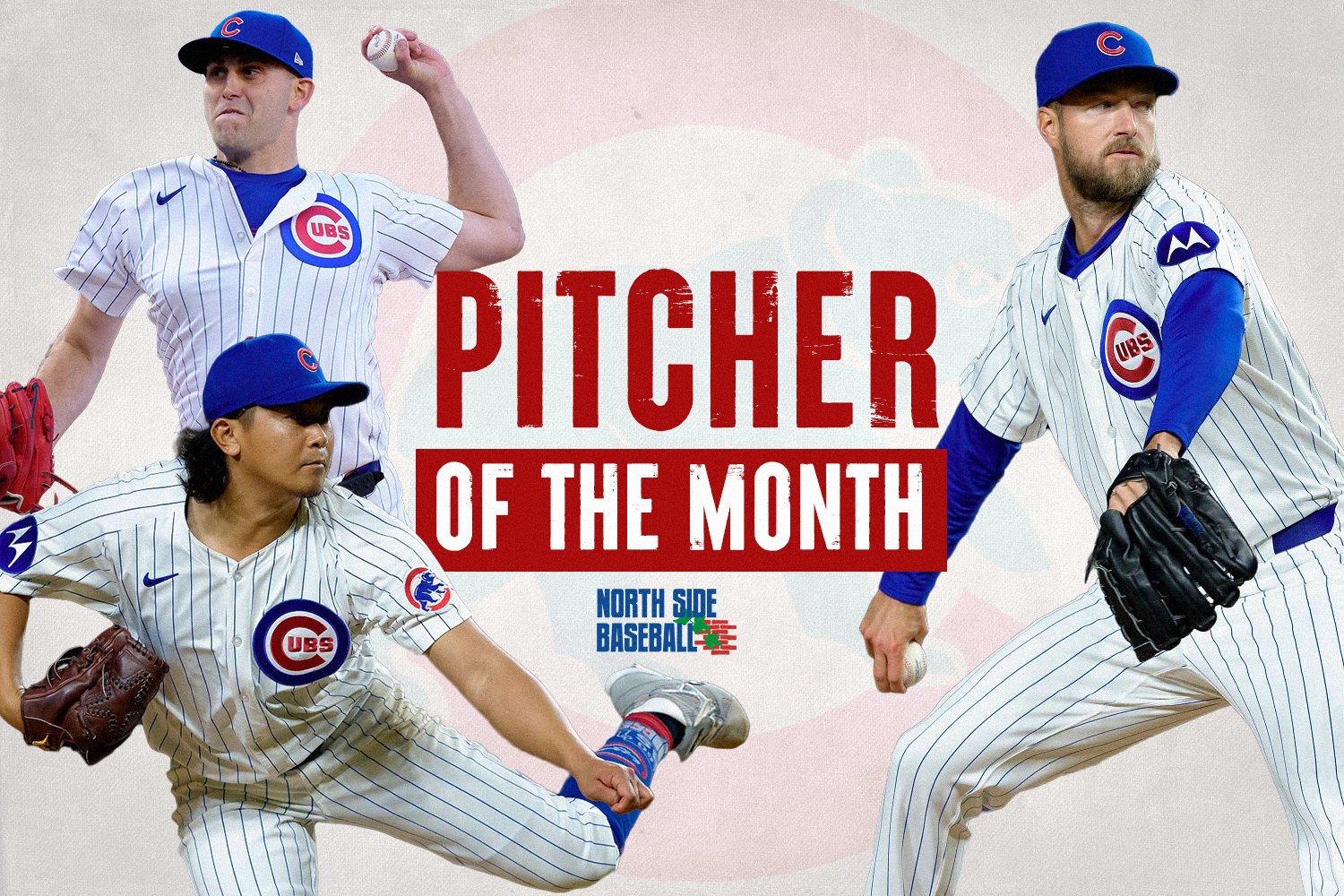 The Cubs were one of the best teams in baseball in April, despite losing the first two games of the year against the Dodgers in Tokyo. While their MLB-leading offense had plenty to do with that, their pitching staff also deserves a lot of love for some impressive performances against the hardest schedule in baseball by a significant margin. You won't see any honorable mentions here, nor will you see any members of the team's much-maligned bullpen. There were three starters who carried the heaviest load in March and April, and they are the ones who we'll be shining the spotlight on here. #3: Shota Imanaga March/April Stats: 39.0 IP, 2.77 ERA, 4.88 FIP, 18.9% K-rate, 8.2% BB-rate, .305 wOBA allowed It was just another ho-hum month for the best pitcher on the Cubs. After finishing fifth in Cy Young voting as a "rookie" last year, the 31-year-old Imanaga continued to dominate hitters in the first month of the 2025 season despite drawing the Dodgers (twice), Diamondbacks, Padres (twice), and Rangers. His splitter remains one of the most valuable pitches in baseball, even as his fastball struggles to get by hitters at 91.2 mph. His 4.88 FIP is worrisome, and that can be attributed to his declining fastball and awful ground-ball rate (26.3%). He's always been a fly ball pitcher, which is why he must improve on his strikeout and walk rates (both of which are far worse than 2024) if he hopes to limit the damage in the summer. Still, as the schedule eases up, Imanaga should remain the Cubs' best pitcher (once he recovers from his hamstring injury). #2: Matthew Boyd March/April Stats: 33 1/3 IP, 2.70 ERA, 3.80 FIP, 20.7% K-rate, 9.0% BB-rate, .331 wOBA allowed Another guy who outperformed all of his advanced metrics, Boyd is looking like one of the smartest moves ever made by Jed Hoyer's front office. I'd say he was the signing of the offseason, but that would be a disservice to the GOAT, Carson Kelly. Like Imanaga, Boyd is also working below-average walk, strikeout, and ground-ball rates, but he is proving more adept than ever at limiting hard contact. He sits in the 86th percentile in barrels allowed, and he's not far behind in hard-hit rate and average exit velocity on balls put in play. He made notable changes in his limited time with the Guardians last year, and his fastball, slider, changeup, and curveball are all performing above league-average, according to xwOBA. #1 (March/April Cubs Cy Young): Colin Rea March/April Stats: 18 2/3 IP, 0.96 ERA, 1.53 FIP, 25.0% K-rate, 3.9% BB-rate, .248 wOBA allowed I cannot believe this. I was frustrated with the Colin Rea signing at the time — perhaps irrationally so — mostly because Rea was just another depth option for a team that needed a true No. 1 or No. 2 to pair with Imanaga and Justin Steele. Those feelings were only heightened when Steele went down for the season with an elbow injury. Well, turns out Rea is even better than the guy he's replacing. He was dominant in the season's first month, authoring a comically-low ERA that is actually supported by a laughable FIP. He walked three guys all month. Yes, the sample size is small (covering just three starts and six total appearances), but he's riding a ridiculous seven-pitch mix to befuddling success. What's really fun about his arsenal is that his four-seam fastball comprises over half of the pitches he throws... while his other six offerings sit somewhere between five and ten percent. Who knows how long he can keep the magic going, but he's proving to be another astute signing by Hoyer and company. What do you think about our list? Are there other Cubs pitchers who you feel deserve this honor? Sound off in the comments!