.jpg.900f6d1bc80a5a156f3ba09ea0e4b3d7.jpg)

Jason Ross
-
Posts
8,154 -
Joined
-
Last visited
-
Days Won
74
Content Type
Profiles
Joomla Posts 1
Chicago Cubs Videos
Chicago Cubs Free Agent & Trade Rumors, Notes, & Tidbits
2026 Chicago Cubs Top Prospects Ranking
News
2023 Chicago Cubs Draft Picks
Guides & Resources
2024 Chicago Cubs Draft Picks
The Chicago Cubs Players Project
2025 Chicago Cubs Draft Pick Tracker
2026 Chicago Cubs Draft Tracker: Picks & Bonuses
Blogs
Events
Forums
Store
Gallery
Everything posted by Jason Ross
-
Dodgers (TBD) vs Cubs (Boyd): 4/23/25, 6:00pm
Jason Ross replied to Brandon Glick's topic in Fred Hornkohl Game Thread Forum
Cubs are now 4-1 against the Dodgers in North America. -
Dodgers (TBD) vs Cubs (Boyd): 4/23/25, 6:00pm
Jason Ross replied to Brandon Glick's topic in Fred Hornkohl Game Thread Forum
Hodge is a straight up dude. -
Dodgers (TBD) vs Cubs (Boyd): 4/23/25, 6:00pm
Jason Ross replied to Brandon Glick's topic in Fred Hornkohl Game Thread Forum
Big out by Boyd! -
Dodgers (TBD) vs Cubs (Boyd): 4/23/25, 6:00pm
Jason Ross replied to Brandon Glick's topic in Fred Hornkohl Game Thread Forum
This offense won't stop. -
Minor League Discussion & Boxes, 4-23-25
Jason Ross replied to CaliforniaRaisin's topic in Cubs Minor League Talk
Was just coming to brag on it. He leads the Southern League in OBP as well. -
Dodgers (TBD) vs Cubs (Boyd): 4/23/25, 6:00pm
Jason Ross replied to Brandon Glick's topic in Fred Hornkohl Game Thread Forum
This time PCA decided to hit it so that it would only a HR in juat one park. Wrigley. -
Dodgers (TBD) vs Cubs (Boyd): 4/23/25, 6:00pm
Jason Ross replied to Brandon Glick's topic in Fred Hornkohl Game Thread Forum
I like when the Cubs hit the baseball in the basket. -
I dont think "his body couldn't handle it" is a fair statement. He got hurt, yes, but he threw 88 IP the year prior, so it isn't like his body gets to 34 and then simply gives up. He had a shoulder issue, it lingered, the Cubs were conservative and shut him down. Assuming he's at full health, and the velo suggests he's fine through April, 100-120 feels fair. Hes at just arpund 16 and probably makes one more April start which is a roughly, 120 IP pace. 120 would include playoff baseball, as well, so expect BP work to slow that down.
-
Dodgers (TBD) vs Cubs (Boyd): 4/23/25, 6:00pm
Jason Ross replied to Brandon Glick's topic in Fred Hornkohl Game Thread Forum
Bummer. Looked good off the bat. -
Dodgers (TBD) vs Cubs (Boyd): 4/23/25, 6:00pm
Jason Ross replied to Brandon Glick's topic in Fred Hornkohl Game Thread Forum
To be a bit fair, the three guys who squared him were Freeman, Betts and Edman which are two HoF'ers (likely) and Tommy Edman on the heater of his life. Tough inning. But yeah, I'm indifferent. He's fine, he's got some funk. But he's not so good you have to keep him. -
He's a name I keep checking in on when NPB names get brought up coming over, but the pre-WBC hype seems to have waned. He's kept the K% in check this year so far per-B-R, but it's like, 16 PA's of reported data, not enough to make even a drop in the pan, really.
-
A fair guestimate would be around 120 IP. Maybe a few more, or a few less.
-
He has been ramping up. He hit 76 pitches today, this is his high water mark. Last game it was 71. There's a push and a pull between ramping up and throwing into the deep end. Expect his next start to go around 80. He's looked exhausted around the 50-55 mark in the past and is generally when he's had struggles. His fastball velo will drop from sitting 97-98 to 94-95mph. The game prior, it was pitch #52 that he surrendered a middle-middle home run on a slider that never dropped off, and pitch 61 where he gave up a 95+ mph rocket to RF. Having him go 90, for example, would not have been a good idea. It's begging for injury from a tired pitcher. He will probably make a debut in Chicago sometime around May. I would expect him to maintain a pitch limit between 80-90 pitches. This should be enough to guide him through 5 or so innings.
-
Michael Fulmer has signed back with the organization. He is coming back from UCL surgery and will be assigned to Iowa.
-
Murakami has monster contact concerns. He struck out 180 times last year in 500 PAs, or in percentages, 36% of the time. That percentage, if it stayed flat (which against the jump in pitching, is unlikely) would lead the league in 2024 for all qualified hitters by 1.5%. Against the level of pitching of the NPB this is a massive red flag. Maybe he can fix it, but even one year of improved data isn't going to quell that concern.
-
Minor League Discussion & Boxes, 4-23-25
Jason Ross replied to CaliforniaRaisin's topic in Cubs Minor League Talk
Purely based on RPM, he's on par with Dylan Cease's average spin both on slider and curveball. Cease is notoriously a "not a super consistent strike thrower" Essentially, Horton's ceiling feels like "What if Dylan Cease threw a lot of strikes and didn't walk guys?" -
Minor League Discussion & Boxes, 4-23-25
Jason Ross replied to CaliforniaRaisin's topic in Cubs Minor League Talk
Here's something to note: Horton has thrown ten curveballs. -
Minor League Discussion & Boxes, 4-23-25
Jason Ross replied to CaliforniaRaisin's topic in Cubs Minor League Talk
Whiff number is really good. I expect he'll be back for a fif th. Should approach 80 pitches if that's the case. -
So, he's someone who doesn't throw a lot of strikes on the surface. Hollowell is a bit like Eli Morgan - he limits hard contact by generating lots of chase. They do it a bit differently, but it's a similar outcome. When Hollowell is in the zone, you can get some swings on him; we saw that last night. Hollowell was clearly looking to throw strikes (he was in the zone more than normal). He's fastball-sweeper heavy - that sweeper needs to get off the plate and chase. He gave up EV's of 107 (xBA of .640), 99, 96 in his two innings Granted, these were against two players who likely end in Cooperstown (Freeman and Betts) and Edman (who's on a heater) so a little can be explained by that. But I think you get the idea; Hollowell in the zone probably isn't his home. This are his total pitches thrown and his chase last night (pitches in the bold received swings) You'll, his o-zone pitches were generally "waste" pitches...no one is really going that far out of the zone to go get those. His sweeper sat in the zone a bit. His fastballs were mostly centercut. If you can generate chase with Hollowell, if he can sit that sweeper on the outside against RHP there's a guy who can be used. His arm angle as Matt outlined in his article yesterday is funky, so deception is his friend. I don't think the Cubs have a back end guy, but if you told me he was Tyson Ross who threw a bit harder, I'd believe you.

-
I still think he can be alright. He missed some real time last year, and is up to a new level. The hope is that as he settles into Iowa, pitch recognition will come with experience. The good news is that when he hits the ball, real damage occurs. If he can just be "alright" with pitch recog...could be good bench guy.
-
We'd have to get pretty deep into the injury red for Murray to be viable. I suspect if he did go down again, the Cubs would either find the Drew-Pomeranz of utility guys, or go with an Alcantara or Franklin (probably the former as he's on the 40). A few weeks of Kevin on the bench, working his way in to CF a few times won't hurt him long term and the Cubs have been open to that idea of letting him learn some as they go. He's more ready than guys like Cowles or Murray and I do think there's positives of being around an MLB team. Finally was able to get Murray's 2024 statcast for emphasis (I wanted to post this in the first one, but wasn't able to get it into it)
-
I can't speak to his pain, but he seems disconnected from his top half and his bottom half. One concern with his leg motion is that there's a lot going on with his timing. He picks the foot up, it slides forward, his body shifts his hands his moves his body forward...it's part of the reason he hits the ball hard. But with moving pieces creates potential glitches in the system. So it could be a pain thing but it could just be a mechanical thing. From my stand point, it feels like he's slow...like his timing mechanism is off. He was hitting the ball hard for a few games once he got back stateside, but there were some games the balls weren't landing. I kind of think it's a mental thing and a mechanical thing, but like I said, can't speak to the pain, so it could be that too. Once the lower half and the top half are in sync I think he'll get it together.
-
Workman kind of sucks right now, but he can relax on the bench for a few weeks. It's either Workman or a different flavor of Workman. The Cubs saw something in him to take him in the Rule V and in ST. He doesn't really need to play much, they've proven they can tote a Mastrobuoni or a Torrens on the bench and we'll barely notice them. Promoting Ben Cowles, who has work to do and can be something more, just to sit on the bench in lieu of that being Workman is change for change's sake. Maybe there's value in that, but I wouldn't expect that value to really be noticed on the field as much.
-
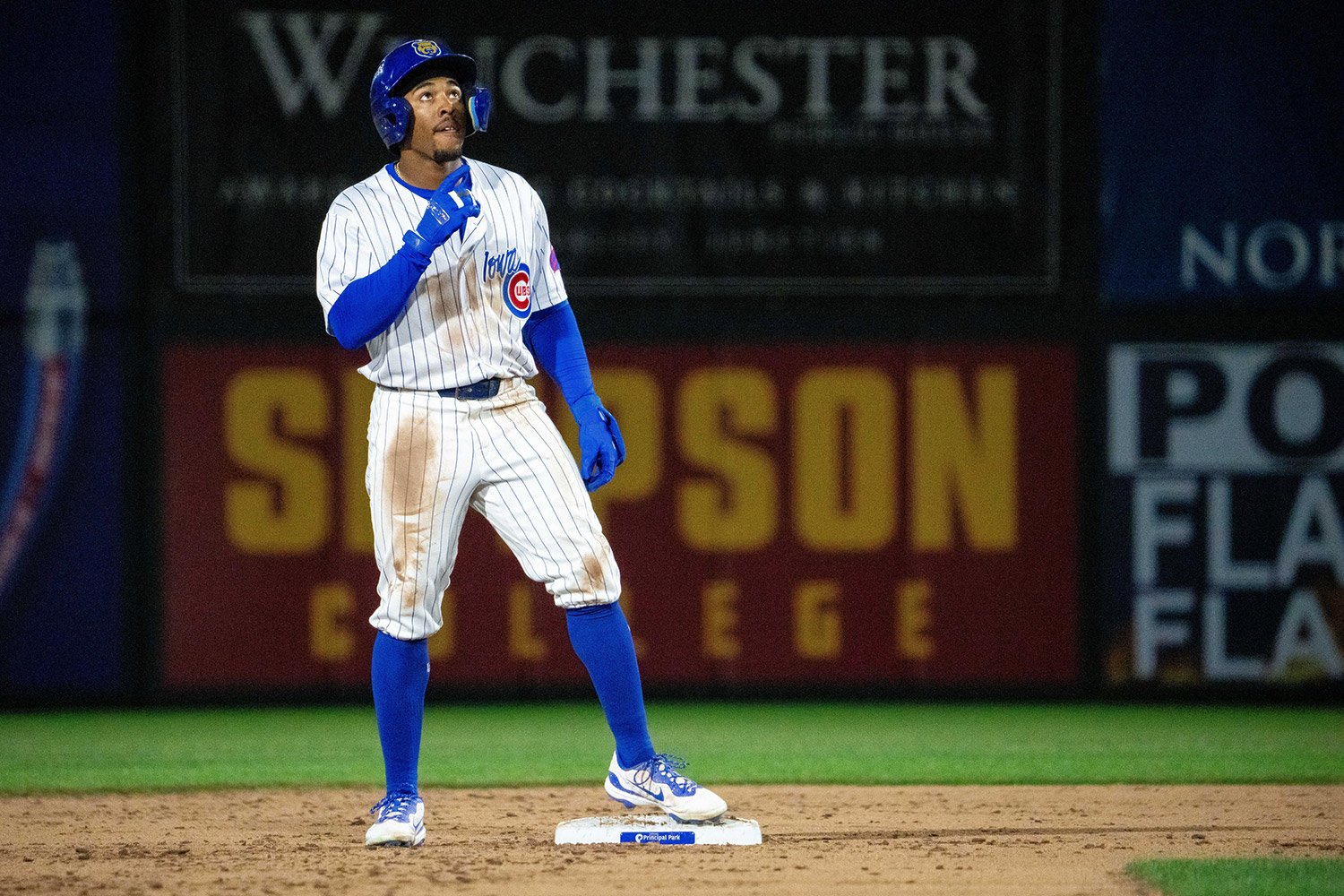 Christian Franklin was the Cubs' fourth-round selection in the 2021 draft. At the time, it felt like the Cubs got a bit of a steal. Franklin was a draft-eligible "sophomore" from the SEC who had a good run of production; you'd tend to find these types higher in the draft. The reason I used the quotations around sophomore is probably a bit of the reason why Franklin was picked when he was. He got an extra year of eligibility due to the pandemic-shortened 2020 collegiate season. As of late May 2021, MLB Pipeline had him targeted as a potential fourth outfielder. Even so, it felt hard to think there were really 122 better prospects in the draft, and not to think that the Cubs kind of got a bit lucky he was there. Between 2021 and today, Franklin has had success at every stop. Offensively, he's been 25-30% better than average at every stop along the way. He's displayed really strong plate discipline and strikeout numbers, which has been a major driver in his offensive ability. If you were to look for some negatives, they would generally come with his power numbers; Franklin's never been a big slugging guy. As someone who, defensively, is likely more suited for a corner spot, this can be a bit of an issue when we consider his ceiling. The former Razorback's highest isolated slugging has been a .162, during his stay at High-A South Bend. Since then, he's been well below .100 and hasn't displayed the oomph you'd really want. While this isn't immediately disqualifying, it makes the road that much more difficult to traverse. This season has seen Franklin enter another gear. While his raw numbers aren't mind-blowing, they are just good enough to kind of hide the true story. Sporting a 116 wRC+, a 22 K% and a 17 BB%, Franklin's line is consistent with what he always does. It would be easy to come to the conclusion that nothing had changed. All you would have to do is peek under the hood, though, and you'd begin to see what improvements he's made. Baseball America, in a post from April 7th, highlighted Franklin as a Statcast standout. These numbers are two weeks old. and in the early part of the MiLB season, two weeks can mean a lot. With that said, they highlight many of the early indicators someone would look for to suggest that there was something different. The outfielder was a standout early in making contact against all types of pitches, making hard contact, and—generally speaking—being a menace to opposing pitchers. . If you were worried that this was small-sample stuff, all he's done is keep it up. Looking at Franklin's up-to-date (as of this writing, April 22nd) batted-ball profile suggests there is no letdown. He's making a lot of hard contact; swinging at the right pitches; and making some real strides. Amazingly enough, his wOBA of .388 seems unlucky so far, as his expected wOBA is .413, To compare to the I-Cubs' other two outfielders, Owen Caissie has an xwOBA of .404 and Alcantara has an xwOBA of .355. Both are great, yet Franklin outpaces both. In the Baseball America article, one thing to note is that Franklin attributes the difference in contact quality to using a larger bat. This isn't the first Cubs outfielder to switch to a heavier bat and see their level of contact quality increase. The parent club's starting center fielder, Pete Crow-Armstrong, has seen similar results. This isn't the only change, however. From a mechanical standpoint, there's been a bit of a change over the last year. Below is Franklin during ST in 2024. Franklin hits a home run off of Chasen Shreve to left field. Note both his hands, and his load. It's a simple load that really doesn't engage the lower half of his body well. It's not a bad swing, by any means, but it could probably be better, especially for someone of Franklin's stature. This isn't Ivan Brethowr (who stands 6-foot-6). This is someone who, at best, scrapes 5-foot-10. He can't use natural leverage or size to his advantage in the same way. Christian Franklin slugs a two-run home run 03172024 MLBcom.mp4 Compare that swing to the one below. This comes from April 14th of this year, roughly a year later. Franklin will drive a ball to deep left-center field. What I'd pay attention to: His hands are in a slightly different area. His engagement of his lower half. He isn't going with a super funky leg kick, but there is more motion on the front foot. He's not just toe-tapping, but lifting. This is helping to create momentum and weight transfer—or, in other words, power. This is important for someone in a smaller package; they need to find ways to create power. It suggests that the strong batted-ball numbers aren't random. They're not an accident. They're planned, and they're the results of real changes, in terms of trying to do more damage per swing. Franklin's hot start seems more than a minor heater. A heavier bat, a better lower half in his swing, strong plate discipline and pitch recognition make Franklin a deadlier hitter. I'll stop short of claiming that Franklin needs to be placed alongside Owen Caissie and Kevin Alcántara on top-100 lists. He's a few years older, much smaller, and probably doesn't offer the same high-end outcomes as the previous two. But the more that Franklin hits this way, the more I'm convinced that the Cubs have a big-league player on their hands, and possibly one who could offer starting upside. I'm getting some Mike Tauchman vibes from Franklin. This isn't meant to be a stylistic comparison, but it's a thumbnail sketch of what Franklin could be. Tauchman was (and is) a quality member of a big-league outfield. He's capable of being your team's corner outfielder, but could moonlight some in center field. The bat was always approach-over-power, but you could find just enough home runs to make it play as a platoon piece. That Franklin isn't pulling the ball a ton in Triple-A gives some pause on how much power he'll flash at a higher level, but the approach shouldn't be a concern. That's why I keep coming back to that Tauchman vibe. The good news for the Cubs is that Franklin is just 25, and carving out a six-year career even as a fourth outfielder would be very valuable. How the Cubs handle their embarrassment of riches in the minors remains to be seen. Franklin probably can't replace Caissie or Alcántara in a trade for (say) Sandy Alcántara in July, but he could make the Cubs more comfortable moving one of those guys, or be used as a really interesting second piece in a trade for a team who's interested in what the batted-ball profile says. Regardless, Franklin has come a long way. He's gone from a fourth-round selection, to an interesting prospect, to someone I think I've slept on for too long. Don't make the same mistake. What do you think of Christian Franklin? Do you think the changes to his swing are the catalyst for his strong batted-ball data? What kind of a ceiling do you think he has? Let us know in the comment section below.
 -
The Iowa Cubs have a stacked team, and specifically, a stacked outfield. Since they boast two top-100 prospects, it's easy to forget that teams deploy three of those. The third guy in the Cubs' Triple-A outfield, however, isn't a nobody, and there's reason to believe he's better than he's been credited for. Image courtesy of © Cody Scanlan/The Register / USA TODAY NETWORK via Imagn Images The Iowa Cubs have a stacked team, and specifically, a stacked outfield. Since they boast two top-100 prospects, it's easy to forget that teams deploy three of those. The third guy in the Cubs' Triple-A outfield, however, isn't a nobody, and there's reason to believe he's better than he's been credited for. Christian Franklin was the Cubs' fourth-round selection in the 2021 draft. At the time, it felt like the Cubs got a bit of a steal. Franklin was a draft-eligible "sophomore" from the SEC who had a good run of production; you'd tend to find these types higher in the draft. The reason I used the quotations around sophomore is probably a bit of the reason why Franklin was picked when he was. He got an extra year of eligibility due to the pandemic-shortened 2020 collegiate season. As of late May 2021, MLB Pipeline had him targeted as a potential fourth outfielder. Even so, it felt hard to think there were really 122 better prospects in the draft, and not to think that the Cubs kind of got a bit lucky he was there. Between 2021 and today, Franklin has had success at every stop. Offensively, he's been 25-30% better than average at every stop along the way. He's displayed really strong plate discipline and strikeout numbers, which has been a major driver in his offensive ability. If you were to look for some negatives, they would generally come with his power numbers; Franklin's never been a big slugging guy. As someone who, defensively, is likely more suited for a corner spot, this can be a bit of an issue when we consider his ceiling. The former Razorback's highest isolated slugging has been a .162, during his stay at High-A South Bend. Since then, he's been well below .100 and hasn't displayed the oomph you'd really want. While this isn't immediately disqualifying, it makes the road that much more difficult to traverse. This season has seen Franklin enter another gear. While his raw numbers aren't mind-blowing, they are just good enough to kind of hide the true story. Sporting a 116 wRC+, a 22 K% and a 17 BB%, Franklin's line is consistent with what he always does. It would be easy to come to the conclusion that nothing had changed. All you would have to do is peek under the hood, though, and you'd begin to see what improvements he's made. Baseball America, in a post from April 7th, highlighted Franklin as a Statcast standout. These numbers are two weeks old. and in the early part of the MiLB season, two weeks can mean a lot. With that said, they highlight many of the early indicators someone would look for to suggest that there was something different. The outfielder was a standout early in making contact against all types of pitches, making hard contact, and—generally speaking—being a menace to opposing pitchers. . If you were worried that this was small-sample stuff, all he's done is keep it up. Looking at Franklin's up-to-date (as of this writing, April 22nd) batted-ball profile suggests there is no letdown. He's making a lot of hard contact; swinging at the right pitches; and making some real strides. Amazingly enough, his wOBA of .388 seems unlucky so far, as his expected wOBA is .413, To compare to the I-Cubs' other two outfielders, Owen Caissie has an xwOBA of .404 and Alcantara has an xwOBA of .355. Both are great, yet Franklin outpaces both. In the Baseball America article, one thing to note is that Franklin attributes the difference in contact quality to using a larger bat. This isn't the first Cubs outfielder to switch to a heavier bat and see their level of contact quality increase. The parent club's starting center fielder, Pete Crow-Armstrong, has seen similar results. This isn't the only change, however. From a mechanical standpoint, there's been a bit of a change over the last year. Below is Franklin during ST in 2024. Franklin hits a home run off of Chasen Shreve to left field. Note both his hands, and his load. It's a simple load that really doesn't engage the lower half of his body well. It's not a bad swing, by any means, but it could probably be better, especially for someone of Franklin's stature. This isn't Ivan Brethowr (who stands 6-foot-6). This is someone who, at best, scrapes 5-foot-10. He can't use natural leverage or size to his advantage in the same way. Christian Franklin slugs a two-run home run 03172024 MLBcom.mp4 Compare that swing to the one below. This comes from April 14th of this year, roughly a year later. Franklin will drive a ball to deep left-center field. What I'd pay attention to: His hands are in a slightly different area. His engagement of his lower half. He isn't going with a super funky leg kick, but there is more motion on the front foot. He's not just toe-tapping, but lifting. This is helping to create momentum and weight transfer—or, in other words, power. This is important for someone in a smaller package; they need to find ways to create power. It suggests that the strong batted-ball numbers aren't random. They're not an accident. They're planned, and they're the results of real changes, in terms of trying to do more damage per swing. Franklin's hot start seems more than a minor heater. A heavier bat, a better lower half in his swing, strong plate discipline and pitch recognition make Franklin a deadlier hitter. I'll stop short of claiming that Franklin needs to be placed alongside Owen Caissie and Kevin Alcántara on top-100 lists. He's a few years older, much smaller, and probably doesn't offer the same high-end outcomes as the previous two. But the more that Franklin hits this way, the more I'm convinced that the Cubs have a big-league player on their hands, and possibly one who could offer starting upside. I'm getting some Mike Tauchman vibes from Franklin. This isn't meant to be a stylistic comparison, but it's a thumbnail sketch of what Franklin could be. Tauchman was (and is) a quality member of a big-league outfield. He's capable of being your team's corner outfielder, but could moonlight some in center field. The bat was always approach-over-power, but you could find just enough home runs to make it play as a platoon piece. That Franklin isn't pulling the ball a ton in Triple-A gives some pause on how much power he'll flash at a higher level, but the approach shouldn't be a concern. That's why I keep coming back to that Tauchman vibe. The good news for the Cubs is that Franklin is just 25, and carving out a six-year career even as a fourth outfielder would be very valuable. How the Cubs handle their embarrassment of riches in the minors remains to be seen. Franklin probably can't replace Caissie or Alcántara in a trade for (say) Sandy Alcántara in July, but he could make the Cubs more comfortable moving one of those guys, or be used as a really interesting second piece in a trade for a team who's interested in what the batted-ball profile says. Regardless, Franklin has come a long way. He's gone from a fourth-round selection, to an interesting prospect, to someone I think I've slept on for too long. Don't make the same mistake. What do you think of Christian Franklin? Do you think the changes to his swing are the catalyst for his strong batted-ball data? What kind of a ceiling do you think he has? Let us know in the comment section below. View full article