.jpg.900f6d1bc80a5a156f3ba09ea0e4b3d7.jpg)

Jason Ross
-
Posts
8,154 -
Joined
-
Last visited
-
Days Won
74
Content Type
Profiles
Joomla Posts 1
Chicago Cubs Videos
Chicago Cubs Free Agent & Trade Rumors, Notes, & Tidbits
2026 Chicago Cubs Top Prospects Ranking
News
2023 Chicago Cubs Draft Picks
Guides & Resources
2024 Chicago Cubs Draft Picks
The Chicago Cubs Players Project
2025 Chicago Cubs Draft Pick Tracker
2026 Chicago Cubs Draft Tracker: Picks & Bonuses
Blogs
Events
Forums
Store
Gallery
Everything posted by Jason Ross
-
Exactly this. I appreciate the idea of a creative solution for a straight forward problem, but I don't think the Cubs need creativity here. Jon Berti is...fine. His xwOBA is .324 currently. suggesting some unlucky outcomes, he adds base running and he's a fine fielder. A star? No. But the Cubs are getting well above average offensive contributions across the board and Berti can stabilize. That's all they need right now. Just go be a 90 wRC+ hitter, a somewhat positive fielder, and steal bases for a few weeks. Let Shaw work on his timing (his timing still seems off in Iowa; he's just a little disconnected right now) and when he gets it back together, you go back to Matt. Straightforward solution for a straightforward problem.
-
I do! TJ Stats has a Patreon page that also allows you access to his app. His app uses fangraphs and MiLB statcast data to generate these plots for every player in Triple-A and in the Florida League (the only other league with accessible Statcast), Runs $10 a month with a $5 first month discount. I use them a lot because of the articles and the podcast I do through here, so for me, I can say fully worth it.
-
BJ Murray was horrible in Iowa last year. He had a 72 wRC+ with all of the batted ball data to suggest he was every bit that bad. He wouldn't be the first prospect to find his footing eventually, surely, But let's put it this way: Gage Workman, in Double-A, posted a 142 wRC+. Then he skipped Triple-A. And he had, supposedly a good glove. How's that working out? BJ Murray is the same age, repeating Double-A and doesn't have a good glove. He failed badly at Triple-A as well. There is literally zero reason the Cubs should give a PA to Murray at the MLB level right now. Murray needs to continue to hit at Knoxville, then show up to Iowa and show that the numbers last year are behind him before he becomes viable. Impossible? Certainly not. But that's beyond desperation at this stage for a team who doesn't need desperation.
-
He's not ready - that's the profile of someone struggling with pitch recognition. He's making good contact when he hits it, but he's chasing a ton and whiffing a ton. There really isn't a creative option right now. But the Cubs shouldn't force it - just play Berti. He's fine. The offense is doing great. The Cubs don't need to try to ruin a Cowles (who's still learning Triple-A) or force a 1b to play 3b in Johnny Long. Matt Shaw should hopefully be back in a few weeks.

-
Listen, half the reason the last two have been all-timers are because of the bullpen. They're just entertainers.
-
Yeah. He's special.
-
A bit harsh, but his calling card is his glove. Offensively he's outmatched. He might be able to learn his way into being an MLB hitter, but offensively, he's not adding much for a bit. If he can't make the fairly tough ones defensively? I try to be pretty nuanced, but this isn't the first gaffe he's had. Could be in his head. Could be a "we thought his glove was better than it is" type of scouting...but it's not working right now for him. On a human level I feel bad, on a baseball level, if his glove isn't going to be plus then I'm not sure he's an MLB option right now.
-
Prospect voting now open for 2025!
Jason Ross replied to Brock Beauchamp's topic in Cubs Minor League Talk
I filled out my top-20 and kind of blanked on even adding him - being that he's been with the parent club all year and having never really been a "Cub" prospect prior. On one hand, I feel bad for the kid on a human level for how rough tonight was. On the other, my prospect list... -
Vidal's helmet held on for dear life until the bitter end.
-
W!
-
Jed playing 4D chess. Amaya can't hit a home run off Tanner Scott if Tanner is in your own damn bullpen. It's why he let the Dodgers sign him.
-
MIGGY!!!!
-
C'mon, Gage.
-
Can't be. I've been told more than once that the Cubs didn't have any star type prospects over the last few years. Sadly, that means his performance is merely "okay" or "pedestrian". Dealer's choice.
-
Prospect voting now open for 2025!
Jason Ross replied to Brock Beauchamp's topic in Cubs Minor League Talk
-
Prospect voting now open for 2025!
Jason Ross replied to Brock Beauchamp's topic in Cubs Minor League Talk
@Brock BeauchampCan I get Ivan Brethowr, Juan Tomas, Alexey Lumpuy, and Kevin Alvarez added? -
No one can convince me otherwise; Drew Pomeranz hired Tom Segura to carry his bag.
-
Hopefully his control is a bit better. He's been a bit off at the start of the year. I like his slider-fastball-mustache combo, though.
-
Prospect voting now open for 2025!
Jason Ross replied to Brock Beauchamp's topic in Cubs Minor League Talk
A few other good names! -
Prospect voting now open for 2025!
Jason Ross replied to Brock Beauchamp's topic in Cubs Minor League Talk
Names to add: Ivan Brethowr, Alexey Lumpuy, Juan Tomas, Kevin Alvarez Some names we can likely delete: Brennen Davis, Cam Smith, Luis Vazquez, Alexander Canario, Juan Bello - all are outside of the org now (Just some prospect dork cleanup suggestions) -
While certainly not impossible, Roberts and Miller represent similar profiles - they both should limit hard contact using a sweeper/slider heavy approach and work far better against RHP. Having both is probably overkill on that profile. I would agree with Bertz that the likely answer is that Roberts will be optioned to Iowa. It's fine, it's not criminal, only a bit of a bummer from his stand point.
-
Minor League Discussion & Boxes, 4-22-25
Jason Ross replied to CaliforniaRaisin's topic in Cubs Minor League Talk
Good to see the Cruz name pop up. You'll have to forgive my lack of source on it at this moment (I'll look it up shortly again) but, I believe it was BA who had an interesting blurb on Cruz - the Cubs thought Cruz outhit Cam Smith on the Trajekt system over the fall and winter. That's obviously not game stuff, but he feels like a guy who could have some real helium behind him. -
Bummer if it's Roberts down. He's looked a bit like he's settling in, but Miller is probably a more stable version of "limits hard contact" from the right handed side as is.
-
There's plenty of jokes to make, but his statcast page looks solid-enough. He's 36, so there's a good bit of "yeah, but he like played in the MLB for a while" to that. But...it's something to hang your hat on. Wish the stuff+ was a bit better, but if you can use him match-up-style wise? The best version of this is that the Cubs don't really need a lot from him. Maybe 15 innings of mostly competent pitching in what will probably be games they're down in. Then you can move on from him as you approach the deadline
-
Minor League Hot or Not: Can Anyone Stop Moises Ballesteros?
Jason Ross posted an article in Minor Leagues
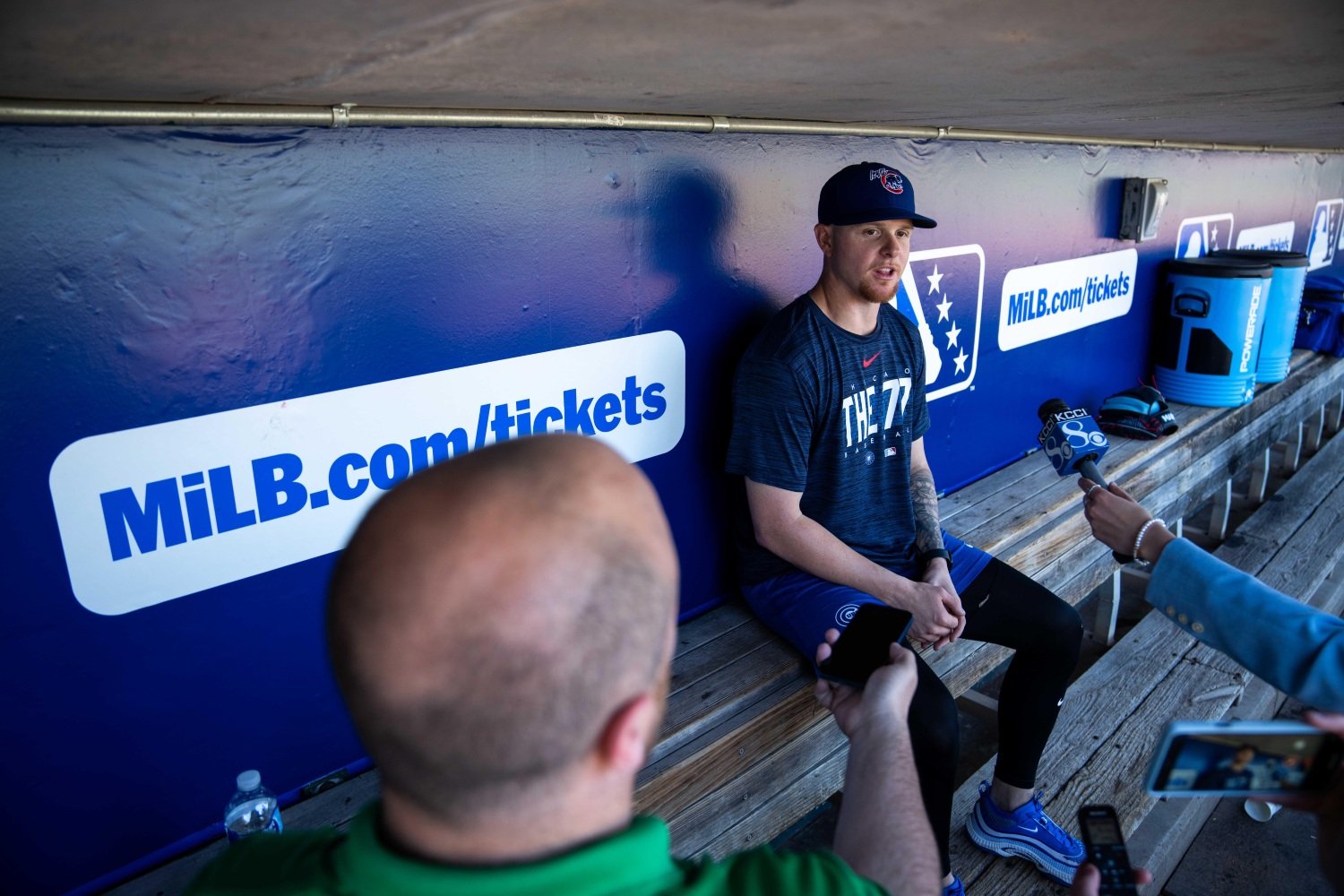 April enters into it's final full week, and the Cubs' minor-league affiliates are chugging along so far. Iowa got a big boost with the addition of Matt Shaw mid-week (trying to look at the positive side of things), as the third baseman is headed back to the I-Cubs for timing work. Not to be missed, the Iowa Cubs set a record for home runs hit. Our very own @Travis Klosinski explored how they did that and who went yard. The Cubs have changed how they are using their farm arms (make sure you read my explanation and theories behind it here). The weather is hopefully warming up as well. Overall System Rating: 🤷♂️ From a purely wins-and-losses standpoint, it was not a great week. Iowa was the only .500 or better team; South Bend managed to lose all six. But from a prospecting standpoint, the guys you'd hope to do well, did, and there were no obvious injuries. Owen Caissie made his return (and hit a homer against rehabbing Twins starter, Pablo López). It's hard to be terribly upset at the tradeoff. Frankly, I'd rather it be this than the reverse (wins, but the top names struggling). Iowa Cubs, Triple A (3-2) Up next: @ Louisville Bats (Cincinnati Reds) 🔥 Cade Horton, SP - 5 IP, 6 K, 3 BB, 1 ER: I really thought Cade Horton had a strong outing. It wasn't a perfect outing, but I loved how many strikes he threw (55% in the zone) and how the Cubs gave him extra rope after he looked a little gassed. He's getting closer and closer to being capable of helping the Chicago Cubs. 🔥 Moises Ballesteros - 290 wRC+, 4.2 K%, 16.7 BB%, 2 HR, 2 XBH: Video. Game. Numbers. The Cubs' top catching prospect currently sports a 172 wRC+ on the season; is striking out around 13% of the time; sports a 90th-percentile exit velocity in the 85th percentile among Triple-A batters; and has an 84th-percentile hard-hit rate. If the Cubs weren't leading the league in offense and didn't have excellent production from first base, catcher and the designated hitter spot right now, Ballesteros would probably be a lot closer to taking a spot than he is right now. 🥶 Jack Neely, RP - 1 2/3 IP, 2 K, 4 BB, 6 ER: Oh, that's bad. The Cubs acquired Neely last year at the trade deadline, and he's struggled for command and consistency this year. He's either piping things to avoid walks or throwing poor strikes. The stuff is there, and it's a bummer that he's not settling in as much as you'd hope. The Cubs still have a need in the bullpen at the next level, but Neely is not currently in contention for any of those innings. 🔥 Tyson Miller, RP, 2 1/3, 4 K, 0 BB, 0 ER: This is cheating a bit, because Miller is on a rehab assignment, but I'm going to highlight him anyway. Whereas Neely is squandering a chance to up his positioning in the pecking order, Miller is coming back from a hip impingement and (likely) forcing his way back into the plans. With Eli Morgan down for a bit and Jordan Wicks struggling, seeing Miller back with the Cubs shortly feels like a real possibility. Knoxville Smokies, Double-A (3-3) Up next: @Pensacola Blue Wahoos (Miami Marlins) 🔥 BJ Murray Jr., 3B - 200 wRC+, 16.7 K%, 4.2 BB%, 3 HR: Murray is probably too advanced for Knoxville, but will likely be stuck here for a bit longer. With the Cubs sending Matt Shaw back to Iowa, there really isn't much of an opportunity for Murray to crack the Iowa lineup over other prospects. Still, Murray can state his case for a second shot at Iowa by continuing to hit in Knoxville. 🔥 Pedro Ramirez, INF - 179 wrC+. 8 K%, 12 BB%, 1 2b. 1 3b: I'm not sure the power is there for Ramirez to really ever enter "starting upside" territory, but he just keeps hitting, and at some point, he's going to force his way into a conversation. Ramirez, 21 years old, is looking great so far in Knoxville. His .093 ISO suggests that eventually, this will catch up to him in some form, but he's certainly making himself interesting enough and refusing to go away. It wouldn't be surprising to see him in Iowa at the end of the year. 🔥 Grant Kipp, SP - 5 IP, 6 K, 1 BB, 1 ER: Grant Kipp is 25 years old, so we're not talking about the youngest arm in the system. However, there have been some real leaps forward concerning Kipp's slider, and he's put himself on the radar. I think the profile is more of a reliever at the next level, but that's not a knock. I wouldn't be surprised to see him moved to Iowa, and Kipp getting middle-inning looks in Chicago late this summer seems plausible. 🥶 Will Sanders, SP - 3 2/3 IP, 2 K, 0 BB, 5 ER: Sanders had been having a nice season, but this was not his best stuff. Struggling to get hitters out, Sanders gave up seven hits (though a double was his only extra-base hit surrendered). Sanders still has enough going for him that a back-of-the-rotation starting role is possible, and with his season's start, you can chalk this up as a blip—for now. South Bend Cubs, High-A (0-6) Up next: vs Beloit Sky Carp (Miami Marlins) 🔥 Jaxon Wiggins, SP - 5 IP, 7 K, 2 BB, 1 ER: The High-A Cubs went winless, but Wiggins did everything in his power to help deliver a victory. He looked great, and was afforded the chance to go five strong frames. This is the kind of outing you hope your next wave of arms has relatively often, and Wiggins is off to a good start. There's a good chance that by the end of the season, he's widely viewed as a top-5 Cubs prospect. 🔥 Ivan Brethowr, OF - 148 wRC+. 28.6 K%, 19 BB%: I have a feeling I'm going to stump for this kid all year. He's still not getting to his power, but I think that's because of how he's being pitched, more than anything. I asked Eric Longenhagen in his most recent prospect chat about Brethowr. Longenhagen mentioned the swing is still a bit long and that he had a lot of opposite-field contact, but I think pitchers are afraid to come in on the behemoth right now. We'll see if that changes. 🥶 Cristian Hernandez, INF - 44 wRC+, 12.5 K%, 12.5 BB%: Hernandez, who was off to a torrid start and named Player of the Week, came back to Earth a bit. No one is going to have a banner week every week, though. I'm not really worried, and think he should rebound shortly. 🥶 Luis Rujano. SP - 3 1/3 IP, 1 K, 4 BB, 2 ER: Rujano had some juice at one point, but has really struggled so far in 2025. There's some stuff there, but he's just unable to make it work. The starting pitcher struggled to throw quality strikes and was through 60 pitches in the third when his day was over. The scoreline in total was bad in this one, and it's not all Rujano's fault, but not a great start to his High-A career, either. Myrtle Beach Pelicans, Low-A (2-4) Up next: vs Kannapolis Cannon Ballers (Chicago White Sox) 🔥 Nazier Mule, 4 2/3, 5 K, 2 BB, 1 ER: It's fair to note that he did surrender more than just the single earned run (five in total), but a few of those were let in by his relievers. He also contributed to the runs with two throwing errors and a balk. But ignoring the need for pitchers fielding practice, I thought he looked really good. The stuff sat 94-95 mph, and he commanded it way better than before. 🔥 Cole Mathis, DH - 177 wRC+, 19 K%, 9.5 BB%, 2 HR, 5 XBH: Good to see Mathis settle in a bit. In theory, he should move quickly, being an advanced bat with previous Cape experience. Both home runs came in the same game, but he managed three doubles, too. A few more good weeks and he could see South Bend quickly. 🔥 Lionel Espinoza, OF - 128 wRC+, 26.8 K%, 0 BB%, 2 HR: Espinoza has been making loud contact in Myrtle all year. Given that he's 22 and a bit of a repeater at the level, I'm not fully convinced as to what to make of him, but it's enough that he's a name that should probably be on the radar. Espinoza is the rare case of a mid-season call-up from the Dominican Summer League. last year. I wouldn't be surprised to see him in South Bend later this summer. 🥶 Christopher Paciolla, 3b - 10 wRC+, 13 K%, 8.7 BB%: There was some post-draft hype coming from the third baseman, but that's essentially dried up. His contact rate is much better, but he's doing nothing with it on the season, sporting a 70 wRC+. This is his third taste of Low A. I don't want to kick anyone when they're down...but the runway on Paciolla is starting to end quickly.