

.jpg.900f6d1bc80a5a156f3ba09ea0e4b3d7.jpg)

Jason Ross
-
Posts
8,154 -
Joined
-
Last visited
-
Days Won
74
Content Type
Profiles
Joomla Posts 1
Chicago Cubs Videos
Chicago Cubs Free Agent & Trade Rumors, Notes, & Tidbits
2026 Chicago Cubs Top Prospects Ranking
News
2023 Chicago Cubs Draft Picks
Guides & Resources
2024 Chicago Cubs Draft Picks
The Chicago Cubs Players Project
2025 Chicago Cubs Draft Pick Tracker
2026 Chicago Cubs Draft Tracker: Picks & Bonuses
Blogs
Events
Forums
Store
Gallery
Everything posted by Jason Ross
-
I would argue though that even that door cracked is "business as usual". They were willing to do a Scott deal late in the cycle, but they rarely get aggressive and get a guy they like. Sadly, for anyone who likes aggressiveness, this is more or less who Hoyer is. It's pretty likely that this roster will be far from its final form into late January or early February again. I was hoping coming off a 92 win season would change that but it seems like, based on Sharma, that it'll be similar to the 2024 and 2025 off-seasons, as I read the tea leaves. I do hope that that belief only resonates with the pen, but who knows? That isn't to be doom and gloom, Hoyer has put together winning rosters, but just that it feels like we are getting a better and better picture each year of what it will always look like.
-
Sharma immediately threw cold water on the excitement for the potential BP in 2026 with an article today. To boil it down to a quick and digestible form; don't expect them to change who they are. Building from within, trading for an expiring contract and not setting the RP market seems like their plan.
-
Cubs Decline Option, Shota Imanaga Is Now A Free Agent
Jason Ross replied to Matthew Lenz's topic in Chicago Cubs Talk
I was thinking about it on my drive home from work and I kind of came to this conclusion in general and I think the Rea decision will seal it for me; Assuming Ricketts hasn't changed his spending habits and the LT will remain a line in the sand (generally speaking) *if* the Cubs were going to spend bigly in the off-season, I would expect them to clear out whatever funds they could to do so. Declining Shota and Kittredge feels like a start to that and if they declined Rea as well I'd feel more like that was a real plan on the table. We will see what it ends up being. But yeah there are some fun options right now and I'm curious to see where they go. -
Cubs Decline Option, Shota Imanaga Is Now A Free Agent
Jason Ross replied to Matthew Lenz's topic in Chicago Cubs Talk
I posted it elsewhere and while I know the Cubs have conditioned some people to feel the worst about their spending, I think it's overblown. First, regardless of how down you are about the Cubs spending, they are $80m under their spending level last year. And to be fair to them, while they didn't get either over the line, they made real chances to get to the $230m range with either Scott or Bregman, meaning there was some willingness to spend more. The Cubs are not going to come off of a 92 win team and drop to a $175m payroll. The optics would be so horrendously bad. So it's fair to assume they will get around, at least, what they did in 2025. That's $80m. Secondly, the Cubs signed Dansby Swanson to a 7 year contract worth over $170m. That's in the range of what you could expect any of the biggest SP's to get this offseason. So not only have they shown a willingness to spend that kind of money on that kind of a contract under Hoyer, they also have a comp pick to do so with. Aging curve of pitchers right now is better than hitters, too. So if they're going to go 7+ years on a guy, a SP is kind of the way to go. If you are someone who thinks the Cubs are just going to punt the offseason in 2026 with one year deals...well they just declined the Kittredge option (they traded him for cash, but it's clear they were just declining it and got a little something for that choice). If they were going to load up on 1 year deals, you weren't going to find better bang for buck than with Kittredge. It's likely his replacement requires multiple years, which kind of shoots that theory down. The Cubs have made fans feel negative for many of their own actions. But I also think we're jumping the shark a bit with the fear that they're going to come off a 92 win team and just throw Jordan Wicks in the rotation and call it quits. -
Declining Shota Imanaga's Option Will Allow the Cubs to be Better in 2026
Jason Ross posted an article in Cubs
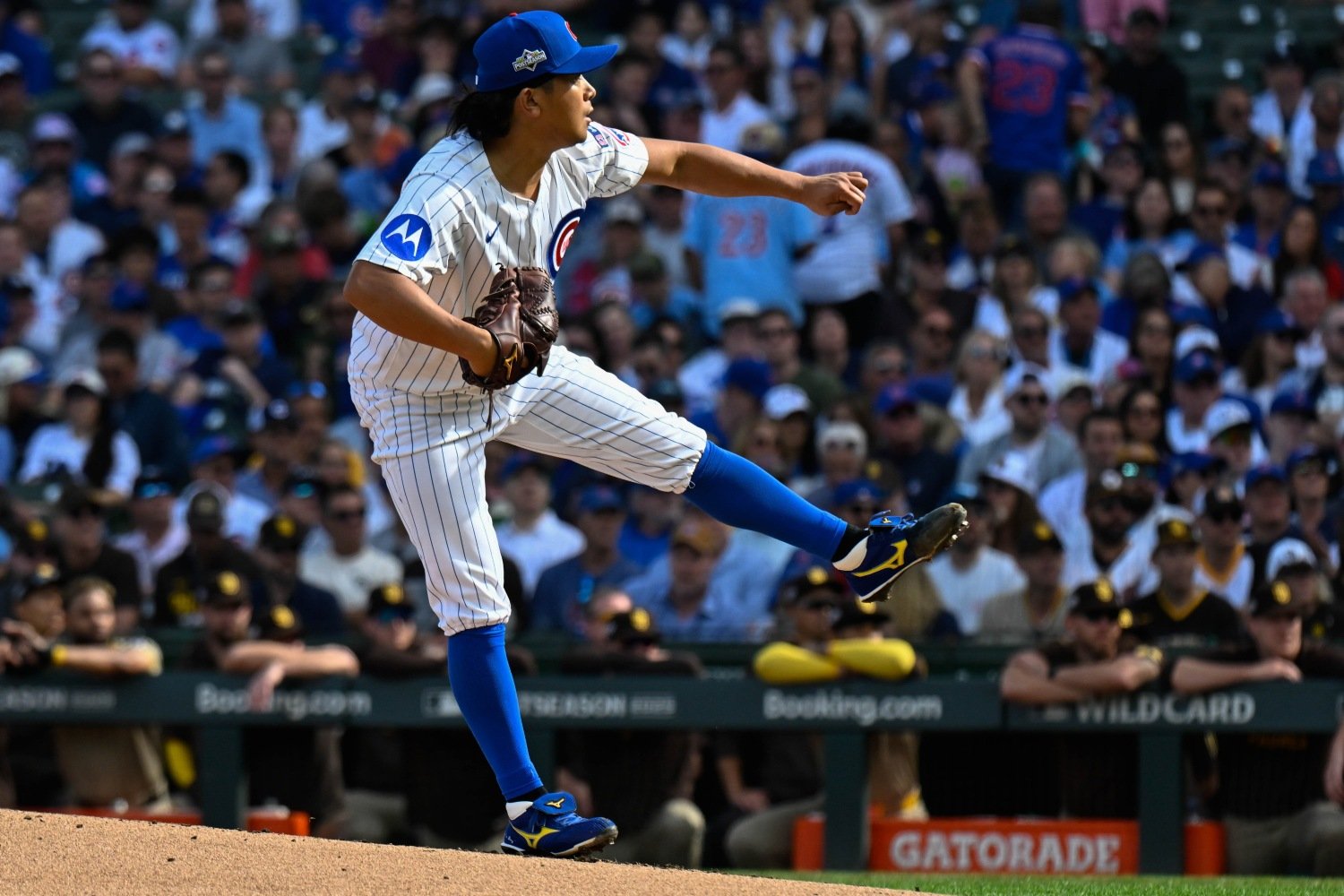 When the Chicago Cubs signed Shota Imanaga two offseasons ago, the contract they agreed upon was anything but a simple five-year pact. Instead, it was a convoluted mix of team and player options, as both sides would have agency on deciding how long the contract would truly be. Finally, on Nov. 4, both sides declined their respective options, leaving Imanaga a free agent and the team a pitcher short in their rotation. If your initial reaction was of shock and confusion, that's fair. It would have been inconceivable a few months ago that the two sides would have gotten to this point and yet, here we are. There's still a chance that the Cubs will extend the qualifying offer to Imanaga and that he will accept, foregoing free agency and sticking around on a one-year, $22 million contract, but as our own Matt Trueblood reported the other day, that would seem unlikely. Ultimately, even though Imanaga was a fresh of breath air as a human, the Cubs making this choice is likely one with reason and with a plan for the future. From the Cubs' perspective, the choice was either to pick up the remaining three years and $57 million or to decline their end of this deal (thus allowing Imanaga to choose free agency). Looking at recent free agents who signed contracts in the ballpark of 3/$50m (or so) gives us an idea of what type of a pitcher gets these kinds of contracts; Yusei Kikuchi (3/$63m), Luis Severino (3/$67m), and Seth Lugo (3/$47.5m) are likely our three closest proxies over the last two years. There are a few players, such as Nathan Eovaldi, who got three years as well, but at $75m total, it's probably fair to say his contract is a little too rich compared to the others. Looking at these four starters and seeing where Imanaga stacks up gives you a decent picture as to why the Cubs may have chosen to not pick up his option. By highlighting the season each pitcher had prior to signing their contract, we can see that Imanaga performed below most of the others in almost every category (though it is fair to point out that part of the reason why his fWAR is so low compare to others is because of his 2025 injury). His FIP and xFIP are both significantly worse than the other three, which does not bode well for the future. The only other pitcher on this list who had expected data in the 4.00 range was Severino, and part of his contract was likely a premium paid to get him to accept going to play for the Sacramento Athletics. What this means is that if Imanaga were a free agent alongside those guys, he would probably have gotten less than a 3/$52m deal in the open market. That doesn't exactly mean he's toast, but he probably didn't pitch well enough in 2025 to be a slam-dunk at that price point. You could probably make an argument that with a few mechanical tweaks you could get him closer to the guy he was in 2024, but I'm not sure he's a pitcher who's really any better than a good third option in a contending teams' rotation. Another point of emphasis for the Cubs is that to improve from a 92-win team in 2025, it will not be easy. The team appears content with losing Kyle Tucker from right field, but beyond Tucker, there aren't a lot of obvious places to get better. Most of their roster is fairly entrenched with above-average starting players, but a lack of true star power. Even in the rotation, the Cubs have Rookie of the Year finalist Cade Horton, 2025 All-Star Matthew Boyd, Jameson Taillon and Justin Steele who will all be back in 2026. By allowing Imanaga to leave via free agency, they create an opening that they may be able to fill with someone who offers bigger upside. The good news is that the offseason is going to offer a lot of options for the Cubs to take a leap pitching-wise. Free agents such as Dylan Cease (of whom the Cubs have already been linked with), Michael King, Framber Valdez and Ranger Suarez will all be able to be signed by any team. It's possible that Japanese pitcher Tatsuya Imai will be posted, and could add another high-ceiling pitcher into the mix. And we can't forget that the trade market will likely see names such as Joe Ryan, Edward Cabrera, Sandy Alcantara and MacKenzie Gore pop up from time to time as possibilities. It's not fun to see Imanaga leave, but this will allow the Cubs many opportunities to get better. If you're worried about the Cubs spending the amount of money or prospects it would take to acquire one of these names, I do think the Cubs will make at least one splashy move this offseason. Remember, the team dipped into the prospect pool for Kyle Tucker already (which would allow you to think they could be players in the trade market) and they did sign shortstop Dansby Swanson to a $177 million deal a few offseasons ago. With Tucker likely netting the team a compensation pick, they will likely be fine with bidding on even the best players in the pool. In addition, it's pitchers, not hitters, who seem to be aging better (even with the threat of Tommy John always looming). Six pitchers aged 35 or older posted 3+ fWAR seasons in 2025 compared to just two hitters of the same age. The Cubs' may not have the same reservations in signing a pitcher to a long-term contract as they do with hitters. Beyond just past behavior, the Cubs should have plenty of money to throw around. FanGraphs' Roster Resource currently has the Cubs at a projected Opening Day salary of $148m, and they ended last season with an estimated payroll of $206m. Even if we ignore late free agency attempts last offseason to sign Tanner Scott or Alex Bregman (which showed a willingness to increase that number), they are almost $80m shy of last year's (admittedly poor) total. Add in the context of coming off a 92-win season, Jed Hoyer's previous comments about creating a consistent team who wins 90 games, and the extra playoff revenue, it's likely that the Cubs will spend most of that money. Spending it entirely on one-year deals and the bench is impossible. They could easily sign two starters for $45 million combined and still have $40 million left over to address the bench and bullpen. This money will certainly play into that. Ultimately, I think the Cubs' decision to not pick up Imanaga's option makes perfect sense. He might not even get a three-year, $57 million contract on the open market, and by allowing his spot to open up, the Cubs will give themselves opportunities to improve on what Imanaga is likely to provide in the future. I'll miss the Mike Imanaga II jokes, his pithy comments, and his umpire stare-downs, but in a business world, this is a business decision. And I think at the end of the day, the Cubs will go into 2026 with a better roster because of it. What do you think of the decision to let Imanaga walk? Do you think this was a good idea, or a bad one? What other pitchers would you like the Cubs to target? Let us know in the comment section below!
 -
Cubs Decline Option, Shota Imanaga Is Now A Free Agent
Jason Ross replied to Matthew Lenz's topic in Chicago Cubs Talk
The Cubs have $80m+ to spend next year and not a ton of obvious spots to spend it in. It's pretty likely that the Cubs will look to upgrade over Shota through adding a SP, not by just inserting Wicks or Brown. -
Cubs 2025 Season Review/Offseason Preview Thread
Jason Ross replied to Brandon Glick's topic in Chicago Cubs Talk
This likely signals good things, not bad ones, if we are being honest. If you are of the belief that the Cubs were basically going to punt any multi-year deals, than Kittredge on a 2026 only contract is a slam dunk. Instead, they clearly weren't picking up the option at all. Unless you think the Cubs are just going to super drop payroll (I do not, that feels like a really bad media look and one you'd be hard pressed to come back from), it probably means the Cubs are going to target some multi-year pickups. -
Cubs Decline Option, Shota Imanaga Is Now A Free Agent
Jason Ross replied to Matthew Lenz's topic in Chicago Cubs Talk
I'll say this: the Cubs have kind of created this situation with their own actions, but outside of fans who have created this, there isn't anything to really substantiate this type of thinking. I understand that the reason people are jumping to this is because they think the Cubs are looking to stay under a potential cap, but the Cubs could spend $100m this offseason on new contracts for just the 2026 season (and beyond) and with their expiring deals after 2026, have $85m dropping right back off. I cannot imagine a world in which a salary cap is substantially below the current first line of the LT and even if it was set at $200m, the Cubs would be way under any 2026 cap still. I'm not even very sure they'll get a cap. Frankly, I think the 2027-cap-boogeyman is more of a red herring to get other concessions to the owners anyways. Now, I'm not saying I expect the Cubs to go Dodgers-like and spend like drunken sailors, but I think there's a very good chance they sign at least one contract in the Dansby Swanson range (think 6 or 7 years and under $200m). Not only will they have a compensation picking coming their way in the way of Kyle Tucker, the aging curve on pitchers right now is much better than hitters. Six pitchers 35+ posted 3+ win seasons compared to just two hitters, as an example. I don't think they will limit themselves to non-QO players, and with their need specifically being pitching, I think there's enough data to suggest them jumping in that pool. Boil it all down, whether it's Imai, Cease, or whatever, I do think the Cubs will very much be in play for one of those guys on a traditional, no opt out heavy contract. Will they get one over the line? Well that's the rub. But I don't think the Cubs will enter the offseason excluding that kind of a deal because of a potential lockout. I think a good majority of that are fans justifying keeping their expectations low to not be disappointed, but as stated, the Cubs have created that feeling around themselves on their own, as well, so I don't blame anyone for feeling that way. -
Image courtesy of © Matt Marton-Imagn Images When the Chicago Cubs signed Shota Imanaga two offseasons ago, the contract they agreed upon was anything but a simple five-year pact. Instead, it was a convoluted mix of team and player options, as both sides would have agency on deciding how long the contract would truly be. Finally, on Nov. 4, both sides declined their respective options, leaving Imanaga a free agent and the team a pitcher short in their rotation. If your initial reaction was of shock and confusion, that's fair. It would have been inconceivable a few months ago that the two sides would have gotten to this point and yet, here we are. There's still a chance that the Cubs will extend the qualifying offer to Imanaga and that he will accept, foregoing free agency and sticking around on a one-year, $22 million contract, but as our own Matt Trueblood reported the other day, that would seem unlikely. Ultimately, even though Imanaga was a fresh of breath air as a human, the Cubs making this choice is likely one with reason and with a plan for the future. From the Cubs' perspective, the choice was either to pick up the remaining three years and $57 million or to decline their end of this deal (thus allowing Imanaga to choose free agency). Looking at recent free agents who signed contracts in the ballpark of 3/$50m (or so) gives us an idea of what type of a pitcher gets these kinds of contracts; Yusei Kikuchi (3/$63m), Luis Severino (3/$67m), and Seth Lugo (3/$47.5m) are likely our three closest proxies over the last two years. There are a few players, such as Nathan Eovaldi, who got three years as well, but at $75m total, it's probably fair to say his contract is a little too rich compared to the others. Looking at these four starters and seeing where Imanaga stacks up gives you a decent picture as to why the Cubs may have chosen to not pick up his option. By highlighting the season each pitcher had prior to signing their contract, we can see that Imanaga performed below most of the others in almost every category (though it is fair to point out that part of the reason why his fWAR is so low compare to others is because of his 2025 injury). His FIP and xFIP are both significantly worse than the other three, which does not bode well for the future. The only other pitcher on this list who had expected data in the 4.00 range was Severino, and part of his contract was likely a premium paid to get him to accept going to play for the Sacramento Athletics. What this means is that if Imanaga were a free agent alongside those guys, he would probably have gotten less than a 3/$52m deal in the open market. That doesn't exactly mean he's toast, but he probably didn't pitch well enough in 2025 to be a slam-dunk at that price point. You could probably make an argument that with a few mechanical tweaks you could get him closer to the guy he was in 2024, but I'm not sure he's a pitcher who's really any better than a good third option in a contending teams' rotation. Another point of emphasis for the Cubs is that to improve from a 92-win team in 2025, it will not be easy. The team appears content with losing Kyle Tucker from right field, but beyond Tucker, there aren't a lot of obvious places to get better. Most of their roster is fairly entrenched with above-average starting players, but a lack of true star power. Even in the rotation, the Cubs have Rookie of the Year finalist Cade Horton, 2025 All-Star Matthew Boyd, Jameson Taillon and Justin Steele who will all be back in 2026. By allowing Imanaga to leave via free agency, they create an opening that they may be able to fill with someone who offers bigger upside. The good news is that the offseason is going to offer a lot of options for the Cubs to take a leap pitching-wise. Free agents such as Dylan Cease (of whom the Cubs have already been linked with), Michael King, Framber Valdez and Ranger Suarez will all be able to be signed by any team. It's possible that Japanese pitcher Tatsuya Imai will be posted, and could add another high-ceiling pitcher into the mix. And we can't forget that the trade market will likely see names such as Joe Ryan, Edward Cabrera, Sandy Alcantara and MacKenzie Gore pop up from time to time as possibilities. It's not fun to see Imanaga leave, but this will allow the Cubs many opportunities to get better. If you're worried about the Cubs spending the amount of money or prospects it would take to acquire one of these names, I do think the Cubs will make at least one splashy move this offseason. Remember, the team dipped into the prospect pool for Kyle Tucker already (which would allow you to think they could be players in the trade market) and they did sign shortstop Dansby Swanson to a $177 million deal a few offseasons ago. With Tucker likely netting the team a compensation pick, they will likely be fine with bidding on even the best players in the pool. In addition, it's pitchers, not hitters, who seem to be aging better (even with the threat of Tommy John always looming). Six pitchers aged 35 or older posted 3+ fWAR seasons in 2025 compared to just two hitters of the same age. The Cubs' may not have the same reservations in signing a pitcher to a long-term contract as they do with hitters. Beyond just past behavior, the Cubs should have plenty of money to throw around. FanGraphs' Roster Resource currently has the Cubs at a projected Opening Day salary of $148m, and they ended last season with an estimated payroll of $206m. Even if we ignore late free agency attempts last offseason to sign Tanner Scott or Alex Bregman (which showed a willingness to increase that number), they are almost $80m shy of last year's (admittedly poor) total. Add in the context of coming off a 92-win season, Jed Hoyer's previous comments about creating a consistent team who wins 90 games, and the extra playoff revenue, it's likely that the Cubs will spend most of that money. Spending it entirely on one-year deals and the bench is impossible. They could easily sign two starters for $45 million combined and still have $40 million left over to address the bench and bullpen. This money will certainly play into that. Ultimately, I think the Cubs' decision to not pick up Imanaga's option makes perfect sense. He might not even get a three-year, $57 million contract on the open market, and by allowing his spot to open up, the Cubs will give themselves opportunities to improve on what Imanaga is likely to provide in the future. I'll miss the Mike Imanaga II jokes, his pithy comments, and his umpire stare-downs, but in a business world, this is a business decision. And I think at the end of the day, the Cubs will go into 2026 with a better roster because of it. What do you think of the decision to let Imanaga walk? Do you think this was a good idea, or a bad one? What other pitchers would you like the Cubs to target? Let us know in the comment section below! View full article
-
Cubs Decline Option, Shota Imanaga Is Now A Free Agent
Jason Ross replied to Matthew Lenz's topic in Chicago Cubs Talk
Bertz pointed it out the other day, but Shota has performed worst than pitchers who got contracts similar to the years and $$ remaining on his option. The Cubs now have $80m to spend to just get back to the $206m payroll they finished with in 2025. They also attempted to spend more than that with going after Bregman and Scott, suggesting that wasn't their top line. If they add $20m to that, the Cubs could spend $100m this offseason. But they also don't have a lot of clear cut spots that need upgraded. This opens a clear spot at SP to spend, and lots of money. I like Shota but he's probably a good mid-rotation arm. There are plenty of upper end arms the Cubs could replace him with. I know many people have created a narrative that the Cubs won't spend because of the lockout, but I just don't think that's going to be the case. I think the Cubs have given themselves an opportunity to get better with this. -
Cubs 2025 Season Review/Offseason Preview Thread
Jason Ross replied to Brandon Glick's topic in Chicago Cubs Talk
Assuming Pete Crow-Armstrong can't repeat a 109 wRC+ is a "horrible" assumption? Based on...what, exactly? His wOBA was .10 points under his xWOBA and he made better swing choices in the 2nd half of the season (the issue was mechanical). Sure, I don't expect him to be an MVP candidate for 2 months, but getting to a 109 wRC+ is...super doable. He's always going to be a streaky hitter, but please, there is no data-driven argument that he can't repeat a similar overall line. There are different ways to skin a cat, so if the argument is "he had a really good 2 months" he can find a different way to get to the same value and there's nothing really in his data that says he cannot. The Cubs finished with the 5th most runs scored as well. What would be a "good" offense? We're jumping the shark if the Cubs offense wasn't good last year. Even when they weren't hitting well, their dRC+ was very good (expected data, and competition level factored into wRC+). I don't expect a top-5 offense losing Tucker. I do think they'll probably be a bit better than people expect them to be offensively in 2026 without a massive addition. -
Cubs 2025 Season Review/Offseason Preview Thread
Jason Ross replied to Brandon Glick's topic in Chicago Cubs Talk
The Cubs have nearly $80m to spend this offseason just to get back to last year which was well below the LT. They can easily spend $25m on Imai/Cease, $20m on another SP and still have $35m to upgrade the bench and RP's. If they are willing to approach the LT or even slightly over (optimistic I know) then they have even more. They have proven time and time again they can build a BP on a shoestring budget. They're going to be fine. Even without Shota. Yes, they probably can't buy two SP's and a big bat, but there isn't a bat I'd spend on, to be honest if we're eliminating ourselves from the Tucker competition. They had the 9th best dRC+ in the 2nd half and had some bad luck. I think they can create a great pitching team and hit well enough that if they don't get a big time bat they will be alright. -
Cubs 2025 Season Review/Offseason Preview Thread
Jason Ross replied to Brandon Glick's topic in Chicago Cubs Talk
Well, to be fair, they still have the option of the QO. I was on the record of saying it was an easy pickup a few weeks ago, but Bertz did a good job of showing the level of pitcher who got the kind of money Shota's option would have put him on...and he probably fell short of that level. The Cubs rotation isn't entirely barren right now either. Horton, Boyd, and Taillon are all under contract, Steele will get tendered and be back by May 1st if not sooner. Really, they have four guys even sans Shota if he does leave and there is no QO offered. The market has a decent amount of SP's. It may change the math that the Cubs grab 2 SP's instead of one, but they have a ton of money to spend to even get back to the disappointing 2025 levels. So I think they'll ultimately be fine. -
Woaaaah. I figured he'd pick that up.
-
I agree neither are better than Shaw, though to be fair that wasn't the original statement either. It's more that I've seen Murakami is at least viewed as as current MLB 3b by a handful of reports I've seen. Defensively it's hard to compare NPB defense and MLB defense. And to be fair to Suzuki while he isn't an MLB plus plus defender he's better than the eye test suggests; he just makes a bad play here or there that really stands out. He's been about an average type of a corner defender racking up slightly negative OAA or DRS (the bar for average corner play is low). So I'm not sure the GG thing has much to do with it. Voters routinely pick the wrong players there, even at the MLB level. I do agree Murakami isn't much of a fit. And as stated I'm a big no thanks on him.
-
His defense may be better than some people give credit for and I've heard that he's more likely to play 3b than the other big NPB bat coming over Okamoto. It's hard to defensively scout NPB guys, so I'll just say that I don't think either will be plus defenders. That said, a 50% whiff rate on breaking balls from the NPB is insanely worrisome. And that would be my major concern.
-
He will get far less than that. Those are likely poor reports based on previous play. He is looking at something closer to the $18-$20m range annually.
-
A big "no thanks". He swung and missed at nearly 50% of all breaking balls last season. His K% has been horrible for a while. And we can assume that against better and better breaking balls, it isn't going to be any easier. There's probably a player in there somewhere, but it likely requires a pretty strong overhaul and a plan to get him to hit the breaking ball, but with the contract necessary to secure him, I wouldn't want the Cubs to be the team to find out.
-
Tucker. Is. Not. A. Boras. Client. This has been a consistent misunderstanding and has been explained like 100 times. I don't disagree that the Cubs won't spend on Tucker, but Boras is not his agent. He's also never been his agent.
- 2 replies
-
- 1
-

-
- kyle tucker
- shota imanaga
- (and 2 more)
-
New York Mets Poach Iowa Cubs Hitting Coach
Jason Ross replied to Matthew Lenz's topic in Chicago Cubs Talk
It's likely still a promotion in title and pay. It could be a placement less about level and more *who* is at that level as well. "We want you to work with this prospect specifically" type stuff -
Rachel Folden will be leaving the Cubs MiLB coaching ranks and joining the Mets organization. She was a big part of some notable swing changes, namely PCA originally helping him with his launch angle.
-
I probably would not have paid what Cleveland would have wanted for Bieber. I think that might have been the most expensive player moved. With the TJS and the fact that you were only getting a few guaranteed starts, it was a no go from me. I do think the Cubs left themselves short at the deadline, though. So while I don't think Shane Bieber on a few starts and then free agency was the right player to target, I do think the Cubs missed an opportunity to be better.
-
Yeah, I think you two kind of nailed on what I think (and have thought about) Assad. I don't think he's a bad player, and he's made himself into a useful MLB'er. I hope the Cubs enter 2026 with a better 5th SP than Javier. I also think they have some higher upside guys who I'd like to see get looks in the event of an injury.
-
2.454 miles.
-
Bieber was traded for a prospect who was ranked #79 on Eric Logenhagen's top-100. So that's not true. It's true that he wasn't a consensus top-100 prospect. I will also point out that I think Jaxon Wiggins is a better prospect before I made my next statement, but the closest proxy to the pitcher dealt for Beiber in the Cubs system is Wiggins. The Jays didn't get him for free. You can make an argument he went for one of the highest per start prices of any pitcher dealt.
