


Cubs Video
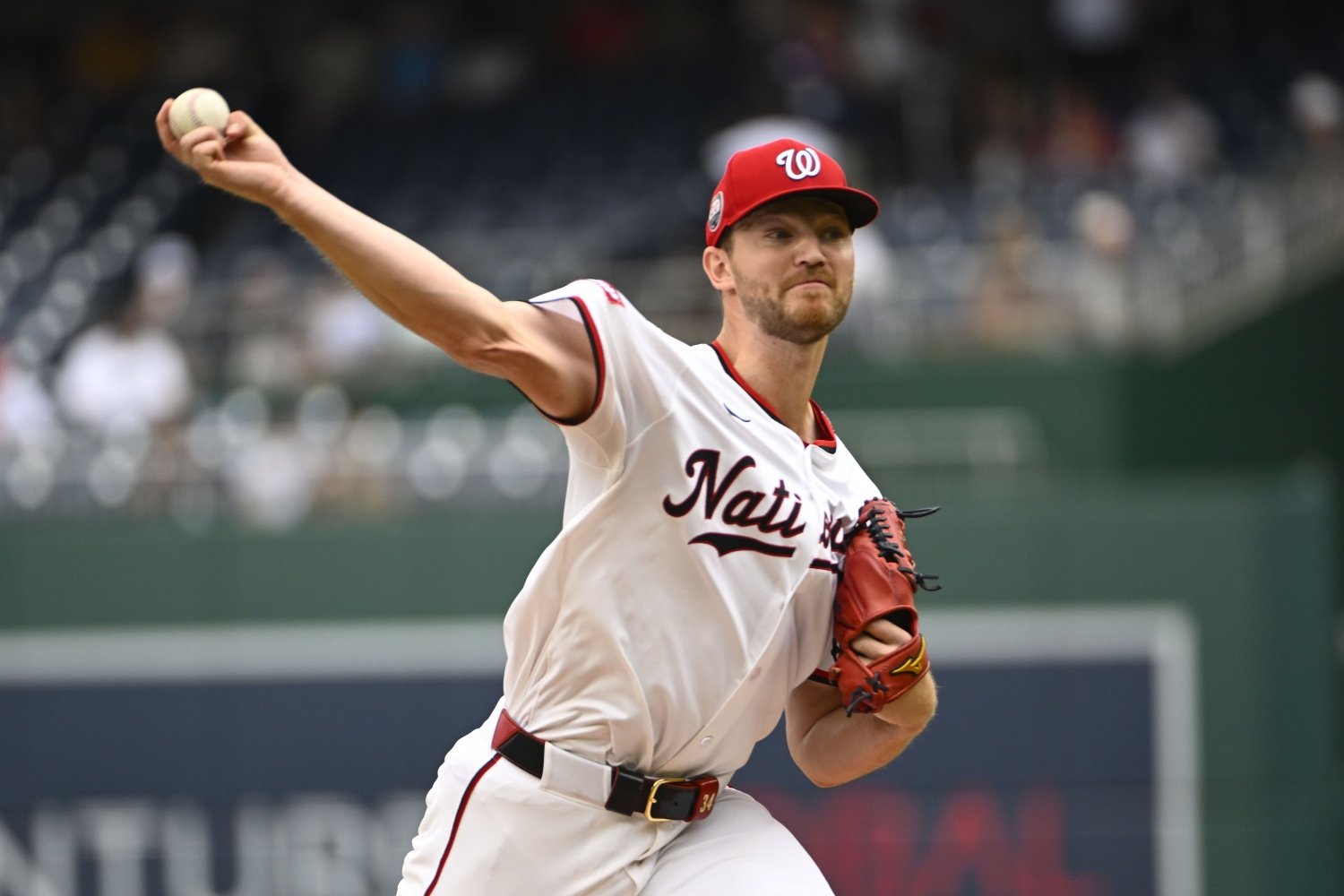
The Cubs had interest in Michael Soroka this offseason, before he signed a one-year deal with the Washington Nationals for $9 million. They first talked to the Nationals about trading for him over a month ago, in late June, around the time they also reached out to the Royals to discuss a possible Seth Lugo deal. Wednesday, in the shadow of the looming trade deadline, they got their man, sending outfielder Christian Franklin and shortstop Ronny Cruz to the Washington organization in exchange for Soroka.
It's a pursuit born of a profile the Cubs very much like. Soroka moved from the starting rotation to the bullpen mid-season for the 2024 White Sox, right alongside then-teammate Chris Flexen. As he did, he mostly junked his pedestrian sinker and tapped into something new and important, by becoming a four-seam fastball-dominant arm. He also discovered new velocity, by "letting it eat" on every pitch. Over the winter, he also lowered his arm slot—something the Cubs would have implemented themselves, if he hadn't beaten them to it—and tapped into another new dynamic: his heater now enjoys superb spin mirroring with a breaking ball that has morphed from a slider into a uniquely big-breaking two-plane curve.

As @Jason Ross wrote just 10 days ago, Soroka's results haven't truly dazzled this year, but the under-the-hood indices all have. He had a 4.87 ERA during his stint in the Beltway, but lousy defensive support explains a good chunk of that. According to Baseball Prospectus, his adjusted Deserved Run Average (DRA-, where 100 is average and lower is better) is 91, which is the second-best mark of his career, trailing only his All-Star season way back in 2019. Matthew Boyd's DRA- is 87. Soroka's figure is tied for 41st-best among the 127 pitchers with at least 70 innings pitched this season. Among those with whom he's tied: Spencer Strider, late-emerging trade candidate Robbie Ray and much-rumored Cubs target Merrill Kelly.
In short, Soroka has been very good this season. He's striking out 25.4% of opposing batters and walking just 7.0% of them. That curveball may not be a game-breaker, but it's an out-getter. Though he's been limited by injury (he missed virtually all of April and the first week of May with a biceps strain) and has just 80 1/3 innings pitched in 16 starts, when Soroka has been on the mound, he's been solidly above-average.
Why, then, was his price tag considerably lower than Kelly's? Why did the Cubs get a starting pitcher they've targeted for months at a discount, one day before the deadline? Well, that injury history is certainly a key factor. Soroka not only had that biceps issue in the spring, but missed a big chunk of last summer with a shoulder strain. He's torn his Achilles twice, which has kept the mileage on his arm relatively low, but he's not a durable pitcher, the way Kelly is.
Another key reason why he wasn't in as much demand as you might have guessed, though, is that his stuff doesn't grade out as well as that of other (potentially or actually) available pitchers, going by industry-standard pitch modeling. Within that is the big, waving red flag (or is it?): Soroka's velocity is down significantly in his three starts since the All-Star break.

This isn't a small change. Soroka's average heater is down almost 3 miles per hour since the break, which is especially weird, since he got eight days off between starts at that point. There'd been a downward trend even before that, so some teams were scared off by what always has a chance to be a sign of lurking or impending injury.
In this case, though, the change seems to be a matter of mechanics. It's likely fixable, but just as importantly, it might not need to be fixed. Let's dig in.
Here's Soroka inducing a whiff by Heliot Ramos on one of his big breaking balls, back in the first half.
Here's him doing the same thing to Manny Machado, just after the All-Star break.
I don't know how well you can see it, but one very early mechanical difference begets another here. In the second video, Soroka strides slightly more open as he comes down the mound. If you isolate the frame when his front foot hits the dirt—what pitching gurus call 'foot strike'—in each clip, it's easier to spot.
(2).png.58954efad96295e65159dcf574186b70.png)
Firstly, getting even slightly more open will often sap a small but noticeable amount of zip from a pitcher's stuff, because one key ingredient in generating velocity is the torque created by delaying trunk rotation for as long as possible—the creation of hip-shoulder separation, whereby the lower half rotates slightly ahead of the upper half and the body is forced to move extremely fast to realign itself.
Secondly, though, that slight difference in landing position means that instead of whipping around his landing leg's block, Soroka vaults over it slightly more. The stride that lands more open is slightly longer, so he ends up getting farther down the mound, but is falling off to the first-base side more. That leads to a slightly higher arm angle at release, as you can see if we isolate the frame in which he releases the ball in each clip.
(4).png.5b22d0711f78dbbdd52ee3373433be4e.png)
See how the lines I've superimposed there are shorter in the image on the right? That's not because Soroka is extending his arm less, but because he's releasing the ball farther in front of his own body lately than in the first half.
Broadly speaking, a mechanical change like this is of neutral value. It can be good for some guys; it can be bad for others. It's only an unmitigated problem if it's a product of a pitcher being physically compromised in some way, forcing them to move differently to compensate. Although we're seeing less power from Soroka recently, there's no immediate reason to believe that he's thus compromised. The Cubs did approve his medicals, after all, and we know that that's no guarantee where they're concerned.
The change in arm angle is real, and a trend that has been happening all year. He's still throwing from a lower slot than he used for most of 2024, but he's trended back up after coming way down to begin the year.
.png.8c0527d852eb1a137072cdb94e037cfc.png)
That turns out to be fine for him; it accentuates the unique stuff he possesses. For one thing, it's given him an extra inch or two of carry on his four-seamer, which is a bit of a dead-zone offering and can benefit from the boost—especially at the top of the zone, which (unsurprisingly) he's had an easier time hitting with the pitch since changing his delivery slightly. Here's where his fastballs ended up in the first half.

And here's where they've been in his three starts since the break:

Despite the velocity loss, Soroka's outcomes on the fastball have significantly improved recently. He's hitting the high, arm-side sector of the zone (and just above it) more often, and that's where he gets whiffs and weak contact with that pitch. Throwing harder is turning out to be less important, for him, than locating better and achieving slightly improved movement.
Speaking of improved movement, though, Soroka has also discovered a new and much more functional changeup: the kick-change. He's always been good at generating spin and bad at killing it, and that's the very problem the kick-change is meant to help pitchers like him solve. Before implementing the change to his change, Soroka was allowing a .380 wOBA to left-handed batters. Since then, it's .308. When you see just how drastic the difference in the depth on that changeup is, that makes sense.
.jpeg.313d488aaa3afafbfca8bfdf395c529e.jpeg)
The Cubs believe in the kinds of changes Soroka has made. They're willing to bet on him despite the dip in velocity, not least because it looks like the kind that might be as salutary as it is limiting. They believe he can be a mid-rotation starter whenever he's able to take the mound, although he'll need to be lifted more proactively than starters with deeper arsenals or better stamina would be. They were able to get him at a price that doesn't reflect either the underlying performance he's already delivered or the upside they perceive, when you compare him to pitchers with whom he's similar.
On the other hand, the main reasons why they were able to get him are that velocity dip and the injury history, and the potential linkage between the two makes it hard to buy too heavily into the idea that he's their top acquisition. One reason why they were willing to give up what they were for him is that he defuses the leverage of certain potential trade partners. Soroka is good enough that, even if the team still badly wants to add a stronger starting pitcher (as they probably do), they can credibly approach negotiations in a posture of willingness to let him be their main guy. It's harder for a team like the Marlins to hold their feet to the fire, because they got Soroka. That's one more small way in which he provides value.
Plainly, though, the main focus for the team will be the more tangible, on-field value they expect to get from Soroka. He has an unusual breaking ball and a much-improved changeup. He should benefit from pitching in front of their defense, instead of that of his old team. He's inarguably better than Colin Rea, provided that he's healthy enough to pitch at his best, but he also has recent experience working in relief, so he doesn't foreclose any other options for the team. The risks associated with his health record are real, but taking them was a no-brainer.






Recommended Comments
Create an account or sign in to comment
You need to be a member in order to leave a comment
Create an account
Sign up for a new account in our community. It's easy!
Register a new accountSign in
Already have an account? Sign in here.
Sign In Now