


Cubs Video
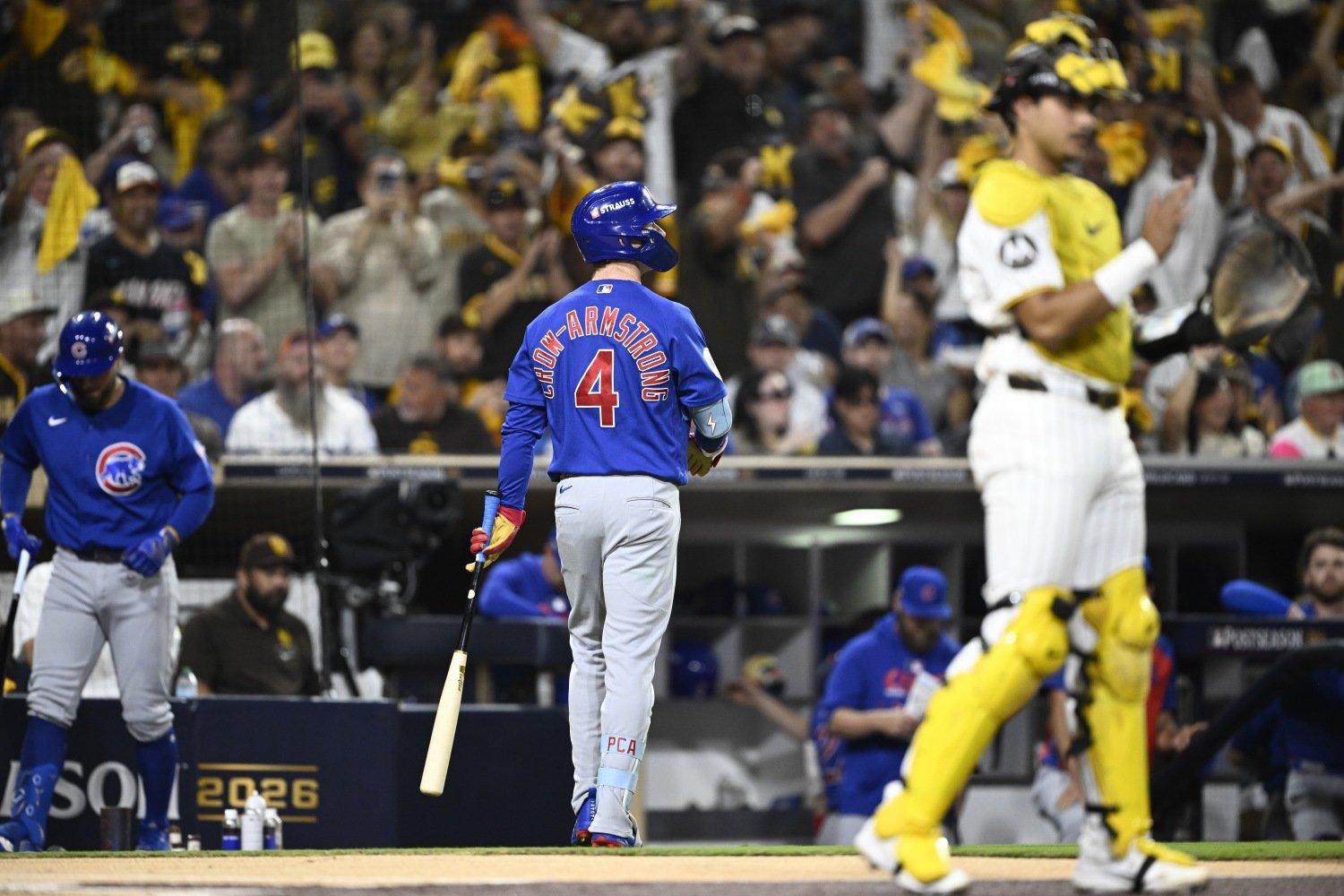
Pete Crow-Armstrong got his chance. It wasn't just an opportunity to set the tone right off the bat, or a 1-in-100 shot at robbing a home run as he flung himself against the wall. In the top of the third inning of Wednesday night's Game 2 in the National League Wild Card Series, Crow-Armstrong stepped to the plate against a struggling Nick Pivetta, with the tying runs on base. The San Diego Padres led 2-0, but one swing by Crow-Armstrong could have flipped the scoreboard. At the very least, a single would have moved that tying tally into scoring position, and it probably would have truly dislodged a snowball, sending it racing down the hill and giving the Cubs a chance to crush the Padres with a sudden avalanche of runs.
Instead, Crow-Armstrong popped out almost directly to the second-base bag. That was the moment when the final rush of air left the lungs of the wounded creature that was the 2026 Cubs. Its valiant fight was over—lost. For the soon-to-be-named National League MVP, it was anything but a fitting ending to a season almost overflowing with heroics. As impressive as the stats are, the fun facts about Crow-Armstrong's power and speed have felt a bit empty, because they didn't properly capture how great he was when it mattered most. Crow-Armstrong led the league in Championship Win Probability Added this year, because he was clutch within games and late in the vicious fight for Wild Card positioning, as well as being great in a day-to-day, consistent way.
Cruelly, though, baseball doesn't pretend to be its full-season self once the playoffs begin. In the six-team playoff format, you're lucky if your superstar gets even one real chance to tilt a game and save your season. Crow-Armstrong got a handful of half-chances, and that one legitimate one. He came up empty every time. In the two-game series, he went 0-for-7, and he didn't make solid contact at all. His lone triumph was a walk, and he did immediately apply pressure thereafter by stealing second base, but that came to nothing. For the whole series, the Cubs' efforts practically did so; they were outscored 12-1.
Of course, Crow-Armstrong isn't primarily to blame for the loss. Even in that pivotal inning that saw a golden opportunity slip away, he was not the most egregious culprit. That heavy weight falls across the shoulders of Dansby Swanson, who was ahead in the count 3-1 on Pivetta with nobody out and those two runners already aboard, then chased two straight pitches outside the zone to strike out. Swanson went 0-for-6 in the series and damaged multiple rallies with bad at-bats.
The only run the team scored in either game came in the frame right after Swanson, Crow-Armstrong and Alex Bregman wasted their golden chance. After a single and a walk with one out, Nico Hoerner bounced a single into center field to score Seiya Suzuki, halving the Cubs' deficit. But Hoerner was merely making up for his own costly miscue. In the bottom of the second, he lost track of himself as he raced into place to receive a throw from Carson Kelly on a steal attempt by Jackson Merrill. The ball beat Merrill and was on target, but Hoerner had come too far in front of the keystone and snared the ball too soon. Had he been better-positioned and let the ball travel more, Merrill would have been out. Instead, he was safe, and the Padres scored two runs in the inning. One of the two should have been avoided.
Little things like that went wrong for the team all series. Crow-Armstrong didn't catch a homer he could possibly, maybe have stolen from Fernando Tatis Jr. in Game 1. Swanson couldn't handle a throw later in that game, and his teammates reacted too slowly behind him, leading to a steal of second that became a run for San Diego. David Peterson didn't cover first quickly enough to get an out the team should have had on a grounder later in Game 2. Crow-Armstrong squandered one of the team's two ABS challenges with a bad appeal in the first at-bat of the contest, and Kelly lost the other in the bottom of the third.
None of that ultimately mattered that much, though. Hoerner's misplay was costly. So were the bad at-bats by Swanson, Crow-Armstrong and Bregman in the third. The game was well and truly decided when, after some characteristically nervous managing by Craig Counsell brought Daniel Palencia into the game in the bottom of the fourth, Palencia threw a fastball right into Gavin Sheets's wheelhouse and watched a long home run turn a 2-1 divot into a 4-1 hole. All series, the Cubs were outplayed—outhit, by a fresher Padres team that carried over their excellent slugging numbers from the final month of the regular season, and outfielded, too, but especially outpitched.
Michael King and Pivetta were both impressive (in different ways), but the Padres bullpen also showed its depth and its raw stuff throughout the set. The strikeout and walk numbers weren't as imbalanced as one might guess, but Padres batters had six of the seven hardest-hit balls in Game 1 and eight of the nine hardest-hit balls in Game 2. They hit four home runs in the series; the Cubs didn't hit a ball more than 353 feet. San Diego's hurlers produced some late swings and some early ones, and despite the Cubs' arguably superior offensive talent, the far superior pitching of the Padres prevented them from doing damage. The Cubs' weak pitching staff couldn't do the same to the home side's sluggers.
The unceremonious exit (their playoff-branded gear alludes to October, but they didn't actually make it out of September) is a gut punch for the Cubs, organizationally. It brings Crow-Armstrong's glorious season to an end that will sit in his craw all winter, the same way his poor and often embarrassing showing against the Brewers in last year's NLDS did. It marks the official termination of the season that might have marked the team's best hope for a deep playoff run for a while.
Swanson, who will turn 33 before the team reconvenes for spring training, batted .212/.281/.385 from May 1 onward, and he lost significant time due to a soft-tissue injury (an oblique strain) for the first time in his career. Bregman turns 33 next March, too, and while he had a marvelous season and his partnership with Swanson on the left side of the infield was a joy to behold, the actuarial tables say those two players will be markedly worse next year than they were in 2026. They're very much part of the team's core, though, for four more seasons.
Though considerably younger (he'll be 30 next spring), Hoerner was also much worse than those two this season. Ditto for Michael Busch, the only infielder not on a long-term deal. Counsell pinch-hit for Busch against lefty Adrian Morejon in the late innings of Game 2, which was the right call, but it felt jarring. Busch got a whopping 710 plate appearances in 2026. The percentage of his at-bats that came against right-handed hurlers dropped from 84% to 71%. He was an everyday, all-game player, but that didn't work: he slugged .393 at a position from which teams need to get power. That Counsell pulled him when there was no more slack left to offer felt like an admission that this was never the plan, and that it can't be, going forward. Had Tyler Austin stayed healthy, this season might have been different and better for Busch, even with less playing time. Having seen his warts (and knowing he'll be 29 years old next year, with below-average bat speed already), though, the Cubs must now decide whether to try for a platoon arrangement again in 2027—or try to find an outright upgrade.
That's just one (and not even one of the biggest) of a huge number of tough decisions that amount to a massive amount of uncertainty for the team, as they look toward a winter that will be uncertain for nearly everyone. For a moment, forget about the questions that will swirl around negotiations for a new Collective Bargaining Agreement, and about the lockout that seems sure to swallow most of the winter once the current deal expires on December 1. This team has bigger fish to fry. Is Busch the answer at first base? He almost has to be, because moving that spot into even a top-10 list of priorities would be tough.
Gausman started Game 2. Peterson provided some bridge relief work, and although he didn't enter the fray, Clay Holmes warmed up in the bottom of the eighth, just in case. All three of those hurlers are ticketed for free agency at the end of the World Series. So are Matthew Boyd and Shota Imanaga—the entirety, in other words, of the team's extant rotation at the end of the year. Most of that corps will depart, though it wouldn't be a huge surprise to see Boyd or Holmes return on a new deal.
Beyond any arms from that group who return, the team will try to backfill with some internal options who were unavailable down the stretch. They remain cautiously optimistic about Justin Steele's progression toward a 2027 return and about Ben Brown being able to pitch without pain in his neck by the spring. Edward Cabrera should have a normal offseason, and Cade Horton might be able to return to the rotation by the middle of next year. Then again, Steele was supposed to be back already; he's now missed almost two full seasons in the wake of his second elbow reconstruction. The same fate is very much in play for Horton, so the team can't afford to treat him as a sure thing. Nor did Steele actually show well enough in any competitive minor-league action to inspire confidence heading into the winter. Brown's prognosis is unclear, as neither he nor the team has yet gotten a good answer about how to ensure that the stress reactions he's suffered in his neck won't recur. Cabrera is, at this moment, nothing so much as a symbol of the team's inability to help pitchers. Braxton Garrett is in the mix, but again, the less he's counted upon when building the offseason plan, the better.
If anything, the corner outfield spots are even more uncertain. Ian Happ and Suzuki are both free agents-to-be, and though the team has at least some interest in a reunion with one or the other, there's no guarantee of that. Neither Matt Shaw nor Pedro Ramírez profiles very well as a full-time corner outfielder, and the lightning that was Michael Conforto's season is unlikely to strike twice. (Conforto is a free agent, too, of course.) Kevin Alcántara hasn't gotten any real chance to prove that he can hit big-league pitching, and in fact, he's only intermittently showed that he can hit Triple-A hurlers, but he's out of options next spring and will have to be on the big-league roster if he's in the organization at all.
Kelly is an impending free agent, himself. Even if you're a big Owen Ayers believer, you can't plan to simply install him as a semi-regular behind the plate next Opening Day. The Cubs will have to add a catcher. Since their bullpen investments of this year mostly went bust, they'll have to spend more on relievers, too—though they did mitigate that need a bit by trading for Ryan Zeferjahn.
Re-signing and/or replacing all of the talent sloughing off this roster will be hugely expensive. The Cubs don't have great alternatives, though, given the state of their farm system. Their margin for error next year is thinner than it would have been if they'd been less aggressive at the deadline, too, as Brett Bateman (outfield), Moisés Ballesteros (DH) and Jefferson Rojas (infield) all could have been reinforcements for the roster if they hadn't been dealt away. The front office recognized the importance of capitalizing on the year they were getting from Crow-Armstrong and on the last prime-adjacent years of Bregman, Swanson, Happ, Suzuki and more. They pushed in their chips. After Wednesday night, it sure feels like they lost the hand, but playing it was the brave (and perhaps the only) thing to do.
A core remains. They should have better injury luck next year, though it won't be as rosy as some will try to tell you it might be. This season should (and probably will) force a reckoning with the team's failures to create a robust pitching pipeline that suits the modern game. They also found their superstar this year. Crow-Armstrong's season deserves (and will get) greater encomiums than the rush of the final week and the thud of this series have allowed; it was a delightful thing. But Crow-Armstrong will (if for no other reason than because it's the only direction he can go) get worse in 2027. He missed his own chances to extend this magical season, and his team was never up to catching him when he fell back to the pack. Indeed, without him, they would have been eliminated a week before the end of the regular season.
As they look toward 2027, the Cubs have to be real with themselves. Almost everywhere, they failed in 2026. Crow-Armstrong saved a bad season, but he ran out of steam at the end of the race, thanks to having carried the entire franchise on his back for most of the course. Somehow, they have to support him better next year, and this week's pulverization by a team with a much deeper group of dynamic contributors was a reminder that doing so will require an uncharacteristically dramatic organizational transformation. It's ok to be worried about whether they can pull that off; they probably can't.
Are you optimistic about the Cubs right now?

Follow North Side Baseball For Chicago Cubs News & Analysis



-
 1
1


Recommended Comments
Create an account or sign in to comment
You need to be a member in order to leave a comment
Create an account
Sign up for a new account in our community. It's easy!
Register a new accountSign in
Already have an account? Sign in here.
Sign In Now