ryanrc
-
Posts
138 -
Joined
-
Last visited
ryanrc's Achievements






-
in an interesting turn of events, our esteemed staff decided Theilbar is NOT a liability, and they chose him over Milner. All other facts aforementioned remain valid - I see both Boyd and Peterson as postseason bullpen arms. I also do NOT expect Steele to be used unless someone really collapses. That person would most likely be Trent Thorton.... And Shelby Miller has a small chance of making it if someone else gets hurt, which is fairly possible.
-
Hello Cubs World, It has been awhile since I last wrote. Quite a number of twists and turns to this season are worth covering... But perhaps the most important thing is that the Cubs went "all in" on contending this year. Fans are used to feeling like Jed Hoyer is too cautious and cheap to do such a thing. But here we are... Let's rank the current starting rotation options in terms of stuff, to get an idea of what we're looking at in the coming postseason run. "Deserved ERA": The Fragile Duo The Rotation is not very good, if we rely on expected ERA (xERA), Stuff+, and WAR metrics. Many "expected" stats closely track each other in the rankings, meaning that it doesn't matter too much if you look at Stuff+, WAR, xERA, and so on. But for simplicity's sake, we can use Baseball Prospectus's "Deserved ERA" to compare players. It attempts to translate overall ability metrics into a coherent expectation of outcome. While the Cy Young race is a who's-who list of starters with a great Deserved ERA, the majority of top 100 pitchers in such rankings are high leverage relievers who specialize in strikeouts. Quite frankly, the only two starting rotation Cubs who have had great seasons from this perspective are Clay Holmes and Ben Brown. They both have hovered around rank 70-80 among all pitchers in fundamental nastiness, which bolsters the argument their elite ERAs this year are for real. Holmes has a plus sinker and devastating sweeper, and Brown's knuckle curve remains one of the best pitches in baseball. But... they have both been fragile and missed lots of playing time. Its uncertain if they will be at their best when we need it the most. Yeah, I know, it's depressing: Cub simply don't invest in starters who carry cartoonish breaks and velocity. Now, the real question: can we keep these two healthy enough for the critical starts? And, do they have the support they need? The Relief Corps: Stronger In Fundamentals It is worth noting that the back of the bullpen is better than you may think. Ryan Zeferjahn is a top relief option who outranks both Brown and Holmes in stuff metrics, and threatens to be even better than Holmes was as two-time Yankees all-star closer. Zeferjahn is about 100th percentile in strikeout rate and whiff rate - it doesn't get much nastier than that. Our own Jacob Webb is having a career-best season. Webb also is topping Holmes and Brown because of his out-getting 93rd percentile whiff rate, and 80th percentile strikeout rate. So, make a mental note: ZeferJahn (hovering around the top 30) and Webb (top 50) are among the best high-leverage options in baseball this year. And, behind them, you've got above average support. 102-fireballer Daniel Palencia is nearly as nasty as Zeferjahn, and working his way back by the end of this month. Hard thrower Trent Thorton, power lefty Ryan Rolison, and low-slot lefty specialist Hoby Milner are a trio of above average bullpen pieces with substantial "red paint" in MLB Savant statistics. So, this group of six can likely handle the post-season late-inning duties. (So long Caleb Theilbar, Tyler Ferguson, etc....). The #3 Platoon: The Splitter Starters Gausman and Imanaga have been above average, but neither are having a great season compared to their career best. They both have shown flashes of brilliance, and are known for elite stretches of ball, but are effectively competing as marginal #3s for the 2026 post-season run. They both rank around 100-120 in terms of nastiness this year. Gausman relies on his splitter to get outs form the right side, and Imanaga does the same from the left. However, they both struggle with limited efficacy from their four seamers this year and yet still throw a lot of them. They also both suffer when their breaking balls are not touching the corner of the strike zone, and we need to be grateful that the momentum is in the right direction for their control. My best guess is that we see them used in tandem against specific teams in the playoffs: Imanaga 's 93rd percentile chase and walk rates are effective against the best lefty-powered lineups, and Gausman's respective 87th and 82nd percentile rates dominate against the strongest righty brigades. The Grinders: The Pitch to Contact Wizards Cubs specialize in players who routinely outperform fundamentals, relying instead on pitching to ground ball contact and using the elite defense. All of these players lean on complex offerings and command to freeze and confuse hitters. They carry extremely low walk rates to minimize runs from smallball opportunities. This "moneyball" approach to beating the odds makes Cubs starting pitching among the hardest squads to evaluate - over half of their guys excel in producing outstanding WHIP alongside ERA results a full fun or more ahead of expectation. In sum, the North Siders don't have the kinds of statistical freaks you'll find on the Dodgers, Yankees, Phillies, or Brewers - however, you may be surprised to realize how good they have performed in ERA and WHIP. Topping list are a pair of veteran lefties, Matthew Boyd and David Peterson. Both of them were all stars last year, and both of them are looking red hot right now. However, neither of them have above average "red paint". Boyd's ability to control the bases and execute defensively is enough to consider him as a #3 guy, if anyone gets hurt or stumbles. Thus, he's a #4 who may get a chance to start in the early chase. Peterson is unlikely to earn a postseason start, but it's not impossible. The main knock is that his stuff is below average- he has all the elements of a classic back-order out-getter who steps back into the pen in the postseason. The next two guys have been the lifelines holding the season together but have horrible Savant pages. Assad has outperformed every metric in the book for years, and continues to do so, holding up a sub-3.6 ERA season. He's been elite at stranding runners on base his whole career, and he's maybe the best in the league at it in recent months. However, the Dodgers and Brewers cannot be so easily manipulated. Assad has an option remaining, and the most likely result is he is about to take his last trip to AAA until the roster expands. Rea is, well, the same sort of player but with 1 more run per nine innings. If anyone gets cut from the rotation, it's him - however, surrendering the club option on him for next year is quite a risk. The Wildcard: What to do with Edward Cabrera? I have strong feelings about this one. Cabrera has arguably the best changeup in the majors, and exceptional velocity on his four seamer and sinker; however, the combination of wildness and injury have been disappointing this year. He was excellent in April and May, and then completely fell apart. He has looked more like his early-season self during his last two rehab starts, but with such a crowded rotation, it seems like Cabrera is destined for the pen. I truly think he could be an elite bullpen piece if we are willing to accept that he never seems to be good past the fourth inning of a start. RANKING THE ROTATION OPTIONS Note: if anyone is not healthy enough for an 80 pitch start, it's a simple matter of sliding everyone up one spot on the list. #1 R Clay Holmes - Tone-Setting Nastiness Let's be frank: Holmes is the only veteran ace World Series Game One candidate on this squad. He'll probably be rusty his first couple of starts but settle back in soon. The Cubs are betting quite a lot on this guy, because he's the only one who has a full plate of nasty options. Since his injury wasn't a throwing one, he is as fresh as anyone can be. I expect Holmes to be drawing elite ground ball rates with his sinker and therefore be the 1st man up in every series. We can easily manage his pitch count because of the huge number of starter-types on our roster. Holmes is vulnerable against lefties, however, and he'd be pulled early if they are doing well. #2 R Ben Brown - Wipeout Knuckle Curve Brown is not coming back until the September roster expansion. He is emerging as a future ace to compete with Cade Horton and Justin Steele at the top of the 2027 rotation (that's exciting stuff!). Although he may not ultimately start down the stretch - working back from two years of repetitive neck stress is serious - I think everyone wants him in the 2 slot. He'll probably be ready in time. Ideally, he just gets a few innings of pen work in September, but becomes a 80-pitch, 5-inning starter who turns the ball over to Boyd or Cabrera to finish up. His fastballs are great, but his knuckle curve is superhuman. #3 L Shota Imanaga - Lefty Splitter Nobody wants to see him give up homers, but everyone loves it when he's working into the 7th inning and the only run given was a first inning solo shot. Frankly, he's still the best option we have against superstar lefty sluggers, as his splitter can remove those guys from the game. Expect to see Imanaga start against the primary National League threats: Dodgers, Brewers, Phillies, Marlins, and Braves. Imanaga has a slight upper hand statistically over Gausman in the early rounds of the postseason, simply because he's a tick better against lefty-vulnerable lineups. #4 R Kevin Gausman - Righty Splitter He's virtually the righty Imanaga twin in statistical projections, as aforementioned, and can often pitch through the seventh - exactly what you want from Game 3 of a series, to give your bullpen breathing room for the critical game 4/5 showdowns.. He also handles lefties and righties equally, which is nice - he's holding both to a slightly below average OPS. I expect a red-hot Gausman to produce 9 more starts in regular season, and to start once or twice in the chase. In the National League, Gausman matches up well against the Padres and Diamondbacks, either of whom we may need to face. In general, Gausman also has the edge over Imanaga facing the top American League threats - especially the White Sox and Red Sox. So, Gausman is the most likely 3rd guy in the World Series. Long Relievers in the Postseason #5 L Matthew Boyd - Gold Glove Game Manager This is the guy most affected by the arrival of Holmes and Gausman - so, he's now your most trusted "next guy up" in the postseason. Righties have been hitting him well this year, but he can completely shut down a left-handed side. Although he may be critical in September, his stuff this year cannot compete with the four guys above. I am happy to see his caliber of player as the long relief for Holmes or Brown. There is still a sizable chance he outperforms Imanaga or Gausman over the next 10 games and earns the ball... #6 R Edward Cabrera - Freakish Hard Change He's not reliable for a postseason start. Still, when he's hot, he's unhittable. Just like Boyd, I'd love to see him finish out game one or two of every series with a multi-inning relief showing. He can beat any lineup if he only has to face it once. #7 R Javier Assad - Endless Bag of Tricks His voodoo is a good luck charm. He's been dominant for the last two months. After all we've been through with this guy, there's no way he gets cut. He'll be the next middle-inning reliever behind Boyd and Cabrera. He's outperforming Rea just enough to win a long relief spot in the pen. I want to see Assad as the rescue relief for the splitter duo, Imanaga and Gausman. Cut Candidates - "There Can Be Only One!" # 8 L David Peterson - Old School Junk Lefty When Brown comes back, it's very possible Peterson gets cut, but only if there's a 7th short inning guy who emerges as essential. Its far more likely he edges out Rea as the remaining "insurance arm". There's just not a lot of room in a 14-man group. Similar to Boyd, Peterson is doing much better against lefties than righties this year. But when it comes to stuff, he's the worst guy on the roster - the classic "get you there" junk arm. it's still possible he replaces Milner or Rolison in the pen, if either befalls injury or missteps in the next few weeks. Peterson's last few starts have still shown an upside higher than Rea because the league is generally doing worse creating contact against lefty starters, #9 R Colin Rea - Old Reliable Dog As a 36-year old righty with neither the fundamentals nor the results to scare anyone, Rea will get used heavily until Palencia, Milner, and Brown all return. After that, it is not looking so good unless he has a sudden turn of brilliance. It's a really good time to play some pick-up basketball and twist an ankle, to hold onto his roster sport for next season. I was quite surprised to see him escape trade negotiations, unless nobody truly wanted him. This is the odd-man-out. Thanks for all the good times! RANKING THE SHORT RELIEVERS The high leverage crew # 1 R Jacob Webb - Closer Webb has been a real surprise. He came in as a cheap middle-relief option and found his way to the closer role. You don't want to upset the vibe that Webb has established. Stay with him. He's perhaps not a top 10 closer, but he's just slightly behind that level right now. # 2 R Daniel Palencia - Setup/Closer Even with time missed, Palencia has the stuff everyone fears to face. He will patrol the 8th, and very likely the 10th-11th innings. # 3 L Ryan Rolison - Setup A surprise weapon for the Cubs, Rolison is the high leverage lefty in the 8th and beyond. He's been astoundingly reliable. # 4 R Ryan Zeferjahn - Fixer I like him as the righty "fixer" who can shut down the top of the order with strikeouts. He sometimes falters, but his fundamentals for throwing right past an Ohtani or Judge are all-world level. he's the guy I want taking the ball against the top of, say, the Dodgers order at a critical moment. The low leverage boys # 5 L Hoby Milner - Lefty-Only Fixer He's the lefty "fixer" who has the ideal style to generate ground outs during critical jams in the 5th through 7th, if he's facing mostly lefty bats. As usual, he's a 3-4 batter guy, though, and despite being elite against southpaws, is a threat to give up a critical run against ANY righty bat. # 6 R Trent Thorton - Hold the Lead Although he has shown great stuff, and helped win big games, his stock is falling in recent weeks due to control issues. Still, he's a luxury for low leverage. Conclusion How good is this group? Everything depends on Holmes, Brown, Palencia, and Zeferjahn stepping up. If they do, it is an outstanding pen ready for a World Series. If they falter, there's plan B and C options, but nobody wants to depend heavily on the Cubs defense to solve every problem. If 3 out of those four guys do their best, and if Imanaga and Gausman hold up, this is a potential winner. If not, we should be even BETTER in 2027 folks.
-
Revisiting my Batting Order Plan: Am I Beating Counsell?
ryanrc posted a blog entry in Robert Conan Ryan
Hello Cubs world, those who follow me know that I made projections for the idea batting order (as tough as that is). Remember, i asserted with caveats that a manger will always make small adjustments based on ballpark, who's pitching, how the guys are feelings, and so on. Even still, the statistics converge on a "good general idea" - and its a plan closer to my own than theirs. Although they have been shifting things around very actively, a few things are dominant. Let's take a look at his most favored starting order vs RHP so far, The first four have been fairly consistent, and the last two. 1 Hoerner - nearly every game 2 Bregman - sometimes Busch/Ballesteros 3 Suzuki - most games since healthy 4 Happ - nearly every game 5 Busch - unstable 6 Kelly - unstable 7 Ballesteros - unstable 8 PCA - nearly every game 9 Swanson - nearly every game MY STANDARDIZED ORDER Now let's look at the player stats vs RHP through the first 42 games. and compare it to my own preferred order. Note: several of these hitters excel versus lefties: Bregman (.392 OBP). Kelly, Shaw, and Swanson, in particular, are much better going that way. RISP is the only stat listed against BOTH handed pitching, due to the small sample size. If I underlined the stat, it means it hit the sweet spot for the batting order I suggested. If I bolded the stat, the player is in the top 3 on the team. I didn't bother scoring Amaya, as he is merely the backup catcher right now. OBP AVG OPS RISP SB 1 Happ .375 ,241 ,810 .156 2 2 Busch .338 .244 .735 .326 1 3 Hoerner .355 ,276 ,768 ,261 8 4 Suzuki .391 .274 .890 .114 0 5 Bregman .309 .246 .678 .267 2 6 PCA ,315 ,236 ,712 ,302 10 7 Ballesteros .321 .242 .704 .240 0 8 Kelly ,344 ,235 .702 .263 0 9 Swanson .294 .203 .635 .195 3 BENCH BATS Conforto ,452 ,326 1,126 .222 0 Shaw .302 .219 .668 .192 2 Analysis: How close am I? Let's doublecheck! Well, its hard to say, but I'd argue my lineup is closer to coherent than theirs. #1 looks CORRECT> Happ's terrible RISP but elite OBP and OPS is a classic sign of a leadoff hitter. #2: Suzuki fits here instead of Busch. His team WORST RISP despite a team BEST OBP. fits better. #3 Hoerner makes perfect sense at #3 because all his numbers align with your rally extender guy - especially adding the fact he almost never strikes out and can advance the runners with guaranteed contact. His lower OBP and higher RISP means yes, i was correct, Happ is a better leadoff guy. #4 With Busch's elite RISP, hitting in the #4 hole makes a lot of sense. #5 Bregman still feels right because of his solid RISP - his other stats should recover after a bad slump. #6 PCA is spot on. He can act as a second leadoff style player mid-order, move around the bases, and also come through as a situational hitter with an elite RISP, despite low batting average. #7 Ballesteros can be moved back, and Kelly up, if for no other reason than the lefty/righty thing. #8 Kelly acts as a second cleanup hitter in the 7 spot- he's been more consistent than most. Solid RISP and power helps one slot higher. #9 Swanson is correct here - he has flashes of brilliance, is great with sac hits, and runs the bases well, but the low average holds him back. Verdict: Here's my revised order (faith in Busch and Bregman heating up): This order is nearly perfect in OBP, AVG, OPS, RISP sorting! Of course, it may revert to my earlier suggestion by midseason - and I kinda expect it to do that. But for now, this order fits their stats most closely: Happ .375 ,241 ,810 .156 2 Suzuki .391 .274 .890 .114 0 Hoerner .355 ,276 ,768 ,261 8 Busch .338 .244 .735 .326 1 Bregman .309 .246 .678 .267 2 PCA ,315 ,236 ,712 ,302 10 Kelly ,344 ,235 .702 .263 0 Ballesteros .321 .242 .704 .240 0 Swanson .294 .203 .635 .195 3 -
Hello Cubs World, In my last blogpost, I gave predictions for the division. Immediately afterwards, the Reds collapsed, but the Cubs, Brewers, and Cardinals kept on trucking. Some might over-react and claim my projections were immediately obsolete, but I don't think so. There's quite a bit of short-term streakiness and luck in baseball. Projections are made for macro-patterns and tehy also include a team's willingness to make midseason move. . I had suggested that the Cardinals were heading for 70 wins, not even the 74 suggested by PECOTA. Here's why i still think that's reasonable to assume. Their starting rotation simply isn't good. These stats are well below average and don't indicate a winning record for the Cardinals in a tough division, Their Team ERA is 20th in baseball, at 4.28, and their rotation is sitting right around there with signs of further regression. They basically have a #2 (McGreevy), a #3 (Liberatore), and three #5 quality pitchers. 1: Matthew Liberatore the "Ace" has a 4.07 ERA currently. He's too inconsistent to give you streaks of dominance. He may have some stuff, but that is ERA close to his season expectations. His 1.43 WHIP would make him the worst in the Cubs rotation.... 2: Michael McGreevy, their one bright spot, won't be able to sustain his 2.18 ERA. He's talented but not THAT good. His game is actually quite similar to Colin Rea - its built on complexity rather than elite stuff - McGreevy's fastball is sub 92 mph. Most of his success has come from a perfectly tunneled, and therefore hard to distinguish, sinker/changeup combo. Even still, a 3.5 ERA seems to be his trajectory, based on his fundamentals. 3: Dustin May, their third starter is sitting at a 4.85 ERA and despite decent stuff, he isn't showing any signs of brilliance. Again, he's a hot/cold pitcher that should be a #5 not a #3. 4: Kyle Leahy's 4.31 ERA and 1.59 WHIP are barely passable for a back rotation player. 5: Andrew Pallante brings up the rear with a pedestrian 4.34 ERA and 1.37 WHIP. Their pitching depth is lacking. My projection is they finish around 23rd-24th in pitching this year, for various reasons, but most importantly because they are paper thin in the bullpen. It would be one thing if they had some nasty talent coming up, but frankly, they don't. If they lose rotation guys, or their top relievers, they're sunk. And given the injury rate in this sport, the low budget rebuilding mindset of the organization, and the difficulty of this division, they aren't likely to spend real funds to replace anyone. They would be more likely to be sellers of short-term vet arms at the trade deadline. Their hitting is also sub-par. The Cardinals are sitting at 20th in team batting average, and 15th in OPS, and that is by overperforming their player projections on a hot streak. Their strengths are base stealing (13th) and home runs (10th); however, both of those numbers are a bit elevated due to said hot streak, which is already fading. I have them projected as about 18th-20th at the plate. Their defense is also pedestrian. This is the real killer: guys like Wynn (SS) cannot make up for so much mediocrity because there's simply not enough top gloves to support him. Although they are a top 10 team in avoiding errors so far, Baseball Prospectus has them as a negative defensive win team. While the Cubs have produced 5.3 defensive wins already, the Cardinals are at -.2. They WILL Become demoralized when they cool off, and that triggers a downwards spiral. Whenever a team loses steam, and hope for making the playoffs, they tart playing badly. Look at the San Francisco Giants: a much better team than the Cardinals on paper, and yet still playing at the very bottom of the league. The explanation is simple: they have no MOJO. They aren't confident in their coaching. They don't particularly like each other that much (Mets suffer from this same problem). And, with a team attitude that the ownership hasn't done enough to put them into contention, the Cardinals will soon look more like the Giants once the injuries hit and the stats regress. Conclusion Is it possible they Make it to .500 this year? Yes, but very unlikely. PECOTA has them as the worst team in the division, and so do I. If they have miraculous luck with injuries, and if their front office tries to spend and fight for a wildcard spot, then sure it could happen. Its just highly unlikely. SO, many of the losses are predicted to come after the All-Star break, when the Brewers and Cubs are perennially battling for the big show. But with a very good Pirates team and a rather impressive Reds pitching staff, there's simply no room for the Cardinals to Shine. So, yeah, 70 wins is still my intuition.
-
Predicting the Cubs Wins for 2026: Revisiting My MOJO System
ryanrc posted a blog entry in Robert Conan Ryan
Hello Cubs World, It is about time to give you my division standing predictions for the Cubs and their rivals. Before I do so, let me remind you that at the beginning of the 2025 season I scored the Cubs at 92.5 Wins, and the Cubs did, in fact, land at 92 Wins whereas PECOTA had them at 90.5. I also predicted the Brewers at 90 wins (+8 MOJO), outperforming PECOTA's 82; however, they had a generational overshoot of expectations. My MOJO Chemistry system adjusts PECOTA for 6 common team-level factors: Total MOJO = Momentum + Organization +Job Role + Offering Diversity + Injury Risk + Slugging Bonus MOJO Scores run to a maximum of +10 (I had the 2025 Brewers at +8) and a minimum of -10 (2024 White Sox). These scores require hand-smoothing to ensure that league records add up to the correct number of total (symmetrical) wins and losses. Any outlier results above or below + or - 10, such as the Brewers's insane + 15 wins last year, cannot be explained by MOJO alone, and generally involve insane luck for player results. The Brewers' pitching staff outperformed their raw ability to a once-in-a-generation level, and then promptly collapsed against the Dodgers in the pennant series. Basically, it would be foolish to ever expect a team to outperform their individual talents to such a level, so we can generally ignore the Brewers' FREAKISH +15 outcome. They weren't honestly THAT good, as proven by the fact that they only beat us in the 5th post-season game due to key Cubs injuries. In my approach, I modify basic WAR projections with "bonus points" that capture the completeness of a team and its spirit: Momentum (+2 to -1 range) - great teams, like the 2023 Braves, play their career best ball due to high team morale and charismatic stars leading the late season battle. These teams get hot and become unbeatable for stretches of time, particularly in September and October. As part of momentum, I also consider the value of having multiple young players on a confident trajectory to have breakout statistical performances. It is in this particular area where the 2025 Cubs shined, with PCA, Busch, and Shaw all with high upside potential on the same roster at once. Exuberant youth energy tends to pay off. Organization (+3 to -2 range) - some organizations are "winning organizations", with exceptional coaches and managers that fight for every win. Like the Brewers, Astros, and of course the Yankees- they seem to get the best out of healthy players. I didn't give the 2025 Cubs any help in this category, but with Counsell and Hottovy on board, and with excellent baserunning coaching, the Cubs are developing a powerful organizational identity with bonus qualities. Job Roles (+2 to -2 range)- a great roster has a "complete set" of role players for every key postseason role- a true closer, an electric leadoff hitter, a scary cleanup hitter, a worthy ace, and so on. The Cubs were one of the most complete teams in the National League in 2025,, but got even better in the 2026 offseason. I had hoped for Bregman to complete our roster, and lo and behold, we have him now. We lost our Ace, Cade Horton, but are so rotationally deep that Imanaga and Cabrera can cover for it. Offering Diversity (+2 to -1 range) - Finally, a great bullpen is a Swiss Army Knife of great pitches to handle every type of opponent. Similarly, a great hitting lineup has the right balance of all bat and run skills to put together rallies, get game winning RBIs, and flexibility to shift between powerball and smallball as the situation requires. The 2025 Cubs had good balance overall but were unable to sustain season-long superstar bat performances compared to the Dodgers, Blue Jays, and Braves. Their big hopes for improvement over 2025 come from Moises Ballesteros and a more experienced Matt Shaw, with Bregman being a wash compared to Kyle Tucker. Injury Adjustments (0 to -3 range) - Certain teams put too much faith in a healthy lineup, which sinks their true depth. I deduct up to 3 WAR for teams with highest injury risk in key roles. Most of this risk is already picked up by other stats, such as Job Role and Offering Diversity, so I try not to double count those penalties. I do not award bonus WAR for teams with healthy profiles. The Cubs were hammered by injury risk last year and are still vulnerable to it. Too many of their pitchers have rough histories and early season injuries. This is also a key factor for the Dodger not performing up to their projections - they are deep in injury-prone pitching. Slugging - (+1 to - 1 range) This is a very small bonus for regular season play but is a larger factor in the small sample, high pressure postseason situation. The top 2 slugging teams per League receive +1 win bonus, and the bottom 2 are deducted 1 win. Slugging is simply an expected tiebreaker stat in close postseason matchups. This bonus structure clearly evolves over the history of baseball, but currently it's a homerun biased game, rather than batting average-biased game as it was in the early years. The Cubs are a threat to be a top 3 NL slugging team this year, but as of yet I cannot give them #2 credit. Momentum Organization Job Roles Offering Diversity Injury Risk Slugging CUBS MOJO, 2026: 1 1 1 1 -2 0 The Cubs clearly have high morale coming off the 2025 season. With so many elite gloves and media-popular stars, we have to give them a bit of credit. However, we will cap that to 1 bonus, as the Cubs also have a long history of homestand slumps that transcend the otherwise great Wrigley ballpark vibe. In terms of Organization, we add one game since Jed Hoyer has proven he can assemble a contender, and a great coaching staff, without spending like Steve Cohen's drunken Mets binges. Our Job Role situation would be even better except our bullpen closer role is too thin - both closer candidates are already hurt. Our Offering Diversity was limited last year, but now we have a well-above-average balance of sidearms, extenders, spitters, knuckle curves, elite velocity fastballs, and so on. We also have a bench capable of hitting or fielding in almost any situation mainly due to Matt Shaw and Michael Conforto being unusually good in their roles and being three-deep in catchers. However, our injury risk is serious. After losing Cade Horton, Justin Steele suffering a setback, and with aforementioned problems in the bullpen, we must reduce that stat by 2. The Cub's NF Central division is among the most positively adjusted divisions for MOJO in baseball this year: a rare occurrence for either Midwest division. The Cubs would have a bit more bonus in wins, were it not for this tough scenario. Here are the current PECOTA projections as of May 1, and my MOJO ADJUSTED results: PECOTA Standings - Baseball Prospectus Division Summary: MOJO ADJUSTED MAIN LOGIC CUBS 92.1 94 With healthy pitching, it'd be a juggernaut. Needs 2 big midseason bullpen adds. BREWERS 83.4 88 Brewers find a way. Elite momentum + org,, but injuries and little depth. REDS 80.6 84.5 Reuniting with Suarez was huge - a more complete club with big enthusiasm. PIRATES 80.1 83 Severely lacking in pitching depth but are rising with a decent batting order. CARDINALS 73.8 70,5 A demoralized team cannot win, even if they show flashes of good baseball. (If Ozuna shows up big, which nobody really expects, add 2 wins to the Pirates). Conclusion Well, there you have it. I Expect the Cubs to top out at 94 wins. The main thing Holding Hoyer back is his insistence on developing players for the long run instead of using a win-now approach with his young talents. Suppose he rushed Kevin Alcantara (3 OF position backup) and Jonathon Long (righty first baseman to platoon for Busch) into the majors, dropped Nicky Lopez, and traded Michael Conforto for a bullpen pitcher, and merely turned to minor league infielders as subs in case of injury rather than having them ride the bench uselessly. (Matt Shaw can cover the infield quite fine, thank you very much). There's a likelihood Hoyer could squeeze a couple of more wins out of this season - I'd give them 96 instead of 94,. simply for acting like a "win now" organization (+2 org) and elite bench depth (+2 offering diversity). On the other hand, I can see why Hoyer is conserving his depth for the postseason. Hence, winning the World Series is a different goal than winning in the regular season, and its often the case that teams like the Brewers flame out, while teams like the Dodgers make it across the finish line because they were built more for the postseason than merely "win-maxxing". The big concern, going forward, is injury depth in the bullpen. If Hoyer takes our world series chances seriously and lands two elite pitchers (1 starter, 1 closer/setup) for the late season stretch, we can expect a serious World Series run If he tries to be "financially creative", we can expect a repeat of 2025: a postseason collapse driven by a bullpen-by-committee, and injuries to the front of the rotation. He will need to move multiple prospects, but we have them to trade - at best, I see 4 of our top 10 prospects will find roster spots, opening day Wrigley, in 2027... Jaxson Wiggins #3 in rotation (for Taillon), Kevin Alcantara RF (for Suzuki), and Jonathon Long DH/1B (for Carson Kelly, with Ballesteros becoming a fulltime catcher in 2027).... and 1 of our several utility infielders sticking on the bench (bye bye Kingery, Lopez, etc.) -
A critical look at the Cubs batting order: RE24 and other musings
ryanrc commented on ryanrc's blog entry in Robert Conan Ryan
yeah thanks, its a really wild and complicated calculation. It is so subtle on so many situational factors. So, psychologically, why Hoerner and Koenig are ideal #3s is that the pitcher feels defeated against them. Koenig has one of the lowest strikeout rates in baseball history that year. He had a .500 average in postseason, and that matterd more than his midseason slumps when he gave up after Ruth hit homers. He phoned it with weak contact whenever the game was already won, but he had ELITE RISP and was virtually impossible to strikeout when the game was still on the line and score was close. Hoerner has another special power: he can do THAT and also hit a few homers, as he proved recently, and steal elite bases. SO, he's an ideal rally extender, and why any team wouldnt use him in #3 is mostly due to a lack of a an ideal leadoff hitter like Earle Combs, or Acuna Jr. -
A critical look at the Cubs batting order: RE24 and other musings
ryanrc posted a blog entry in Robert Conan Ryan
Hello Cubs World, Dr. Robert Conan Ryan here - your resident management/entrepreneurship professor and economist. I've been having tons of fun playing with simulations of batting orders, including revisitations of classic ones like the 1927 Yankees; similarly, I've looked at modern roster patterns that don't resemble anything anyone would recognize 100 years ago. My quest: to unlock counter-intuitive and superior results that hunt for a classical/modern synthesis. Here's three principles I uncovered, which should apply to the Cubs' current lineup, The Cubs are a particularly tricky team for batting order construction because of the overall parity between player talents and the various internal contradictions in the player skillsets; thus, these principles clarify the problem. #1: MICROTOOLS LED TO STRONG PARITY ACROSS A CONTENDING TEAM'S ORDER. The ideal batting order evolved across baseball history to match the increasingly complex distribution of skills in the league; therefore, optimization of contemporary lineups is far less lopsided affair than in the past. It is now very sensitive to a team's "portfolio of microtools". #1a) Classic batting orders were based on player fit into consistent archetypes, with "macro tools" like the basic hit, slug, and smallball (leadoff) archetypes. Contending teams still had large chasms between the handful of archetypal superstars in the top of their order and the rank-and-file replacement players in the back (glove-first players). #1b) So called "modern" lineups - the first few decades of modern free agency coinciding with the serious for-profit shift in club philosophy - relied more on the "micro tool" manipulation of splits, pinching, and platoons to keep costs down and make the back of the order more useful. On the other hand, steroids seemed to uphold the persistence of superstar archetypes to fill classic roles for big market super-squads. #1c) Contemporary lineups have a much smoother distribution of niche talents, with most major league players on contending teams having at least some significant hitting value, thereby improving parity between the front and back of a contender's batting order. Even the superstars are less likely to fit a classic archetype across all metrics. Furthermore, the international nature of the game has drawn in talents from various cultures around the world, each with their own quirks, especially abilities to hit homespun, familiar styles of pitching that also has come into the majors. #2. SIMPLE METRIC ORDERS DON'T WORK. WE LIVE IN THE "DOZEN+ VARIABLE ORDER" ERA #2a) Classic orders were based on two archetypal stats. The 927 Yankees worked like this: Leadoff, highest average, best baserunner. Second, lowest strikeout rate, best small ball skill player for advancing runners. Third, best home run slugger, highest walk rate. Fourth, best extra base hitter with runners in scoring position. Fifth and sixth, the best OBP and then SLG among remaining players. The rest was not heavily analyzed, as it was generally assumed the back of the order of most teams was close to parity; however, it was common to "reset" the bottom order at 6 with a second leadoff guy, and then the rest in order of OPS. #2b) This era was deeply divided by the designated hitter rule and corrupted by steroids. So, I won't bother analyzing it carefully; however, the major updates involved using a more fine-tuned bench for matchups. Classic bench players were usually runners and fielders, with awareness of lefty/righty builds; however, big market teams started carrying an extra bat-first player that could platoon either in the DH role or to substitute for elite glove-first or opposite handed starters. this was a departure from the older rosters that tended to prefer the best bats always start the game to establish a lead. #3) Contemporary media people circulate metric systems that aren't accurate. For example, the most popular single variable pattern is to just sort players by OBP, from top to bottom, down the order. The best two-variable improvement is to favor slugging over obp around #4-5 and around #7-8, To make it a three variable pattern, restore the idea of the leadoff player being an elite runner, even if they are merely #2-3 best in OBP, and put great runners also around the #2, #6-7, and #9 holes. This new step assumes the back of the order plays more smallball and the front plays more home run derby. By this point, it becomes obvious that most teams will struggle to build an ideal squad on 3 variable systems - yet, even this isn't enough. Now add left/right splits, which may radically shake up an order. Okay, it gets worse: add the value of high contact and low strikeout profiles, particularly around #2-3, #5, and perhaps #7. even still, runners in scoring position can sometimes create counter-intuitive flips, where high contact players actually give you more chances to succeed by extending rallies than relying on a strikeout-prone homer masher. So, #3, #5, and #7 become the critical rally-extending spots. But it doesn't end there - you can further improve by finding a fast, high OBP player in the #9 hole, but if, and only if, you have enough parity across your roster that the back of the order is highly productive. In such a case, the #9 spot can steal thunder from the #6 because of the frequency of opportunities the #9 players have to "reset the order" in crucial late-game innings. Again, once you build a bench, things get even more complicated, because you can use subs as golden bats and golden runners to squeeze more flexibility out of the batting order. I What are the dozen core variables that are minimally capable of predicting a good batting order? Baserunning tool, Contact rate, Smallball tool (sacrifices, bunts, place hitting success rate), xOBP, xSLG, xWOBA (recent rolling average), AVG, WAR, HR/AB, K/AB, RISP, L/R Splits, RE24 Splits #3: RE24 COMBINED WITH STATCAST METRICS MAKES BATTING ORDERS TRULY DYNAMIC RE24 Is a statistic that didn't exist in older eras, so we only need to evaluate the contemporary situation. Runs Expected 24 is a basic matrix of outcomes that may occur whenever a player comes to bat. Depending on 24 different split situations- such as 1 runner on, 2 out, or 2 runners on, 1 out - an average player is expected to produce an average result in that situation in a particular stadium or generically across the whole league in a particular season. Then, we can measure how well a player performs in every situational split versus the average player. Optimizing a batting order becomes dynamic, because every time you move one player up or down in the order, it has a chain reaction of effects on whether other players are more or less likely to find themselves facing their ideal split combinations. It gets even MORE COMPLICATED if you add weights to the RE24 matrix based on advanced Statcast analysis, such as predicting RE24 based on a players' average exit velocity, squared up rate, chase rate, and so on. Suddenly, you cannot merely assume the best hitters should hit clustered at the top of an order, because it can cause a chain reaction of inefficient RE24 across a 9 inning game. For example, suppose the Cubs have Nico Hoerner lead off because of his baserunning, high average, poor homerun rate, and balanced pitch type splits. However, his RISP is elite, and now it has a low percentage chance of being used where its most needed in the RE24 cycle across a 9-inning game. If a team is so lucky to have TWO elite RISP players, you may pass on this problem. However, if he's by far the best in RISP, which is the case of the current Cubs roster, having him in the one hole creates a suboptimal TEAM result. AS the elite rally extender, his profile is closest to ideal RISP in the #3 or #5 spots, the ideal places to ensure an inning doesn't end. Here's another example. Some analysts prefer Michael Busch as leadoff because of his high on base percentage and general hitting ability, with decent running ability. However, they again overlook that his RE24 analysis would be suboptimal for the team unless there were enough alternatively good all-around hitters with elite wXOBA and high HR/9 for the #2 and #4 spots. The Cubs do have options: Suzuki or Bregman could fill those holes. Here's a back-order quandary: where do you put PCA? Clearly when he's hot, he could be an asset just about everywhere because of his rare toolset. However, his strikeout rate and low OBP are a huge buzzkill for the top of the order. Due to all of his internal contradictions, my analyses usually place him in the #6 (when hitting well) or #8 hole (when slumping). Still, he's an outrageously good asset to have in the late order because of his many ways to help win a game - he's just too random to be trusted. PUTTING IT ALL TOGETHER: TWO BASE ORDERS FOR THE CUBS Look, the true answer is obviously to adapt the order continuously to the situation Craig Counsell finds himself facing. The Cubs are an unusually deep and balanced order- part of Jed Hoyer's roster design strategy is to have a smooth order with no true weak spots. When your "weak spots" are projected to be Matt Shaw and Dansby Swanson - both strongly tooled hitters and excellent runners - you really can't go wrong. Players go hot and cold, have good and bad days in practice, play with minor injuries, have very long and detailed split data, etc. Thus, this base order is simply based on long term projections, and is likely to more closely track as the season progresses. Today's managers will need to constantly tweak these orders to deal with so many factors and the streaky habits of ballplayers. Still, we can use a long run analysis to project the best base orders versus LH and RH pitching. Using all twelve variables, and assuming all the younger players take a step forwards this year, here's what I came up with. Assume vs LHP, Shaw plays RF, Suzuki is DH, and Ballesteros sits out, with Kevin Alcantara at center. VS RHP, base: VS LHP: DOMINANT LOGIC HAPP SHAW BEST RE24 FROM LEADOFF SPOT BUSCH SUZUKI HIGHEST WAR HITTER, TOP 3 OBP, TOP 3 SLG, CAN RUN HOERNER HOERNER RALLY EXTENDER (ELITE RISP, ELITE CONTACT, LOW K RATE) SUZUKI KELLY/HAPP BEST REMAINING BALANCE OF ALL 12 STATS BREGMAN BREGMAN HIGHEST OBP REMAINING, WORST RUNNER PCA ALCANTARA LEADOFF/POWER HYBRID, HIGH K RATE BALLESTEROS HAPP/AMAYA HIGHEST REMAINING OBP, CONTACT RATE, AND RISP KELLY/AMAYA BUSCH POWER WITH PLATE DISCIPLINE SWANSON SWANSON RESETS ORDER, HIGH K RATE, SPORADIC HEROICS Note: In an early draft of the vs RHP order, I had moved Ballesteros up to #4 cleanup, assuming he lived up to full expectations, which elevated Suzuki to #3 and demoted Hoerner #6 *PCA's HOLE) with PCA hitting at #7 for Ballesteros. This is the best LONG RUN ALTERNATIVE VERSION, assuming he heats up, but I'm trying not too make this analysis too complex to understand, so let's leave it at that. WRAP-UP Here's a fun game: Using contemporary thinking, how would you change the 1927 Yankees order? Let's remember, before we proceed, that when you have a dead spot in the order from pitching, you have a fundamental dilemma. If the pitcher is 9th, then you starve the elite bats the next time around to the top. However, the pitcher at 7th would increase their at-bats substantially. Thus, most lineups are improved by simply moving the pitcher up to 8th and placing a speedy high average player into the 9 hole. You still don't want to move a serious bat down to #9 because of how it would reduce the overall RE24 of the middle of the order, and because they won't get enough at bats across a season that way. The exception is of course the playoffs: you don't care about maximum use of at bats when you're focusing more on situational heroics. I ran simulations that showed the ideal playoff order would be a bit counter-intuitive (I didn't optimize the regular season for this exercise). Think about how the Dodgers have gotten tremendous work from Kike Hernandez in October, despite merely average season performance, year after year. Well, despite the many criticisms of using Mark Koenig high in the order, when modernists would prefer elevating Meusel, I found their runs expected wasn't as good as mine. Classic: Modernists: My order, best runs expected: Combs Combs Combs Koenig Ruth Ruth Ruth Meusel Koenig Gehrig Gehrig Gehrig Meusel Collins Meusel Lazzeri Lazzeri Lazzeri Dugan Koenig Dugan Collins Pitcher Pitcher Pitcher Dugan Collins Here's a link to the stats! 1927 New York Yankees Statistics | Baseball-Reference.com -
Image courtesy of © Christopher Hanewinckel-Imagn Images For the past four years, one of the Cubs' treasured rites of spring has been sending starting pitcher Javier Assad to Triple-A Iowa. Despite his strong performances when actually on the mound (he has a 3.43 career ERA, despite often being used so flexibly that it makes his job harder), Assad finds himself leapfrogged on the roster every year, only to get a renewed shot as the "next guy up" when injuries strike. Injuries have struck early for the 2026 team. Matthew Boyd was their reliable workhorse last season, but he suffered a biceps strain and was placed on the injured list Monday. The team says they hope and expect him to return after a minimum stay on the shelf; the actuarial tables say it'll probably be a month or more. Colin Rea, the North Siders' primary swing man, is in line to cover for Cade Horton, who went down three days before Boyd with an injury that could end up sidelining him even longer. Rea has been a steady back-end rotation talent over the last three seasons, with a complex mix of pitches and solid control. Ben Brown, the other long reliever on the squad, has electric stuff, with a 96-97 mph heater, nasty knuckle curve, and the occasional sinker and firm changeup. Unfortunately, Brown has been too mercurial to rely on in multiple passes through the opponent's batting order. Thus, we can't expect him to take the rotation spot any time soon, despite his upside. Assad has been one of the most intriguing (but weird) young starters in the game over the last four seasons. In 331 Innings, he has produced excellent results in terms of sheer run prevention, despite a paucity of strikeouts and a troubling amount of traffic on the bases. For comparison, Assad's career ERA is better than Edward Cabrera's (3.96), and the former Marlin's 2025 ERA (3.53), despite obviously inferior raw stuff. To make matters more interesting, he was solid as Mexico's "ace" for this years' World Baseball Classic. He pitched eight innings (no one else pitched more than three). He had two starts, seven strikeouts, and 1.13 WHIP. He came away with a middling 4.50 ERA, but a chunk of that was because the bullpen let in runners who were his responsibility after he left. Despite his stuff limitations, Assad is a very reliable pitcher who can throw seven different pitches, most with decent breaking action but fringy velocity. His 2025 fastballs averaged 92.2 MPH, though we've seen him push that number past 96 on occasion. His strategy is confusion and mayhem. Like an old-school junk master, he rarely serves up anything anyone really wants to hit—and sometimes, when he does, they aren't ready for it. Assad very skillfully avoids being predictable. Some teams in the league would have opened the season with him as a 4th or 5th starter. Assad is a victim of his own success. I find it hard to believe Jed Hoyer's phone has been silent all this time. Surely, clubs have bid for his services, but no one has offered anything convincing. Hoyer's failure to develop a robust pipeline of homegrown pitching has made Assad more valuable to the Cubs themselves than as a trade chip, and in the modern game, few teams value a pitcher like him more highly than the Cubs do, anyway. They need him as depth; they aren't getting desperate offers for him; and yet, they always want to do better than him in the rotation. How long he sticks around this time will, of course, be partly a question of how quickly Boyd and/or Horton return. However, even with just one of them down, there's a strong case for keeping Assad around and letting him ply his trade a while as the swingman, with Rea vacating that role in favor of one of the starting gigs. More importantly, if Assad pitches well, he's very likely to stay on the big-league team for the long haul, this time—because before the team gets back either of Boyd or Horton, they're reasonably likely to lose someone else, too. We can't ignore that, last year, Assad had a similar opportunity, but was unable to seize it because of his own injury trouble. If he's put that behind him, he has a wide lane this year, to be a hero for a contending team in need of quality innings. He does things unconventionally, but he does them well. He lives dangerously, but he's still alive. View full article
-
 For the past four years, one of the Cubs' treasured rites of spring has been sending starting pitcher Javier Assad to Triple-A Iowa. Despite his strong performances when actually on the mound (he has a 3.43 career ERA, despite often being used so flexibly that it makes his job harder), Assad finds himself leapfrogged on the roster every year, only to get a renewed shot as the "next guy up" when injuries strike. Injuries have struck early for the 2026 team. Matthew Boyd was their reliable workhorse last season, but he suffered a biceps strain and was placed on the injured list Monday. The team says they hope and expect him to return after a minimum stay on the shelf; the actuarial tables say it'll probably be a month or more. Colin Rea, the North Siders' primary swing man, is in line to cover for Cade Horton, who went down three days before Boyd with an injury that could end up sidelining him even longer. Rea has been a steady back-end rotation talent over the last three seasons, with a complex mix of pitches and solid control. Ben Brown, the other long reliever on the squad, has electric stuff, with a 96-97 mph heater, nasty knuckle curve, and the occasional sinker and firm changeup. Unfortunately, Brown has been too mercurial to rely on in multiple passes through the opponent's batting order. Thus, we can't expect him to take the rotation spot any time soon, despite his upside. Assad has been one of the most intriguing (but weird) young starters in the game over the last four seasons. In 331 Innings, he has produced excellent results in terms of sheer run prevention, despite a paucity of strikeouts and a troubling amount of traffic on the bases. For comparison, Assad's career ERA is better than Edward Cabrera's (3.96), and the former Marlin's 2025 ERA (3.53), despite obviously inferior raw stuff. To make matters more interesting, he was solid as Mexico's "ace" for this years' World Baseball Classic. He pitched eight innings (no one else pitched more than three). He had two starts, seven strikeouts, and 1.13 WHIP. He came away with a middling 4.50 ERA, but a chunk of that was because the bullpen let in runners who were his responsibility after he left. Despite his stuff limitations, Assad is a very reliable pitcher who can throw seven different pitches, most with decent breaking action but fringy velocity. His 2025 fastballs averaged 92.2 MPH, though we've seen him push that number past 96 on occasion. His strategy is confusion and mayhem. Like an old-school junk master, he rarely serves up anything anyone really wants to hit—and sometimes, when he does, they aren't ready for it. Assad very skillfully avoids being predictable. Some teams in the league would have opened the season with him as a 4th or 5th starter. Assad is a victim of his own success. I find it hard to believe Jed Hoyer's phone has been silent all this time. Surely, clubs have bid for his services, but no one has offered anything convincing. Hoyer's failure to develop a robust pipeline of homegrown pitching has made Assad more valuable to the Cubs themselves than as a trade chip, and in the modern game, few teams value a pitcher like him more highly than the Cubs do, anyway. They need him as depth; they aren't getting desperate offers for him; and yet, they always want to do better than him in the rotation. How long he sticks around this time will, of course, be partly a question of how quickly Boyd and/or Horton return. However, even with just one of them down, there's a strong case for keeping Assad around and letting him ply his trade a while as the swingman, with Rea vacating that role in favor of one of the starting gigs. More importantly, if Assad pitches well, he's very likely to stay on the big-league team for the long haul, this time—because before the team gets back either of Boyd or Horton, they're reasonably likely to lose someone else, too. We can't ignore that, last year, Assad had a similar opportunity, but was unable to seize it because of his own injury trouble. If he's put that behind him, he has a wide lane this year, to be a hero for a contending team in need of quality innings. He does things unconventionally, but he does them well. He lives dangerously, but he's still alive.
 -
Image courtesy of © Jesse Johnson-Imagn Images It's an awkward time of year to review (or even preview) a starting rotation. Teams often go into camp with up to nine potential starters and (if they're very lucky) a couple of intriguing prospects. At least one projected member of the 26-man roster usually hits the injured list before Opening Day. There's still the chance for trades and signings, but what we see right now is the Cubs' Plan A for the rotation. The pitching injury rates of the current era necessitate serious depth. Last season was a good lesson for the Cubs on that score, as three members of their Opening Day rotation—Justin Steele, Shota Imanaga and Jameson Taillon—missed significant time due to injuries. Matthew Boyd didn't miss time, but that was the first time in over half a decade that he'd stayed healthy all year; he's unlikely to do so again. Hence, we see the Cubs remaining interested in additions to their starting depth chart. For now, though, let's taxonomize the guys who are coming to camp as rotation candidates. Measuring Aces vs. Mid-Rotation Contenders In the top tier of starting pitching, you don't want to make any longwinded excuses for anyone. You want the statistics to leap off the page and command confidence. Ideally, you want at least one such stud at the front of a rotation. Do the Cubs have one? Let's define an ace arm in very simple terms. An ace arm should rank in the top 40 in the league in terms of long-term fundamentals. You don't want the guy to be too dependent on finesse and luck against the world's best hitters. We'll use two stats for fundamentals: Expected ERA (xERA), and Pitching+, via Fangraphs, the latter of which combines Stuff+ and Location+ modeling. A player with fundamentals below these expectations (even one who manages to get results) is showing a red flag: Those ace-caliber results may be inconsistent going forward. Still, there are plenty of dudes who have a complex approach to hacking the fundamentals, and the Cubs specialize in finding those guys. More importantly, perhaps, an ace will rank in the top 25 in basic results. We'll combine three measures to rank pitchers on that front: Earned Run Average (ERA), Home runs per nine innings (HR/9), and walks per nine innings (BB/9). One's ERA is the natural statistic for how reliable a player is, but it can sometimes overlook an elite player because of a few bad outings, or poor defensive support. Homer rate is less important during the regular season, except in extreme cases, but it becomes very important for assessing a player's ability to face elite slugging lineups in the postseason. Meanwhile, limiting walks is essential for amassing quality starts during the season but has a bit less impact against elite contact hitters in postseason. I computed total indices as an average of all five statistics, but with ERA weighted three times as heavily as the other two. After all, we want to emphasize run prevention in this portion. We'll also give a pitcher some extra credit if they play good defense, including controlling the running game well. For a World Series hopeful like the Cubs, you'd like to see the top 5 starting options to rank in the top 75 in both xERA and ERA (out of 127 players in the year 2025 who had 100 or more innings), and all of them, obviously, should be as highly ranked as possible. Without further ado, let's evaluate the leading three options for ace quality, based on their 2025 statistics. (Note, in the case of Boyd, adding in 2024 would inflate his overall results into clearer ace territory, but it was a small sample). The Top Trio: Cade Horton, Matthew Boyd, and Edward Cabrera Horton ERA: 12th (2.67) HR/9: 18th (0.76) BB/9: 51st (2.52) xERA: 44th (3.88) Pitching+: 70th (97) TOTAL WEIGHTED RANK, 2025: 31 An elite pitcher rarely peaks in their rookie year. Ideally, a hurler loses some "major-league jitters" their sophomore season. Horton had ace-like numbers in ERA and HR/9 in his debut. He was appropriately showered with affection during Rookie of the Year voting. His best results came during the second half of the season ,when you most need it. His overall stuff and expected ERA should both be better this year, as we have seen him do better in minor-league performances with clean bill of health. If you're an optimist, you see an ace in the making. I expect top-40 fundamentals and top-25 results in 2026. It's worth remembering, though, that "sophomore slumps" are as real as those jitters we mentioned earlier. Boyd ERA: 29th (3.21) HR/9: 29th (0.95) BB/9: 23rd (2.10) xERA: 33rd (3.75) Pitching+: 76th (96) TOTAL WEIGHTED RANK, 2025, including good fielding bonus: 25 Boyd is famous for his nice guy attitude and leadership on the mound. Here's a mid-velocity lefty with very good breaking pitches, who really remade himself last year. I believe his career year in 2025 has some chance to be repeated, but his stuff has hit a hard ceiling. His Gold Glove-level defense makes him a borderline ace; he kept runners in check as well as anyone in baseball last year. His results are quite fringy for an Ace, without factoring in defense. However, as a lefty with 5 decent or good pitches, we can give him quite a bit of leeway on velocity, too. Cabrera ERA: 42nd (3.53) HR/9: 51st (1.11) BB/9: 80th (3.14) xERA: 56th (4.05) Pitching+: 21st (107) TOTAL WEIGHTED RANK, 2025: 47 Cabrera is virtually the opposite of the typical Cubs starter: a guy whose raw ingredients hint at an ace, but who has yet to put it all together for a full season. His numbers profile as classic third option, but with good enough momentum to be a trusted No. 2. The bad news is that he drags the Cubs down from an elite walk rate; the good news is his results should improve in the Friendly Confines, and with the pitcher-friendly Cubs defense behind him. The even better news is that he's young and has showed steady improvement three seasons in a row. He had a four-month stretch last year wherein he was in the top 5 in ERA. The 4-6 Rotation Arms: Justin Steele, Shota Imanaga, and Jameson Taillon Breaking down the less starrish arms can lead to many arguments. You'll see cases of very high WAR and xERA paired with a bad ERA (Ben Brown, 2025), or a consistently impactful starter with a deceptively low WAR and stellar ERA (Jameson Taillon's 2024). Overall, the Cubs can be proud of their fourth through sixth guys; they're better than the back half of many rotations. The best of the bunch, Steele, certainly belonged to the first tier of the team's starters before his injury last year, but that very thing now makes it harder to gauge what the team will get from him and when. We'll judge him based on his 2024 stats, since he essentially lost 2025. Steele ERA: 17th (3.07) HR/9: 19th (0.80) BB/9: 52nd (2.47) xERA: 7th (2.81) Pitching+: 52nd (102) TOTAL WEIGHTED RANK, 2024: 26 Steele's 2024 self was as good as the team can reasonably hope for Horton, Boyd or Cabrera to be. However, two problems restrict his ranking in 2026. First, pitchers rarely play their best ball when they come back midseason from injury, especially in terms of fundamentals (Pitching+). Second, his results were a just below the desirable cutoff of top 40 in Pitching+, and thus, he's likely to face regression. He succeeded so much with precision before shredding his elbow that it's hard to expect him to be as good afterward. Between these two factors, we must expect Steele to have a shortened and diminished 2026. If he can reclaim health, he'll still be atop the rotation in 2027. Imanaga ERA: 20th (3.28) HR/9: 108th (1.64) BB/9: 4th (1.53) xERA: 28th (3.66) Pitching+: 39th (104) TOTAL WEIGHTED RANK, 2024 AND 2025: 34 Here, by the way, I've used his last two seasons' numbers taken together. I wish we could just roll with his 2024 stats, because he flashed ace-level results in his first major-league year. It's safer, though, to assume that he'll be somewhere between the stud he was that year and the suspect he was down the stretch of 2025. His velocity really became a problem last season, as he lost over 1 mph while navigating a stubborn hamstring strain. Still, the upside is real. We've seen it relatively recently, and he's a tenacious and creative competitor. Taillon ERA: 28th (3.45) HR/9: 83rd (1.37) BB/9: 12th (1.83) xERA: 46th (3.95) Pitching+: 60th (100) TOTAL WEIGHTED RANK, 2024 AND 2025: 41 We'll look at each of the last two seasons again here, to accentuate the reliability of the team's veteran workhorse. Taillon has put together two very impressive seasons, with a near-ace ERA and an elite walk rate that is confidence-inspiring. Still, his low strikeout rate hurts his xERA. In addition, those darn homers keep him out of postseason primacy. The only good news in that category is that he had a career-worst HR/9 year in 2025 and regression should be expected. Taillon has the exact profile of a season-long innings eater who wins many games with ruthless efficiency. He's definitely worth his $18-million salary, but he won't carry you in October like $30-million arms do. The Rest of the 40-Man Starters Colin Rea, Ben Brown, and Javier Assad: Better Than You Think Let's look at the rest of the important arms quickly. Colin Rea and Ben Brown finished last season with xERAs of 4.52 (85th) and 4.53 (86th), respectively. This means each team has, on average, three better pitchers capable of giving 100+ innings. When we look closer, it gets better. In BB/9, Rea was 50th (2.49), and Brown was 55th (2.71). Rea was tied for 52nd in HR/9 (1.13), whereas Brown can brag about his Pitching+'s 70th rank (97) being a floor, not a ceiling. In the case of Assad, you've got a guy who is much like Rea in junk pitching style, but somehow always outperforms Rea's (and his own) fundamentals. In terms of players with at least 250 innings pitched from 2023-2025 (134 results), Assad's ERA is shockingly good, at 29th-best (3.47). Adding to that, he boasts a HR/9 (1.10) that ranks 52nd, despite a sad xERA of 4.98 (117th) and equally bad BB/9 of 3.56 (117th). His horrendous Pitching+ scrapes the bottom of qualified players, and explains why he rarely strikes anyone out. This huge gap between actual and expected performance is why most analysts believe Assad will never again repeat his best two seasons. His best role on a good team is in long relief, although a non-contending team would immediately stick him into the back of the rotation. Caveats Clearly there's no exact science for projecting results from prior history. Pitching can be rather volatile across a season, let alone multiple seasons. The simplest evaluation is the most recent healthy year, though in some cases, two years is more appropriate. Comparisons: Who Potentially Has Three or Four Aces? Instead of thoroughly evaluating all 30 ballclubs, let's just compare six of the scariest rotations on highly complete contending squads: the Dodgers, Braves, TIgers Mariners, Phillies, and Red Sox. The point here is merely to illustrate how good the Cubs really are, rather than predict the relative quality of these teams. The Dodgers Stand Alone Los Angeles has an embarrassment of riches, of course. Yoshinobu Yamamoto, Shohei Ohtani, Tyler Glasnow and Blake Snell stand clearly above the Cubs' top four, although not by as much as you may think. It's hard to make statistical comparisons, because three of the four didn't have 100+ innings in 2025 or 2024. It will be interesting to see if they actually meet their lofty expectations. Of course, it doesn't end there. Roki Sasaki and River Ryan could blossom into deadly weapons this year. Four Top-Quality Performers, When Healthy: The Mariners, Tigers and Braves Seattle still has its deadly ace trio of Bryan Woo, Logan Gilbert, and George Kirby. Luis Castillo, who has some fringe ace stats at his best, is comparable to Cabrera in ERA and xERA. However, their next three guys can't compete with the Cubs' fifth through seventh options (Imanaga, Taillon, and Rea). Detroit can go man-for-man with Seattle, after signing Framber Valdez and Justin Verlander to complement their previous top duo of Tarik Skubal and Jack Flaherty. Skubal is, without controversy, the best pitcher in baseball. Valdez is an ace in his own right, and Verlander and Flaherty are solid mid-rotation pieces. The team won't have Reese Olson to round out their staff this year, as Olson is set to undergo season-killing surgery, but they have a handful of other young arms and former No. 1 pick Casey Mize to brace them against the risk of an injury to Verlander. Until camp opened, it looked like Atlanta would fit into this tier, too, although more tenuously. Chris Sale remains dominant at times, but is starting to age. Spencer Strider returned from Tommy John surgery, but wasn't his best self. Reynaldo López missed last season with shoulder trouble, and now Spencer Schwellenbach will spend at least the first two months of the year on the IL, too. The upside is very high for the Braves, but the downside is coming after them. Two Studs, One Fringe Ace: The Red Sox and Phillies Philadelphia's Christopher Sánchez, Zack Wheeler, and Jesús Luzardo (fringe) are good enough to top Horton, Boyd, and Cabrera, but Wheeler is coming off thoracic outlet syndrome and won't be ready to start the season. Similarly, Boston's Garrett Crochet, Ranger Suárez, and Sonny Gray (fringe) trio can strike fear in batters' hearts. Boston has better depth; Philadelphia has better upside. Neither is clearly superior to the Cubs, though. Conclusion Though other teams have truer aces, the Cubs blend depth and upside as well as almost anyone. They'll have to prove that they can hold up, and Cabrera and Horton have to take the next step after their quasi-breakouts in 2025, but this is an October-ready starting rotation. Unless and until they run into the Dodgers, they can hang with anyone. View full article
-
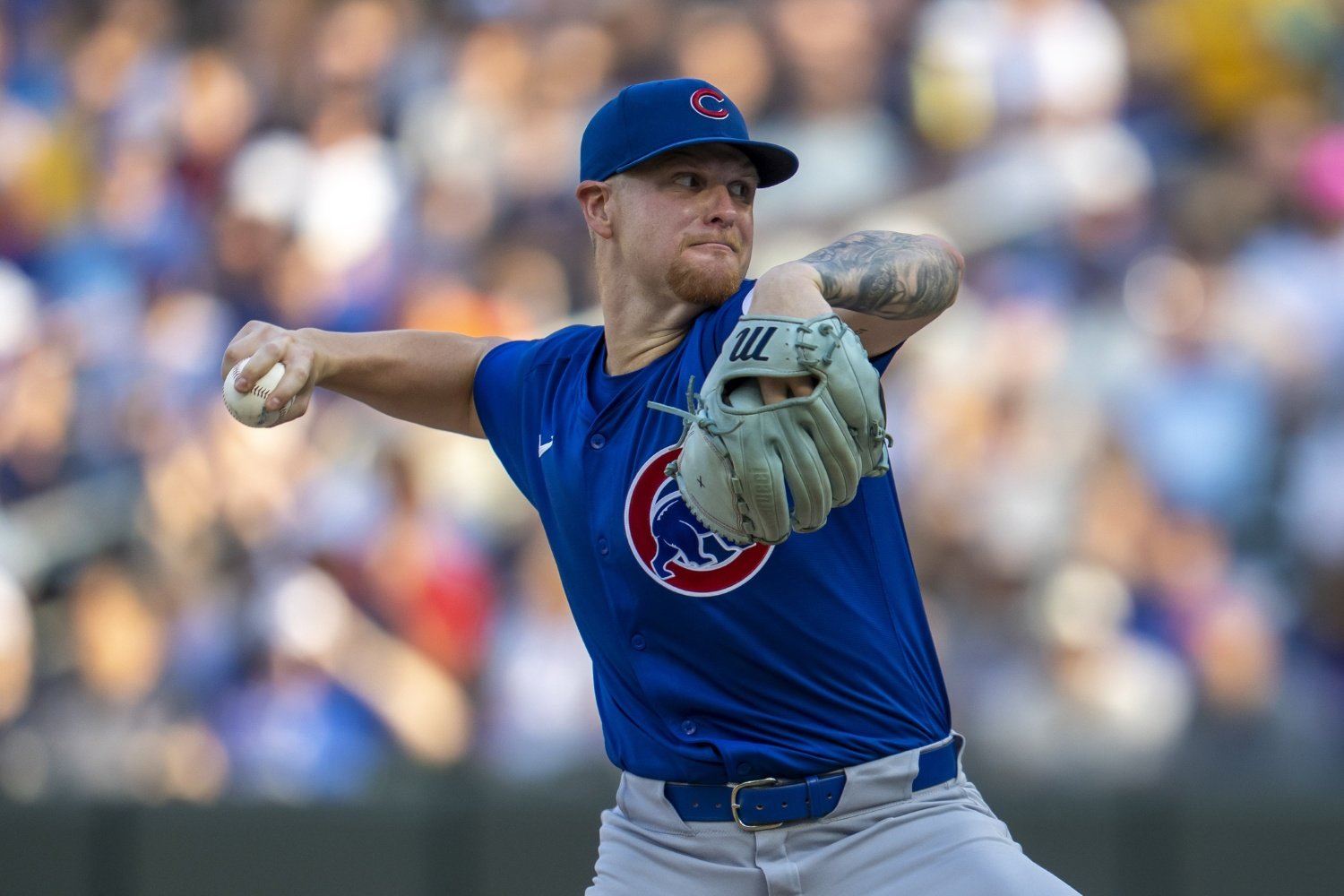 It's an awkward time of year to review (or even preview) a starting rotation. Teams often go into camp with up to nine potential starters and (if they're very lucky) a couple of intriguing prospects. At least one projected member of the 26-man roster usually hits the injured list before Opening Day. There's still the chance for trades and signings, but what we see right now is the Cubs' Plan A for the rotation. The pitching injury rates of the current era necessitate serious depth. Last season was a good lesson for the Cubs on that score, as three members of their Opening Day rotation—Justin Steele, Shota Imanaga and Jameson Taillon—missed significant time due to injuries. Matthew Boyd didn't miss time, but that was the first time in over half a decade that he'd stayed healthy all year; he's unlikely to do so again. Hence, we see the Cubs remaining interested in additions to their starting depth chart. For now, though, let's taxonomize the guys who are coming to camp as rotation candidates. Measuring Aces vs. Mid-Rotation Contenders In the top tier of starting pitching, you don't want to make any longwinded excuses for anyone. You want the statistics to leap off the page and command confidence. Ideally, you want at least one such stud at the front of a rotation. Do the Cubs have one? Let's define an ace arm in very simple terms. An ace arm should rank in the top 40 in the league in terms of long-term fundamentals. You don't want the guy to be too dependent on finesse and luck against the world's best hitters. We'll use two stats for fundamentals: Expected ERA (xERA), and Pitching+, via Fangraphs, the latter of which combines Stuff+ and Location+ modeling. A player with fundamentals below these expectations (even one who manages to get results) is showing a red flag: Those ace-caliber results may be inconsistent going forward. Still, there are plenty of dudes who have a complex approach to hacking the fundamentals, and the Cubs specialize in finding those guys. More importantly, perhaps, an ace will rank in the top 25 in basic results. We'll combine three measures to rank pitchers on that front: Earned Run Average (ERA), Home runs per nine innings (HR/9), and walks per nine innings (BB/9). One's ERA is the natural statistic for how reliable a player is, but it can sometimes overlook an elite player because of a few bad outings, or poor defensive support. Homer rate is less important during the regular season, except in extreme cases, but it becomes very important for assessing a player's ability to face elite slugging lineups in the postseason. Meanwhile, limiting walks is essential for amassing quality starts during the season but has a bit less impact against elite contact hitters in postseason. I computed total indices as an average of all five statistics, but with ERA weighted three times as heavily as the other two. After all, we want to emphasize run prevention in this portion. We'll also give a pitcher some extra credit if they play good defense, including controlling the running game well. For a World Series hopeful like the Cubs, you'd like to see the top 5 starting options to rank in the top 75 in both xERA and ERA (out of 127 players in the year 2025 who had 100 or more innings), and all of them, obviously, should be as highly ranked as possible. Without further ado, let's evaluate the leading three options for ace quality, based on their 2025 statistics. (Note, in the case of Boyd, adding in 2024 would inflate his overall results into clearer ace territory, but it was a small sample). The Top Trio: Cade Horton, Matthew Boyd, and Edward Cabrera Horton ERA: 12th (2.67) HR/9: 18th (0.76) BB/9: 51st (2.52) xERA: 44th (3.88) Pitching+: 70th (97) TOTAL WEIGHTED RANK, 2025: 31 An elite pitcher rarely peaks in their rookie year. Ideally, a hurler loses some "major-league jitters" their sophomore season. Horton had ace-like numbers in ERA and HR/9 in his debut. He was appropriately showered with affection during Rookie of the Year voting. His best results came during the second half of the season ,when you most need it. His overall stuff and expected ERA should both be better this year, as we have seen him do better in minor-league performances with clean bill of health. If you're an optimist, you see an ace in the making. I expect top-40 fundamentals and top-25 results in 2026. It's worth remembering, though, that "sophomore slumps" are as real as those jitters we mentioned earlier. Boyd ERA: 29th (3.21) HR/9: 29th (0.95) BB/9: 23rd (2.10) xERA: 33rd (3.75) Pitching+: 76th (96) TOTAL WEIGHTED RANK, 2025, including good fielding bonus: 25 Boyd is famous for his nice guy attitude and leadership on the mound. Here's a mid-velocity lefty with very good breaking pitches, who really remade himself last year. I believe his career year in 2025 has some chance to be repeated, but his stuff has hit a hard ceiling. His Gold Glove-level defense makes him a borderline ace; he kept runners in check as well as anyone in baseball last year. His results are quite fringy for an Ace, without factoring in defense. However, as a lefty with 5 decent or good pitches, we can give him quite a bit of leeway on velocity, too. Cabrera ERA: 42nd (3.53) HR/9: 51st (1.11) BB/9: 80th (3.14) xERA: 56th (4.05) Pitching+: 21st (107) TOTAL WEIGHTED RANK, 2025: 47 Cabrera is virtually the opposite of the typical Cubs starter: a guy whose raw ingredients hint at an ace, but who has yet to put it all together for a full season. His numbers profile as classic third option, but with good enough momentum to be a trusted No. 2. The bad news is that he drags the Cubs down from an elite walk rate; the good news is his results should improve in the Friendly Confines, and with the pitcher-friendly Cubs defense behind him. The even better news is that he's young and has showed steady improvement three seasons in a row. He had a four-month stretch last year wherein he was in the top 5 in ERA. The 4-6 Rotation Arms: Justin Steele, Shota Imanaga, and Jameson Taillon Breaking down the less starrish arms can lead to many arguments. You'll see cases of very high WAR and xERA paired with a bad ERA (Ben Brown, 2025), or a consistently impactful starter with a deceptively low WAR and stellar ERA (Jameson Taillon's 2024). Overall, the Cubs can be proud of their fourth through sixth guys; they're better than the back half of many rotations. The best of the bunch, Steele, certainly belonged to the first tier of the team's starters before his injury last year, but that very thing now makes it harder to gauge what the team will get from him and when. We'll judge him based on his 2024 stats, since he essentially lost 2025. Steele ERA: 17th (3.07) HR/9: 19th (0.80) BB/9: 52nd (2.47) xERA: 7th (2.81) Pitching+: 52nd (102) TOTAL WEIGHTED RANK, 2024: 26 Steele's 2024 self was as good as the team can reasonably hope for Horton, Boyd or Cabrera to be. However, two problems restrict his ranking in 2026. First, pitchers rarely play their best ball when they come back midseason from injury, especially in terms of fundamentals (Pitching+). Second, his results were a just below the desirable cutoff of top 40 in Pitching+, and thus, he's likely to face regression. He succeeded so much with precision before shredding his elbow that it's hard to expect him to be as good afterward. Between these two factors, we must expect Steele to have a shortened and diminished 2026. If he can reclaim health, he'll still be atop the rotation in 2027. Imanaga ERA: 20th (3.28) HR/9: 108th (1.64) BB/9: 4th (1.53) xERA: 28th (3.66) Pitching+: 39th (104) TOTAL WEIGHTED RANK, 2024 AND 2025: 34 Here, by the way, I've used his last two seasons' numbers taken together. I wish we could just roll with his 2024 stats, because he flashed ace-level results in his first major-league year. It's safer, though, to assume that he'll be somewhere between the stud he was that year and the suspect he was down the stretch of 2025. His velocity really became a problem last season, as he lost over 1 mph while navigating a stubborn hamstring strain. Still, the upside is real. We've seen it relatively recently, and he's a tenacious and creative competitor. Taillon ERA: 28th (3.45) HR/9: 83rd (1.37) BB/9: 12th (1.83) xERA: 46th (3.95) Pitching+: 60th (100) TOTAL WEIGHTED RANK, 2024 AND 2025: 41 We'll look at each of the last two seasons again here, to accentuate the reliability of the team's veteran workhorse. Taillon has put together two very impressive seasons, with a near-ace ERA and an elite walk rate that is confidence-inspiring. Still, his low strikeout rate hurts his xERA. In addition, those darn homers keep him out of postseason primacy. The only good news in that category is that he had a career-worst HR/9 year in 2025 and regression should be expected. Taillon has the exact profile of a season-long innings eater who wins many games with ruthless efficiency. He's definitely worth his $18-million salary, but he won't carry you in October like $30-million arms do. The Rest of the 40-Man Starters Colin Rea, Ben Brown, and Javier Assad: Better Than You Think Let's look at the rest of the important arms quickly. Colin Rea and Ben Brown finished last season with xERAs of 4.52 (85th) and 4.53 (86th), respectively. This means each team has, on average, three better pitchers capable of giving 100+ innings. When we look closer, it gets better. In BB/9, Rea was 50th (2.49), and Brown was 55th (2.71). Rea was tied for 52nd in HR/9 (1.13), whereas Brown can brag about his Pitching+'s 70th rank (97) being a floor, not a ceiling. In the case of Assad, you've got a guy who is much like Rea in junk pitching style, but somehow always outperforms Rea's (and his own) fundamentals. In terms of players with at least 250 innings pitched from 2023-2025 (134 results), Assad's ERA is shockingly good, at 29th-best (3.47). Adding to that, he boasts a HR/9 (1.10) that ranks 52nd, despite a sad xERA of 4.98 (117th) and equally bad BB/9 of 3.56 (117th). His horrendous Pitching+ scrapes the bottom of qualified players, and explains why he rarely strikes anyone out. This huge gap between actual and expected performance is why most analysts believe Assad will never again repeat his best two seasons. His best role on a good team is in long relief, although a non-contending team would immediately stick him into the back of the rotation. Caveats Clearly there's no exact science for projecting results from prior history. Pitching can be rather volatile across a season, let alone multiple seasons. The simplest evaluation is the most recent healthy year, though in some cases, two years is more appropriate. Comparisons: Who Potentially Has Three or Four Aces? Instead of thoroughly evaluating all 30 ballclubs, let's just compare six of the scariest rotations on highly complete contending squads: the Dodgers, Braves, TIgers Mariners, Phillies, and Red Sox. The point here is merely to illustrate how good the Cubs really are, rather than predict the relative quality of these teams. The Dodgers Stand Alone Los Angeles has an embarrassment of riches, of course. Yoshinobu Yamamoto, Shohei Ohtani, Tyler Glasnow and Blake Snell stand clearly above the Cubs' top four, although not by as much as you may think. It's hard to make statistical comparisons, because three of the four didn't have 100+ innings in 2025 or 2024. It will be interesting to see if they actually meet their lofty expectations. Of course, it doesn't end there. Roki Sasaki and River Ryan could blossom into deadly weapons this year. Four Top-Quality Performers, When Healthy: The Mariners, Tigers and Braves Seattle still has its deadly ace trio of Bryan Woo, Logan Gilbert, and George Kirby. Luis Castillo, who has some fringe ace stats at his best, is comparable to Cabrera in ERA and xERA. However, their next three guys can't compete with the Cubs' fifth through seventh options (Imanaga, Taillon, and Rea). Detroit can go man-for-man with Seattle, after signing Framber Valdez and Justin Verlander to complement their previous top duo of Tarik Skubal and Jack Flaherty. Skubal is, without controversy, the best pitcher in baseball. Valdez is an ace in his own right, and Verlander and Flaherty are solid mid-rotation pieces. The team won't have Reese Olson to round out their staff this year, as Olson is set to undergo season-killing surgery, but they have a handful of other young arms and former No. 1 pick Casey Mize to brace them against the risk of an injury to Verlander. Until camp opened, it looked like Atlanta would fit into this tier, too, although more tenuously. Chris Sale remains dominant at times, but is starting to age. Spencer Strider returned from Tommy John surgery, but wasn't his best self. Reynaldo López missed last season with shoulder trouble, and now Spencer Schwellenbach will spend at least the first two months of the year on the IL, too. The upside is very high for the Braves, but the downside is coming after them. Two Studs, One Fringe Ace: The Red Sox and Phillies Philadelphia's Christopher Sánchez, Zack Wheeler, and Jesús Luzardo (fringe) are good enough to top Horton, Boyd, and Cabrera, but Wheeler is coming off thoracic outlet syndrome and won't be ready to start the season. Similarly, Boston's Garrett Crochet, Ranger Suárez, and Sonny Gray (fringe) trio can strike fear in batters' hearts. Boston has better depth; Philadelphia has better upside. Neither is clearly superior to the Cubs, though. Conclusion Though other teams have truer aces, the Cubs blend depth and upside as well as almost anyone. They'll have to prove that they can hold up, and Cabrera and Horton have to take the next step after their quasi-breakouts in 2025, but this is an October-ready starting rotation. Unless and until they run into the Dodgers, they can hang with anyone.
 -
Hello Cubs World, let's spend a bit of time analyzing the bench. Before we get started, let's recall that the Cubs have had a below average hitting bench for years now. Jed Hoyer has spent most of the past five years collecting glove-only (not even glove-first) players for those roles. The exception was Patrick Wisdom- a completely reverse guy who had all the power we ever wanted, but never truly mastered any position. His supposed spot, third base, was actually his worst, by far. Let's face it - in the majors, he was a platoon option at first base or left field. I thought he would stay in the majors as a part time lefty killer.... Best wishes to him in Asia- he's a strong middle of the order bat in Korea and could probably do the same in Japan. we will get back to Wisdom in a second, but for now let's wonder if the Cubs finally have a serious, and even intimidating bench? Let's go over the pecking order heading into spring training. First, let's examine the 40-man roster. Matt Shaw - the 10th Man I dreamed of Before we get into controversies let's just dispense with Matt Shaw - he is the one absolute lock for the roster. Shaw's trajectory is as a fulltime starter in 2027, but he's exactly what a contender needs right now - the 10th man, the super-utility man who has all of the tools (well, except his arm is pretty average, so let's call him a 4-tool standout). He flashed Gold Glove talent in his first season in the majors, and first full season trying third base. Many fans still don't realize he was an All-American collegiate player at shortstop in only a single go at that position. what is more commonly known is that he showed nearly Nico Hoerner level talent at his preferred position, second base. I see him as the next Ryne Sandberg, but a better fielder (we've been waiting a long time for that guy). I really doubt we can afford to give Nico 30 million a year, which is where the elite ballclubs will be setting his price if he has another great season. Even beyond Sandberg comparisons, he's played plus ball in left field when given that assignment, too. Thus, Shaw will be rotating to give Happ, Hoerner, Swanson (probably with Hoerner sliding to SS), and Bregman days off. Simply backing up four positions should earn him 300+ plate appearances. He will contribute about 1.5 defensive WAR, which is a ton for a utility guy. Overall, his relatively best tool is actually baserunning- he's over the 90th percentile in speed, he knows how to steal, and how to stretch a double into a triple. In the long run, I see Shaw as the Cubs' leadoff hitter- there, I said it. He will continue to improve for the next 3-4 years, so it's wise to not put too much pressure on him right away. But for now, consider all the pinch hitting, fielding, running, and even DH reps, and I think Shaw will be involved in nearly every game. Here is what I see for a healthy Shaw in 2026 with only 2/3rds playing time: 420 PA .260 BA .340 OBP .450 SLG 20 HR 65 RBI 25 SB 4 fWAR (1.5 defense, 2.3 offense, .2 baserunning) Kevin Alcantara - Use it or Lose it Time ! The outfield bench guy is usually a glove first role that is expected to generate 0 to 1 fWAR and rarely sees the wrong side of his best platoon. Here's a guy who has reached his last option year - he's got only one more chance to work things out in AAA if he doesn't make the roster. I give him about an 80% chance of taking full advantage of this situation. Alcantara is a solid centerfielder or plus right fielder - tall, rangy, fast, and generally the type of guy you want backing up PCA and Suzuki. His glove is good enough that he may frequently substitute for Suzuki in late innings - that is, when he's not platooning with PCA already. He can hit long balls as well as Swanson, but he projects to be more of a hit/run tool orientation overall. Alcantara absolutely MASHED against left-handed pitching in the minors, with nearly .900 OPS splits over the past few years. He will outplay the Pirates' O'Neil Cruz very soon. I think fans will be impressed with his defensive prowess and delighted to see him finally pan out. He won't have enough time to do high damage offensively - although he'll surpass 20 HR/season when a full-timer. Still, expect him to be in line to platoon with PCA in 2027 and contend for a fulltime role in right field in 2028. Projections (mostly hitting against lefties, often in center field): 160 PA .245 BA .325 OBP .430 SLG 7 HR 25 RBI 12 SB 1 fWAR (.4 defense, .5 offense, .1 baserunning) Tyler Austin: The Low Risk, High Reward Camp Competitor Okay, here's the first layer of controversy worth a deep look. Tyler Austin is Patrick Wisdom 2.0 ... or, to be fair, the original Patrick Wisdom. circa 2018-2019, He looked like the next big masher for the Yankees. His career MLB stats as a young bench guy tells the story well: WAR 0.9 AB 521 HR 33 BA .219 RBI 91 SB 4 OBP .292 SLG .451 OPS .743 Clearly, this is a guy who had glove and strikeout struggles on a similar level to Wisdom, because this stat line should be close to 2 WAR, not 1. He's a platoon righty first baseman and DH who can be a pinch outfielder when you need to risk it. But man can this cat mash homers. In the last five years in Japan, he's been one of the top 10 sluggers, including an improved hit tool that averaged him 1.0 OPS .... but he's also been injured nearly half the time. Nobody sees him as a viable fulltime starter for that reason, but his platoon results against lefty pitching is even better than Wisdom. So, what's the expectation here? A much better bench bat than Justin Turner, for $1.5 MM. My belief is that Jonathan Long - our best fulltime AAA hitter, and the only guy who could hit like Ballesteros and Shaw over the last two seasons - is supposed to inherit the platoon role with Michael Busch. So, clearly, the Cubs felt Long needed one more year to develop. The Jed Hoyer approach is similar to his mentor Theo Epstein - never rush a guy to the majors unless he's a superstar. Thus, Tyler Austin is the experienced alternative. If he makes the roster, his job will be pretty straightforward- 1) cover Busch and/or Ballesteros against lefties they don't match up with well; 2) pinch hit for Hoerner when you're praying for a late inning homer; 3) try not to get in anyone's way. I give Austin less than 50% chance to make the squad - there's simply a long list of guys who could make a case for themselves. Still, the third bench spot is his to lose, since it is most likely to be used for this exact role. The lineup simply doesn't have that many holes to sneak into. Projection: 150 PA .235 BA .320 OBP .520 SLG 12 HR 30 RBI .6 fWAR (-.2 defense, .8 offense) Justin Dean: This Emergency Outfielder Will Get a Few Cups of Tea. Justin Dean can steal a buttload of bases - 68 in 2024, in the minors, which was about one every other game. He can also play surprisingly good outfield given the fact he's nearly a foot shorter than Alcantara. The Dodgers liked his defense enough to use him in the World Series. And yet, bat-wise, he's strictly inferior to everyone aforementioned, as well as several guys we have down in AAA. He's your classic glove-first backup center fielder with a projected career .660-.700 OPS as a contact hitter and a lot of baserunning opportunities. Overall, I just don't see Dean making the opening roster unless he has an astounding spring training and someone gets hurt. That being said, I expect him to burn his options this year as the next guy up. I am quite happy to have Dean take over the emergency outfield role behind Alcantara. Projection: He spends most of 2026 in AAA and produced about 40 MLB plate appearances, at best - mostly a pinch runner and emergency glove. The Rest of the 40-Man: Infielders Good Enough to Protect, Not Good Enough to Play in 2026 James Triantos. All three of these guys have flashed brilliance, but Triantos has had the most love from scouting reports. He functions as a glove-first 2nd baseman and surprisingly capable center fielder (ignore any claims to him playing third, because he sucks at it) who can kinda hit and definitely run. Unfortunately he hits homers like Hoerner, so won't likely surpass 10 in a season. Of the bunch, Triantos has the highest upside as a Tommy Edman-type. His 2025 season at the plate in AAA was a big setback. What's worse is that Triantos is only viable on this team at the most saturated positions in the Cubs' system - second and center. I don't see him in a Cubbie Blue uniform in 2026 unless Hoerner has a freak accident - he's the most valuable trade chip we have that we simply don't need. Ben Cowles. Cowles is yet another utility guy we swiped from the Yankees. He gets hot at the plate sometimes, and projects as a consistent 10 HR guy. with a solid hit tool but not quite the running or range of Triantos. He can successfully cover 2nd and actually play well at 3rd at a major league level. Unfortunately, his once-enticing bat for a utility guy has trended downwards for two straight years in the minors. Cowles is, frankly, the longest shot of the entire 40-man roster after camp ends -he's easy to DFA and low risk to lose. Pedro Ramirez. Here's the guy I have the most hopes for in the long run as the true utility option, and yet the least concern in the short run. He hasn't even made it to AAA yet. Ramirez is what you really want to step in for Shaw once he is promoted to second. He's a legit second, third, and shortstop of the future. He's a switch hitter, and he stole 28 bases last year in AA. I hope to see him get his shot to play in 2027, but he's only on the 40-man to avoid the rule 5 draft. Given his trajectory I see upside as a 2.5 WAR, 10th man option in 2028, in a truer Edman mold than Triantos. The Guys in the Minors : The REAL Camp Competition. There's exactly two other Cubs everyone should be watching closely in camp. Jonathon Long. Look, I don't care what anyone says- this kid is going to be a serious MLB player with an .800 OPS or higher career average. He. Can. Hit. And despite being barely 23, his glove at first and third is a tick better than Patrick Wisdom already. there's a coin toss of a chance that he looks so good that Tyler Austin is set packing. I project the upside potential of a lower strikeout rate, higher walk rate, and greater positional versatility than Austin. Don't be surprised if Long forces the issue -he's already flashing nearly the exact bat potential as Moises Ballesteros but from the opposite side of the plate- as a lefty though, Ballesteros has the strongside platoon advantage. And wouldn't THAT be a dream platoon to duplicate at the Major league level! Check out these sweet stats from 2025 in roughly 520 at bats: .305 BA .404 OBP .479 SLG ,883 OPS 20HR 91 RBI Chas McCormick. Here's the last guy with any real shot of Bogarting a roster spot somehow. Chas has had some flashes of serious ability at the major league level. However, when relegated to the bench in 2024 and 2025, his bat turned ugly. Even with those two down year, he still boasts a career .734 OPS (104 OPS+), 56 HR, 37 SB, and .247 BA in 1388 at bats. If he can reclaim his abilities, he could muscle his way onto the roster to replace an injured Suzuki, Happ, or PCA as a left-handed everyday outfielder with a solid glove, baserunning, and slightly above average hitting profile. However, he has very little chance to make the roster without injury results. don't be surprised if he gets poached by a needy team for an active roster spot. Overall, this is a really cool set of bench options. I'm happy with it. There's enough to work with here that Jed Hoyer can wait until midseason to make any necessary adjustments and perhaps buy a high profile rental. At any rate, I think its the best bench we've had in a long time - if only for the reason that Matt Shaw is one of the best bench players in all of Baseball, if not THE best.
-
I see Corbin Martin as the only serious option here. He could be one pitch change away from a "marginal" MLB reliever. The other two are only injury hedges. The Vubs are so flush with competition that they cant attract good AAA players. These are below average retreads. Beede is a minor leaguer, period, for 2025. He needs an overhaul, and proably won't make the team. If we need to use Justin Dean, it means that we're down TWO starting outfielders, and also don't call up Jonathan Long to help with left field. Highly unlikely scenario.
-
Hello Cubs World, in this blog entry I'll quickly review the "locked in" members of the 2026 13-man pitching roster, plus the top minors/injury arms on standby. Taking a hybrid approach, we will look at both the role each pitcher will play and the "swiss army knife" value of the player - which, if you've been following my writing, is really all about having a maximally diverse set of nasty pitches and pitching styles. TLDR Version: I project a #5 MLB Rotation, #10 Bullpen. Great Swiss Army Stuff, but overall Role Fit not ideal. The Rotation Welcome Edward Cabrera. I am in the camp that sees him as a breakout #2 quality pitcher, after he made key adjustments in 2025. Still, as a Cub, he won't likely need to fill a top-rotation role for post-season play. I think he will continue to be limited in innings to the 100-150 range, but perhaps more deliberately this time. His pre-ASB talents make good sense when paired with a post-ASB Justin Steele. None of our 6 rotation guys will get optioned - and, Colin Rea and Javier Assad are being paid to hold down the long relief roles already. So, how best to use this "extra starter" when Steele returns? Imagine this: Steele and Cabrera both get pitch-limited to conserve them for the post-season. Cabrera give us 15 starts (<80 innings) while Steele is recovering. Then, around July 15, Steele takes over on a 80-pitch limit. Cabrera becomes the 3-4 inning long reliever behind Steele, on a 50-pitch limit. Steele would amass around 100 innings, and Cabrera, 130. They'd still get skipped a few times on minor injuries, for guys like Rea or Assad. At any rate, we will have enough reliable guys for a post-season rotation -- Horton, Boyd [yes, he'll be reliable], Steele, Taillon -- that Cabrera will be forced into the bullpen for a variety of reasons, along with Imanaga, for the postseason. ON THE OTHER HAND, if Cabrera manages both insane AND healthy baseball, Steele could get that bullpen bump. Some teams boast a better 1-2 punch at the very top - Horton isn't quite a Skubal or Skenes, and Boyd struggled in September. However, few teams have this sort of rotation depth other than perhaps the Dodgers, Brewers, and Phillies. None of THEIR top 5 starters should seriously be labeled as anything below a #3 talent. We are in a similar boat. For proof, look at our 6th best starter, Jameson Taillon - a consensus #3 type arm!!! That's very impressive, and the deepest group Tommy Hottovy has had in training camp since their 2016 Team. Even our backup plans have backup plans: our 2 swing guys (Rea, Assad) are #7 and #8 in line for mid-season starts, yet both would hold rotation spots on 20 or more MLB teams!!!! Furthermore, our AAA guys are fierce. Jaxon Wiggins is projected as yet another #2 type arm by 2027, and Birdsell as a Rea or better. Ben Brown had some outstanding games, so his stats were grossly skewed by his 3 worst performances. I'm not giving up on him, and neither is pitching coach Hottovy. Although he's a bullpen arm on this current roster, if he can increase his improved hard changeup vs. lefties to 15% use -- and, find one similar off-tempo pitch, such as a slider, cutter, or splitter he can throw 5 strikes a game against righties -- he suddenly becomes another juicy #3-4 level starter! The Bullpen ... is, as usual, going to be better than projected. The Cubs have proven they know how to tweak solid guys and make them better. Let's look at the new additions. Hoby Milner is a legit Lefty specialist. Phil Maton was a great pickup as the most reliable soft contact ground inducer - an ideal high leverage "fixer" who bails out starters by drawing double plays when you need them the most. This role is grossly underappreciated by the media, but its every bit as important as a closer. Caleb Thielbar was a steal at 4.5 Million - I thought he'd get 8 million as a mercenary. So that's a huge win. His portfolio features an elite knuckle curve and strong changeup, and he's proven he can handle top leverage innings against both sides of the plate. Even Jacob Webb was a cheap working class 1.5 mm contract to compete for a crowded room of talent. He's above average and yet cheap to cut if he gets dinged up. The Hunter Harvey Quandary Me and everyone else has exactly one quibble: Hunter Harvey. This one "high upside closer potential" move may have dropped our bullpen rank ~5 spots, relative to landing a top free agent like Robert Suarez. Although he flashes elite stuff and improved command, he has one of the worst injury resumes in the league. 6 million on this seems like a weak attempt to find a second closer-type arm to pair with the studly, but sometimes vulnerable, Daniel Palencia. Danny Boy's 4-Seam-slider dependency isn't diverse enough to deal with every type of elite hitter, particularly lefty bombers. Harvey's nasty mix does. Still, even if Harvey "works out", he'll be a 40-50 inning type of presence who misses at least 2 months of action and may never see the post-season. Nearly everyone, including me, hoped they would finally spend on a serious multi-year, 70 inning type of solution, like a Robert Suarez. Such guys are indeed volatile contributors, but over a long period the best of the best usually prove their worth. Frankly, the Harvey roster spot may also be blocking the development of Luke Little, Ben Brown, and so on. There's one too many vets. On the flipside, let's put it this way: if Harvey puts it all together, he is a $10-$15 million/year type of talent, so it could work out to be a genius signing for only one year... but the Cubs underspent their true potential (as usual). The Braves gave Suarez exactly his worth - 3 years, $50 mm, so the perfect high-leverage option missed on his fit to Wrigley Field. Overall, the Harvey signing signals loudly that the Cubs will trade for their elite high leverage guy mid-season- an annual ritual that never matches expectations. Kittredge was good help in 2025, for example, but not scary good. I feel as if the Craig Kimbrell miss set us back half a decade of gun shy Hoyerism. Swiss Army Stuff Ideally, you want a full portfolio - every type of guy to strike out every type of hitter. This includes a balanced blend of lefty/righty, lots of stuff, pitch mixes peppered with exotic movement and pitch types, a repertoire of elite, freaky strikeout pitches, and enough soft contact inducers to get out of any jam. This club has plenty of low arm slots (Cabrera, Milner, Maton, for example), Many lefties (although we are projected to be 1 lefty short in the bullpen on Opening Day, we've got Little and Martin ready to go), a top-flight list of freaky pitches (Cabrera's hard change and knuckle curve, Imanaga's splitter, Steele's sweeper, Maton's cutter, and so on). MOST IMPORTANTLY, the Cubs finally have worked up to showing above average stuff and velocity totals across their entire roster. It's been many years since they could say they had as much raw peak horsepower (Palencia, 103, Harvey 99, Horton 98, Cabrera 98) as elite command/control/complexity (Steele, Boyd, Taillon, Imanaga, Maton, Thielbar, Rea, Assad). The main knocks have to do with the "high leverage" thing. Imanaga and Boyd showed late season decline, which is never ideal for a starter. Palencia is a solid but not elite closer, due to his elite velocity but limited repertoire. Thielbar is 39 and may be in decline from here on out. Milner's elite for lefties, but with a 3 batter rule, he's often exposed for being quite bad against righties. Still, the overall depth continues to be impressive, with an insane number of above average guys in camp, even buried in AAA. Perhaps the team strength is its 10 deep stack of viable starters that are all better than the BEST PITCHER ON THE COLORADO ROCKIES - buried guys like Colin Rea, Javier Assad, Ben Brown, and Jaxson Wiggins that all would have rotational jobs in 2026 somewhere. RATING SCALE: A = Meets Championship expectations B = Above Average League expectations C = Below Average League expectations D = AAAA type of bubble talent F = Minor league only Without further ado, here's my best guess at the Opening Day pitching roster: The Rotation Role Grade Note Swiss Army Grade Note 1 R Cade Horton A Young but Elite swagger A Classic Power mix w/extension 2 L Matthew Boyd B Gold Glove but lost steam A Excellent Power/Control balance 3 R Edward Cabrera A Insane Stuff, Injury bug A Unique 5-pitch Power&Nastiness 4 L Shota Imanaga B #3 but homer vulnerability A 6 control pitches led by splitter 5 R Jameson Taillon A #3 in the #5 Hole! B Fastball-heavy corner painter Top Minors and Injured Guys - Should collectively See 22+ starts in 2026 6 L Justin Steele A All-Star may see bullpen B Top command, but 2-pitch heaviness 7 R Jaxon Wiggins A 2027 Imanaga Replacement A Excellent power mix w/ nasty splitter 8 R Brandon Birdsell B 2027 Taillon Replacement C Lacks a true plus-plus pitch 9 L Jordan Wicks C Probably his last Cub year D Needs a new plus pitch, +2 mph 10 R Connor Noland C Phil Maton but as Swing Guy C Nasty breaks, but MLB fringe velocity The High Leverage Crew- Locked in, 200+ innings 1 R Daniel Palencia (closer) B Not a top 10 closer yet B 102 4-seam, slider: use changeup plz! 2 L Caleb Thielbar(8th setup)A Great vs L or R, hale 39 A 4 good pitches, elite knuckle curve 3 R Phil Maton(fixer/setup) A Elite junk vs. R, reliable A 5 pitch king of weak contact, w/ K's. The Lefty Specialist: Super Safe Job 4 L Hoby Milner B Lefty killer but righties kill A lowest lefty arm slot, great mix Low Leverage Relief - Their Jobs Aren't Safe, but High Upside 5 R Hunter Harvey B the late inning, low lev. guy A elite, nasty power mix if healthy 6 R Jacob Webb B underrated midgame option B pretty nasty ride/break, but slow The (what a luxury!) Swing/long Guys - Each expected to go 2-3 innings every fourth game. 7 R Javier Assad A amazingly not traded yet B great mix but no heat or plus pitch 8 R Colin Rea A a real luxury as a swing B Very similar to Assad, but more heat Top 4 Minors Arms, with expected replacement role 9 L Luke Little B Proven lefty, first man up B Simple mix but great velocity 10 R Ben Brown B Great stuff, Assad/Rea backup C Desperately needs 1 more pitch 11 R Porter Hodge C Struggled 2025, Harvey/Webb B Great stuff, needs control 12 L Riley Martin C Milner/Thielbar, unproven B Great junk, needs an elite pitch Side note: Which of these starters should we extend in 2026 - Boyd, Imanaga, or Taillon? My best guess is Matthew Boyd is the only one of the three extended. He's demonstrated an unlocked level of higher play, leadership ability, Gold Glove fielding, and should be able to handle longer seasons now. Due to his age, I forecast a 2-year, 50 MM contract for 2027 and 2028 with a 3rd year 20 mm club option/5mm buyout. Taillon has served us well, but he's become "just another guy" in our crowded rotation. He's already "right priced" around $17mm annually. Taillon could fit in a #3 role on a mid-market team like Diamondbacks, or a #4 on a team like the Mets. Imanaga has been a fun personality and great asset, but I don't think we should outbid his highest bidder in 2027. I expect him to carry a 3 year, $65mm price tag- precisely the range that we didn't want to pay, but someone else will. Why? simple: He belongs in a long-ball starved stadium, where his "tendencies" won't hurt. Imanaga would give up 20% fewer homers in Detroit, Pittsburgh, or San Francisco -all teams that are hoping to contend in 2027 and need his help. Luckily, Steele is under contract for 2027. In my preferred scenario the 2027 rotation is Horton, Boyd, Cabrera, Steele, Wiggins with Rea and Assad still as swing/long relief, and the quite serviceable Birdsell still the next man up from AAA. I used to want to move Assad, but now it seems smarter to keep him around, as his best work has come in multi-inning pen appearances. Finally, there's a realistic chance that Wiggins will be a sub 3 ERA type of stud as early as then. All that adds up to a long-term sunny outlook for the rotation. I just wish Hoyer found that ONE SPECIAL GUY to finish this year's bullpen. Here's hoping Hunter Harvey delivers.
-
Re-doing the Cubs 2026 Pitching Staff: The Swiss Army Knife Approach
ryanrc posted a blog entry in Robert Conan Ryan
Hello Cubs World, My first news article will be dropping in a few days. Keep your eye out for it! In the meantime, I'm raising an issue here: What would be the BEST OF ALL POSSIBLE bullpens, if Hoyer focused solely on that issue this offseason? It is incorrect to only add WAR and chase strikeout kings. You need a Swiss army knife approach to a good bullpen and actually squeeze more WAR from team chemistry. You need to generate matchup outs, because no team - even the Dodgers or Mets - can afford to stack the pen with all-around studs. Also, let's remember the injury rate of pitching - even if you've got a good bullpen, 1/3rd of them will be out of commission at any given time, so you need at least 3 more starters and 5 more relievers ready to go in AAA. Thus, its good to have a few "burner vets" on one year deals you can cut midseason, and only a few premium vets that you handpicked for their injury resilience and elite skills. Here's what a dream bullpen will have, to cover every possible base: 1) Every pitcher should have at least 3 pitches unless both pitches are top notch. However, we must recognize that many so-called 2 pitch pitchers have a lot of command, to the point that those 2 pitches would act like 4 pitches if both can reverse break along one plane. 2) 3 lefties, 5 righties. This balance roughly matches the balance of left and right-handed batters. You want 1 lefty for each of the three types, below: 3) 3 Power Pitchers. The power pitchers focus on generating Ks and whiffs. Ideally, each one of them would have a unique strikeout pitch. I would prefer one slider; 1 curve; and, 1 changeup (the lefty). 4) 3 Junk Pitchers (1 power/junk hybrid righty). The junk pitchers focus on chases and weak contact. One righty should be a "kitchen sink" pure junk pitcher with a huge repertoire of frustrating junk to create maximum chasing. The second righty should be a power/junk hybrid that is really a groundball expert leading with a sinker (ideally, sinker, changeup, curve, akin to starter Framber Valdez). The lefty should be halfway between those two, with an emphasis on curveballs. 5) 2 Freak pitchers. These guys use rare pitches and rare arm slots. Ideally, the righty would be a submariner leading their repertoire with a rising sinker. The lefty would be a knuckleballer with a great fastball and curve for disruption. These pitches are knuckleball, screwball, forkball, slow curve, slurve, and knuckle-curve. Combined, the account for only 3 to 4 percent of the current pitches thrown in the league. Now, 2 of these guys must be dedicated for long relief.... so let's further break that down. 6) 2 Long Relievers. The lefty long reliever would be the specialty or junk type, and the righty a Power/junk hybrid. Pitching lower velocity and to weak contact, with low arm strain strikeout strategies, would be their best strategy to reliably bail out starters and handle heavy workloads. Would it be possible for the Cubs to build such a squad for 2026? Almost. Let's take account of the Cub's current best options (top 8 pitchers in bold text, long relievers with **) Power Righties: Daniel Palencia (fastball/slider), Ben Brown **(fastball/curveball), Jack Neely (Fastball/slider) Power Lefty: Luke Little (fastball/sweeper), Porter Hodge (Fastball, sweeper, slider) Power/Junk Hybrid: Ethan Roberts (Cutter/slider/fastball), Gavin Hollowell (fastball/sweeper/sinker) Junk Righties: Phil Maton (cutter/curve/sinker/changeup), Javier Assad **(6 pitches), Junk Lefties: Riley Martin (curve/fastball/slider/changeup), Jordan Wicks** (6 pitches) Specialty Pitchers: NONE (although Imanaga has a splitter, he's a starter, and Asaad's slurve is not thrown much). Well..... this is not gonna cut it. Let's go through some observations. Let's go through these options in reverse order as listed above. 1) WE NEED SPECIALITY PITCHERS. Tyler Rogers is one available submariner. I would prioritize signing him. Ironically, the only other qualifier is Caleb Theilbar, who uses his rare knuckle-curve at least 10% of the time and as a key strikeout pitch. VERDICT: Signing Rogers (2y/ 24 mm, 3rd year option) and Theilbar (1 y 8mm) would be the fastest and best way to improve the Swiss army knife strategy. 2) WE HAVE THE JUNK RIGHTIES, BUT LEFTIES ARE SHAKY. Riley Martin is taking Jordan Wicks' job, and Maton and Assad are locks as the junk righties. There's simply no room for the both of them. Wicks is now the contingency plan. VERDICT: The Junk Righties are solid. Pursue For left, sign Hoby Milner - CHAT GPT5 thinks 1y $ 3.5 million would land the best soft contact option in free agency. 3) THE POWER PITCHERS ARE GOOD YOUNG AND UNRELIABLE. Palencia is the only sure thing. Brown, Little, Hodge, and Neely all have a risk of burning options in AAA in 2026. This means the cubs have room to replace any of them with free agents. The only lefty available is Aroldis Chapman, and Cubs fans don't like him VERDICT: The cubs should upgrade 1 power/hybrid pitcher...sign Robert Suarez as closer 1 to leapfrog Palencia, who throws 99 and yet has a plus changeup for groundball induction and weak contact. he would just fit into a Jed Hoyer budget (around 3 year, $50 million). Is this a true need? PROBABLY NOT, but with the kind of cash Hoyer has to burn, it is a WANT. Total cap hit of signings, 2026: 40 million (Kyle Tucker money). This would eliminate the pursuit of any pricey starters for 2026, but would optimize the bullpen. Here is what the remade bullpen would look like, with AAA callup guys in (CAPS): POWER RIGHTIES: Palencia (BROWN), (NEELY) POWER LEFTY: Little (HODGE) POWER/JUNK HYBRID: Suarez (ROBERTS) JUNK RIGHTY: Maton, Assad JUNK LEFTY: Milner (MARTIN) SPECIALTY: Thielbar, Rogers Okay, that would be a badass bullpen, and the best possible combinations that would fit under $45 million. +++++++++++++++++++++++++++++++++++++++++++++++++++ Suppose the Cubs took this strategy. Their salary situation would sit at about $213 million. They could then use their remaining headroom to sign Jorge Polanco as a lefty infield bat (2y. 26 mm, 12 in 2026, 3rd year mutual options). This would bring them to $225 million total outlay, which is a good figure for this year. Instead of chasing starting pitching, this strategy ensures an elite bullpen balance. Why is this a good idea? Mainly due to the Cub's really deep quality in the backup rotation. Beyond their starting five, Brown and Assad have proven they can win games; Justin Steele will be back after May 1 sometime; Walker Powell is looking quite serviceable as a mid 4 ERA junk righty, and, they Jaxson Wiggins and maybe Brandon Birdsell waiting. How well balanced is the rotation? Actually = it is great from a Swiss Army Knife perspective. Although some wish we had 1 more fireballer to replace Rea, I think if you stare at this long enough and look at the bullpen upgrade suggestions, you'd concur that any upgrade should be a SPECIALTY righty pitcher. Ideally you also want 3 pitchers who would be in the top 10 list for Cy young Candidates in their League (MLB top 20), and one of those an Ace that would be top 10 in the majors. 1 Horton - power righty, could be 10th best MLB starter 2 Boyd - power/junk hybrid lefty, potentially 10-20th best 3 Imanaga - specialty lefty (splitter) potentially 10-20th best 4 Taillon - power/junk hybrid righty. potentially top 50 5 Rea - power/junk hybrid righty. potentially top 100 IF anyone were bumped to the pen, it would be Rea. The ideal veteran starter would cost less than 10 million and be a specialty pitcher. If Hoyer finds a clever, affordable trade to upgrade over Rea, he would move to the bullpen and eliminate the need for one veteran. Ideally, this would be Hoby Milner, the least important of the additions. We would start the Season with only 2 lefties (Thielbar, Little), and call up Riley as the next guy up. Junk pitchers have a tendency to play better against both handed batters, whereas power pitchers dominate their same-handed fellows but have a bit more disadvantage opposite hand. Rea's bullpen presence would override Milner. As an aside, many arguments exist to let more youth pitch- Milner would add just one more block to using Brown and Riley. ************************************************************* Suppose Cubs go one step further. Instead of Milner, they hire a free agent starter within budget. who would perfectly fit the Budget and still improve the roster over Rea? Only if Ricketts spends a bit more. But it can still be done under the salary cap and with cushion left over. Answer: Tyler Mahle. I think he would take a 2 year Boyd-style contract . 13 mm first year, 17 million second, 2 mm buyout. His splitter is a plus strikeout pitch and has turned him from a mediocre starter to an Imanaga-caliber player. This would bring the total budget for the season to $235 million. It would leave open $9 million before the salary cap for making mid-season moves - and such a deep roster that there would be little need to make any! This would be totally doable, because there's several ways they could salary dump midseason if things turn bad - on a cliffhanger year, they could have a fire sale of Happ, Suzuki, Kelly, and/or Boyd if things don't work out as hoped just like they did with the old 2016 team before the pandemic. OVERALL VERDICT: add Mahle, Suarez, Thielbar, and Rogers, and have Rea/Assad as swing/long relief. And Polanco. Trade away Brown, Wicks, maybe Alcantara, and any other extraneous guys so they can find their happy place. This, Cubs fans, is a very plausible way to build out a Swiss Army Knife Strategy within budget. There are some close variations, but they woudn't change much - such as Danny Coloumbe instead of Thielbar. The combined WAR value of these pitchers is estimated at about 5.5 compared to Kyle Tucker's 4.5; in addition, the combined WAR projection i Have for the Cubs' new position players is about 6 WAR due to their platoon rotation (Polanco 2, Ballesteros 1.5, Long 1, Caissie 1.5)... and this is above the -1 WAR we got from last years' bench. The total is 12.5 - 4.5 = 8 WAR gain, NOT EVEN COUNTING JUSTIN STEELE, and still under the salary cap. I'm still not convinced Hoyer will get to spend that much, especially on bullpen, but WHAT THE HECK ELSE would he spend it on? His position player situation is a youth movement and it would be foolish to squander that for one yar of contention. If he could embrace this approach, this team could beat the Brewers. If he doesn't absolutely STACK the bullpen, there's little hope of a World Series run. If they added Polanco, they would have an impressive bench (Polanco S, Long R, Caissie L) that would make everyone forget about Kyle Tucker in terms of net WAR. This Swiss Army Knife Bench would platoon regularly, allowing Suzuki to platoon as the outfield Righty against lefties, and Polanco could also help Ballesteros at DH. And guess what? it would add far more WAR for the same money than signing Kyle Tucker. This is about +8 WAR!!!