.jpg.900f6d1bc80a5a156f3ba09ea0e4b3d7.jpg)

Jason Ross
-
Posts
8,153 -
Joined
-
Last visited
-
Days Won
74
Content Type
Profiles
Joomla Posts 1
Chicago Cubs Videos
Chicago Cubs Free Agent & Trade Rumors, Notes, & Tidbits
2026 Chicago Cubs Top Prospects Ranking
News
2023 Chicago Cubs Draft Picks
Guides & Resources
2024 Chicago Cubs Draft Picks
The Chicago Cubs Players Project
2025 Chicago Cubs Draft Pick Tracker
2026 Chicago Cubs Draft Tracker: Picks & Bonuses
Blogs
Events
Forums
Store
Gallery
Everything posted by Jason Ross
-
Good first.
-
So, a few things. 1. Brewers Magic is not derogatory. They've done an admirable job, dating back to 2018, in building a strong, top-to-bottom organization. Their magic is in part positive variance but variance they help create. That's why they've been good. 2. They didn't magically become good 2.5 years ago. They really began the "Brewer breakout" in 2018 when they caught the Cubs late in the year. From 2018-2023 they were 14th in runs scored. Offense has only really kicked up recently when some of their big offensive prospects have come up. 3. Payroll has literally nothing to do with my article. 4. That's a really oddball takeaway from an article on Bryse Wilson. The point of this was not to denigrate Milwaukee, but to focus on how the Cubs used a playbook that Milwaukee has often used themselves; one of using unsung heroes to steal a game when on paper, they may not have been the team you'd have bet on.
-
Ben Brown got hit all over the field last year. He also needed a rework of his repertoire. Remember how bad against lefties he was? Now he throws a sinker and a changeup with more confidence. And it's not a 1:1. Nothing I said suggests that Jordan Wicks will become Ben Brown. But that if we left this board, or really, Cubs fans in general decide who was worthy, they'd have thrown away both Ben Brown and Justin Steele years before they'd have broken out. People need more patience. Pitchers break out in their mid-20s. Especially pitchers who have dealt with injury delays...which all three of my examples have. I'm not sure what the future holds for Jordan Wicks. He really may never manifest as an MLB mainstay. But he's not so old or untalented that he can't breakout in some way, either. But many (too many) treat him as an extreme after thought.
-
Hollowell and Alcantara recalled. Shaw to IL as is Roberts. I feel like the Roberts one is not a real one; but they needed to have a pitcher "hurt" to get Gavin back.
-
Yeah, Wilson was just "solid". I think he got a little help from luck (the Brewers just didn't do anything with RISP all weekend). I think he got a little help from himself. But he looked like he belonged in the MLB for one day. And I think he'll stick around for a bit. Even if just incase of another injury to the rotation. Funny aside, as I realized I typed in "one day" again (shocker, I wrote an article with some sort of pop culture undertone); the real driving force behind this article was the song "Heroes" which I was certain was written by the Wallflowers, and I learned that no, that's a cover, and it was originally a David Bowie song. So, uh, thanks Bryse Wilson for the music lesson.
-
Yeah, it was a fun day from him. I wouldn't expect it often, but those kinds of performances are fun. You went into yesterday thinking "ugh" and it turned out to be an emotional, exciting game. Truthfully one of the special things about baseball. When you play 162 every game has the opportunity for very surprising moments.
-
My favorite comment any announcer made all day was when they mentioned Wilson was good at football. Yeah, I'm not surprised.
-
Who has suggested the Cubs use him as a leverage reliever in any serious manner recently? This sounds like a manufactured complaint more than anything. We can't believe Outshined was suggesting it any other way than tongue-in-cheek he added Liam Hendricks who is a late 30s pitcher making his debut in the Complex league right now. I've seen people suggest before that he could become a trusted reliever at some point, and most of those opinions have come well before 2026. i don't see anyone clamoring for Jordan Wicks as a legitimate 8th inning option today. The entire thread yesterday was groaning and whining that he was even on the roster. As of now Jordan Wicks is 26. He's a former 1st round pick who has had some flashes of MLB use while also dealing with a handful of injuries that may have sapped his upside or maybe has just set him back. There's still MLB capability there. And maybe one day he can work back into a rotation. Wouldnt be a crazy outcome.
-
To be fair, I don't think he was being serious about Wicks closing in September. That said, Wicks passed any eye test you could have asked for yesterday. It's the first eye test here past in a while, but he did well. Even the walk wasn't really a walk. Let's not forget, last summer this board was ready to take Ben Brown and shoot him to the moon. Justin Steele had his first good year at age-26. I'm not entirely ready to take Jordan Wicks and punt him into space.
-
Knee injury. "Inflammation"
-
Padres bullpen isn't in great shape either. It's probably less abused than ours, but multiple guys have gone 20+ last two days. I think they need innings from him. Factor in the brutal heat about to be faced and there are four or five guys on there that could *really* use the day off.
-
Minor League Discussion & Boxes, 6-29-26
Jason Ross replied to CaliforniaRaisin's topic in Cubs Minor League Talk
Yeah. Send him to Iowa. -
2026 MLB Draft
Jason Ross replied to CaliforniaRaisin's topic in MLB Draft, International Signings, Amateur Baseball
Carlos Collazo of BA had his 5.0 Mock drop today. A few other names of relevancy: 24. Taylor Rabe 26. Cade Townshend 28. Zion Rose 29. Teagan Kuhns 32. Hunter Deitz 37. Daniel Jackson
-
Correct. But they've recently been calling guys up and down, and with the rules they can't keep recalling the same players unless an injury occurs. There's a pause. It may cause the club to need to DFA someone to add someone else. I don't have every one of those tracked off my head. As well, Iowa has been churning through relievers, no guarantee any specific guy isn't also down because of use over the weekend. The Iowa Cubs had Christian Bethancourt pitch yesterday, for example. That's the Cubs depth catcher. I don't think it's their first plan. But it may be a requirement regardless. Wilson has a negative career fWAR so it's not a particularly difficult choice if they are forced to make it.
-
Image courtesy of © Jeff Hanisch-Imagn Images The Cubs' 4-3 victory over the Milwaukee Brewers on Sunday in extra innings was a game the visitors didn't deserve to win, but they won it, anyway. No shade to the Brewers, but in many ways, the Cubs managed to out-Brewers them. Chicago was outhit (in terms of actual hits and expected hits) and got performance after performance from a cast of randoms and leftovers from other organizations. Milwaukee has used what can only be called "Brewers magic" for years to do this to other teams; they seemingly manifest pitchers out of thin air and do just enough offensively to get wins. On Sunday, it was the Cubs that used this formula to great effect. The catalyst in that formula was a pitcher who knows Brewers magic very well: Bryse Wilson. Wilson, 28, was designated for assignment on June 22 by Philadelphia. The Cubs, desperate for any human being with a pulse and an arm, claimed the right-handed pitcher on waivers. It's probably safe to say that there were little in the way of expectations, as their new addition has accumulated -0.4 fWAR over his career in 463 IP at the big-league level. It's been years and years since he was a top-100 prospect, so any pedigree has long been forgotten. Little was expected. The message (probably encoded a bit more hopefully) was surely along the lines of "please eat some innings". The Cubs didn't even trust Wilson to start the game, instead going with Ryan Rolison as the opener. They also called up Jordan Wicks for a "break-in-case-of-Bryse-emergency" bulk inning role. The burly pitcher, however, had different ideas. When the 6-foot-2, 255-pound Wilson entered the game in the top of the third, the Cubs were already down 1-0. Instead of getting walloped, all he did was battle. The tone was set for his entire performance in that third inning—though the inning did not start well for the North Siders. The Brewers were quickly able to get runners on both first and third, with only one gone. Cue the music: Cub-killer extraordinaire Jackson Chourio was headed to the plate, perhaps the last Brewer you'd want to see there. The game felt like it was about to get out of hand; the tables were set for Milwaukee to break the game open. Then, it felt like a switch flipped for the man on the mound, and the game flipped on its head. One of the most important things for a pitcher is getting ahead of hitters. It changes the at-bat significantly, and Wilson went right after Chourio by firing in a show-me 89-mph cutter through the zone for strike one. Coming back 0-1, he threw a 92-mph sinker at the top of the zone (though to be fair, I don't think he meant to throw it up there) for a second straight strike. Now up 0-2, Wilson reared back and got every bit of his body behind a 95-mph heater right at the top of the zone, which got the young slugger to give a big swing... and an even bigger miss. It was a statement moment from an unlikely hero. Wilson ended up getting out of the jam, but that single at-bat felt like it began to give the pitcher the confidence he needed. On the day, Wilson pounded the strike zone with that confidence. He started two-thirds of the hitters he faced with a strike, and kept the ball in the zone nearly 60% of the time. This is a big change from what he's done in the past; his career in-zone rate is under 50%. His fastball had some extra juice as well, as it averaged over 94 mph for the first three innings of his appearance (though it dipped below in the fourth, he was clearly gassing out). It was a bulldog-like performance. It's true that he only got five swing and misses on the day; you'd hope that he'd throw a few more over four innings. It makes the four strikeouts a little less impressive, but it's easy to forgive that after throwing four scoreless frames on the road, all things considered. Another thing to note going under the hood; Wilson used his arsenal a little differently than normal. He threw more four-seam fastballs (23%) than his 2025 (17%) and barely utilized his curveball (just three curves were thrown all day despite him using this pitch 16% of the time last year). Are these little flourishes the Cubs installed? Hard to tell in such a small sample size. It could also just be random happenstance or Brewers-specific matchup things—or Wilson consciously altering his plan to confound a team that knows him well. Regardless, Wilson didn't really look like the guy he had been before. Interestingly enough, the only real success Wilson has had in his career came in 2023 and parts of 2024 when he was mostly a reliever with Milwaukee. His keys to success? Over 60% first-pitch strikes and being in the zone over 50% of the time. He relied heavily on the sinker, cutter and four-seam fastball—pitches he leaned into Sunday. This could be a good example of "if you can't beat 'em, join 'em". The reality of the Cubs' situation is that their bullpen is beat to death right now. The team had to call upon Wicks in extra innings with the bases loaded and no outs to bail them out of the game. Trent Thornton was the only pitcher who wasn't used, but he had pitched three of the last four outings and the Cubs are going to need someone capable of coming out of the pen this week. Hell, they're going to need someone to come out of the bullpen Monday night. To do that, the team may have to make the hard choice to designate Wilson for assignment to bring up someone, because it's likely that the right-hander will be down for the next few days after throwing 61 pitches Sunday afternoon. Sadly, four innings cannot erase 164 games of futility, and the Cubs know what he's been in the past. Wilson, though, may have bought himself a little time. Ethan Roberts was terrible in relief; he could be optioned to Iowa instead. Frankly, Roberts (sporting an xFIP of 5.17 on the year entering Sunday) has been terrible all year. He deserves the demotion. Craig Counsell looked absolutely miffed and exhausted coming to yank him after he loaded the bases. I'm not sure there's a lot of trust there after that performance. It might just be best for everyone involved if he takes a break from the parent club, opening up the chance to Wilson (whom Counsell managed and liked in 2023) to stick around. For a team who's short on middle relief options right now, that could give Wilson a window to seize some extra innings. Regardless of what happens to him, successful teams find innings from people like Bryse Wilson throughout the year. The Cubs have used 30 pitchers on the year (not counting Carson Kelly), and beggars cannot be choosers. Last year, the Cubs rode Chris Flexen for 43 innings. Flexen was terrible in terms of almost every statistic except for ERA, but those 40 innings were key for a team in the middle of the year who needed someone to throw strikes. The Cubs need to add some talent to this roster. They need at least one starter and one or two relievers, without much help coming internally—meaning it's going to come via trade. Teams really aren't open for business yet and the Cubs would prefer to wait some of these prices out—probably two weeks or so, if not longer. They're going to need these kinds of performances from someone. Even if they do DFA the righty before he makes a second appearance with the Cubs, his four innings with the club were incredibly important in the moment. The Cubs won an emotional series in Milwaukee that they probably didn't deserve to win. Many players contributed to that win, and Wilson played a starring role. If the Cubs are going to stick around until reinforcements come, they're going to need a few no-name guys to find those innings. On Sunday, Bryse Wilson reminded us that he can be a hero, even if it's just for one day. What did you make of Bryse Wilson's first appearance? Do you think he can keep it up? Let us know in the comment section! View full article
-
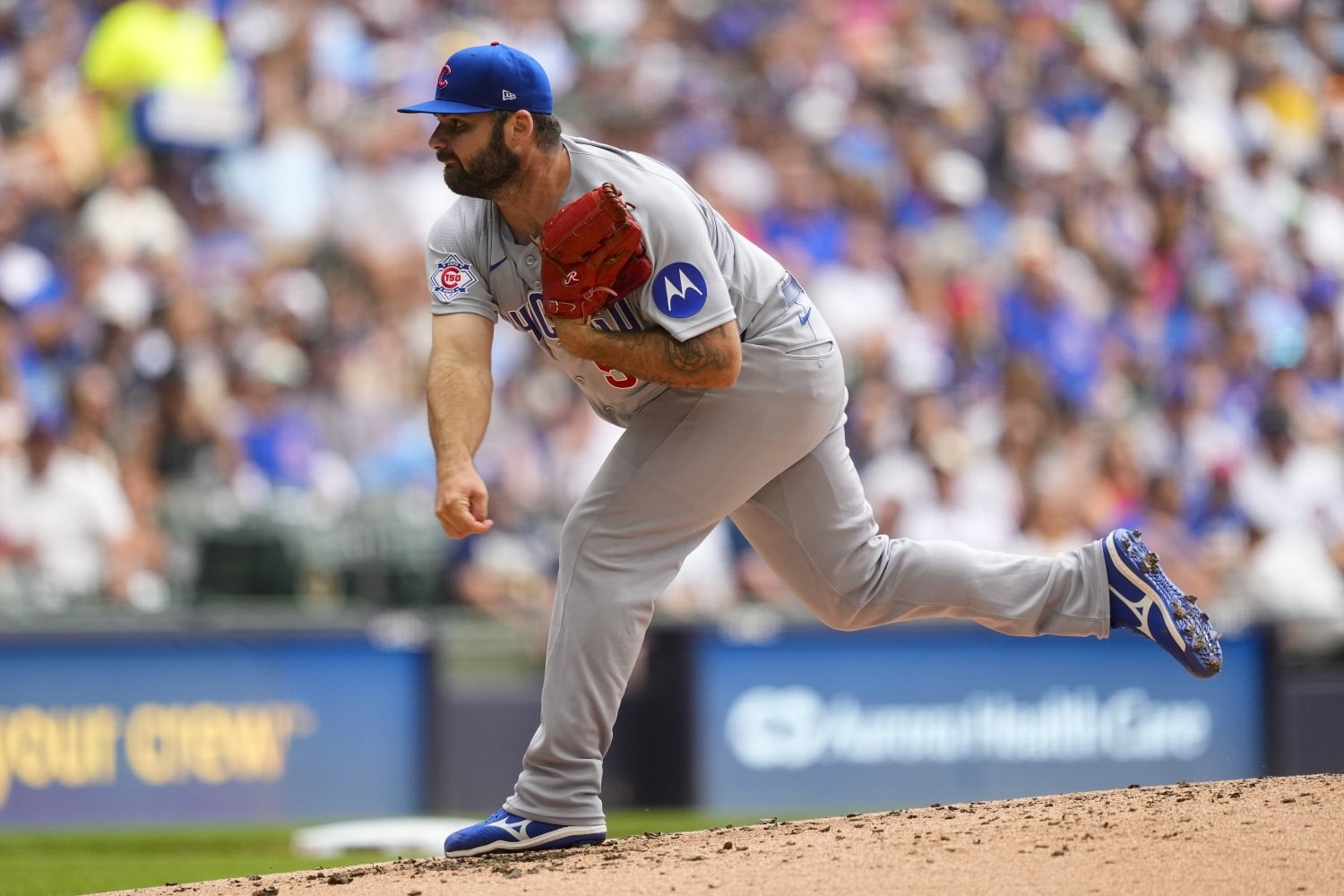 The Cubs' 4-3 victory over the Milwaukee Brewers on Sunday in extra innings was a game the visitors didn't deserve to win, but they won it, anyway. No shade to the Brewers, but in many ways, the Cubs managed to out-Brewers them. Chicago was outhit (in terms of actual hits and expected hits) and got performance after performance from a cast of randoms and leftovers from other organizations. Milwaukee has used what can only be called "Brewers magic" for years to do this to other teams; they seemingly manifest pitchers out of thin air and do just enough offensively to get wins. On Sunday, it was the Cubs that used this formula to great effect. The catalyst in that formula was a pitcher who knows Brewers magic very well: Bryse Wilson. Wilson, 28, was designated for assignment on June 22 by Philadelphia. The Cubs, desperate for any human being with a pulse and an arm, claimed the right-handed pitcher on waivers. It's probably safe to say that there were little in the way of expectations, as their new addition has accumulated -0.4 fWAR over his career in 463 IP at the big-league level. It's been years and years since he was a top-100 prospect, so any pedigree has long been forgotten. Little was expected. The message (probably encoded a bit more hopefully) was surely along the lines of "please eat some innings". The Cubs didn't even trust Wilson to start the game, instead going with Ryan Rolison as the opener. They also called up Jordan Wicks for a "break-in-case-of-Bryse-emergency" bulk inning role. The burly pitcher, however, had different ideas. When the 6-foot-2, 255-pound Wilson entered the game in the top of the third, the Cubs were already down 1-0. Instead of getting walloped, all he did was battle. The tone was set for his entire performance in that third inning—though the inning did not start well for the North Siders. The Brewers were quickly able to get runners on both first and third, with only one gone. Cue the music: Cub-killer extraordinaire Jackson Chourio was headed to the plate, perhaps the last Brewer you'd want to see there. The game felt like it was about to get out of hand; the tables were set for Milwaukee to break the game open. Then, it felt like a switch flipped for the man on the mound, and the game flipped on its head. One of the most important things for a pitcher is getting ahead of hitters. It changes the at-bat significantly, and Wilson went right after Chourio by firing in a show-me 89-mph cutter through the zone for strike one. Coming back 0-1, he threw a 92-mph sinker at the top of the zone (though to be fair, I don't think he meant to throw it up there) for a second straight strike. Now up 0-2, Wilson reared back and got every bit of his body behind a 95-mph heater right at the top of the zone, which got the young slugger to give a big swing... and an even bigger miss. It was a statement moment from an unlikely hero. Wilson ended up getting out of the jam, but that single at-bat felt like it began to give the pitcher the confidence he needed. On the day, Wilson pounded the strike zone with that confidence. He started two-thirds of the hitters he faced with a strike, and kept the ball in the zone nearly 60% of the time. This is a big change from what he's done in the past; his career in-zone rate is under 50%. His fastball had some extra juice as well, as it averaged over 94 mph for the first three innings of his appearance (though it dipped below in the fourth, he was clearly gassing out). It was a bulldog-like performance. It's true that he only got five swing and misses on the day; you'd hope that he'd throw a few more over four innings. It makes the four strikeouts a little less impressive, but it's easy to forgive that after throwing four scoreless frames on the road, all things considered. Another thing to note going under the hood; Wilson used his arsenal a little differently than normal. He threw more four-seam fastballs (23%) than his 2025 (17%) and barely utilized his curveball (just three curves were thrown all day despite him using this pitch 16% of the time last year). Are these little flourishes the Cubs installed? Hard to tell in such a small sample size. It could also just be random happenstance or Brewers-specific matchup things—or Wilson consciously altering his plan to confound a team that knows him well. Regardless, Wilson didn't really look like the guy he had been before. Interestingly enough, the only real success Wilson has had in his career came in 2023 and parts of 2024 when he was mostly a reliever with Milwaukee. His keys to success? Over 60% first-pitch strikes and being in the zone over 50% of the time. He relied heavily on the sinker, cutter and four-seam fastball—pitches he leaned into Sunday. This could be a good example of "if you can't beat 'em, join 'em". The reality of the Cubs' situation is that their bullpen is beat to death right now. The team had to call upon Wicks in extra innings with the bases loaded and no outs to bail them out of the game. Trent Thornton was the only pitcher who wasn't used, but he had pitched three of the last four outings and the Cubs are going to need someone capable of coming out of the pen this week. Hell, they're going to need someone to come out of the bullpen Monday night. To do that, the team may have to make the hard choice to designate Wilson for assignment to bring up someone, because it's likely that the right-hander will be down for the next few days after throwing 61 pitches Sunday afternoon. Sadly, four innings cannot erase 164 games of futility, and the Cubs know what he's been in the past. Wilson, though, may have bought himself a little time. Ethan Roberts was terrible in relief; he could be optioned to Iowa instead. Frankly, Roberts (sporting an xFIP of 5.17 on the year entering Sunday) has been terrible all year. He deserves the demotion. Craig Counsell looked absolutely miffed and exhausted coming to yank him after he loaded the bases. I'm not sure there's a lot of trust there after that performance. It might just be best for everyone involved if he takes a break from the parent club, opening up the chance to Wilson (whom Counsell managed and liked in 2023) to stick around. For a team who's short on middle relief options right now, that could give Wilson a window to seize some extra innings. Regardless of what happens to him, successful teams find innings from people like Bryse Wilson throughout the year. The Cubs have used 30 pitchers on the year (not counting Carson Kelly), and beggars cannot be choosers. Last year, the Cubs rode Chris Flexen for 43 innings. Flexen was terrible in terms of almost every statistic except for ERA, but those 40 innings were key for a team in the middle of the year who needed someone to throw strikes. The Cubs need to add some talent to this roster. They need at least one starter and one or two relievers, without much help coming internally—meaning it's going to come via trade. Teams really aren't open for business yet and the Cubs would prefer to wait some of these prices out—probably two weeks or so, if not longer. They're going to need these kinds of performances from someone. Even if they do DFA the righty before he makes a second appearance with the Cubs, his four innings with the club were incredibly important in the moment. The Cubs won an emotional series in Milwaukee that they probably didn't deserve to win. Many players contributed to that win, and Wilson played a starring role. If the Cubs are going to stick around until reinforcements come, they're going to need a few no-name guys to find those innings. On Sunday, Bryse Wilson reminded us that he can be a hero, even if it's just for one day. What did you make of Bryse Wilson's first appearance? Do you think he can keep it up? Let us know in the comment section!
 -
2026 MLB Draft
Jason Ross replied to CaliforniaRaisin's topic in MLB Draft, International Signings, Amateur Baseball
Seen enough Cubs/Jackson to think there's some smoke there. With that said, he didn't really perform well on the Cape, which would be a bit of a different draft direction for the team. -
I'd guess it's Roberts off the top of my head if they send someone down. Counsel looked straight-up done with Roberts and he's been terrible so far. He's not striking anyone out, he's got an xFIP well over 5.00: I cannot imagine he's in a good spot in the pecking order. With that said, the Cubs are kind of in a weird place with their 40-man RP options as many of them have recently been sent down and it might be a struggle to call up the correct guy. It may necessitate a DFA and Wilson probably isn't immune to that. He's got history with Craig in Milwaukee and really his only success in his entire career came out of the pen in 2023. I wrote up an article last night on Wilson, but the long and short of it is that in his four innings last night he pitched similarly to 2023: lots of strikes, lots of fastball/cutter/sinkers, low-whiff but capable. I have a feeling he's going to stick around for a little while, but there's a reason he was DFA'd and I don't think the Cubs are in any way married to him after four innings.
-
I'd guess at least someone heads to Iowa to get a fresh arm in. Or that Wilson, despite the four innings, gets the DFA for one. So either Roberts heads to Iowa (which I wouldn't be shocked to see, Counsel seemed beyond frustrated yesterday with that) or Wilson is a short term Cub.
-
That's the most Milwaukee way to win a game. The Cubs had a reliever the Rockies didn't want start the game, had castoff Bryse Wilson throw 4 shutout. Offensively they got out hit, but did just enough to scratch across runs. And then closed out the game behind a recent call up who worked out of a bases loaded zero-out jam.
-
Jordan Wicks deserves some real credit. IDK what comes next for him, but that was a nails outing. He didn't deserve the walk, he got three outs with the game on the line.
-
I wasn't stressed at all.
-
One good changeup. Please. One good changuep.
-
horsefeathers CHALLENGE THAT CARSON C'MON.
-
I think Garrett Mitchell sucks and have since he was a first round prospect. Which means he'll triple here.