


Cubs Video
This week, Statcast rolled out new data evaluating the way first basemen receive throws from their teammates elsewhere on the infield. No seasoned baseball fan needs to be told that a well-timed stretch or an adroit scoop can make the difference between safe and out, but this is the first advanced, robust, transparent public framework that has been put forward to assign credit (and blame) for the work first basemen do to maximize outs on close plays and/or imperfect throws.
Michael Busch doesn't light up the new leaderboard for this metric, on Baseball Savant. The net effect of first-base receiving ranges from about 8 extra outs to about 8 lost chances for one, but Busch stands solidly in the middle: he has 0 Outs Above Average (OAA) based on receiving this season. In fact, last season, he had... 0 OAA based on receiving. He's average. That's not very interesting, is it? Were it as simple as that, it wouldn't be, but there's a lot more to sift through here—and, alas, a real cause for alarm as we look toward the stretch run.
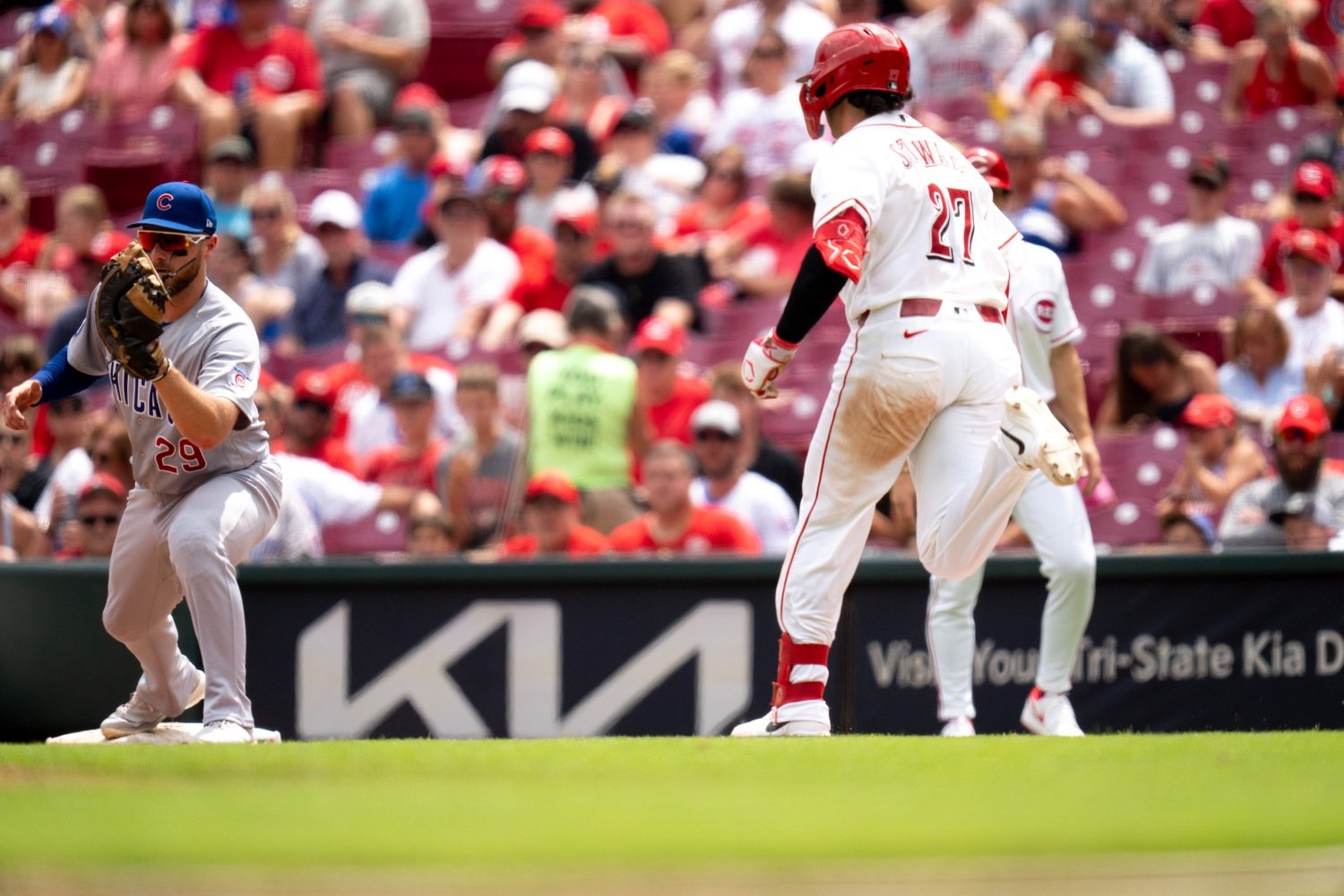
When the throw is on target, Busch is a plus first baseman. He's flexible and fluid when stretching toward a throw, and good at nabbing runners by a fraction of a step. He reads plays well and cuts the ball off as early as he can, without compromising his ability to reach the ball.
Most on-target throws are near-automatic outs, but some first basemen—especially those under 6 feet tall, like the 5-foot-11 Busch—struggle to secure the ones that are fringy, because they don't stretch as well or move as decisively into the ball as the play demands. Busch might not quite be a good enough athlete to play second or third base, as the Dodgers (and, not so long ago, some Cubs fans) once hoped, but he reacts to throws like an infielder; he's comfortable making plays by receiving throws. There are plenty of first basemen of whom that's not true. Bryce Harper, whom the Phillies moved back to the outfield after the trade deadline, rates worst in the league as a receiver at first base, thanks partially to plays like this one: he just doesn't attack the ball quite enough, and catches it a crucial handful of inches later than he could have.
Making sure good throws become outs is the first and most important duty of a first baseman fielding those throws. It's like pitch-framing for catchers, where stealing strikes just off the edges matters less than ensuring that pitches that really are strikes are properly called so. It's a real and important credit to Busch that he does that part of the job well.
However, height—or, more accurately, wingspan—is an important factor in being a good receiver, and it comes into play on almost all forms of throws that aren't on target. For the purposes of the metrics, "on target" means that the throw arrives between 1 and 7 feet high and is within 5 feet of the base. Otherwise, throws are classified as wide, high, low, scoops (throws that bounce more than 5 feet from the bag but less than 15 feet away) or bounces (throws that bounce more than 15 feet from the base, producing long hops rather than short ones and a different fielding challenge than a scoop). Busch is above-average (1.5 OAA) when the throw is on target, but he lags behind on low (-1.2) and wide (-1.4) ones.
At first blush, it might seem counterintuitive that the relatively short Busch struggles with low throws, but in fact, being a few inches shorter than players like Freddie Freeman and Nick Kurtz can turn throws that those players catch ankle-high into vicious short-hop situations. Busch just can't reach the ball before it hits the dirt, whereas another first baseman might be able to do so. Here's one such play.
It should be less surprising that Busch struggles to convert outs on balls thrown more than 5 feet wide of the base. He really does react well and read throws early, which is why he actually rates as average on high throws, despite his height: he's superb at leaping to snare the ball and finding the base on the way down.
Anticipation can't go as far when an infielder misses the mark laterally, though. Physics don't work for you in that situation, the way they do when you spear a ball above your head and only need to work with gravity to get back to the place from which you leapt. It's not Busch's fault that he isn't 6-foot-3, but that does create a real constraint on his range as a receiver.
The dynamics at play are engrossing. You can work around some of the problems posed by being an undersized first baseman, but you can't completely eliminate them. You can be a good receiver around the bag even at 5-foot-11, but that value will be confined mostly to throws that are on target. Whenever you have to deal with balls that stretch your coveage radius, you're going to feel your lack of size working against you.
Here's where things get really fun. Why has Busch been so consistently neutral as a receiver, despite being in trouble whenever a throw is off the mark? Because he faces fewer of those challenging throws than any other full-time first baseman. This season, among the 29 players who've had at least 200 opportunities to catch throws at first (Busch has a league-high 552 of them), none has seen as high a percentage of their throws rated as On Target than Busch's 85%. You can give him a tiny share of the credit for that, because he gets to the base quickly and clearly has a good rapport with his fellow infielders, but mostly, that stat is a testament to the steady work of Alex Bregman, Nico Hoerner and—gulp—Dansby Swanson.
Of the 552 tracked opportunities Busch has had this season, 469 throws were On Target. If he were working with the Orioles' infield instead, as Pete Alonso is, he could expect to have just 435 of those throws hit their mark. That's about a 40% increase in the number of throws on which Busch would have to make a tougher play, exposing his shortcoming (no pun intended) in terms of range in all directions. The Cubs infielders don't have very strong arms, but they're so accurate that they make up for that lack of sheer power—and the value of that precision is boosted by the fact that their first baseman isn't well-equipped to save them when a throw goes astray.
You can see the problem here. Swanson is now sidelined, perhaps for the year, with a Grade 2 oblique strain. That means a heavy dose of Hoerner at shortstop, and Pedro Ramírez at second base. A handful of other infielders (James Triantos, Owen Miller, Gabriel Arias and Matt Shaw among them) will get chances, too.
I looked this up, so I feel obligated to report it. Since the start of 2023, among players with at least 50 tracked throws from shortstop, Hoerner has the highest On Target%. He's thrown 61 balls from short to first, and 58 of them have counted as being on the mark. However, I would apply a huge caveat to that.
Firstly, Hoerner's arm is so weak that it sometimes isn't enough for him to merely be accurate. Here's the most impressive throw he's made as a shortstop since the start of 2023. It's a fine play, on a ball that took him to his right and prompted a jump-throw, but it also came from straightaway shortstop, rather than truly from the hole; he was shading heavily up the middle before the ball was hit. This was in 2024.
Every other competitive play he's made at short over the last three and a half seasons has been less impressive than that. He has a weak arm, and it shows up even when he has time to get behind the ball and fire it off a strong platform. He doesn't transfer his weight well to get his body behind his throws; his upper body stays behind his front leg. He also pronates (turning his thumb down and his palm outward) harder than most infielders at release on most throws, resulting in de facto changeups thrown across the diamond.
Worse, when Hoerner throws on the move, his accuracy gets lousy in a hurry. This is true even at second, but when he's trying to throw on the run or across his body from shortstop, it gets especially ugly.
Busch was able to spare Hoerner an error on the play above, but you wouldn't want to bet on him being able to do so consistently. If you've ever shaken hands with Hoerner, this problem won't surprise you. He has unusual hands, thick and muscular but small; his fingers are longer (relative to his palms) than most people's. Thence come his struggles throwing the ball hard, and thence come the accuracy issues whenever he has to rush his release.
As Hoerner slides to the left side to take over in Swanson's absence, there will be more off-target throws to first from the Chicago infield. That's likely to be exacerbated by the installation of Ramírez at second; he's not as smooth a fielder or thrower as Hoerner at that spot. That's bad news for Busch, whose skill set so nicely suits the accuracy of the throws he was receiving from the up-the-middle combo of Swanson and Hoerner.
The Cubs are going to leak outs pretty badly over the coming weeks. Their rejiggered infield won't get to as many balls. They won't convert the ones they get to into outs as reliably, and they won't finish double plays as often. Busch isn't the problem in this altered equation, but expect to see an extra ball or two get away or an extra runner or two beating out a single by an eyelash. Busch is a fine receiver, but he's not gifted enough to be an excellent one. He's been thriving on the privilege of having exceptionally accurate teammates; he's going to have to survive without that privilege for the balance of this regular season.





Recommended Comments
Create an account or sign in to comment
You need to be a member in order to leave a comment
Create an account
Sign up for a new account in our community. It's easy!
Register a new accountSign in
Already have an account? Sign in here.
Sign In Now