


Cubs Video
The contrasting reactions to the 2023-24 Chicago Cubs offseason are not mutually exclusive. While it’s true that the organization could have sought more impactful means by which to improve their club, it would also be accurate to note that the team is at least marginally better via those that were made. There’s some nuance to be explored, which will be compounded with subsequent moves made pre-trade deadline and beyond. Whichever way one leans, though, it's all about to go from exhibition to exhilaration--from nattering to mattering.
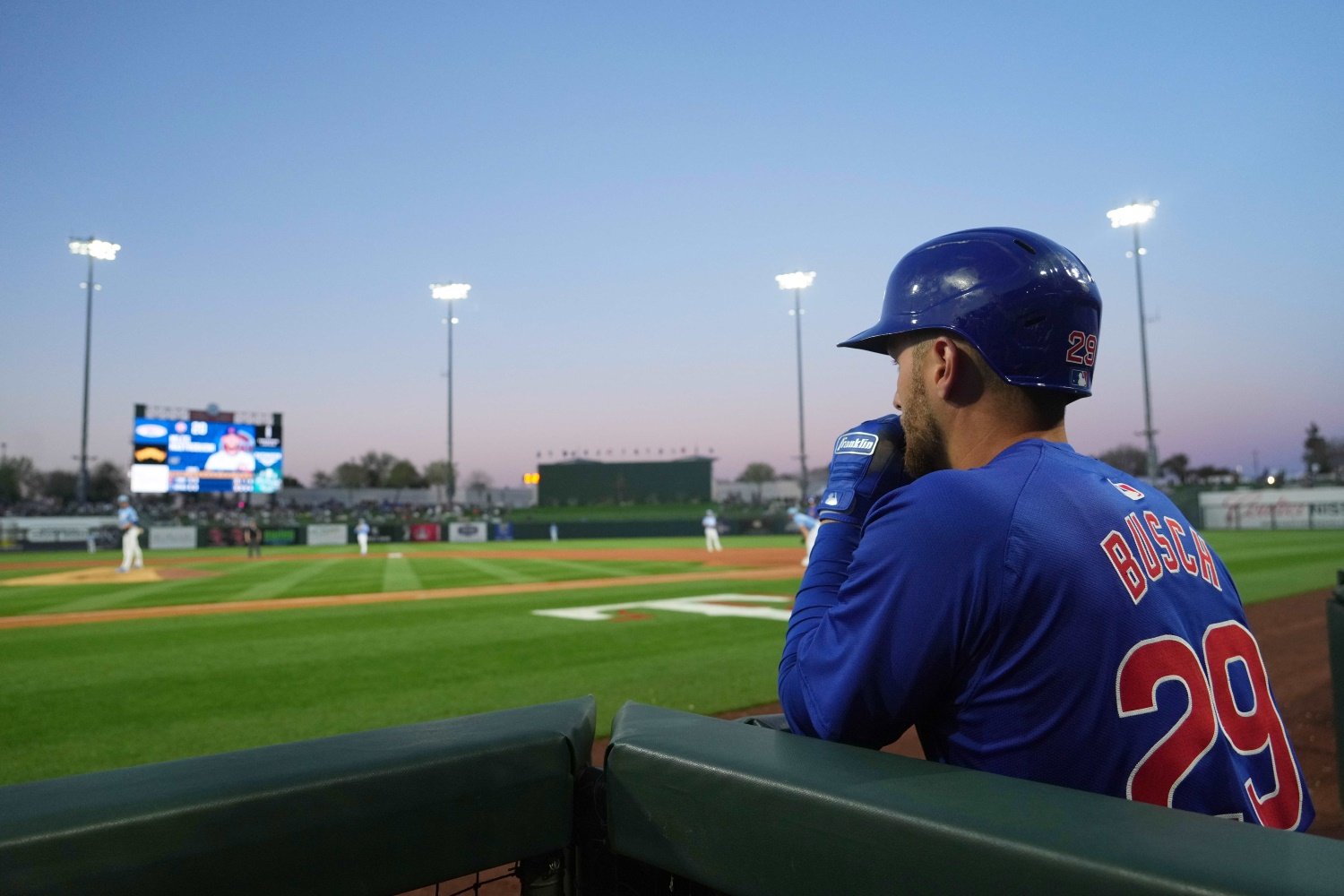
We now have a firm idea as to the roster construction for the outset of 2024. Whatever decisions remain in play regarding lineup construction or defensive configuration, we can be sure that Michael Busch will be a centerpiece in all of it.
Critics of the Cubs’ offseason will almost certainly point to the lack of offensive additions at clear areas of need. Above all, that included first and third base, both of which featured wavering performance and a lack of future clarity. Cherry-picking a few numbers, the team ranked 17th in ISO (.174) and 27th in on-base percentage (.299) at first base last year, while hanging 13th in ISO (.166) and 11th in OBP (.323) in the opposite corner, with the latter spot only walking 8.1 percent of the time (ranked 18th). They were also a middle-tier operation on both sides of the infield from a defensive standpoint.
What’s notable about those spots, above all, is that they’re the two without any long-term certainty. Basically every other position is locked in for at least the next two years, or has a prospect at the upper levels ready to step in. As such, it was extremely logical to see names like Matt Chapman or Pete Alonso floated in connection with the team. The absence of a more impactful addition – given the lack of true standouts on the offensive side – left us ultimately disappointed that a marquee addition didn’t occur at either of what represented the team’s only legitimate openings for ’24.
Enter Michael Busch.
It’s not as if the Cubs didn’t do anything to address the corners. I’m excited to watch Christopher Morel at third base. And as far as Busch is concerned, when the team acquired him from the Los Angeles Dodgers, my immediate reaction was that he’d slot in at that spot. That was quickly dispelled, and we can fully anticipate him manning first base, instead. While the team has indicated they could “protect” him against lefties early on – something that was further solidified with the addition of Garrett Cooper – Busch will get ample opportunities to nab a long-term role for himself out of that position.
With that, however, a pair of questions are left lingering:
- How much can the Cubs rely on a breakout from Michael Busch? and
- How much do they need a breakout from Michael Busch?
As far as the former is concerned, it’s impossible to know when, or if, a prospect will realize their potential. In Busch’s case, though, things look good. He spent time in Double-A in both 2021 and 2022. He was at Triple-A in 2022 and 2023. Over each of those sets of years, he showed significant growth in adjusting to the level.
With the Dodgers’ Tulsa affiliate, Busch’s 2021 slash was .267/.386/.484 across 495 plate appearances. He struck out 26.1 percent of the time and walked at a 14.1-percent clip. His ISO sat at .218. With the exception of the strikeout rate, there’s nothing there to be upset about. But he built on that in 2022, with an obscene .306/.445/.667 line in 137 PAs before being called up to the next level. The punchout rate remained about the same, but he bumped the walks up to 17.1 percent and the ISO to a hilarious .361. Smaller sample size, of course, but he demonstrated marked improvement almost across the board before heading up to Oklahoma City (‘up’ in level; I am uneducated as to the actual geography of the state of Oklahoma). [Ed. note: He went down and left; Oklahoma City is about 105 miles southwest of Tulsa. I was curious. You were curious. Yes, you were. You were curious. Admit it.]
The trends in Triple-A were much the same, if not slightly more encouraging. In over 500 PAs, Busch secured a .266/.343/.480 line, a .214 ISO, 26.0 K%, and 9.9 BB%. He followed that up with .323/.431/.618, a .295 ISO, 18.8 K%, and 13.9 BB% in 469 trips to the plate in 2023. So while the sample size remained large, he showed an ability to not only generate more walks, just as he had in Double-A, but limit the punchouts, too. The bat, in multiple respects, has always been Busch’s primary tool, but he demonstrated a clear penchant for adjustments at each of the two levels. One imagines that trend leaves him set up for the coveted breakout, especially with the runway he’ll get with the Cubs (one which he was not afforded in LA).
Which brings us to the latter query. A breakout from Michael Busch isn’t at all an unrealistic scenario, but how much do they need that breakout to occur to find success within the larger context of the National League?
The Cubs didn’t have an issue manufacturing runs last year. Their 819 runs were third-most in the NL. They walked a fair bit (ranked fifth), didn’t strike out a ton (ninth-best K%), and were aggressive on the bases (fourth in steals). Where they came up short against their Senior Circuit counterparts was in the power game. The Cubs’ home run total (196) ranked eighth in the NL, their ISO was seventh (.167), and they were ahead of only Washington in Hard Hit% (30.7).
While there may be some room for growth out of the other regulars (perhaps an uptick in power from someone like Cody Bellinger), the ISO side of things is fairly well-established for this group. There just isn’t a lot of true impact in the bats. With that offensive output, however, the Cubs fell a game out of a playoff spot. So it’s not as if they scratched every last bit out of the barrel and still fell short. A couple of bounces throughout the year, and they’re playing into October.
At the same time, seven of the top 10 squads in ISO were playoff teams. Busch’s ability to get the ball into the gaps and over the outfield walls is going to be essential for this team. Power plays, and Busch has it. Given the lack of other genuinely impactful transactions on that side of the ball, his ability to stick and provide impact reads as imperative as this point in the calendar.
The good news is that Busch does have the runway. He also has protection. The Cubs could field Cooper or Patrick Wisdom against certain lefties, to ensure Busch’s development at the top level stays on track. But their presence likely won’t inhibit his overall opportunity in the way that it would have under certain previous managers. Ultimately, as the season begins, the offensive output of Busch is something on which I’ll maintain a keen eye, both for his breakout potential and the Cubs’ 2024 fortunes at large.





Recommended Comments
Create an account or sign in to comment
You need to be a member in order to leave a comment
Create an account
Sign up for a new account in our community. It's easy!
Register a new accountSign in
Already have an account? Sign in here.
Sign In Now