


Cubs Video
In the flow of a game, amid the thunder and bluster of a raucous crowd and a playoff series, the play looks normal. Sal Frelick hit a slow, looping grounder to the right side of the infield. Nico Hoerner charged it. If Hoerner had made the play cleanly, it would have been an easy out, and the Cubs would have been close to escaping a rough first inning. They were already down 2-1, but that's no insurmountable deficit. The chance was right there for Hoerner.
You know what happened, instead. Hoerner stooped and reached as he ran, but the ball stayed down. It hit the tip of his glove, but rolled past him, allowing Frelick to reach safely. Andrew Vaughn pulled into second, and the heads-up William Contreras wheeled around third and scored well ahead of a hopeless Hoerner peg to the plate. Suddenly, it was not only 3-1, but 3-1 and counting. There was only one out, and the crowd at Uecker Field hit a new decibel level, and it would have taken something more than Matthew Boyd had to offer to get out of the inning unscathed.
What do you say about such a play? Is it a lapse by Hoerner? A product of the moment, and the Brewers' famous offensive momentum? In part, of course, the answer is yes, times two. Hoerner himself took a big dose of responsibility for the loss after the game.
“If you just get an out like you do most of the time in that situation,” Hoerner said (as reported by Jordan Bastian of MLB.com), “I love Matty’s chances to get out of that inning with two runs and settle in like you’ve seen him do so many times this year.”
It's impossible not to muse about whether Hoerner would have made the play correctly and gotten Frelick at first base, had there not been some tension and anxiety already building up because of the Brewers' two-run answer to the Cubs' opening salvo, a Michael Busch leadoff home run. It seems plausible, at least. Maybe that goes double because Frelick runs well, which forces infielders to think about quicker ways to make plays on slowly-hit balls and often invites mistakes. The Cubs got unlucky, in the way the ball came off Frelick's bat and the situation they were in. Hoerner, however, had a chance to make a play in either of two ways. He just didn't succeed.
Let's break down how freaky this little floater was. Frelick took a healthy swing on the 0-1 pitch from Matthew Boyd. He was looking for a slider, but he got a sinker. As a result, he hit a ball that:
- Came from a swing with a bat speed of 70 miles per hour;
- Left the bat at 49.5 miles per hour;
- Had a 14° launch angle; and
- Traveled 93 feet before its first feather-soft bounce, just shy of the infield dirt.
That's just not a normal batted ball, by any definition. Even slackening the parameters somewhat, I found just 10 batted balls all season that roughly fit the above criteria. You might think it sounds like a typical Brewers—maybe even a quintessentially Frelick—batted ball, but it's not. On the very rare occasions when a guy hits a ball this way, it's usually a power hitter who got hilariously jammed. In only one of the 10 instances did it even result in a broken bat. Sorry, buddy. When you clip this small a piece of the ball with this small a piece of the bat, you don't even break it. Breaking the bat would mean you hit it better than you just did.
Softly hit balls can be dangerous, especially coming from big swings, but ones like this don't even tend to be so. The batter rarely gets out of the box well, because they got so jammed it stops their feet a moment. Plus, these aren't going to die in the grass somewhere far short of a fielder's starting position. They tend to be weird-looking, floating liners, sometimes caught by the pitcher but often played on a dying bounce or two by an infielder and thrown across with ease.
Here's what made this play different. First, Frelick pulled the ball, which is peculiar. Most of these go either back up the middle or to the batter's opposite side; they were very late to the ball. Frelick was less so, and the angle of his bat and the riding shape of Boyd's sinker produced a ball hit toward the hole between first and second. Second, with two runners on base and one out, Hoerner had been playing a step closer to second base than he normally would against a lefty batter. Here's the first frame of the TNT broadcast after it cuts from the center-field camera to the one high and behind home plate.
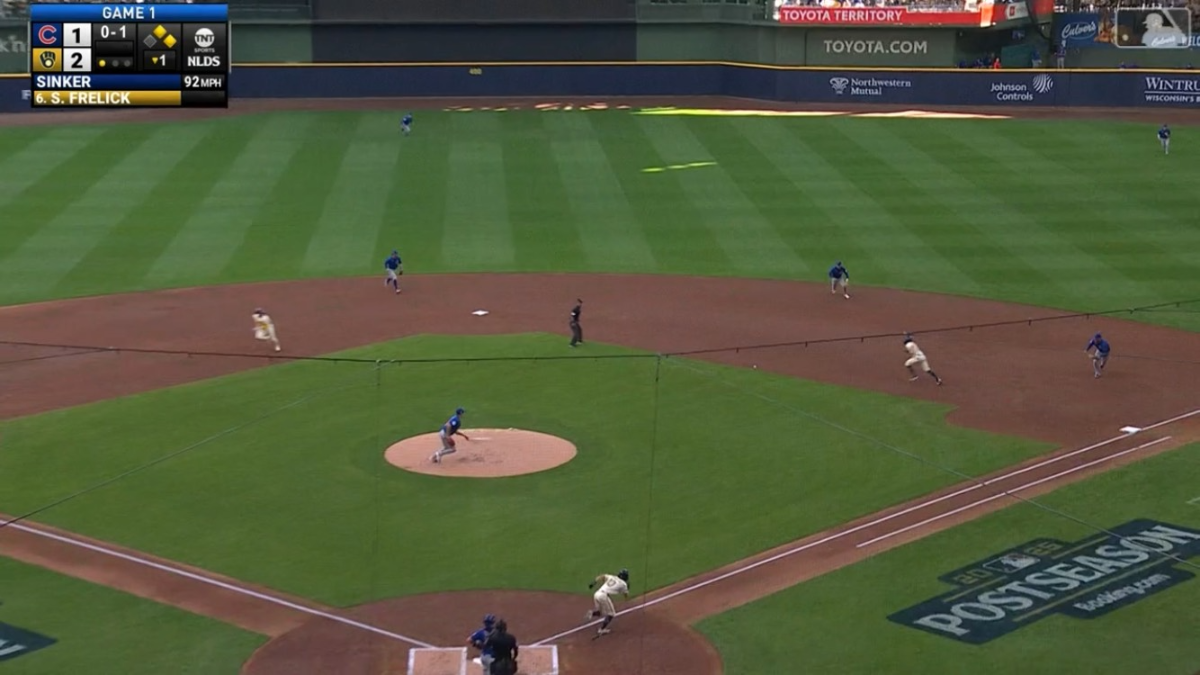
Hoerner's first instinct, reading Frelick's swing and the trajectory of the ball, was to charge and surround it, turning his shoulders slightly toward second base as he fielded the ball to throw there and start a double play. Even as the ball comes off the turf on its first bounce and passes in front of Vaughn, that's Hoerner's thought. You can see him squaring to it, preparing that turn and sidearm fire to Swanson.
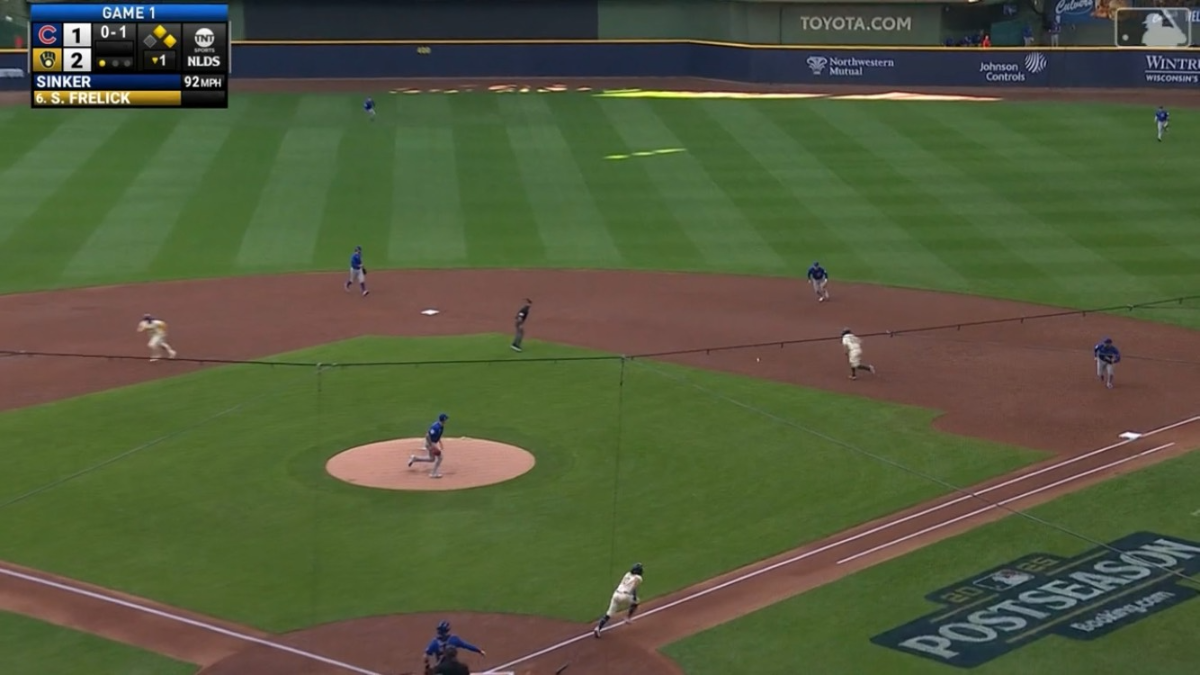
Very, very soon after that, though, Hoerner knew something was wrong. The ball wasn't getting to him fast enough. It was too weakly hit for a double play, at least in the overwhelming majority of cases. Here, you can see his body (his brain had time to do only a fraction of this thinking, but your muscle memory kicks in faster and can sometimes lead you astray) trying to figure out how he'll get to the ball fast enough and under enough control to get it to Swanson with the required alacrity. Carson Kelly, however, has clocked all of this. Notice him pointing Hoerner toward first. That's where the safe play is.
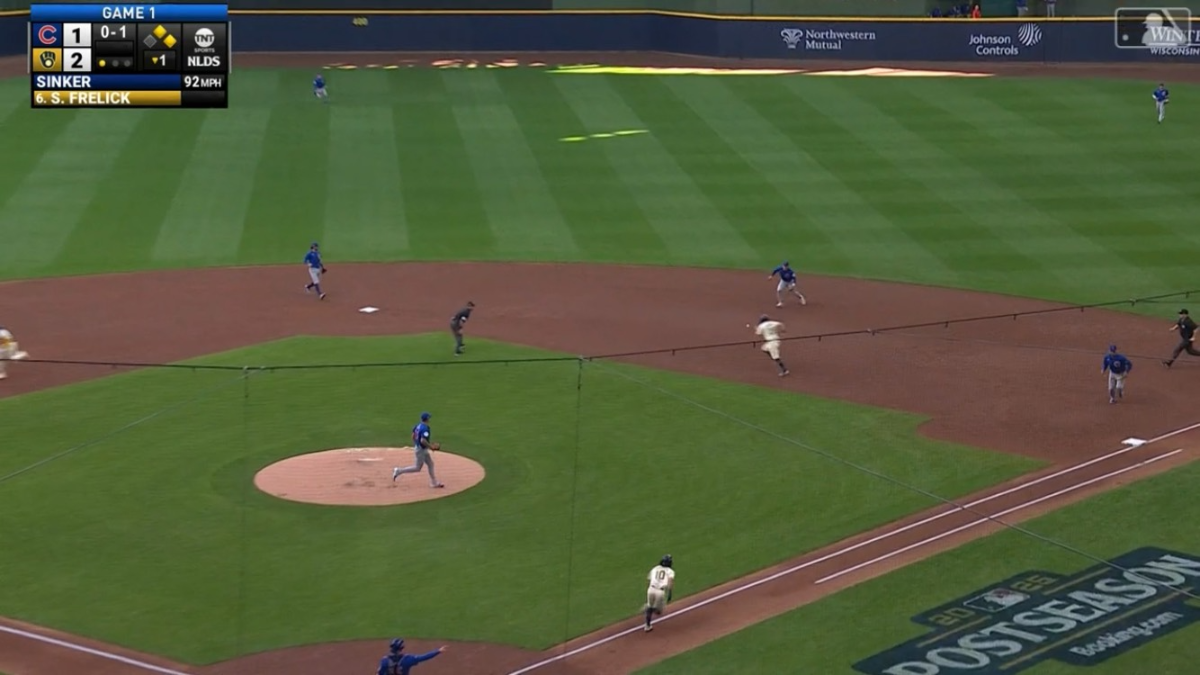
That brings us to the moment when, finally, ball and fielder are about to intersect. This has all been one agonizingly slow bounce, until now, the ball drifting much more dreamily than it does most of the time, just when everyone is programmed to be going extra fast. Now, Hoerner is addressing it, and he's turned his shoulders toward first, at least half-aware that that's where the play should go—but his right foot never gave up on the double play. He's changed direction slightly, but not decelerated much, and that right foot says he had at least half a thought of picking the ball, using a reverse pivot to find the missing power in the play, and throwing to Swanson anyway. And the heartbreaking thing is: he was right. That could have worked, at least to get Vaughn, and possibly to turn what would have been a game-changing double play. Look where the runners are as he gets to the ball.
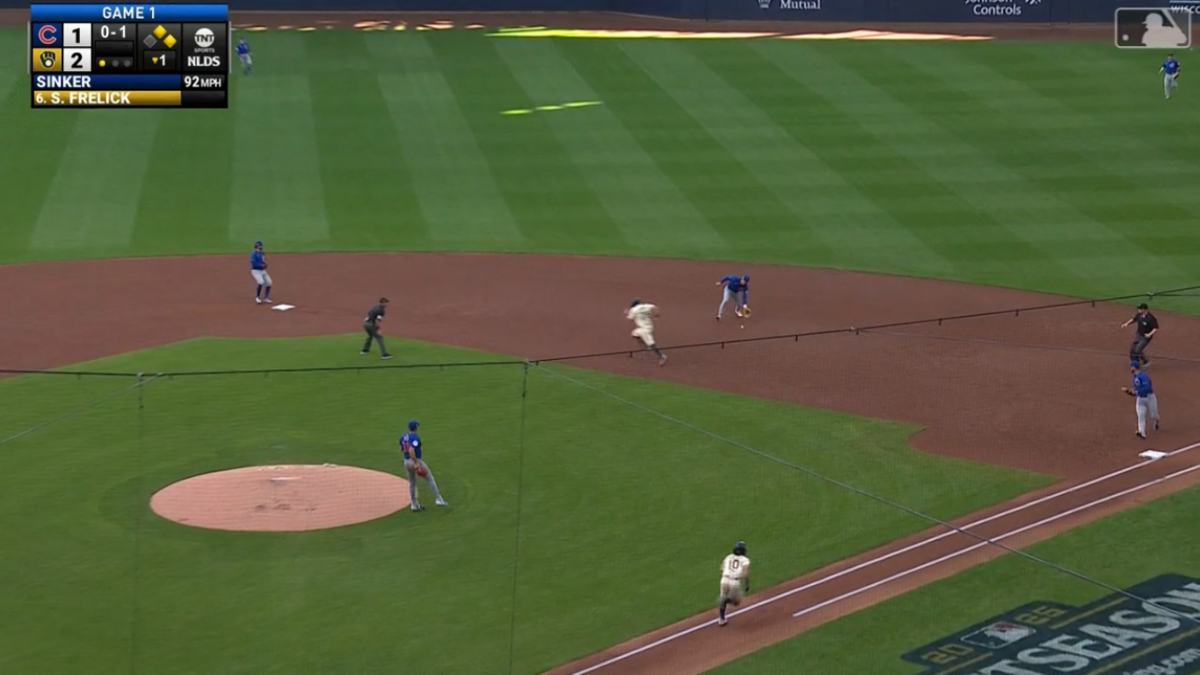
Frelick hadn't gotten out of the box well, either. Picking it on the run and making an unhurried throw to first was a valid option. That low dig and ferocious whirling throw to Swanson was a valid option, although a riskier one. Unfortunately, cursed with a little more time than plays like that usually give, Hoerner got caught between the possibilities. Plus, one more thing: the ball absolutely died on the dirt, in a way only a ball hit phenomenally weakly can. Hoerner had had time to account for that in some measure by then, but the first bounce off the grass fooled him. A ball that gets a healthy hop off the turf rarely then dies on the dirt; it's more like the other way around. Hoerner has to get lower, but he did try to get pretty low, considering that he was still making the play on the move. The ball just won the game of "how low can you go?", in improbable fashion.
One out there makes a big difference. Two tilts the game back toward the Cubs. The actual unfolding of the play was a calamity from which the Cubs didn't recover, and probably never had a chance to. It's bad luck, but it's also the kind of pressure the Brewers apply: there are always runners on, putting more things in your head; there's always speed going down the line, rushing your decisions; and there's always a bit of a frenzy going inside Uecker Field when the home team is assembling a rally. It was all too much for the Cubs Saturday—even too much for their stellar defensive second baseman.





Recommended Comments
Create an account or sign in to comment
You need to be a member in order to leave a comment
Create an account
Sign up for a new account in our community. It's easy!
Register a new accountSign in
Already have an account? Sign in here.
Sign In Now