


Cubs Video
It's a bloodbath. That's the best way to describe the financial landscape for many MLB teams heading into this offseason. The owners are crying poor more ardently than they have in a long time, and while those cries are still hollow and false, they stand on a firmer foundation of fact than in the past. Simply put, the collapse of the local broadcast rights model has genuinely constricted the flow of revenue for most MLB teams, including the Cubs. However, it's hitting the teams who were tied to Bally Sports Network hardest, as that now-renamed family of channels was taken into bankruptcy by their parent company.
Although the Rangers are still one of the richer and safer teams in the league, overall, they've been luxury tax payers for both 2023 and 2024, and their top priority this winter is avoiding the same fate in 2025. That, to be clear, is a foolish and self-defeating top priority for a big-market team, but it's a very real phenomenon. The Rangers intend to cut payroll and duck back under the tax threshold this winter.
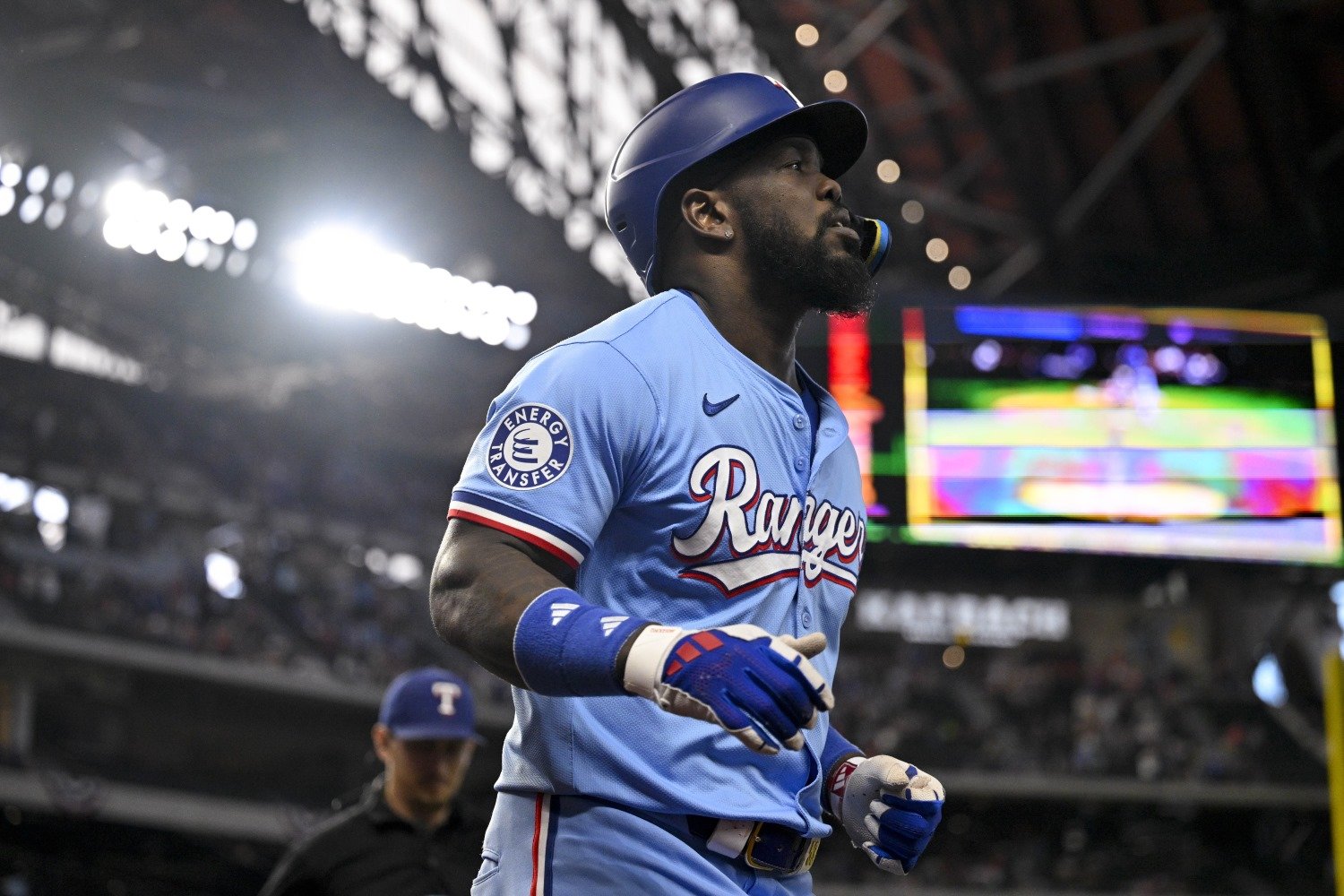
That will require offloading some bad contracts and/or making some very tough choices, because the team is locked into huge expenditures on (among other, lesser players) Corey Seager, Marcus Semien, and Jacob deGrom, so they expect to get creative. One way they could shed some salary and get some young talent at the same time: talk to the Cubs about trading outfielder Adolis García.
The story in which Rangers beat writer Evan Grant explained the team's intentions specifically noted that they won't be looking to move García, but let's consider some essential facts:
- In Wyatt Langford, Evan Carter, and Leody Taveras, the team has three perfectly credible outfielders under cost control. Taveras is getting a bit more expensive via arbitration and has a low offensive ceiling, but the defensive greatness of this group is valuable, and Carter and Langford each profile best as corner outfielders—leaving limited room for García, unless he's performing at his best.
- García certainly didn't perform at his best last year. He was the breakout star of the 2023 postseason, but in 2024, he struggled to match the power and the plate discipline gains he made the previous season. From a 2023 regular-season line of .245/.328/.508, he plunged to an ugly .224/.284/.400 line. He'll turn 32 next March, and is due $9.25 million on the second half of a two-year deal to which he and the team agreed in February. At the time, it looked like a way for the team to keep his salary from exploding in arbitration in 2025, but now it looks almost like an overpay.
Even though the deal the two parties signed only covers 2024 and 2025, García is still under team control for 2026, too. That would be the final year of his arbitration eligibility, and it would probably get even more expensive, so the team might do well to avoid heading into next winter with the prospect of a $20-million award hanging over them.
The Rangers would rather trade Jon Gray, who has one year and $13 million left on the four-year deal to which they signed him prior to 2022. They would, surely, rather trade Tyler Mahle, on whom they rolled the dice while he was recovering from Tommy John surgery but who went back on the injured list shortly after a late-summer debut with the team and who is due over $16 million for 2025. Neither of those deals has any surplus value, though. In fact, if they wanted to shed Mahle's salary, they would have to attach a young player with some value to him and get almost nothing in return. That type of deal had a brief moment of popularity, especially where the Dodgers were concerned, a few years ago, but teams don't really like doing them.
The Cubs, however, are in the market for both a front-end and a back-end starter this winter, and they should be willing to spend big. They could take both García and either Mahle or Gray, and still be willing to send back significant talent. This would be a minor blockbuster, and is only plausible if Cody Bellinger opts out. If he does, though, the Cubs could bring in a good defensive right fielder with the kind of titanic power their lineup has lacked since Kris Bryant, Javier Báez and Kyle Schwarber were at their peaks, pad the back end of their rotation with a too-expensive but usable veteran starter, and still have money to spend for an ace-caliber hurler like Corbin Burnes or Max Fried.
To get García and, say, Mahle, the Cubs would surely have to give up one of their top-tier prospects, close to the big leagues. That means one of James Triantos, Moisés Ballesteros, Kevin Alcántara, or Owen Caissie on the offensive side, or one of Cade Horton and Brandon Birdsell on the pitching side. They might also need to throw in a player who already has a foothold in the big leagues, like Alexander Canario, Hayden Wesneski, or Keegan Thompson. If they could find a fit, though, García could make the cost worth it and then some.
That's because, despite the massive decline in outcomes, he really wasn't as bad as he looked—and is still one of the most dangerous right-handed sluggers in the game. Here are his essential numbers for the last three seasons.
| Seasons | PA | Chase% | ZSw-Chase | InZoneWhiff% | PHiA/SW | 100+/Sw | LandAng | LaunchAng | LowHit% | MedHit% | HighHit% | Hit95+% | Well Hit LA | Sweet Spot EV | BABIP | Barrel% | xWOBA | wOBA | wSSEV_AB |
| 2022 | 657 | 37.0% | 36.5% | 26.5% | 4.1% | 10.1% | -4.5 | 13.3 | 32.2% | 34.6% | 32.7% | 47.8% | 13.2 | 96.1 | .309 | 24.0% | .327 | .324 | 91.6 |
| 2023 | 632 | 29.3% | 42.0% | 23.5% | 4.1% | 11.2% | -3.1 | 15.7 | 30.1% | 29.5% | 40.4% | 49.7% | 16.4 | 96.5 | .280 | 25.6% | .365 | .354 | 91.7 |
| 2024 | 637 | 33.3% | 41.4% | 24.9% | 2.8% | 9.2% | -0.4 | 15 | 31.1% | 30.3% | 38.4% | 48.3% | 14.2 | 96.8 | .273 | 23.8% | .301 | .294 | 90.4 |
To summarize the above: García did hit the ball slightly less hard and pull it less often in 2024, but only slightly. He regressed from the gains he made in controlling the zone and making contact in 2023, but not all the way back to the very rough-edged approach he had in 2022. He still elevates the ball and generates ample power. He is, in short, a still-lethal righty slugger who merely had a down year. His weighted sweet-spot exit velocity, a robust measurement and predictor of production, was down, but it still nestled right between Willy Adames and Teoscar Hernández on the 2024 leaderboard. Those two players will combine to make about $250 million this winter, so if the Cubs have to give up a young player to acquire García at a much lower cost and avoid a new, expensive long-term commitment, they should be open to it.
A deal like this is unlikely, in that all specific trade ideas are unlikely to come from the broad universe of possibility down to the hard Earth of eventuality, but it's very plausible. The Cubs need to spend aggressively and aim for high-end power potential in their lineup, while bolstering their rotation at both ends. The Rangers need to get less expensive and more flexible, without selling off a viable chance to compete in 2025. The two clubs can meet each other's needs in a variety of possible ways.





Recommended Comments
Create an account or sign in to comment
You need to be a member in order to leave a comment
Create an account
Sign up for a new account in our community. It's easy!
Register a new accountSign in
Already have an account? Sign in here.
Sign In Now