


Cubs Video
To my mostly untrained eye, Pete Crow-Armstrong's plate appearances seemed different for the former top prospect. More importantly, they seemed different in a good way. He was driving the ball to the outfield much more often. The contact quality from those three games would back up that thought. He had a 92.7 mph average exit velocity and 55.6 percent hard-hit rate, according to FanGraphs. Those are significant improvements on his numbers for the full season: an 88.9 mph average exit velocity and a 36.0 percent hard-hit rate.
Admittedly, I haven’t been able to watch a ton of Cubs baseball since. Between the Olympics, an out-of-town trip, and otherwise doing activities that are better for my mental health, I didn’t have a chance to sit down and watch a full Cubs game until the Cleveland series this past week. Of course, I follow closely from afar, and while PCA’s raw numbers don’t back it up quite yet, he has been a different and much better hitter since the season flipped to the second half.
|
K% |
BB% |
wOBA |
xwOBA |
Exit Velocity |
|
|
PCA First Half |
25.9% |
4.6% |
.255 |
.249 |
87.3 |
|
PCA Second Half |
15.7% |
2.4% |
.278 |
.319 |
91.6 |
By xwOBA, he has been a league-average hitter! Not only that, but he has trimmed the strikeout rate considerably, and he is hitting the ball more than 4 mph harder, on average, than he was in the first half. This is a huge development for a guy who has been one of the most valuable defenders in baseball.
So, where has he made improvements? If someone is cutting their strikeout rate almost in half and improving contact quality in the process, the first thing I assume is that they are being more selective with their swings.
|
O-Swing % |
Z-Swing % |
Contact % |
|
|
First Half |
43.4% |
72.6% |
74.5% |
|
Second Half |
40.6% |
76.9% |
77.3% |
So, he is making better swing decisions, leading to more contact and fewer called strikes. His called strike rate in the first half was 11.5 percent. In the second half, it’s down to 7.4 percent. Not only does swinging at better pitches mean you’ll strike out less, but typically, the balls you put in play will be hit a lot harder, which lines up with what we’re seeing out of PCA here. Let’s take this one step further.
|
Pull% |
Pull xwOBA |
Center% |
Center xwOBA |
Opposite% |
Opposite xwOBA |
|
|
First Half |
51.7% |
.348 |
25.4% |
.275 |
22.9% |
.249 |
|
Second Half |
36.8% |
.407 |
45.6% |
.417 |
17.6% |
.207 |
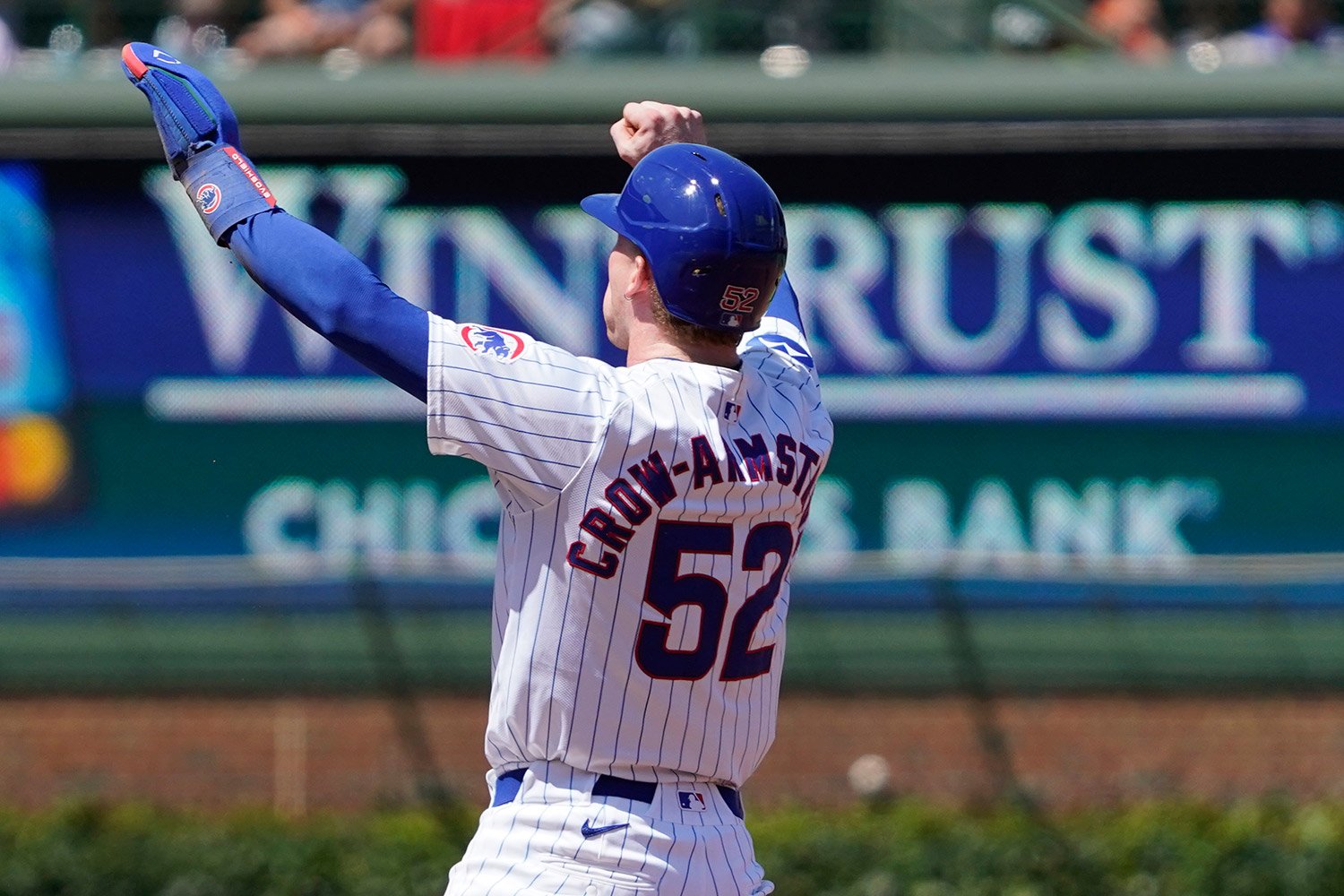
To me, this looks like someone making a concerted effort to use the whole field and not just be a dead-pull hitter. Sure enough, on Friday afternoon, Crow-Armstrong launched his fifth home run of the year, and it was to center field:
In my writing, I try to stick to statistics and facts. I stay away from hitting and pitching mechanics because, frankly, I am not an expert in that area, and the Cubs employ multiple people who are. If you rewatch that video, try to do so while remembering what PCA’s swing looked like in the first half. Here is a still photo from that home run yesterday (second picture) and another one from one of his first games with the big league club (first picture). Both of these pitches resulted in home runs, for what it’s worth:


First, he has a higher leg kick, has adjusted his hand position a bit, and is standing closer to the plate. More significantly, though, is how he has closed off his stance. In the first picture, you can see his back knee behind his front leg. In the second picture, you cannot see the backside of his back leg. To me, this is a clear sign that he is showing more willingness to use the whole field, which is demonstrated in his much better contact quality with center field.
Things haven’t always been pretty for Pete Crow-Armstrong this year. He was thrust into a spot on the major league roster out of necessity and, frankly, before his bat was ready for it. Sometimes, players have to develop at the big league level rather than in the minors, and this is what we’re seeing from PCA here. After yesterday’s bomb, his wRC+ in August is up to 138. The raw numbers are slowly starting to back up the increased contact quality. Seeing continued success out of the youngster will be the most important thing for the Cubs over the season's final six weeks, whether playoffs or not.





.thumb.JPG.19c99ddd60a76edf810c77d321439828.JPG)


Recommended Comments
Create an account or sign in to comment
You need to be a member in order to leave a comment
Create an account
Sign up for a new account in our community. It's easy!
Register a new accountSign in
Already have an account? Sign in here.
Sign In Now