



Cubs Video
At his end-of-season press conference, Jed Hoyer admitted that the strategy he pursued to build a viable bullpen in 2024 was flawed and vowed that he would elect a different one this offseason. While he was right in his diagnosis, I was skeptical of the treatment he claimed to be prescribing. The only real alternative to entering each season with big questions in the bullpen is acquiring elite relievers who stand a bit clear of the natural volatility of that job, and Hoyer has never shown any indication of being willing to allocate his resources that way. It seemed like empty rhetoric.
Nearly two months later, though, as I survey the offseason the Cubs have had thus far, I see a spot both in the depth chart and in the budget for just that kind of player. Just as Hoyer seems to have eased his own rules against paying a huge price to acquire a star player for just one season, he appears to have set the stage for a reliever addition that would break his rules about spending money and making long-term commitments in that segment of the roster.
It's still possible the team will choose to pay whatever it takes to grab Kirby Yates on a one-year deal. Yates is reliably excellent, when healthy, and because he's in his late 30s already, he can be had on a short-term engagement. Increasingly, though, it seems like Tanner Scott would be a perfect fit for this roster. He'd cost something like $15 million per year on a three- or four-year deal, which is a hefty commitment. Here's why he might be worth it, anyway.
Becoming a Strike Thrower
It's easy to look at Scott's 12.2% walk rate from this season (and 12.6% career mark) and worry that he's too wild to be a relief ace. That's far more walks than an average hurler allows; it makes Héctor Neris's control look good. You usually don't want a closer walking that many guys. Many Cubs fans remember the Carlos Mármol experience, which could be thrilling—but not always in the right way. It's also a fragile way to thrive, in most cases.
There are two reasons not to sweat this as much as you normally would. Firstly, while he still handed out a lot of walks in 2024, he made a meaningful change in 2023 that differentiates him from his prior self. Consider this graphic, showing Scott's pitching approach for 2022:

Baseball Savant calls these "Plinko" charts, after the game on 'Price is Right', and I love them, because they have the two most valuable characteristics any information graphic can boast: information density, and easy readability. The thicker the line between any two counts above, the more often Scott threw a pitch that took him from one count to the other. The colored wheels show how he deployed his two-pitch mix in each count. As you can see, in 2022, Scott was a very wild slider monster. He was only slightly more likely to start a plate appearance 0-1 than 1-0, and about equally likely to go from 0-1 to 1-1 as to get ahead 0-2 after throwing that first strike. He was only slightly more likely to go from 1-1 to 1-2 than to go from there to 2-1.
In short, the above is the picture of a pitcher without sufficient conviction in his fastball, and without the command of his slider to consistently get ahead in counts or avoid huge walk totals. Now, let's look at the same chart for 2023:

The relative thicknesses of key lines here have all swung in positive directions. The first-pitch change is especially noticeable, but it's there for 0-1 and 1-1 pitches, too. I also invite you to see how much thicker the line leading to 0-2 is than the one from 0-2 to 1-2, and how that compares to the 2022 image. Scott was putting guys away much more efficiently once he got way ahead in 2023 than he had in 2022. You can also see him using the fastball more often, especially to get himself back in control on 1-0, 1-1 and 2-1 counts. The ability to recover from 2-1 to 2-2 consistently instead of falling behind 3-1 is immensely valuable, and he improved in that aspect from 2022 to 2023. Scott first put himself on the map as an elite reliever that season, by walking just 7.8% of opposing batters.
Here's the 2024 chart:

Though his walk rate was similar to his pre-2023 self, this is a clear way to see that he didn't really regress. He still got ahead of hitters consistently and recovered fairly well when he fell behind, and look at how much his pitch usage swung toward the fastball, in all but the deepest counts. This is a pitcher who's found something with one of their key offerings. We'll get to what that was in a moment. For now, suffice it to say that these breakdowns belie the raw walk rate and tell us Scott didn't forget what he learned about attacking hitters and avoiding free passes in 2023.
The second reason why you needn't worry about the walk rate for the full season is simpler, but equally important: Scott walked almost 15% of opponents before being dealt from the Marlins to the Padres in July, but just 8.0% of them with San Diego. The charts above show us that he can still command the zone, and down the stretch, Scott did just that, even when looking at his walk rate.
An Improving Heater
As we saw above, the 2024 season saw Scott lean into more fastball usage, after he'd heavily relied on his slider (throwing it, sometimes, well over half the time) in the previous couple of seasons. There was a reason for that. Scott slightly but importantly lowered his arm slot back in 2022, which began to unlock the pitcher we've seen him become since then. The funky thing is that, whereas most pitchers see the ball run more to their arm side when they lower their slot, Scott has remained a cut-ride guy even after making that adjustment.
For a short time, Max Bay was one of the brightest lights in the public pitching analysis sphere. It was a brief time, because he's been snapped up, a couple of times. He now works for the Dodgers. We still have a few of his publicly available resources to help us analyze players, though, so let's avail ourselves of one. Using his Dynamic Dead Zone app, we can visualize the way Scott's fastball moves relative to what hitters expect, based on his arm angle. Here's that chart for 2021:
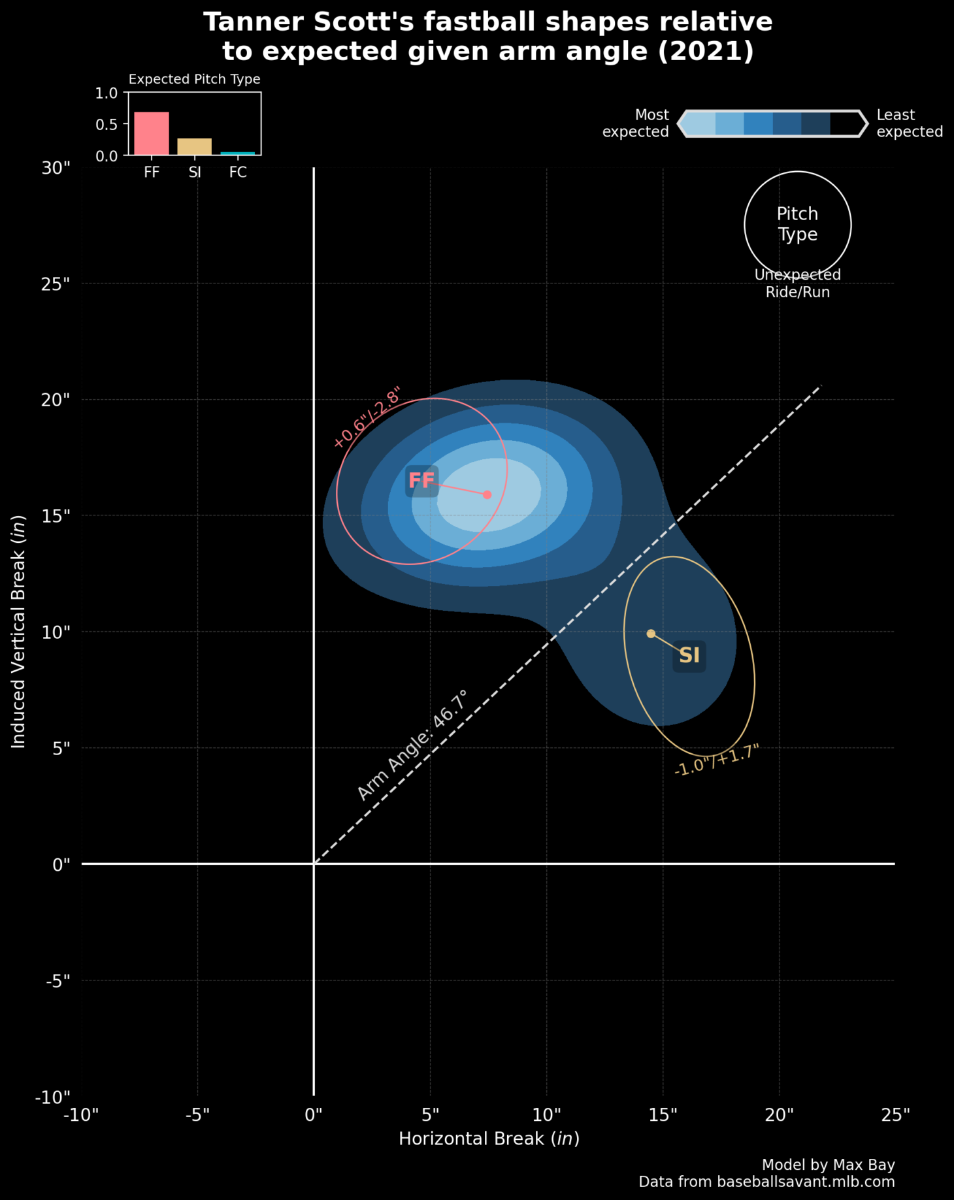
That's an impressive amount of cut, but as you can see, Scott's heater didn't rise much, relative to what hitters would have expected out his hand. Flash forward, now, to 2024:

The slightly lower slot alters what the hitter expects to see, which is represented by the blue topographical map behind the circle representing Scott's actual movement. Whereas they would expect an average of about 16 inches of induced vertical break (IVB) and 7 inches of arm-side run with the old slot, they'd be looking for more like 15 inches of "vert" and 8 inches of run after the change. But as you can see, Scott is still achieving the same amount of relative cut—and he's found considerably more relative rising action.
He made the change to his arm slot in 2022, but it took Scott a couple of years to figure out how best to fire his fastball from that position. He only averaged 15.6 inches of IVB in 2023, but that rose to 16.8 in 2024. Teams look for pitchers with flat vertical approach angles (VAA) on their fastball these days, and Scott's combination of a lower three-quarter slot and hard, rising heat yielded a stellar -4.1-degree VAA on the pitch in 2024.
If a pitcher has movement like Scott's on a fastball that hums in at 97 miles per hour from the left side, they can bully hitters with it. Heck, Justin Steele has a fastball with a slightly more extreme shape but 5 MPH fewer on it, and he bullies hitters with it. Scott's honing of the heater has yielded a steadily decreasing hard-hit rate over the last two years, to the point where he's now elite at suppressing opponents' power, in addition to racking up strikeouts.
Most two-pitch pitchers struggle to limit power, but Scott is a unicorn. His stuff is nasty enough to both rack up strikeouts and keep hitters on the defensive, even without a third offering. The evolution of his fastball shape is crucial to that unique ability. It's not the most important ingredient in his success, though, which brings us to the third reason why Hoyer might depart his comfort zone to lock down Scott at the back end of the pen.
Pure Filth
Scott's slider is one of the most versatile weapons in the game. Among 186 pitchers who threw at least 200 sliders in 2024, Scott ranked:
- 6th in ground-ball rate
- 53rd in whiff rate on swings
- 19th in called strike rate on takes
Only four pitchers—Clay Holmes, Bryan Abreu, Chris Sale, and Jason Adam—got more whiffs on swings and more strikes on takes than did Scott. Holmes and Adam only used their sliders sparingly, anyway, and none of the four came close to matching Scott's ground ball rate when hitters put the slider in play. Only Elvis Peguero and Camilo Doval had him beat in both ground-ball rate and whiff rate, and neither came close to besting him in called strike rate.
Scott's slider ranks 17th of 187 qualifying hurlers in Baseball Prospectus's StuffPro, and 10th in PitchPro, meaning the characteristics, counts, and locations of that pitch make it an elite offering. Pair it with a fastball that ranks 5th in StuffPro and 17th in PitchPro among 353 qualifiers, and you have one of the most potent mixes in the game. While relievers are inherently volatile and injuries can always cause big trouble, the 30-year-old Scott is as safe a bet to be a dominant closer as almost anyone in baseball, now that he's figured out how to deploy both the slider and the fastball to maximal effect.
And One More Thing!
There's one more reason to entertain this notion more seriously than you would treat a typical big-dollar closer deal under the Hoyer administration, and it reaches a bit beyond Scott himself. Look around the rest of the Cubs' prospective roster. They have three left-handed starters in their rotation already, and they might end up either acquiring a fourth or using Jordan Wicks in that role for stretches of 2025. When you run out three or four lefty starters every five or six days, you often end up facing lineups stocked with right-handed batters.
That's great news for the Cubs' righty-loaded middle relief corps. Nate Pearson, Tyson Miller and Porter Hodge are currently the back end of the team's bullpen, and they're all not only righties, but the kinds of righties who especially dominate right-handed batters. For that very reason, though, teams are likely to run some left-handed pinch-hitters and substitutes into the game in the sixth, seventh, and eighth innings, to neutralize the matchup advantage the Cubs will claim by turning the ball over from Steele, Shota Imanaga and Matthew Boyd to the likes of Miller and Hodge.
How can the Cubs counterpunch? In this particular team construction, it might make a special extra layer of sense to have a left-handed closer. Scott can handle batters from both sides of the plate, thanks to his fastball shape and the vertical orientation of his slider, but he's especially dastardly for lefty batters. He put on a show against Shohei Ohtani in the postseason, fanning him four times in the five-game NLDS between the Padres and Dodgers. If a team puts in a lefty who normally starts but was on the bench until the seventh, they'll get a small advantage over Pearson or Miller. Two innings later, though, that guy will be locked into his spot, and Scott will eat him alive. Lefties had a .587 OPS against him in 2023, and that number plummeted to .415 in 2024.
Spending big money on Scott remains a risk, because relievers are always risks. The team still needs to substantially bolster their starting rotation, and fans will be understandably uneasy if they don't also add something to their bench mix before Opening Day. Giving Scott a multi-year deal with an eight-figure annual salary might make it harder to check one of their other empty boxes this winter, so it would have to be the right deal, and it might need to come once Hoyer and company know what else they want to do. He's a unique pitcher, though, and his value to this team would be immense. It might be enough to move Hoyer off one of his most firmly held positions on team-building, in an offseason that will determine his future with the team.





Recommended Comments
Create an account or sign in to comment
You need to be a member in order to leave a comment
Create an account
Sign up for a new account in our community. It's easy!
Register a new accountSign in
Already have an account? Sign in here.
Sign In Now