


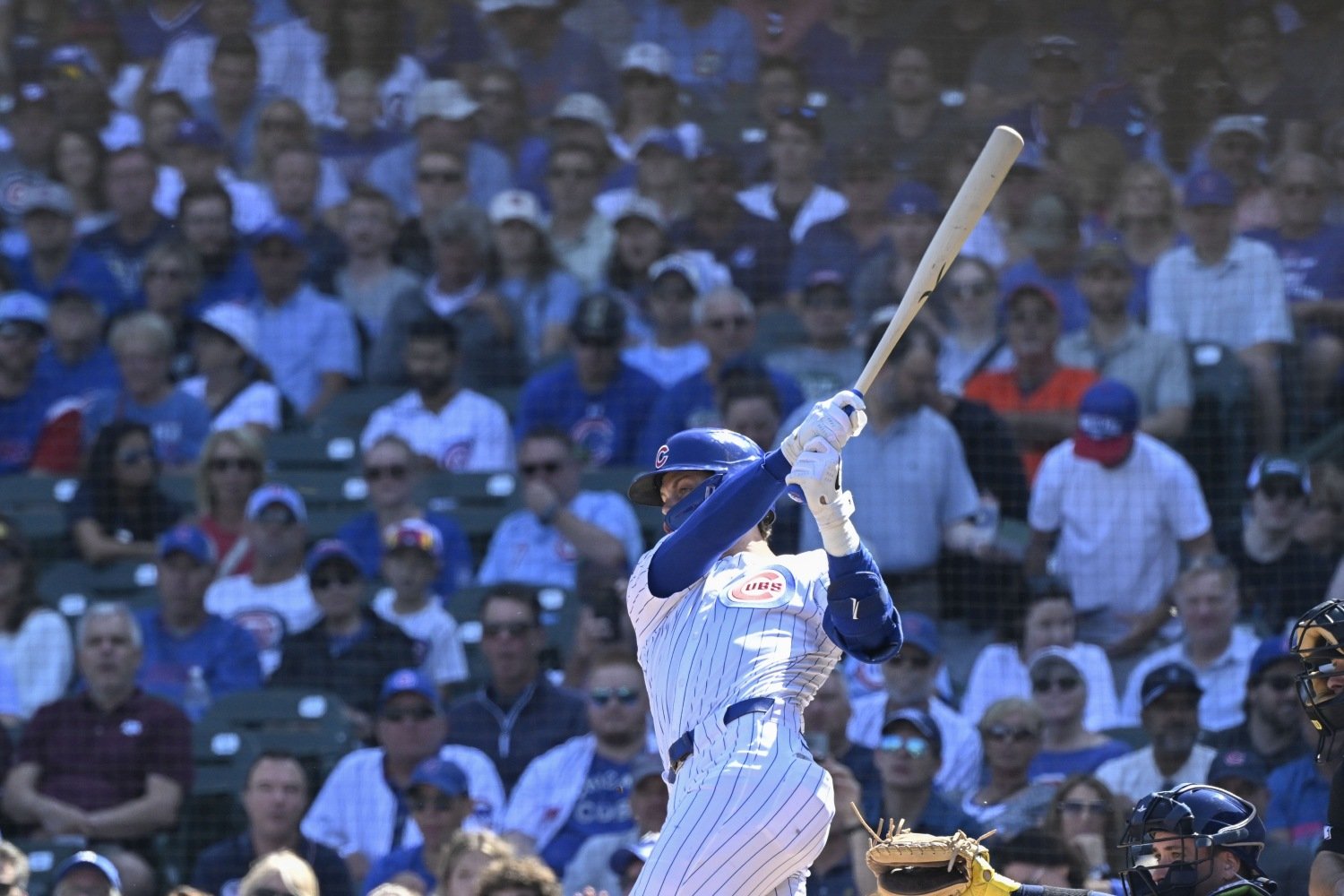
Cubs Video
In another sporting culture, Nico Hoerner almost certainly would have become a soccer player. That would probably be his best sport. He's gifted with some speed, but by the standards of the major American sports (basketball, football, and yes, even baseball), he's on the small side. His body type is best-suited to baseball, of those options, but there's a problem: baseball is all about explosive rotation, and Hoerner is not an explosive rotational athlete.
You can see this in all the major aspects of the game. It's the key to understanding why he looks different making so many kinds of plays than many of his peers do. It's why he'll never hit for much power, but it's also why he makes some plays that other second basemen can't—and it's starting to work in his favor when it comes to hitting for a consistent average and scattering just enough doubles and triples to be a major offensive contributor.
Hoerner runs differently than most guys do, on the basepaths. It's why he's a fine basestealer, but better when going first-to-third or first-to-home. You've probably noticed it before; he seems to pump his arms and legs in a more powerful, compact way than many players do. Yet, he's not elite in terms of raw speed. Most ballplayers run a bit looser and a bit more languidly, even if they're faster, because most of them are exceptional athletes primarily in the way their hips and shoulders can rotate—their range of motion, in combination with strength and coordination. Hoerner is a straight-line mover.
The problem with that, of course, is that most ballplayers excel in rotation for a reason. The most important actions on the diamond are the swing and the throwing motion, and both are (primarily) rotational movements. A player who lacks the ability to turn exceptionally fast (not just with their arms, but with those hips and shoulders) will always lack sheer swing speed and arm strength, relative to the rest of the league, and that's very limiting.
To wit, Hoerner has a swing that most observers would call quick. His hands actually are much quicker than most players', which makes it look like he's swinging a quick stick. In reality, though, great bat speed comes from having lightning in your core, and Hoerner doesn't. Thus, his swing speed ranks in the bottom decile of the league. So does his arm strength. Some of that comes from his choice to play under control at all times, but only a small part. You've heard the old talk about Ichiro Suzuki having been capable of hitting for power if he so chose. That was true; the same is not true of Hoerner. Even if he cut it completely loose, he would be a below-average baseball athlete, in those key areas. That's why he doesn't hit the ball very hard or (especially) lift it with authority on any kind of regular basis.
Because he's also a tenacious worker and a student of the game, though, Hoerner has found ways to turn the set of athletic gifts he does have to his advantage, and to mitigate some of the downsides. First, let's talk about how that shows up defensively. Hoerner knows he can't throw hard enough to make many plays ranging far to his right, which would force him to twist and throw back across his body. That informs the way he positions himself in the field. Hoerner plays as deep as the rules allow, almost no matter what. He trusts that he can gain ground with that straight-line speed, on slowly hit grounders. Playing deep gives him more time to read harder-hit balls and move to them in ways that suit his movement profile. He also plays closer to second base than the average second baseman.
In other words, he's putting more batted balls on his left and giving himself more time to navigate ones hit to his right. You can see that in the images below on the left and the right, where he's highlighted as a big red circle amid the cluster of all second basemen's average positioning against lefty batters (on the left) and righties (on the right). The middle image, meanwhile, shows Hoerner's Statcast Outs Above Average based on his starting position, which reveals (unsurprisingly) that he's at his best when he starts closer to the bag.
(18).png.fa63dbb90db4ef72e04da5e867b80521.png)
A few actual plays can illustrate this more concretely. First, here's Hoerner using the space he makes to his left, knowing that with it comes plenty of time to make the short throw if he can just get there.
A lot of second basemen—even or especially some who twist more explosively and flexibly than Hoerner—don't get to this ball, because they try to use that rapid rotation to race to their left on a flat route. Hoerner, however, has learned to make plays like this by giving ground. He turns and gets his shoulders square to his eventual destination, going away from the ball, making the play into a straight-line pursuit. Few infielders are comfortable doing this; it's more like an outfielder cutting off the ball in the gap or a safety taking an angle on a ball carrier. For Hoerner, though, it's the right way to make the play.
Here's a play to his right.
Two things work in Hoerner's favor, here. First, William Contreras is a slow runner. Second, the ball hits the mound and takes a high bounce, slowing it down somewhat. Still, it's a hard-hit ball he has to field on the third-base side of second, but he makes it a relatively easy play. What's interesting, though, is how. He started quite close to the bag, given that Contreras is more likely than most righty batters to hit a ball sharply the other way. If Contreras had done so, Hoerner would have trusted himself to try fielding it the same way he got T.J. Friedl in the previous clip. By playing where he did, though, he essentially eliminated the chance that he'd have to make a play moving any faster to his right than he did.
Once he fields the ball, he also uses the time he has with Contreras going down the line to turn and (effectively) run toward his target. That backhand play where a fielder plants their foot and fires like a pitcher? It's only a last resort for Hoerner, and not an effective one. Here's the hardest throw he's managed on a non-relay this year, a mere 76 miles per hour.
For context, here's Ketel Marte making a play similar to the one we just studied from Hoerner, in a very different way—punctuated by a throw at 81 mph.
Another way to make that play is the one seen here from Andrés Giménez: starting more toward first base, running faster to field the ball, choppy steps to get the feet set, and then a hard throw.
There's no question, really, that Giménez and Marte have better suites of baseball tools than Hoerner's. Yet, he's a better defender than either, at this stage of their respective careers. He's had to figure out different ways to make plays than they have, but he's done it so well that it looks more like they're the desperate problem-solvers and he's the natural.
There's something similar happening with his offense. Entering Sunday, Hoerner was batting .307/.361/.423 since the middle of May. He's exceptional at making contact, of course, but that's not the primary driver of his offensive value. Rather, he's figured out how to consistently pull the ball effectively—and how to avoid the prolonged periods of weak contact and empty at-bats that cannibalized his production in each of his previous full (or near-full) seasons.
.jpeg.0adbdf5a4cccd0cd64bb1dc128659581.jpeg)
Hoerner never will hit for power, because his hips and shoulders don't permit it. To understand that batter, let's compare his swing to those of some of his right-handed teammates.

This is the moment at which each player's swing finishes working down into the back of the hitting zone and starts to work through it. Notice that Matt Shaw and Dansby Swanson are much more open, already, in terms of the orientation of their front shoulder. Seiya Suzuki is in a similar position to Hoerner, with the front shoulder, but notice that his hands are farther from his body; he's already extending his arms more. Finally, take note of the position of the back elbow of each hitter, relative to the back side of their torso—and of their respective attack directions (the angle of the barrel of their bat, relative to an imaginary line from the mound to the plate) at this instant.
That Hoerner is closer to square to the incoming pitch than the others tells you this moment when he starts to work uphill comes later in his swing than it does for the others. Yet, as you can see, they're all farther along in the process of working under their front half (and thus, their top hands are all driving forward more) than Hoerner is. In short, because Hoerner has less rotation and less bend in his core, his hands do much more of the work of his swing. He's brought his bat around his body more than the others have, but isn't actually getting the bat out front to the same extent, because that front shoulder is staying home.
Part of that is a choice Hoerner makes, to utilize the whole field and cover a wide variety of pitch types and locations. A much larger part, though, is simply what his body is (and isn't) good at. He could try to open up more, but it would only pull him off the ball and cause problems. He can't rotate various parts of his core as independently and create as much torque within his frame as other hitters can.
The compensation for that dearth of power lies in the fact that his swing is all hands. That's why he's able to make contact so well. He's endlessly adaptable; there's just a low ceiling on the sheer force he can generate with his cut. From that full embrace of adaptability has come a forward leap in his contact skills this year. His in-zone contact rate is up to 94.5%; his strikeout rate is down to 7.2%.
Rather than chase power that will remain beyond his reach, Hoerner has gotten comfortable this year simply pulling a clean and undefendable line drive to left field. That's been the genius of this season for him. Entering Sunday, he had 37 pulled batted balls at a launch angle between 5° and 12° this year, up from 17 in 2022, 23 in 203, and 21 in 2024. That's important, because he's hitting a cool .757 on those balls. Those are the singles (and sometimes doubles) that aren't BABIP luck; they're perfect process, resulting in a near-certain outcome. They often look like this:
But sometimes, of course, they also look like this.
Hoerner's overall pull rate is up this year, but the way he's locked in his swing over the last few months has resulted in a particular spike in this kind of hit. No defensive alignment a team can reasonably play against you can stop that from being a hit, and no player in baseball has more hits of this kind this season; Hoerner is tied with José Ramírez for the league lead.
It's become a relentless joy to watch Hoerner play, in all phases. He's never going to find 15 homers per year, let alone 20. In a game that runs on power and demands superb athleticism, he'll never be the best player in the league, and he might not age all that well. At this moment, though, he's at his peak, because he's blending good athleticism (albeit of an unorthodox kind, for a baseball player) with intelligence, skill, and endless adjustments to get the most out of his talent. The Cubs would be lost without him, but as it is, they're hitting their stride at just the right time.
Are you optimistic about the Cubs right now?

Follow North Side Baseball For Chicago Cubs News & Analysis



-
 1
1


Recommended Comments
Create an account or sign in to comment
You need to be a member in order to leave a comment
Create an account
Sign up for a new account in our community. It's easy!
Register a new accountSign in
Already have an account? Sign in here.
Sign In Now