


Cubs Video
I've said it several times already, and will continue to say it, even as we transition from the postseason to the offseason over the coming fortnight: The Cubs have a wide range of needs and problems, but an equally varied array of potentially strong solutions this winter. There is no dearth of available talent or creative opportunities. The team's constraints are the limits of Jed Hoyer's bold vision and Tom Ricketts's willingness to spend like a big-market owner should.
Signing top-tier free agents is always difficult, and it requires a stronger stomach than Hoyer has typically shown during his tenure as the Cubs' top decision-maker. That doesn't mean the team won't make significant free-agent additions, but they'll probably need to supplement whatever shopping they do in that market with improvements via trade--and that might be where the most compelling opportunities lie, anyway.
With every long-term deal to which the Tampa Bay Rays sign a player, it's fairly easy to spot the season in which they intend to trade that player. The deals are almost universally team-friendly contract extensions, and within those, there's nearly always a year in which the player's scheduled salary increases by 50 percent or more. Study the year-to-year dollars in the deal, spot that season when their earning spike, and you've found the time when the Rays will deal them away.
That pattern will not abate this offseason. It was never going to, because it's a vital part of the team's paradigm for building consistent winners in a small market, an outdated and unreachable ballpark, and under ownership focused on maintaining both perennial competitiveness and a strong profit margin. Any doubt can be laid to rest, though, in light of the fact that the team's local TV deal is likely to lose value this year, alongside those of most of the league's non-premium tames--and of the fact that their in-person gameday revenue could crater after Tropicana Field was devastated by Hurricane Milton.
It's tragic that something so huge and so profoundly painful for the region will also shape the direction of the club's offseason, but it's hard to imagine that that won't be the case. Besides, there are a handful of players who were likely to be on their trade block even if they hadn't suddenly been plunged into uncertainty about where they can play home games next year. These three, in particular, would be superb fits for the Cubs and should be high on Hoyer's list of guys about whom to inquire.
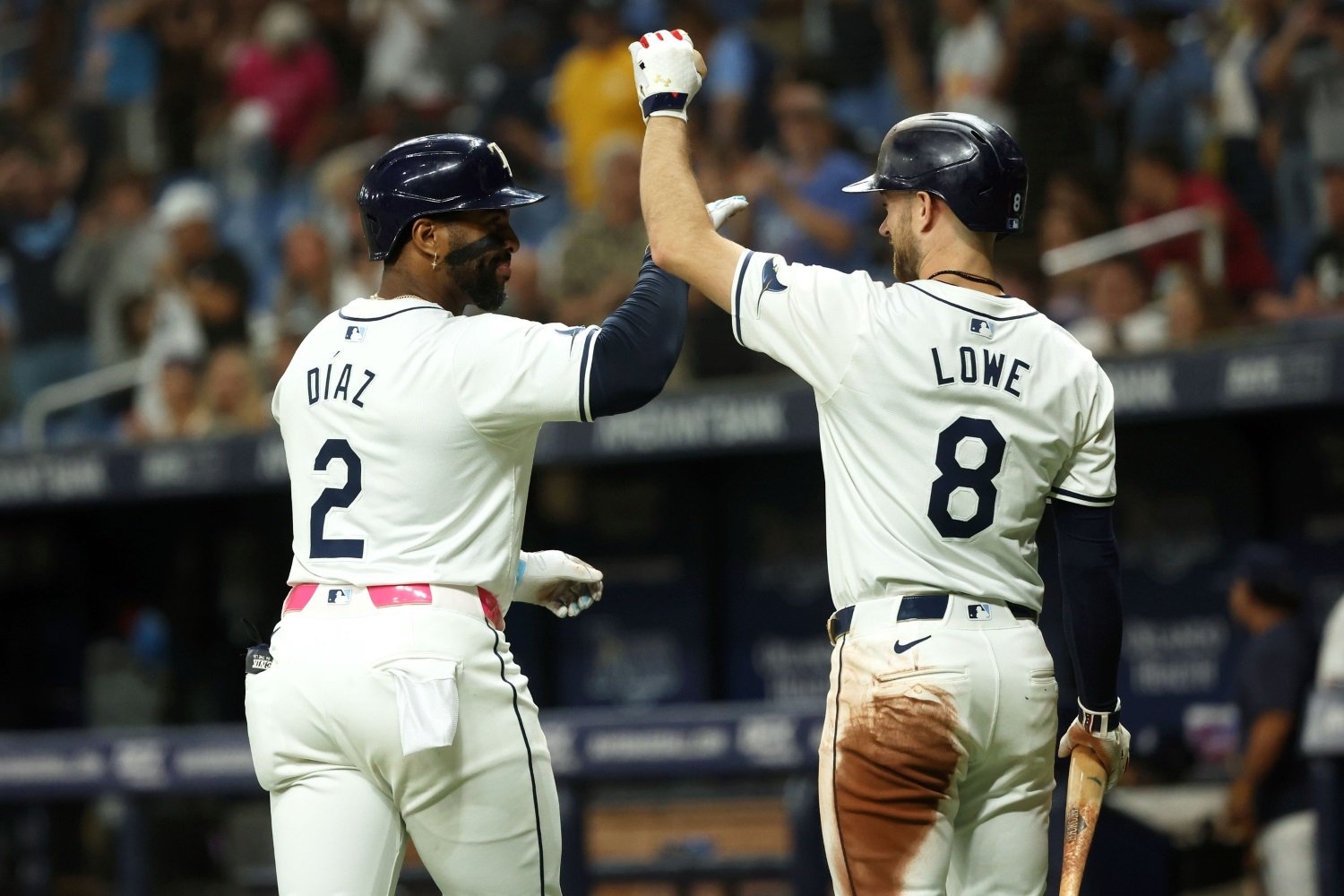
Brandon Lowe, 2B/RF
Club options for $10.5 million ($1 million buyout) and $11.5 million ($500,000 buyout) for 2025-26
Lowe will turn 31 next July. He was a superstar-caliber slugger in 2020 and 2021, but since then, he's been much more limited. Even so, he's been a clearly above-average hitter. He will strike out a lot, but also takes his walks, hits the ball hard, pulls and lifts it. When shielded from left-handed pitchers, he's especially effective.
Defensively versatile early in his career, he's principally a second baseman now, but he has experience in both outfield corners and at first base. He would be a perfectly qualified DH option against righties and a backup to Michael Busch at first, but most importantly, he'd become an offense-first, left-handed complement to the defense-first, right-handed profile of Nico Hoerner. The Cubs don't have to trade Hoerner this winter to improve at second, if they're willing to spend eight figures on a player who can take some of the more unfavorable matchups from him and make him more available to spell Dansby Swanson at shortstop.
Because he's earning a significant chunk of money on a team that figures to be looking not to spend it, Lowe shouldn't cost premium talent, but he'll certainly have a meaningful trade cost. The Cubs would have to be willing to part with one of their top seven or eight prospects and take the inevitable jokes after throwing in a second piece--probably a pitcher.
Yandy Díaz, 1B/DH/3B
Owed $10 million for 2025, with $12 million option for 2026; $1 million bonus paid by acquiring team if traded
When you specify that the acquiring team has to pay the assignment bonus in a contract like this, it's a pretty sure sign that you intend to eventually trade that contract. Sure enough, Díaz made $14 million in total over the first two years of this deal, but will get into eight figures for each of the next two years if the option is picked up. This is the moment for the Rays to move him.
Having turned 33 late this summer, Díaz is no spring chicken, and he slipped to a .706 OPS against right-handed pitchers in 2024. However, in all of baseball, there are few more reliable lefty-mashers, and even against righties, he has some valuable, stable skills. He hits the ball hard, but infamously, it's very often on the ground. He makes a ton of contact, but doesn't draw many walks. He'd need to be carefully deployed, in terms of shelter from some right-handed pitchers and placement within the batting order. He can only play third base in emergencies and is not even a good defender at the cold corner. He'd be a platoon partner for Busch and a DH option against most hurlers, and he should come at a fairly low acquisition cost.
Jeffrey Springs, LHP
Owed $10.5 million each in 2025-26, $15 million option with $750,000 buyout for 2027
The above salaries represent a doubling of the $5.25 million Springs made in 2024, and he's had little time to prove that he'll be worth that much of the team's money. He came up as a reliever with the Rangers, then the Red Sox, before the Rays converted him to a starter in 2022. In April 2023, he underwent Tommy John surgery.
When he's right, though, Springs is a really good three-pitch lefty, with plenty of upside in a starting role. He only sits 90 and touches 93 with his four-seamer, but it's a pitch with two-plane ride and good life up in the zone. His slider keeps hitters honest, and his changeup is a bat-missing out pitch, with excellent depth and a big velocity differential relative to the heater. Springs has also tinkered with a cutter and a sweeper over the years. He and Shota Imanaga would have a lot to learn from each other, and each is an above-average starter when healthy--although Springs has to prove he can take the ball every fifth or sixth day.

His recent injury history and relatively hefty contract should keep Springs's price tag reasonable, but he would certainly only be a target if the Cubs see the upside I do in him. Given how well they've instructed and developed similar pitchers recently. there's good cause for optimism there.
Not every year is there such a cornucopia of options for teams who need to make major changes. Nor does every team in such a position have all the resources the Cubs should have at their disposal this winter. They don't necessarily need to acquire any of the players above, but they should be proactive and turn over their roster in a meaningful way--and these are three players who would check boxes they should have on their list.




.thumb.JPG.19c99ddd60a76edf810c77d321439828.JPG)


Recommended Comments
Create an account or sign in to comment
You need to be a member in order to leave a comment
Create an account
Sign up for a new account in our community. It's easy!
Register a new accountSign in
Already have an account? Sign in here.
Sign In Now