


Cubs Video
It's too early to start making hotel reservations for October, but it's not too early to start saving up for the massive prices of playoff tickets. The Chicago Cubs have surged again recently, and while it hasn't been enough to make them any serious threat to the Milwaukee Brewers for the NL Central crown, they're now firmly back into playoff position and will be buyers at the trade deadline.
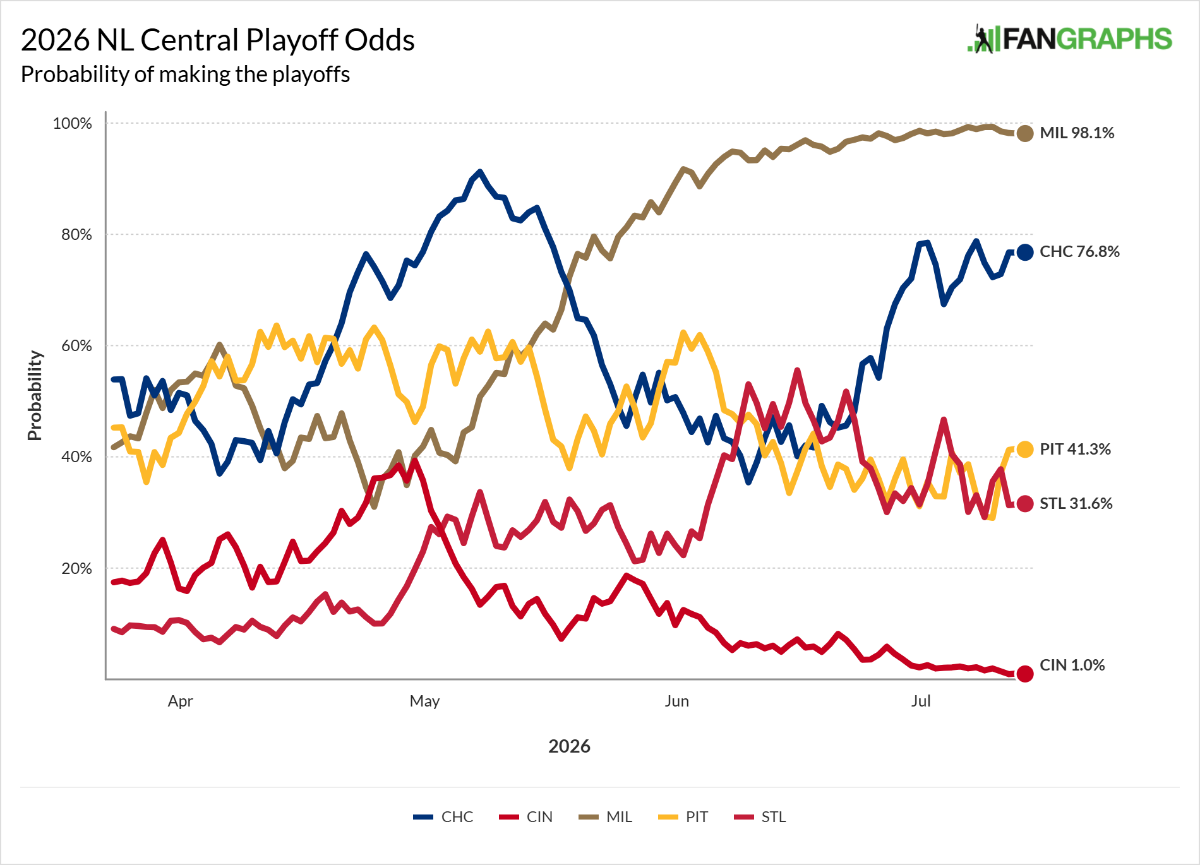
FanGraphs estimates that the team has a 76.8% chance to reach the postseason, more than double the odds it gave them at their nadir a little over a month ago. That might even undersell them, because at this point, it's clear that the Cubs will supplement their pitching staff in some way at the deadline, whereas some of the teams still taking up some of the projected playoff probability in models like FanGraphs's (the Marlins, the Nationals, the Padres, the Diamondbacks, the Cardinals, the Pirates) are much less likely to do so.
Sensing the importance of not only recovering in the standings but continuing to push forward, the Cubs have gone into a mode not unlike a team in its stretch drive or in the playoffs themselves, lately. Craig Counsell is spending less time rotating in and trusting young players. He's using a shorter hook on his starters. And, in fact, one of those starters has also changed his approach, adapting to Counsell's plan to win each day and to the new role he might fill as the roster changes in coming weeks.
Shota Imanaga will not—he can not—be a playoff ace for the Cubs. It's just not part of his spectrum of reasonable projected outcomes, at this point. The team rightfully trusts Matthew Boyd more at this point, and they'll hope to have at least one of Jameson Taillon, Edward Cabrera or Ben Brown (in order, here, from most to least likely) healthy and pitching like a playoff starter by the time they get to the end of the season. They're also going to be in the market for a starter of at least that caliber via trade this month, though it's never easy to acquire such a player. If the Cubs get their way, Imanaga won't be slated to pitch much in a Wild Card Series.
However, if the team is to make any meaningful run in the playoffs, they'll need Imanaga to be his best self. That 'best self' just needs to look a bit different than it does during the grind of the regular season. To that end, we've seen Imanaga make a major adjustment over his last three starts, which could signal both the team's desire to prepare him for the role he'll play in September and October and his own understanding of how his skill set interacts with the world he's pitching in right now.
Ordinarily, Imanaga is a fastball-forward guy. That's what made him so lamentably hittable down the stretch last season, when his fastball velocity sagged into the upper 80s and lowest end of the 90s most of the time. He works off his fastball for two reasons:
- When it's right, the pitch can induce pop-ups, whiffs and other positive outcomes for Imanaga and the Cubs. Well-located at the top of the strike zone, the pitch comes in unusually flat, and hitters struggle to adjust enough to get the barrel through the center of the ball. Even if they center the ball perfectly on the barrel, they're often a bit underneath it.
- Throwing the fastball enough to force batters to look for it sets up his two more devastating options, the splitter and the sweeper. Imanaga thrives on getting batters to chase outside the zone, and they'll do that more readily when they're looking for a fastball and (therefore) expecting a strike.
The heater itself not only isn't an out pitch, though, but tends to get hit hard. Yes, he gets routine fly balls and pop-ups with it, but he also gives up more than his share of home runs on it. That's in the nature of being a guy who works up in the zone with a slower-than-average fastball. It's an important piece of the puzzle for him, but the stats will always be ugly on at-bats that end with fastballs. The challenge is to throw that pitch as little as possible, without diminishing the effectiveness of secondary pitches that rely on the fastball to make them play up.
That's become even more important this season, but also more complicated. The advent of the ABS system has brought about a smaller zone, and most of the lost dimension of the zone has come off the top edge. As a result, more of the fastballs Imanaga throws are technically above the zone, so batters are less incentivized to swing against it—but also less pressured to hunt the fastball, and perhaps less naturally vulnerable to the other offerings.
Three starts ago, therefore, Imanaga made a change. Beginning then and growing even more stark in his two July starts, he's thrown the fastball less than ever before, since he came to the United States in 2024.
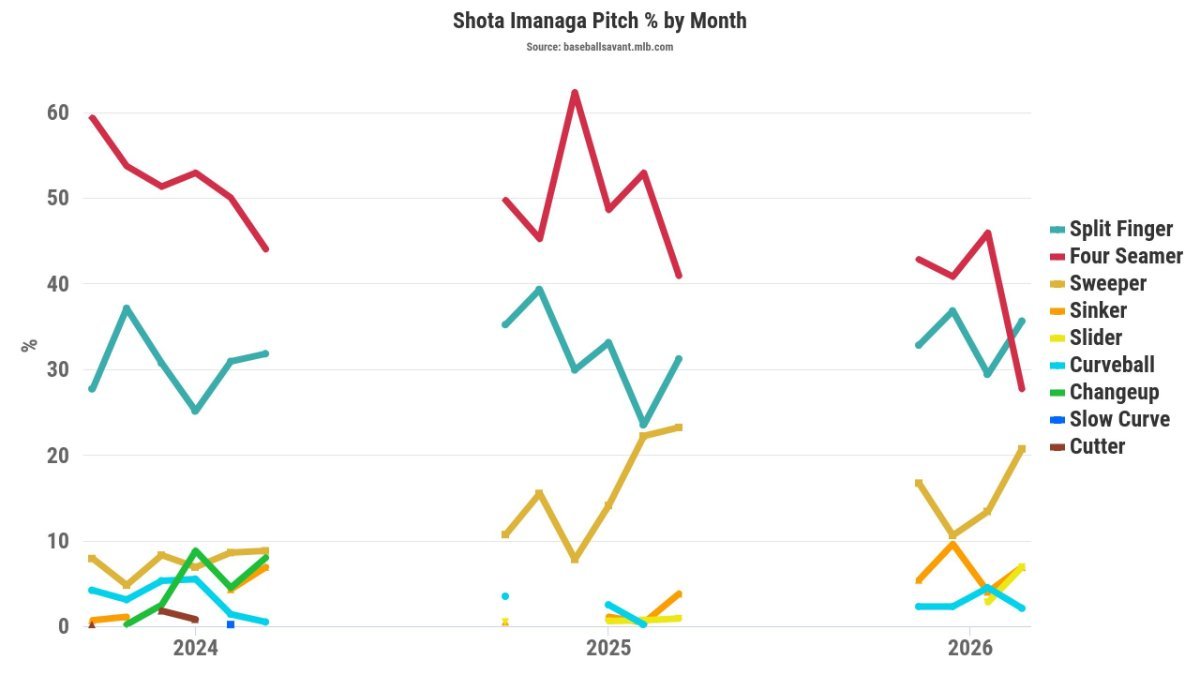
That's come, as you'd expect, with greater reliance on the splitter and sweeper. The metrics on those pitches are much better than on his fastball, but there's a catch: without the fastball to set them up, he has to work harder to get outs with them. The most efficient version of Imanaga is the guy who throws that fastball 45% of the time, rather than about a third of the time. But that efficiency isn't always what the team needs.
In his two starts this month, Imanaga has only recorded 29 total outs. He went 4 2/3 innings against the Cardinals on July 4, and 5 frames against the Reds on Friday night. However, he's only given up three runs in the two outings, combined. He's using more pitches per batter faced, and he's walking more batters than the version of himself who dominated the league for parts of 2024. However, he's still missing enough bats, as evidenced by his 13 strikeouts in the two outings. Counsell is also being more proactive with him, pulling him not at the first sign of trouble, but before that trouble can become a budding disaster.
This is how teams use their third or fourth starter in the postseason: by asking them to be less efficient but more clinical. That Imanaga is already morphing into that version of himself is good news for Chicago. It puts a bit of extra pressure on the bullpen, but it also gives the team a better chance of being in position to win when Imanaga leaves the game. It's time to make those kinds of changes and get serious about the formula they want to use to win games when the stakes rise sharply. Fewer runs allowed per out recorded becomes the sole criterion of utility by mid-September, and Imanaga and the Cubs are turning his starts into rehearsals for that intensity and urgency even in July.





Recommended Comments
Create an account or sign in to comment
You need to be a member in order to leave a comment
Create an account
Sign up for a new account in our community. It's easy!
Register a new accountSign in
Already have an account? Sign in here.
Sign In Now