


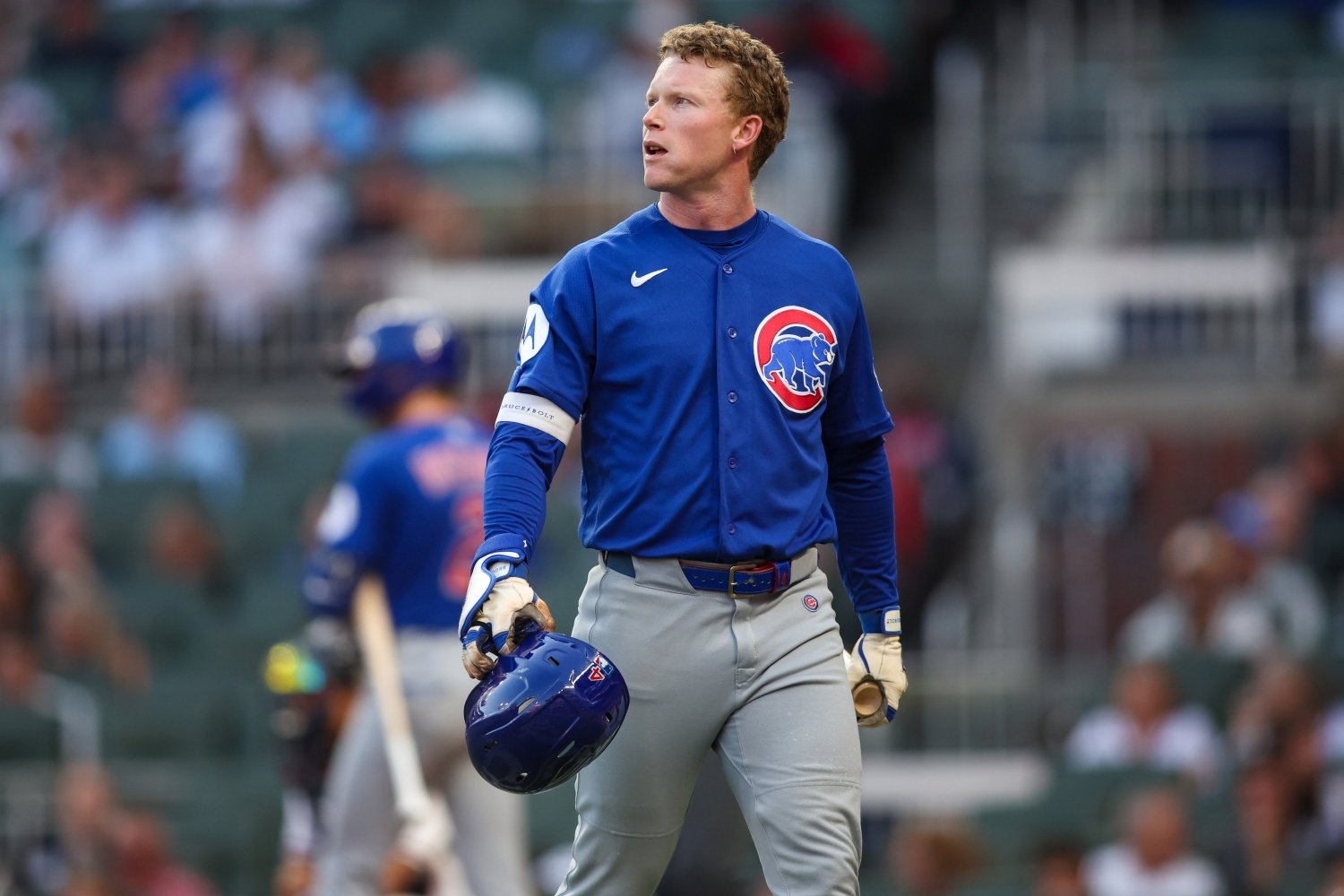
Cubs Video
Let's start here: Bat speed is good. All else equal, you'd rather swing faster, rather than slower. All else is often not equal, of course, but bat speed gives you a greater margin for error, just as foot speed or arm strength do. The faster you can move the barrel through the zone, the later you can make swing decisions, and the harder you can hit the ball even if you don't quite catch it flush. It is, on balance, a good thing—or, to draw a tricky but important distinction, an encouraging thing—that Pete Crow-Armstrong has more bat speed this season than he had in 2025.
There's no mistaking that fact, at least. According to Statcast, Crow-Armstrong's average swing speed is 74.3 miles per hour this year, up from 72.7 MPH in 2025 and up nearly 4.0 MPH since 2024, when he first got a meaningful run in the majors. He swings as fast as some of the top sluggers in the game, which was certainly not true even as he enjoyed a breakout, 30-homer season last year.
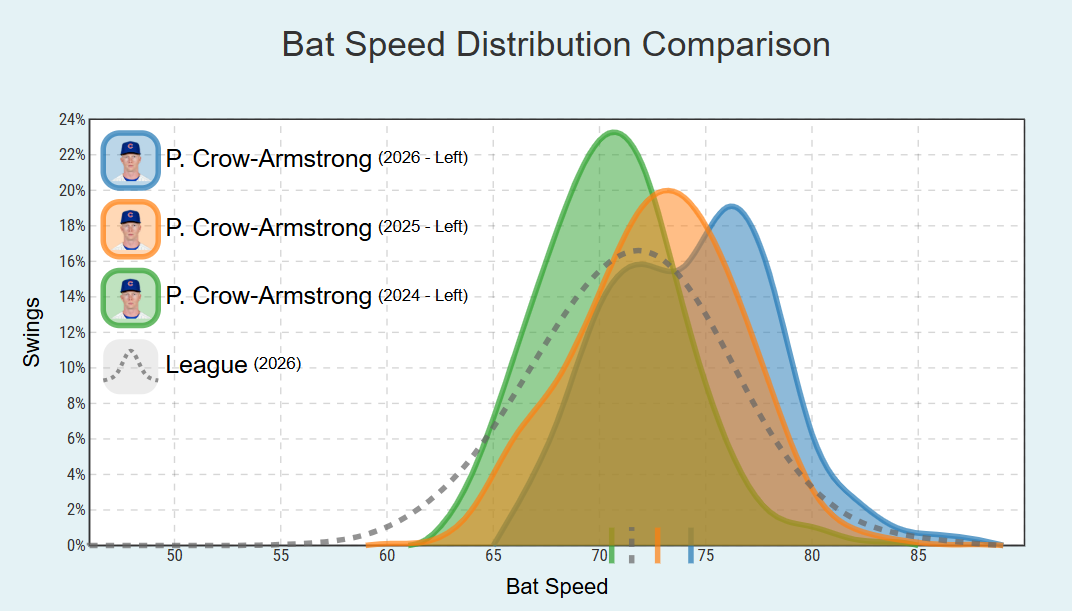
The first thing you should look for, to assess the efficacy of a bat-speed bump, is increased exit velocity. With Crow-Armstrong, we have it. Crow-Armstrong's average exit velocity is up by 1.5 MPH this season, and his hard-hit rate has gone from average to plus, in lockstep with the bat speed itself. The second thing you should check is whether a hitter has sacrificed contact by swinging harder, and have thus set themselves up to strike out a ton. That's not happening here, though. Crow-Armstrong has gotten slightly more selective this year, especially early in counts, and his contact rate on swings is actually up slightly. All the news, to this point, is good.
Here's the bad: Last season, a solid 33.9% of Crow-Armstrong's batted balls clustered in the Statcast-denoted sweet spot for launch angle, between 8° and 32°. Those are line drives and fly balls with the best chance to carry through or over the infield, and to land before an outfielder can run underneath them—while still having a chance to clear the fence, if hit hard enough. That 33.9% number was unbremarkable, but it was good enough to make Crow-Armstrong a star slugger. This season, that figure is down to 23.0%, one of the worst in the league. Crow-Armstrong is just not hitting the ball flush often enough.
At first blush, you might struggle to explain this. Statcast has a metric to estimate the solidity of a player's contact, by using physics to estimate the maximum possible exit velocity given the player's swing speed and the speed of the incoming pitch and then calling a ball Squared Up if it exceeds 80% of that possible maximum. Crow-Armstrong's Squared Up rate is flat (or even up, albeit very slightly) in 2026, so he hasn't lost the ability to catch a fair piece of the ball. If he had, we would also have seen that in his exit velocity distributions, despite the boosted bat speed.
It's easier to see it this way. Here's a plot of all Crow-Armstrong's batted balls from 2025, by launch angle and exit velocity.
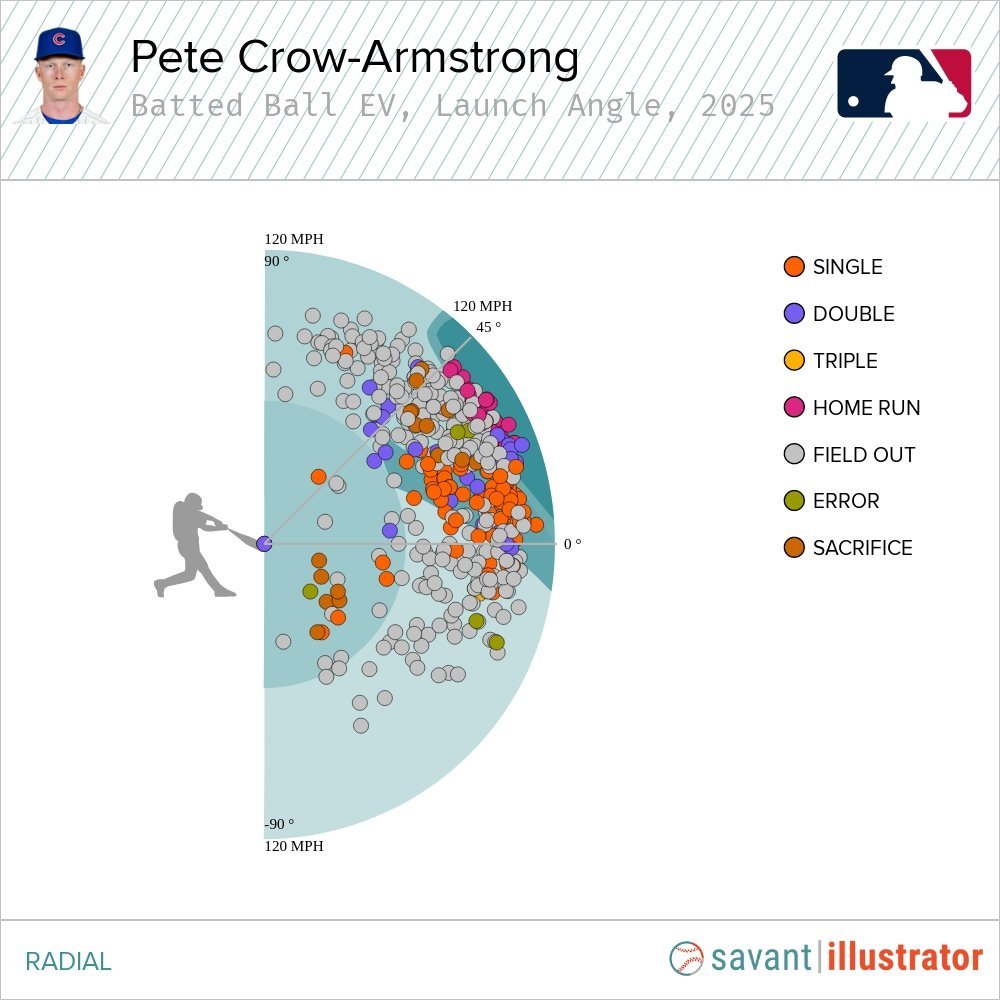
He found all that offensive value last year because he got quite good at hitting the ball hard in that launch-angle sweet spot—but also because, when you find that sweet spot, you don't have to hit it hard to get some value out of it. Soft line-drive singles live there, too. Crow-Armstrong hit a good number of those last season.
Here's the same chart for 2026. I've highlighted two areas to which we should pay special attention.
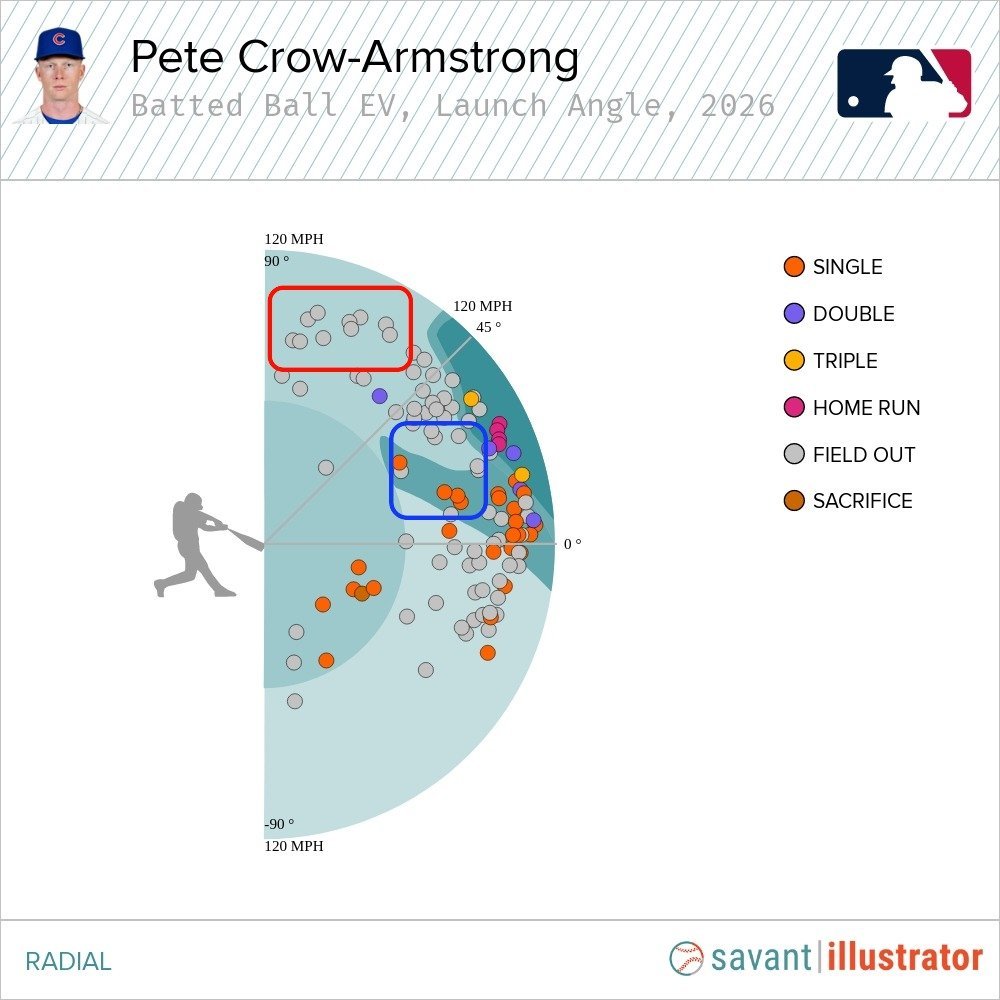
He's hitting more balls hard, although very weakly hit balls are also slightly more frequent. What's missing? A bunch of medium-speed liners that should be inside that blue square. Many of those would be hits, but they're simply not there. Meanwhile, look up at the top of the chart. Crow-Armstrong isn't hitting more lazy, routine flies this year. In fact, he's hitting fewer. But he's hit a bunch of unusually hard-hit balls straight up, which tells us something. Those are the balls that are still counting as Squared Up, and that are propping up his hard-hit rate—but they're still easy outs. They look like this.
That left Crow-Armstrong's bat at exactly 100.0 MPH, but you don't care, because he hit it way up in the air and it never had a chance to be anything but a flyout. This is a frequent problem for him this year, and it stems from the increase in his bat speed—but not necessarily in the way you might think. Crow-Armstrong isn't out of control and unable to deliver his barrel to the right part of the hitting zone. He's just habitually, almost unavoidably early, and the nature of his swing yields lots of these kinds of batted balls.
Crow-Armstrong has a steeper than average swing, and he catches the ball well out in front of him. That much, we already knew. It's why the Cubs were willing to invest in him for the long term, with a nine-figure payout that will look wise only if he at least sometimes flashes what he did for the first two-thirds of 2025. That type of swing gets the barrel working uphill toward the ball, and when it's on time, it generates a lethal combination of loft and ball speed. It looks like this:
Or this:
However, it's possible for hitters who work this far in front of their bodies to get too far out there, for long stretches. Crow-Armstrong reinvented himself offensively in 2024 and had a different contact point in 2025 than before. It also came with a different attack direction, which is the orientation of the barrel relative to the front edge of home plate at contact.
| Season | Contact Point (in. in front of center of mass) | Attack Direction |
| 2024 | 32.8 | 0° |
| 2025 | 36.2 | 4° Pull |
| 2026 | 37.3 | 6° Pull |
It's possible to consistently barrel the ball at 36 inches in front of your body, but that's about the maximum. Beyond that, you're basically too early. Meanwhile, Crow-Armstrong's barrel is still moving. Once it passes that 33-36 inch zone in front of him, it's turning enough that (despite that loft that keeps him capable of getting good wood on the ball and slicing one the other way) a mishit is likely. It'll be a specific mishit, too, most of the time. It'll look like this.
The point of that tilt and that pull orientation in Crow-Armstrong's swing is to get behind the ball and send it screaming toward or over the right-field fence. Obviously, that won't always happen, but the swing is geared to maximize the chances of it on any given cut. When he misses, though—when he's not rolling over on the ball, but has just swept past the optimal zone in that arc before he meets the ball—it hits the upper, outer side of the bat and goes way up. The bat speed was still delivered to the ball, but the angle is all wrong.
Flatter swings usually do better farther out in front; most hitters with tilt similar to Crow-Armstrong do better with deeper contact points. Right now, he's not missing because he's moving the bat too fast to maintain control. Rather, the ball is where he means for the barrel to go, but by the time it gets there, the barrel has already come and gone from that optimal zone. A flatter swing on which a hitter was similarly early would produce rollover grounders and whiffs. Crow-Amrstrong's swing creates, technically, better contact even when he's early. He's getting a lot of the bat on the ball, for a hitter who's early. In practice, though, it's a glancing blow, steered forward by the angle of the bat but much like a foul ball. It comes to the same thing as if he were hitting the ball much less well (or not at all), because those are virtually guaranteed outs.
This isn't bad news, really. There are worse ways Crow-Armstrong could be getting to his underwhelming .675 OPS, in general. There are even worse ways he could specifically be suffering from his own increase in bat speed. Instead, he's still in control of his swing, and if anything, his swing decisions have improved. Swinging faster still should be good for him, in time. For now, though, he's yet to figure out how to alter his timing in a small enough way to compensate for being early, without falling into the trap of being late, as he was for some stretches last season. It's not easy to make that adjustment, small though it might sound. There are no guarantees that Crow-Armstrong will lock in and start producing a .900 OPS again any time soon. There is, however, a real chance of that—because his bat speed is up, and bat speed is good. It's just a matter of paying the cost of it.





Recommended Comments
Create an account or sign in to comment
You need to be a member in order to leave a comment
Create an account
Sign up for a new account in our community. It's easy!
Register a new accountSign in
Already have an account? Sign in here.
Sign In Now