


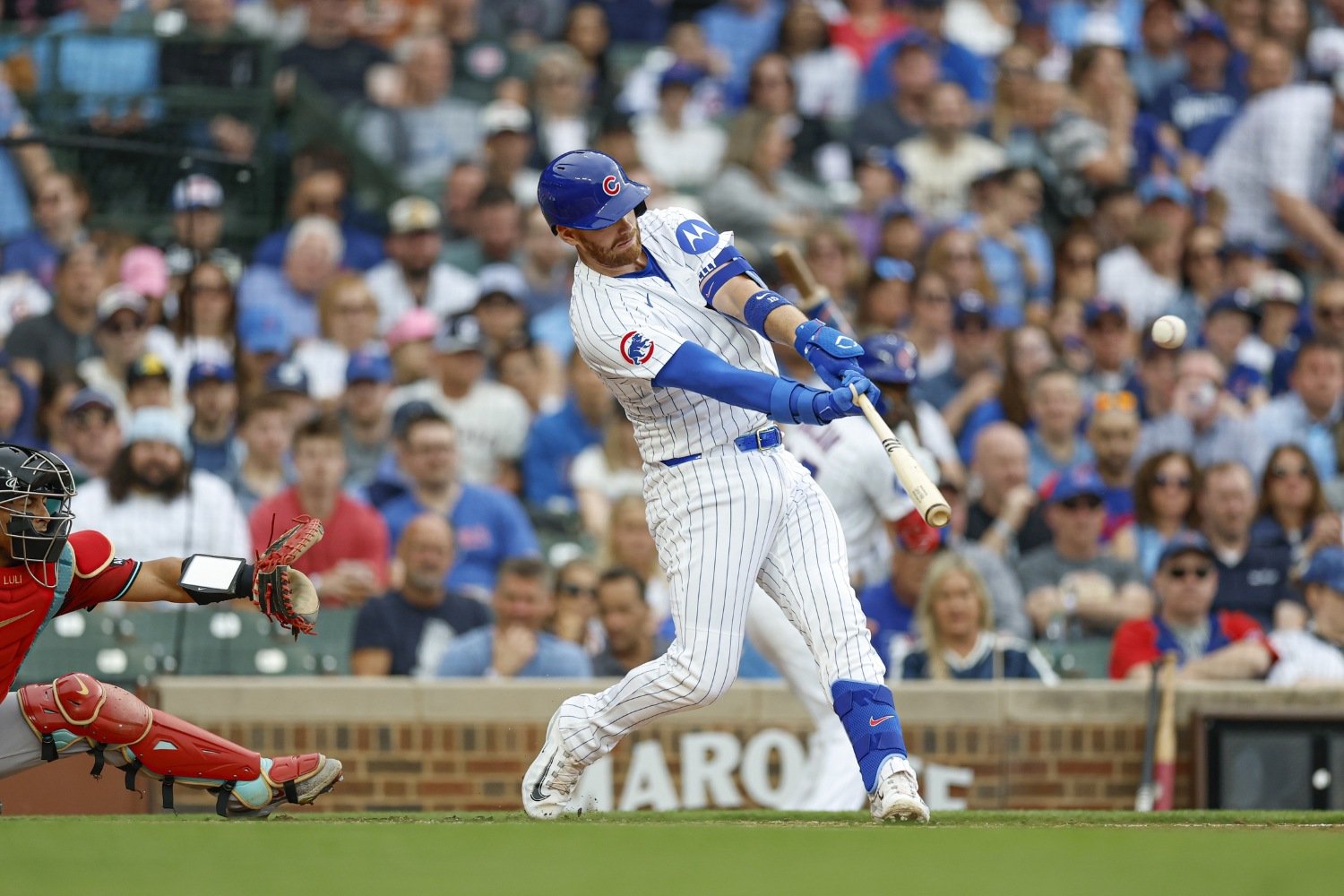
Cubs Video
Somehow, if the season ended right now, Carson Kelly would be the best hitter in baseball for the year 2025. Somehow, as a catcher hitting the age when most catchers decline steeply in all facets, Kelly is swinging the bat 1.3 miles per hour faster than he did last year; his walk rate is roughly triple his strikeout rate; and he's tapping into power he's never achieved in the majors before. Call it a homecoming, since he's from Chicago. Call it a fluke, because it sure seems likely to be subject to regression, just like any sample this impressive. Just know that a little bit of it is good, old-fashioned mechanical cleanup.
As you know by now, Baseball Savant has begun publishing data on where batters set up in the box and where their swings would intercept the pitched ball, in addition to things like bat speed, exit velocity and launch angle, They haven't yet included stride length as a datum in that set, but they do offer visual representations of batters' stride, using three moments of reporting:
- Pre-pitch, when the batter takes his stance;
- The moment when the pitcher releases the ball; and
- The moment when the bat meets (or would meet, in the case of a whiff) the ball
An animated graphic will show you, for instance, how dramatic Matt Shaw's leg kick was, and how far he ended up striding after that initial movement. The batter's boxes in the visualizations are plotted out into six-inch squares, so although the site doesn't report an easy number, an educated and careful observer can easily rough out a hitter's stride length. It's just Applied Pythagorean Theorem, along with a little judgment about what part of the foot to measure from and to. So, I examined Kelly's swing data (including stance and contact point data) for the second half of 2023, all of 2024, and the first handful of weeks of 2025. Here's what that stride looked like in 2023:

Kelly's going right at the baseball, doing things this way, but some of the energy his swing is creating is likely to be wasted. That's because his stride is a little longer than his swing requires. Kelly is not a highly athletic hitter, reliant on getting into his legs and being able to adapt and attack in fractions of a second. He doesn't need this much movement to create torque. He's just reaching.
Here's the same visualization, but with 2024 highlighted:

Uh-oh. That stride got even longer last year. He still had a solid season at the plate, but there was certainly still some wasted movement in his swing. Now, here's him so far in 2025.
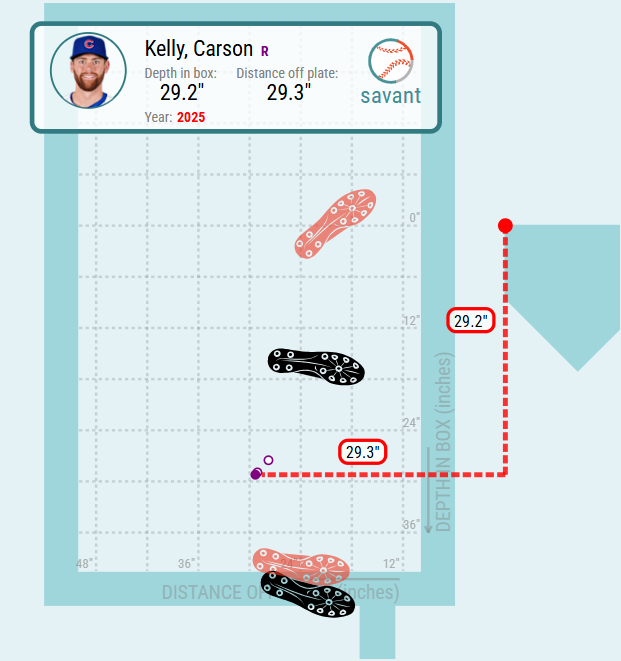
I used those grids to figure out approximate stride lengths for each campaign. Here's how far the center of his front heel moved from his setup to his contact point.
- 2023: 15.3 in.
- 2024: 19.2 in.
- 2025: 13.6 in.
I think we'll eventually get an official, Savant-published version of this stat, and maybe we'll all learn something about my skills in this strange measurement discipline. For now, though, the estimates will do. As you can see, Kelly's shortened that stride. He's starting from a strong, balanced position, and he's staying in it, because he's remaining more upright and focusing more on generating the torque to maximize his swing speed, rather than on moving forward to catch the ball out in front of home plate. His contact point is basically unchanged, but when his bat gets there, it's moving faster, and because he's moved his head less during his swing, he's catching the ball more flush. That's why we've seen his quality of contact spike so handsomely.
If it were this easy, everyone would do it. Kelly might get back into bad habits with his stride, or the novelty of his new set of moves might wear off and he might lose the fine calibration required to make such superb contact. The league might figure him out a bit and start attacking him in a whole new way, forcing a wave of counter-adjustments that destabilizes this whole array of initial changes. For now, though, Kelly is providing more production than the Cubs could possibly have hoped for, and it's thanks to a simple principle: stay tall, don't overstride, and catch the ball squarely.






Recommended Comments
Create an account or sign in to comment
You need to be a member in order to leave a comment
Create an account
Sign up for a new account in our community. It's easy!
Register a new accountSign in
Already have an account? Sign in here.
Sign In Now