


Cubs Video
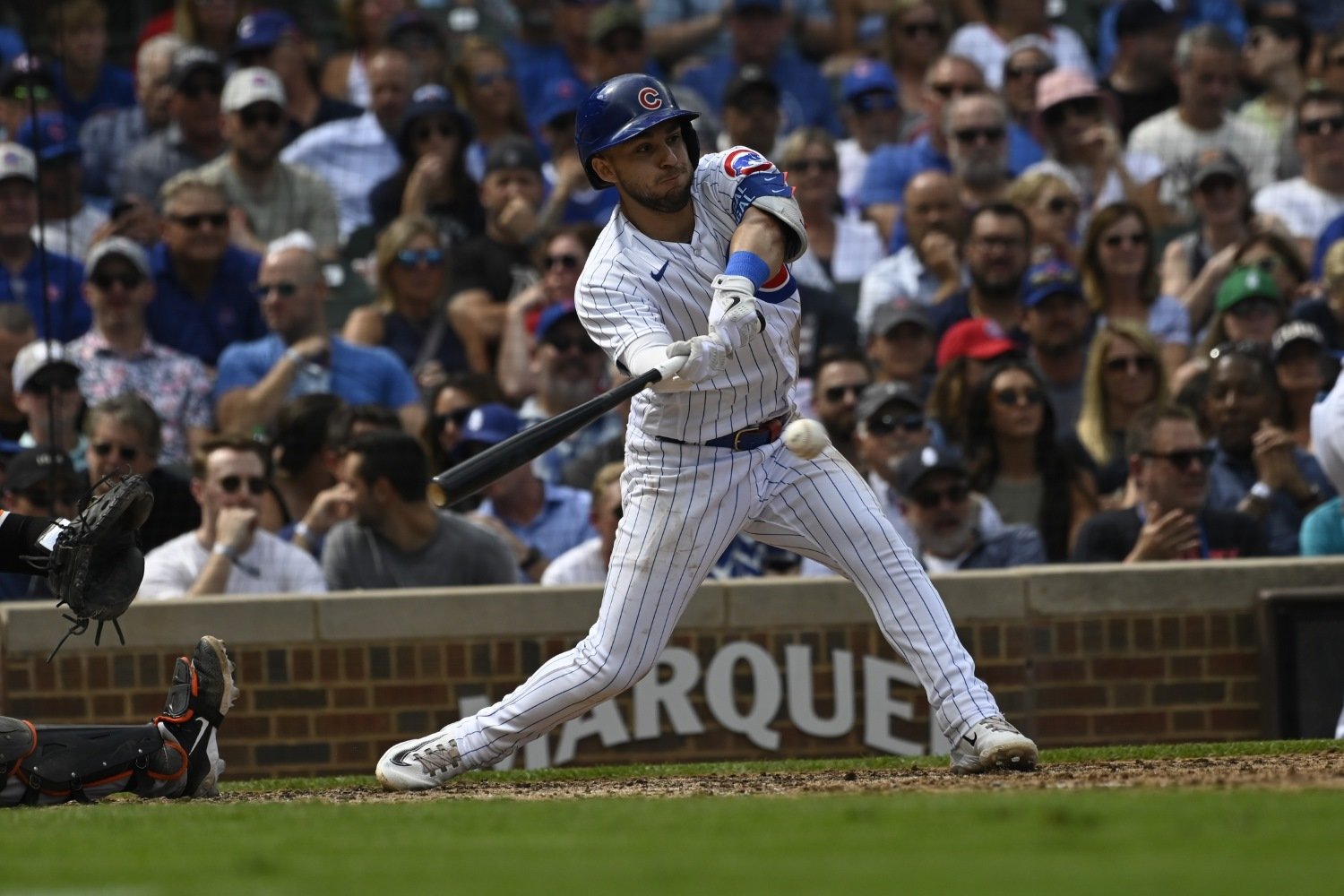
To those who have closely watched the evolution of baseball over the last quarter-century, it was immediately clear that Nick Madrigal and Nico Hoerner couldn't last long in a lineup together, at least for a team with aspirations of winning enough games to reach the postseason. Even as Hoerner made impressive defensive strides at shortstop in 2022, it was hard to deny that his long-term defensive home was at either second or third base. Meanwhile, the lilliputian Madrigal seemed like a locked-in second baseman. Positionally, there was a looming logjam, turned from a potentiality to an urgent reality when Dansby Swanson agreed to join the Cubs last winter.
Because Jed Hoyer refuses to make a trade simply out of need and will find a way to hold onto a player until given what he thinks the player is worth or absolutely forced to let him go, Madrigal was still around in 2023, despite Swanson's arrival and Hoerner's fairly clear assertion of superiority in the battle to slide to second. The tiny contact specialist took reps at third base all spring, which seemed like a bit of a stunt, but he more than held up to his limited trial at the hot corner during the regular season. In fact, he was one of the best defensive third basemen in baseball.
Even so, he didn't find any legitimate power. Nor did Hoerner, who stayed healthier and earned more consistent run than Madrigal and collected 688 plate appearances. Between the two of them, they went to bat almost 1,000 times, managed 43 doubles, legged out five triples, and only muscled up for 11 home runs. That's fairly crazy, in the modern game. Ever since the double-punch of two expansions in a half-decade and the crest of the performance-enhancing drugs problem coincided to alter the way fans consume baseball and its numbers, and ever since sabermetrics has gained a deeper foothold and begun pushing the game toward greater efficiency, power has become an indispensable, non-negotiable part of the package for good hitters.
In fact, you can go all the way back to the integration of MLB in 1947, and you still see a pretty inexorable trend. Here's a chart showing the number of qualifying hitters with fewer than 15 home runs but at least an average OPS+ per team, for each season since Jackie Robinson began the process of legitimizing the National League.

Not only has the trend been steadily (though imperfectly) downward, but we've seen some historically low figures over the last few years. In 2019, only three hitters were above-average at the plate despite having fewer than 15 homers: Kevin Newman, Wilson Ramos, and Kolten Wong. This past season, only six players cleared that bar: Luis Arráez, Mark Canha, Thairo Estrada, Steven Kwan, Lars Nootbaar, and Alex Verdugo. Those are easily the lowest figures in any full season. There was a brief time back in the late 1950s and early 1960s when it was almost as non-optional to hit for power in order to be productive, but even that wasn't quite this extreme.
Obviously, the main driver of that trend is the steady rise in baseline strikeout rate throughout the league. In a league like that of 1952, wherein the average batter struck out under 11 percent of the time and the most whiff-prone regular (Eddie Mathews) was still south of 20 percent, it was much easier to hit for a productive average and get on base at a fine clip without clearing the wall. Now, that baseline rate has more than doubled, and hitters have to get to more power to make up for that.
Madrigal and Hoerner are exceptions to the rule, in some sense. Maybe that counts for something. Hoerner struck out only 12.1 percent of the time in 2023, and Madrigal was way down at 8.2 percent. That makes them much more credible batters than most guys who have such a glaring lack of pop. Still, it sets a hard, low ceiling on their productivity. To wit, despite his great contact skills, Madrigal batted just .263/.311/.353, for a 79 OPS+, and Hoerner (even in what felt like a breakout campaign in which he fully made good on the promise he flashed in 2022) only had a 99 OPS+, himself. He's not even one of the six guys who cobbled together an above-average line without good power.
That's why it just wasn't ever going to work, not for the long term. Madrigal could be a fine little backup guy, but as a regular, he paired with Hoerner to give the team too much in the way of competitive but non-dynamic offense. We can wish it weren't so, but we live in a world beyond that of José Cruz or Buddy Bell. The productive, actively valuable 10-15 homer guy is a dying breed, and no team can afford to rely on two in the same lineup, unless they have undimmed superstars packing the heart of their batting order. Instead of that, the Cubs have Ian Happ, who only managed a couple more home runs last year than would have allowed him to be on the lists above. They can't win with Madrigal in the lineup every day, not because of Madrigal's shortcomings, but because they already have their quota of underpowered players in an overpowered offensive environment.
Yes, this is yet another in a long line of posts throughout the internet over the last year or more imploring the Cubs to trade Madrigal. I don't agree with what I consider a fairly facile set of criticisms of Madrigal's defense at third that have popped up on Twitter recently. There's been an intimation that somehow, because he plays more shallow and relies on a different playing style than Matt Chapman, Madrigal's brilliance with the glove last year is somehow fake or invalid. It's not that way. The up-the-middle positions are the demesnes of rangy, fluid athletes, making plays in space. The corners are a geographical proposition. It's perfectly acceptable, and very much the right choice for Madrigal, to play shallow and try to cut down the amount of range one needs, using exceptional quickness and the angles of the game. Some of history's great third basemen have done just that for over a decade.
I also don't want to automatically disqualify Madrigal because he lacks power at the plate. The narrow aesthetic tastes of too many modern fans notwithstanding, there is something delightful about Madrigal's skill set. I want there to be more Dave Cash types and more Eric Young Sr. types, not fewer. Nor is he as bad as many believe. Surprisingly (but tellingly), PECOTA forecasts a 107 DRC+ (where 100 is average and higher is better) for Madrigal in 2024. Not striking out still has some value. However, he's not ready to accept a backup role, and that's the only one in which the Cubs can presently afford to carry him. Instead of risking falling into using him as a redundant piece of the near-everyday lineup, the team should find a trade partner for Madrigal and then make some alternative plans at third base.
How would you prefer the Cubs handle third base this spring? If not Madrigal, who should get the bulk of the playing time there? Let's discuss it further, including kicking around the remaining outside options.





Recommended Comments
Create an account or sign in to comment
You need to be a member in order to leave a comment
Create an account
Sign up for a new account in our community. It's easy!
Register a new accountSign in
Already have an account? Sign in here.
Sign In Now