


Cubs Video
There are a variety of valid analyses of the Cubs' agreement to sign Matthew Boyd to a two-year deal at the beginning of this week. Some fans appreciate the mixture of depth and upside he adds to the team's starting rotation, but others balk at the lack of star power and at a price tag that tends to suggest a lack of huge moves trailing in this one's wake. Both are reasonable positions. However, there's also a thread of conversation going around the internet that is not reasonable, and which we need to thwart. No matter what you might hear, or from whom, the Cubs are not going to deploy Boyd as a reliever—at least not unless or until he suffers some significant injury that alters his arc from here.
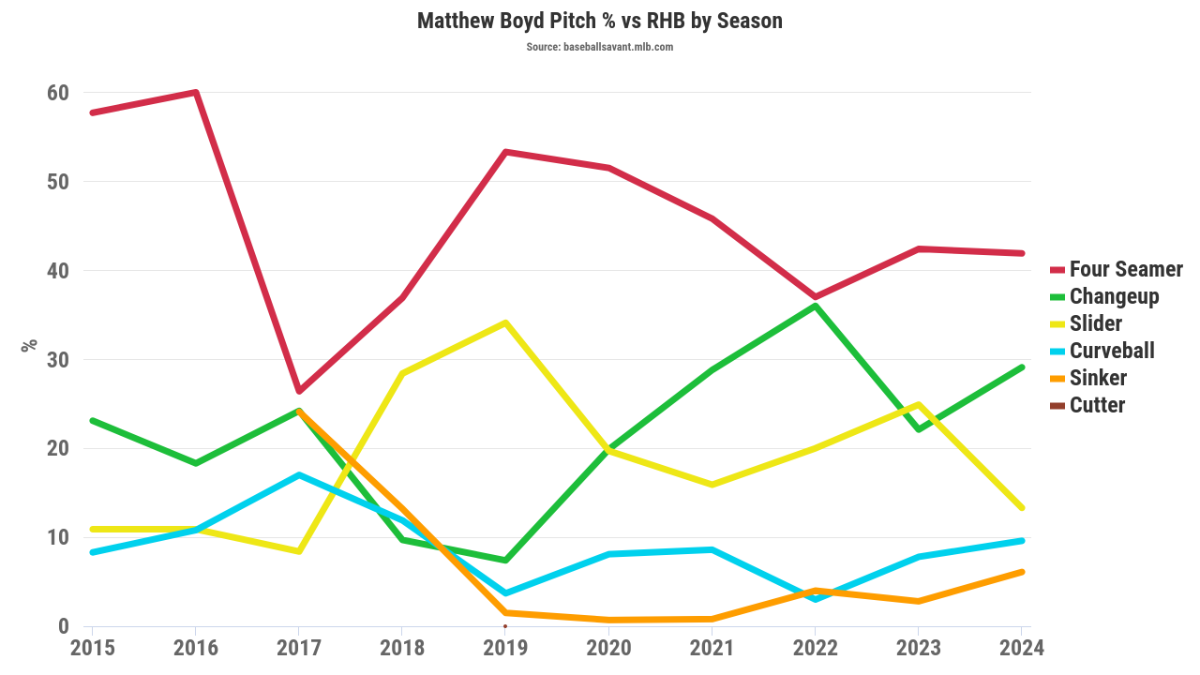
Boyd has evolved nicely over his long career, from a lefty very much vulnerable to right-handed batters into a much more platoon-neutral one. He allowed just a .641 OPS to righties in 2024, easily the best of his career in seasons featuring any meaningful number of batters faced. He's developed his changeup into a weapon against those batters, and throws it more than he used to.
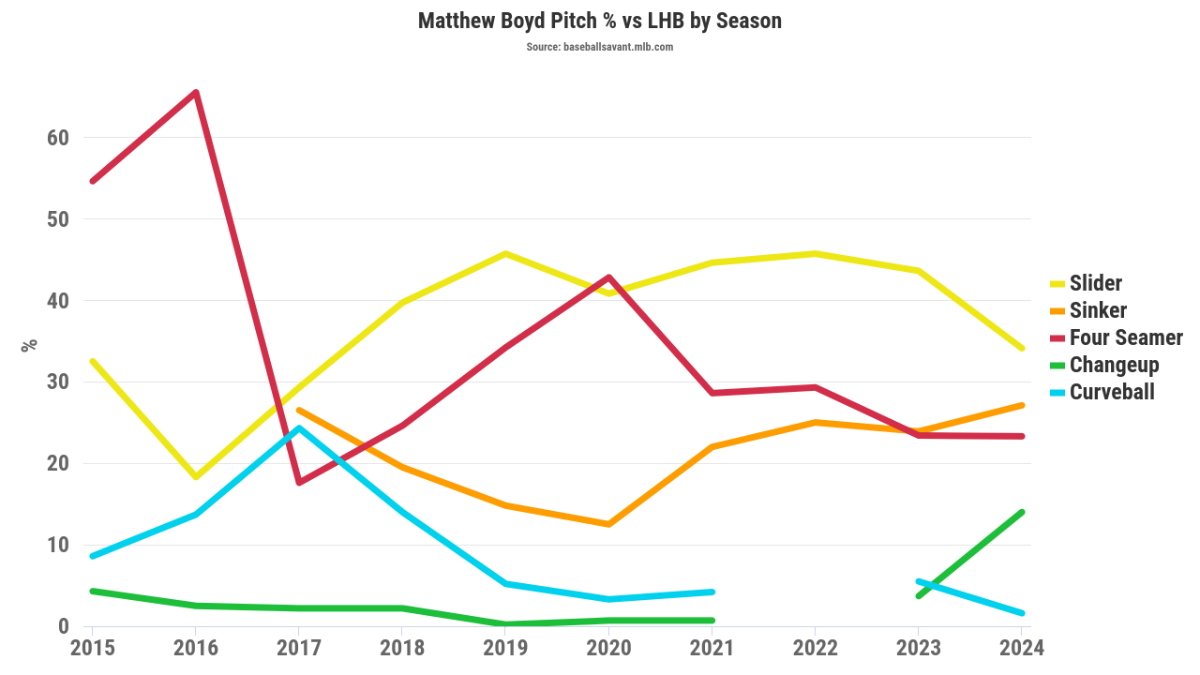
Meanwhile, he's brought along his sinker, which works nicely out of his low slot as a weapon against lefties and allows him to be less reliant on his sweeping slider than he was earlier in his career.
In short, while he might not be available every fifth day the way an ideal starting pitcher would be, it's his well-rounded skill set and ability to thrive as a starter that made him attractive to the team. He's started 168 of the 182 games in which he's appeared in his MLB career, and he's only become more viable as a starter in the last few years.
You can also consider the terms of the deal and see the situation plainly: The Cubs didn't pony up $14.5 million per year to a player they envision as a reliever, given that even if he did slide into that role, Boyd's upside would be something less than that of a relief ace. While many Cubs fans (rightfully) hope and expect that the team will still try to add to the top of the rotation depth chart this winter, and while many of them (less rightfully) might prefer Javier Assad, Ben Brown, or Jordan Wicks as starters, the fact that this deal happened at all sends a clear message: the Cubs don't agree. Boyd got this deal because the Cubs (and at least one or two other teams in the market) view him as a starter, and a strong one. If he can harass lefties with his slider, sinker, and four-seamer and make the changeup work off his four-seamer consistently against righties, Boyd is simply a different pitcher than his somewhat ugly career stat line implies—and the team is betting big on that being the state of things.
Part of the value of this move was that it headed off some other possibilities. Fans won't view it that way, and are certainly not obligated to do so, but that's a real consideration. For the third year in a row, Jed Hoyer and company entered this offseason with a huge spectrum of possible paths to building a better roster. Sometimes, all those possibilities pile up on one another and become an obstacle to decisive action, rather than facilitating it. Early moves (like the team's trade for Eli Morgan and the Boyd signing) sometimes help as much by partially checking off an item on a list as by actually solving a roster problem. There is still plenty left for the Cubs to do this winter. Signing Boyd narrowed the number of options available, but that should make it easier for the team to choose their next moves. To see that value clearly, though, you have to embrace the inevitability of Boyd being part of the team's starting rotation. It's not a fluid situation. He's locked in, just as Justin Steele, Shota Imanaga, and Jameson Taillon are.






Recommended Comments
Create an account or sign in to comment
You need to be a member in order to leave a comment
Create an account
Sign up for a new account in our community. It's easy!
Register a new accountSign in
Already have an account? Sign in here.
Sign In Now