


Cubs Video
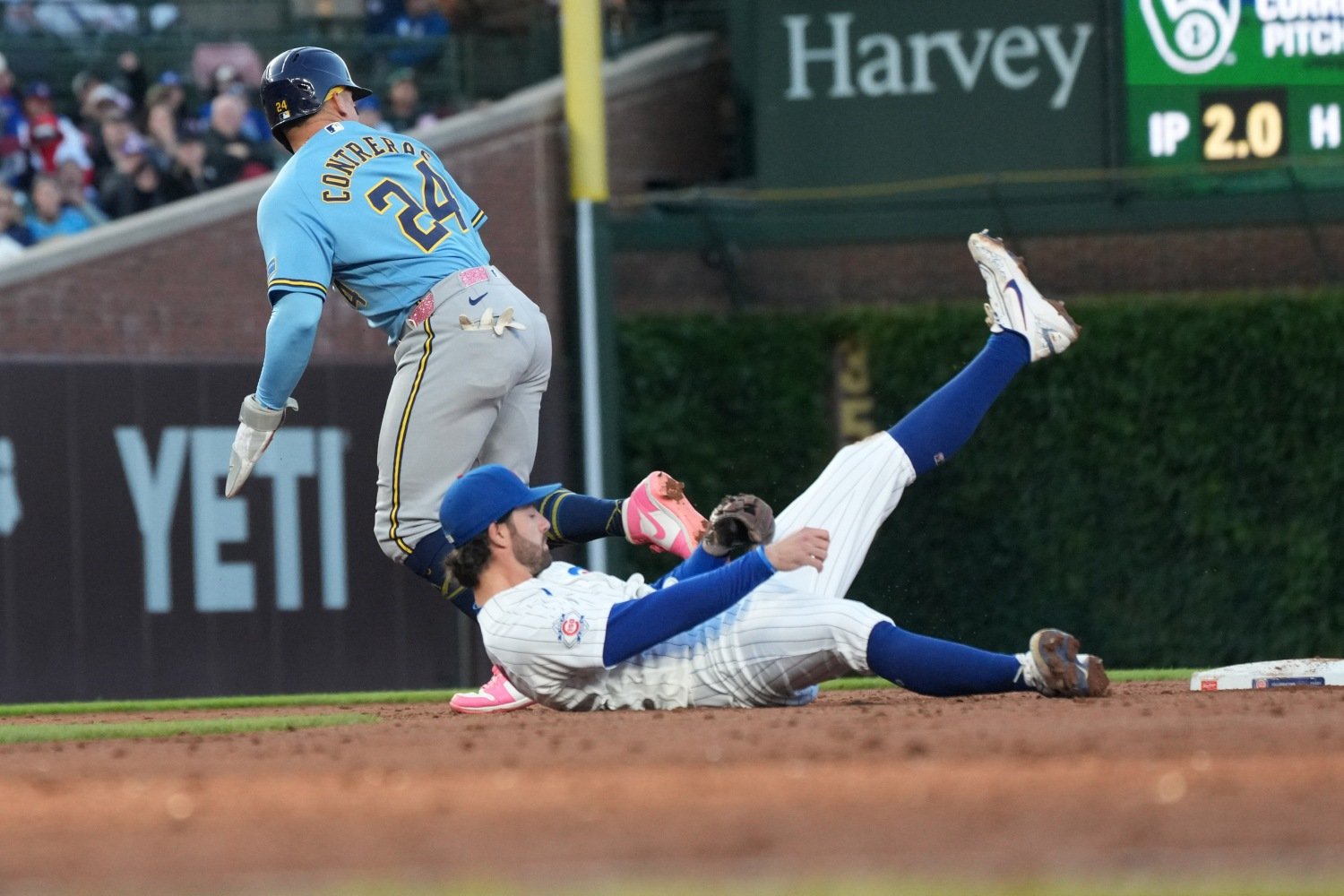
It's just three games. Right? Sure, the Brewers came into town and beat the Cubs in both convincing and ominous fashion. They used three pitchers they acquired over the winter through proactive trades and one guy they've developed into the best pitcher in the world to overmatch an ostensibly high-powered, unquestionably expensive Cubs offense. They got crucial home runs from the second baseman who has blossomed into the superstar Cubs fans have longed for Nico Hoerner to be, and from a scrapheap scoop-up who now seems to be a legitimately above-average first baseman, and from the Cubs' gleefully antagonistic long-time nemesis, Christian Yelich.
Sure, Pete Crow-Armstrong made embarrassing mistakes. Alex Bregman, Ian Happ and Seiya Suzuki missed opportunities to turn the tides of two of the three losses. The Brewers clearly have Shota Imanaga's number, and Edward Cabrera left his fourth straight ineffective start with a blister. The Brewers pulled into first place, where they've spent the majority of the past half-decade. But it's just three games. Right?
Increasingly, it feels like it's more than that. The Brewers keep resoundingly beating the Cubs when it really matters. They keep frustrating their former manager and proving to be more fundamentally sound and smarter, as well as immensely talented. More importantly, they're never just winning three games. They came to town having won eight of 10 and 13 of 18. They leave town looking like they're back into the groove they found last summer, with 16 wins in 21 games. The Cubs won 20 of 23 at one point this season, of course, but they haven't showed the same capacity for dominance as the Brewers have this year. Chicago has scored 4.9 runs per game and allowed 4.4. Milwaukee has scored 5.0 per game and allowed only 3.4.
Were this because Milwaukee was all-in this year, it would be easier to feel ok about it. In reality, though, it's the Cubs who are closer to that end of the spectrum of timeline plans. As we've talked about at length, this team faces the losses of both corner outfielders and several starting pitchers (Jameson Taillon, Matthew Boyd, Imanaga) to free agency this winter. They can spend money to replace those guys, but not without constraints, because they owe a nine-figure sum to a group headlined by Bregman, Crow-Armstrong Hoerner and Dansby Swanson. Justin Steele and Edward Cabrera will be expensive arbitration cases. Michael Busch, Miguel Amaya, Daniel Palencia and Ben Brown will be relatively cheap ones, but they'll get at least $10 million more expensive as a group than they are this year. Bregman, Swanson, and Carson Kelly are likely in the last years of their respective primes. The farm system is not robust. The Cubs need to be good this year; they're very likely to be a bit worse next year and the year after.
Meanwhile, the Brewers are a perpetual motion machine. Kyle Harrison became the most salient symbol of that this week at Wrigley Field, but he won't be the most visible one for long. Milwaukee is younger and cheaper than the Cubs, but they're also much deeper, and—this, given the disparity in their payrolls, is the big blow—their stars are better than the Cubs'. On top of all that, with a couple of other top prospects graduating, Milwaukee now has the top overall prospect in baseball, in infielder Jesus Made. They're not necessarily better this year than they were last year, but they're almost certainly going to be better next year than they are right now, and they should even be better the year after that than they are next year.
No cavalry is coming for the Cubs. They don't have savior-caliber prospects on either side of the runs ledger, either long-term or short-term. They aren't going to get a front-office overhaul and a creative spark, because Jed Hoyer got an extension to remain the team's president of baseball operations for the balance of the decade. It feels silly to talk about farm systems and long-term concerns around a good team in late May most of the time, but in this case, the long-term concerns are also short-term ones. The Cubs have to win now. Can they do it? Only if they start getting better performances from the guys on the roster, because they have no mechanism by which to add much to the roster this year. That made this week's reminder that the Brewers are better than the Cubs for the eighth full season in a row especially painful.
Locking in this core made some sense, but it raised the stakes of the team's efforts to improve its player development. So far, the jury is out on that. Signing Bregman and trading for Cabrera this winter made sense, but it moved forward the team's timeline for geting back to the top of the NL Central at the cost of sustainable excellence. The jury is certainly out on that, too.
Signing Hoyer to that extension last summer, meanwhile, remains a head-scratcher. It came at a strange point in the calendar. It seemed to take pressure off a team that needed to embrace the very real pressure it faced. It certainly locked them into the philosophies and capacities of Hoyer, which are not on par with those of some of the top front offices with which Cubs fans hope the team will be fighting for supremacy in the years ahead. It rewarded Hoyer for a job he hadn't actually completed, and still hasn't: reasserting the Cubs' place as the team to beat in the NL Central. Hoyer tried to finish that work over the winter, but this week demonstrated how profoundly he failed.
The Cubs can still win the division this year. In a season when no team feels like an unbeatable colossus, they can still dream of a pennant. At the moment, though, it's hard not to feel like the team overcommitted to a bunch of second-tier commodities: a second-tier front office, second-tier big winter moves, and a second-tier homegrown core. Eventually, even in the Second City, the second tier isn't good enough. How the team can get to the first tier from here, though, is hard to say.





Recommended Comments
Create an account or sign in to comment
You need to be a member in order to leave a comment
Create an account
Sign up for a new account in our community. It's easy!
Register a new accountSign in
Already have an account? Sign in here.
Sign In Now