


Cubs Video
One year ago, the Yankees traded for Juan Soto, giving up a handsome package in exchange for a single season of the services of one of the best hitters of his generation. It was a less daunting deal than it could have been, though, for the simple reason that there was just that one year of control to be had. Soto was, as everyone knew, headed for a highly lucrative free agency, and he and Scott Boras were not going to be dissuaded from that path. That dampened the trade market slightly. For instance, it chased the Cubs away from any serious effort to sign him, before they even considered one.
As cautiously as Jed Hoyer approaches huge outlays for top-tier free agents, he's even more reluctant to splurge in the less renewable currency of young talent, by trading top prospects for players over whom he'll have only short-term control. Some players come at a discount because they won't be around long, and such players can hold some appeal for Hoyer and the Cubs, but they're not looking to deal for players at steep prices if they stand to lose them in short order. As the Dodgers eventually did, the team would surely have sought an extension with Tyler Glasnow as a condition of the trade, had they been the ones to pry him away from the Rays last winter.
All of that is to say this: If Kyle Tucker of the Astros is not open to an extension this winter in lieu of hitting free agency next fall, then the Cubs are wildly unlikely to acquire him. Reports from the Houston beat at the Winter Meetings indicate that the Astros are lacking clear marching orders from ownership in terms of their 2025 payroll (wonder what that's like, sounds terrible), and that they're open to moving one of Tucker and fellow impending free agent, left-handed starter Framber Valdez. Both players are due significant salaries in their final year of team control, anyway, so moving them would give the team at least a modicum of financial flexibility, but the Astros also have one of the league's worst farm systems, and a blockbuster deal involving either Tucker or Valdez could help them replenish it, This is not, in other words, a Mookie Betts-type situation, where clearing salary will be the sole motivator in a trade and it might be possible to acquire a superstar at a deep discount. Tucker, should be traded, will command a top prospect or two in exchange.
Still, it's possible to imagine the Cubs jumping into that fray. Tucker is not a Boras client; he's represented by Excel Sports Management. Quietly, that group can also be tough to hammer out pre-free agency extensions with. They've taken clients like Dansby Swanson, Jason Heyward, George Springer, and Andrew Benintendi all the way to free agency recently. Then again: Dansby Swanson, Jason Heyward. Another couple of Excel clients: Jameson Taillon, Joc Pederson. The Cubs have a solid relationship with that group. Plus, there are counterexamples to the above. Paul Goldschmidt and Pablo López are Excel clients who recently signed extensions with teams shortly after being acquired by those clubs in trades.
So, let's imagine Tucker is open to an extension if traded to a team willing to spend big enough to keep him. What would such a deal look like—the trade, and then the contract attached to it?
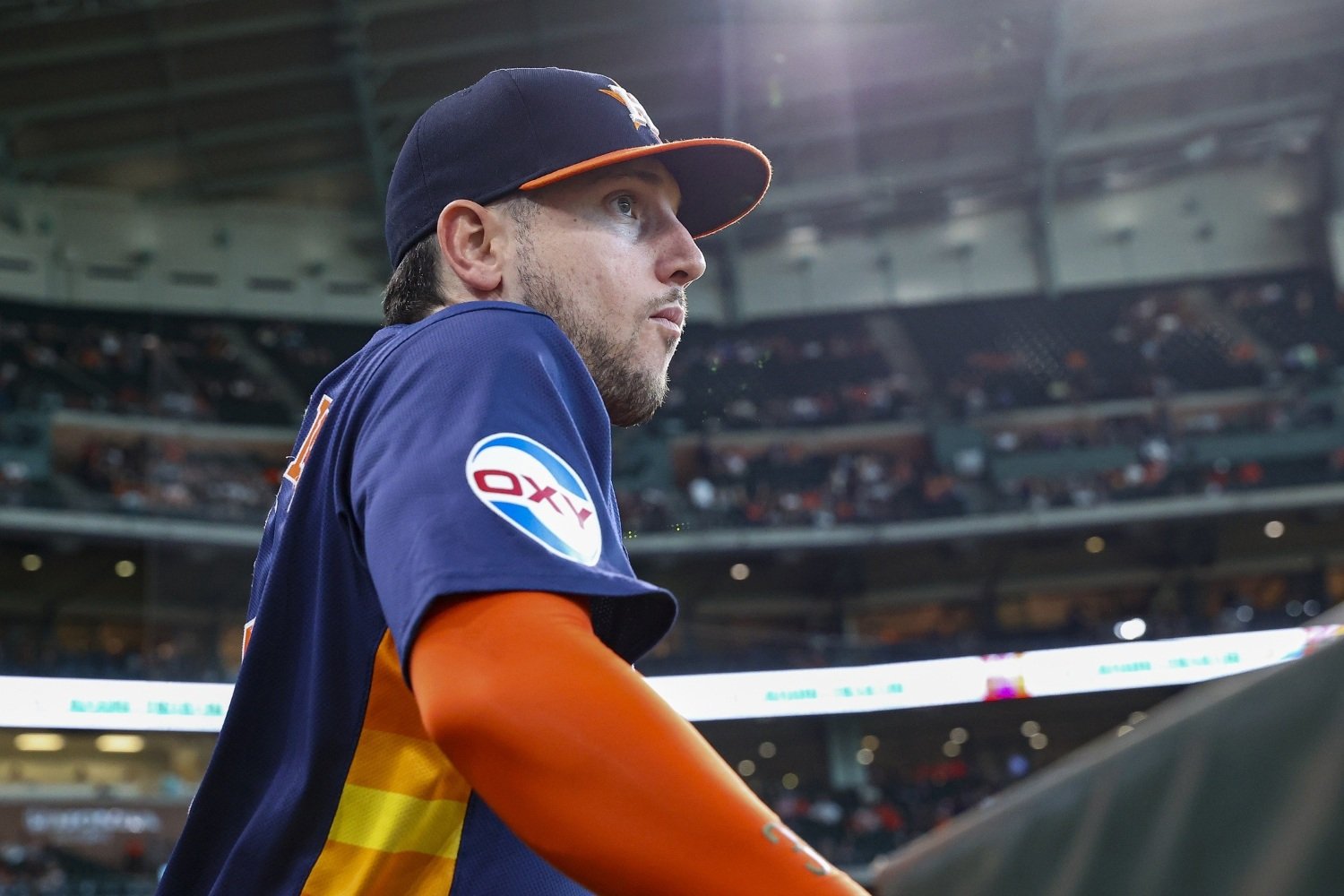
The Astros have a tall, slugging left-handed right fielder who will turn 28 in January; who has made the All-Star team in each of the last three seasons; who owns a Gold Glove Award and a Silver Slugger Award; and who has batted .280/.362/.527 over the last four seasons, with 112 home runs and 80 steals in 91 attempts. He's not Soto, but he's a better player than anyone on the Cubs. In fact, he's better than anyone the Cubs have had since the peaks of Kris Bryant and Javier Báez—but he's younger than Bryant was at that stage of his career, and has a much more well-rounded skill set than Báez did.
In short, Tucker will cost whoever trades for him a hefty return. The Cubs' only refuge from the high expected cost is that they might be able to cover part of the value by swapping him out for a similar (though clearly inferior) player. Cody Bellinger has already been linked with the Astros in trade rumors, and while Houston's uncertain payroll situation makes it impossible that they would take on the bulk of Bellinger's contract, the Cubs could offer them a square deal: Bellinger and $15 million, such that they effectively take Tucker at the price of Bellinger and give Houston Bellinger at the price of Tucker. Then, they can add value from there to compensate Houston both for the difference between the projected production of the two players and the risk Houston will assume of Bellinger opting into his 2026 salary.
That extra cost wouldn't be small. We're still talking about one player from the top four of the Cubs' top prospects list, and another from the third tier of the system. Houston could get more than that, maybe, from the right buyer without an onerous contract swap to include, and there's always a risk that they would prefer the cleaner deal. The theory here, though, is that Houston would pounce on this structure, because they're not looking to reload, retool, or take a step back in 2025. They want to continue their dominance of the AL West and push toward another World Series; they just acknowledge that they might need to trade one of their soon-to-be-free-agent stars to ensure the staying power of their hegemony. Bellinger is a better player for 2025 than they'd be likely to get from any other suitor in a Tucker trade.
There is a clear difference favoring Tucker in terms of projections for 2025. Here are Steamer's forecasts for each:
- Bellinger: 582 PA, .258/.320/.430, 109 wRC+
- Tucker: 669 PA, .276/.366/.510, 148 wRC+
Tucker is also the better defensive right fielder, even if Bellinger is probably the player you'd rather have if forced to use them in center field or at first base. Tucker is the better baserunner, too. There's a substantial gap here. Still, you wouldn't want to give up (say) Matt Shaw and Brandon Birdsell for one year's worth of that upgrade, especially given that you'd take on the heavier financial burden in that one season. Houston could get good talent elsewhere, though, so to get them engaged on a deal that clears Bellinger's money for 2026 and gets you the bump from Bellinger to Tucker in 2025, you'd have to offer a deal at that painfully high level. To justify that, naturally, you'd need to have Tucker not just for one year, but for the long run.
Getting Tucker to eschew free agency would be an extremely expensive business. He has just one good comparator In the recent past, as a left-hitting outfielder playing at such a high level from ages 24-27: Christian Yelich, who signed a nine-year deal worth $215 million with the Brewers in early 2020. Yelich, though, was two more years from free agency than was Tucker, thanks to a previous extension signed with the Marlins before he was traded to Milwaukee. We can loosely peg the deal the Cubs might cobble together to the one Yelich signed almost five years ago, but it would have to be scaled up significantly.
In all likelihood, a deal that would keep Tucker in Cubbie blue beyond 2025 would end up running 10 years and $340 million. He'd get roughly $16 million in 2025, then $35 million per year for nine more seasons, followed by a mutual option with a bulky buyout to push a little extra money out to the end of the deal. Yelich's contract included deferrals, but Tucker is in a strong position to resist those. The Cubs would have to be willing to go far beyond what they've done for any player in the past. Tucker and his representatives would have to be willing to forego the possibility that the Yankees would give him closer to $450 million one year later.
If this all sounds wildly unlikely, you're getting the right idea. Tucker and the Cubs make a smart fit, but an improbable one. The tendencies of the Chicago front office, the fog of uncertainty under which Houston is working, and the multiple player evaluations the two sides would have to match up on make the logistics of a deal difficult. The Yankees might just trade for Tucker, instead, the same way they dealt for Soto last winter. They're not as fussy about keeping control when the opportunity to land a superstar arises as the Cubs are. Still, unless and until moves that preclude this one take place, it'll be worth keeping an eye on the Astros and the Cubs. They make strange but potentially fruitful bedfellows this winter.






Recommended Comments
Create an account or sign in to comment
You need to be a member in order to leave a comment
Create an account
Sign up for a new account in our community. It's easy!
Register a new accountSign in
Already have an account? Sign in here.
Sign In Now