



Cubs Video
He's neither missing bats at a high level nor keeping the ball on the ground, but Jameson Taillon is finding ways to thrive. He gave up two home runs, worked only 4 1/3 frames and had a lone strikeout on March 28th against the Diamondbacks, but since then, he's made five more starts, and posted a Game Score between 55 and 65 in all five. He's averaging almost six innings per start in April, despite not having thrown 100 pitches in any outing this year.
With Justin Steele sidelined, Taillon is the de facto No. 2 starter for the Cubs. They need him to hold up all year, delivering not only solid work and chances to win every sixth day, but durability. He's on the right track in that regard, with plenty of innings already under his belt and so few pitches on the odometer.
One reason for the efficiency he's managed is that Taillon is leaning much more on his fastball this year than he has in almost any other year of his career—and certainly since he joined the Cubs.
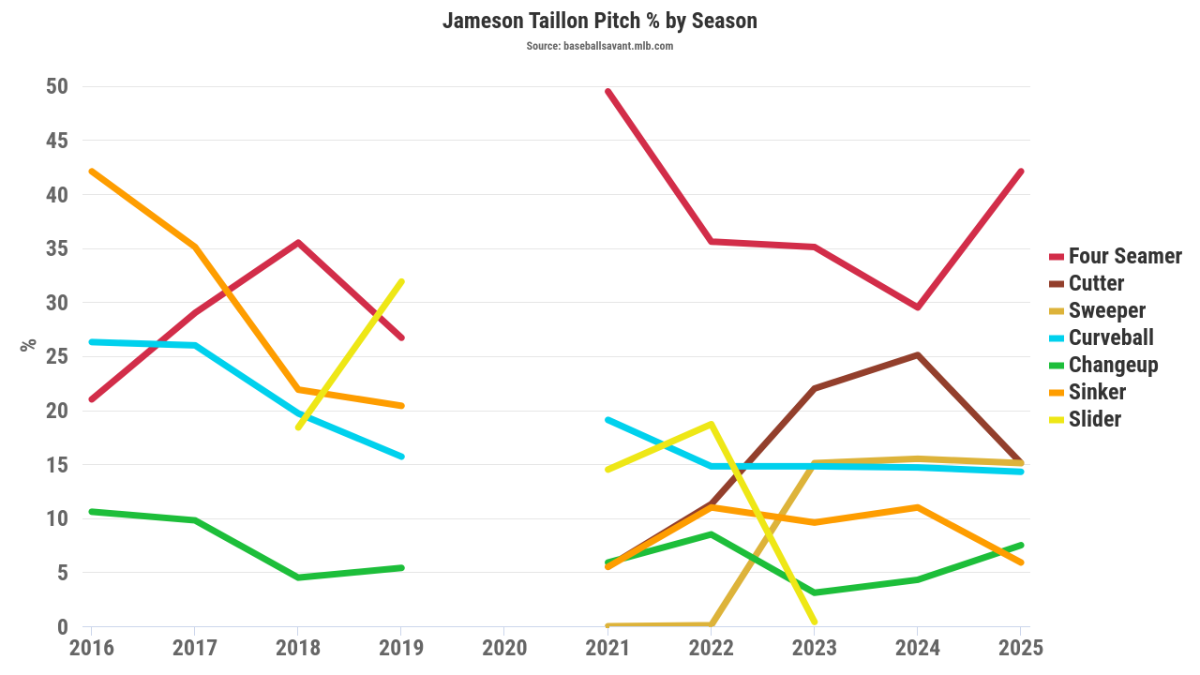
The pitch losing its place in his arsenal as he ramps up the four-seam usage is his cutter, which is welcome news. Though it's played a role as the pitch to induce weak contact and set up other things, the cutter is Taillon's worst pitch. Here's a breakdown of his arsenal this season, with the movement of his pitches charted on the right and the StuffPro distribution on the left. StuffPro, from Baseball Prospectus, rates each pitch a hurler throws based on its expected impact on run production. Zero is average, and a negative number is better, as it indicates that the pitch was less likely to result in runs. It's a pitch-modeling metric based not on results, but on the characteristics of the pitch: release point, arm angle, velocity, movement, and spin.

Taillon's reduction in cutter usage at the expense of the fastball has been a good thing, but a year ago, it wouldn't have been possible. Taillon's four-seamer wasn't good enough to bear the extra usage. This season, he's materially improved the utility of that four-seamer. Here are his StuffPro and PitchPro numbers (PItchPro is related to StuffPro, but also bakes in location) on the four-seamer for each year of his Cubs tenure, thus far.
- 2023: StuffPro: 0.3; PitchPro: 0.1
- 2024: StuffPro: 1.1; PitchPro: 0.5
- 2025: StuffPro: 0.5; PitchPro: -0.4
Again, the lower a number is, the better, so the best number here (by a fair margin) is the last one. On average, when Taillon throws 100 four-seamers this year, opponents are likely to score 0.4 fewer runs than against an average pitcher. A year ago, for every 100 he threw, expected offense went up by 0.5 runs.
But why has Taillon's fastball been so much better? As you can see, the answer has to do with both raw stuff and location. His heater is a half-tick faster than it was last year, and his extension on it is slightly better, but that's not the primary reason for the improvement. Rather, it's coming from changes to how the pitch is moving. He's getting more carry on the pitch—more induced vertical break—and more arnside run, at the same time.
Here's the thing: I'm not sure how that's happening, except because he seems to be altering his targets. If his mechanics are different, overall, it's only very, very slightly. He hasn't made a change in his arm angle, or his spin rate, or the direction of that spin. He hasn't moved on the rubber. Normally, when we see a significant change in fastball shape, it comes with a noticeable change in mechanics, spin axis, or release angles.
Instead, Taillon is throwing his heater in the lower half of the zone more often than he has in any season since the pandemic—and when he does so, there's a lot more run on his offerings.
| Season | Hi/Lo | Velocity | Spin Rate | Extension | Ind. Vert. Brk. | Horz. Brk. | Arm Angle |
| 2021 | High | 93.9 | 2418 | 6.69 | 17.9 | 3.2 | 43.9 |
| 2022 | High | 94.1 | 2370 | 6.62 | 17.8 | 5.6 | 42.5 |
| 2023 | High | 93.7 | 2329 | 6.73 | 16.9 | 7.6 | 42.9 |
| 2024 | High | 92.2 | 2280 | 6.68 | 16.2 | 6.7 | 44.1 |
| 2025 | High | 92.7 | 2313 | 6.77 | 18.2 | 7.8 | 44.1 |
| 2021 | Low | 93.9 | 2420 | 6.75 | 17.9 | 4 | 43.4 |
| 2022 | Low | 94.1 | 2373 | 6.65 | 17.7 | 6.1 | 42 |
| 2023 | Low | 93.6 | 2332 | 6.75 | 16.7 | 8 | 42.2 |
| 2024 | Low | 92.3 | 2288 | 6.73 | 16 | 7.1 | 43.6 |
| 2025 | Low | 92.5 | 2304 | 6.81 | 18.2 | 9 | 43.7 |
More low heaters will tend to mean fewer whiffs, and in the modern game, it can also make a pitcher vulnerable to power. With the extra horizontal movement, though, Taillon is fooling hitters enough to induce weak contact. They're still lifting the ball, but without the authority to make it hurt, most of the time. Meanwhile, throwing the fastball so much is giving him the ability to get in and out of counts quickly, working ahead and filling up the strike zone.
This is a slightly unsatisfying explanation. I would love to have a clearer sense of why Taillon's fastball is moving differently this year, and of why he gets so much more horizontal run when he works down in the zone. In the meantime, though, we can at least say that the root of his success at being both efficient and sturdy lies in eschewing the cutter and leaning on the heat. With better locations on a primary pitch he throws more often, Taillon is avoiding trouble and giving the Cubs what they so badly need from their veteran workhorse.





Recommended Comments
There are no comments to display.
Create an account or sign in to comment
You need to be a member in order to leave a comment
Create an account
Sign up for a new account in our community. It's easy!
Register a new accountSign in
Already have an account? Sign in here.
Sign In Now