


Cubs Video
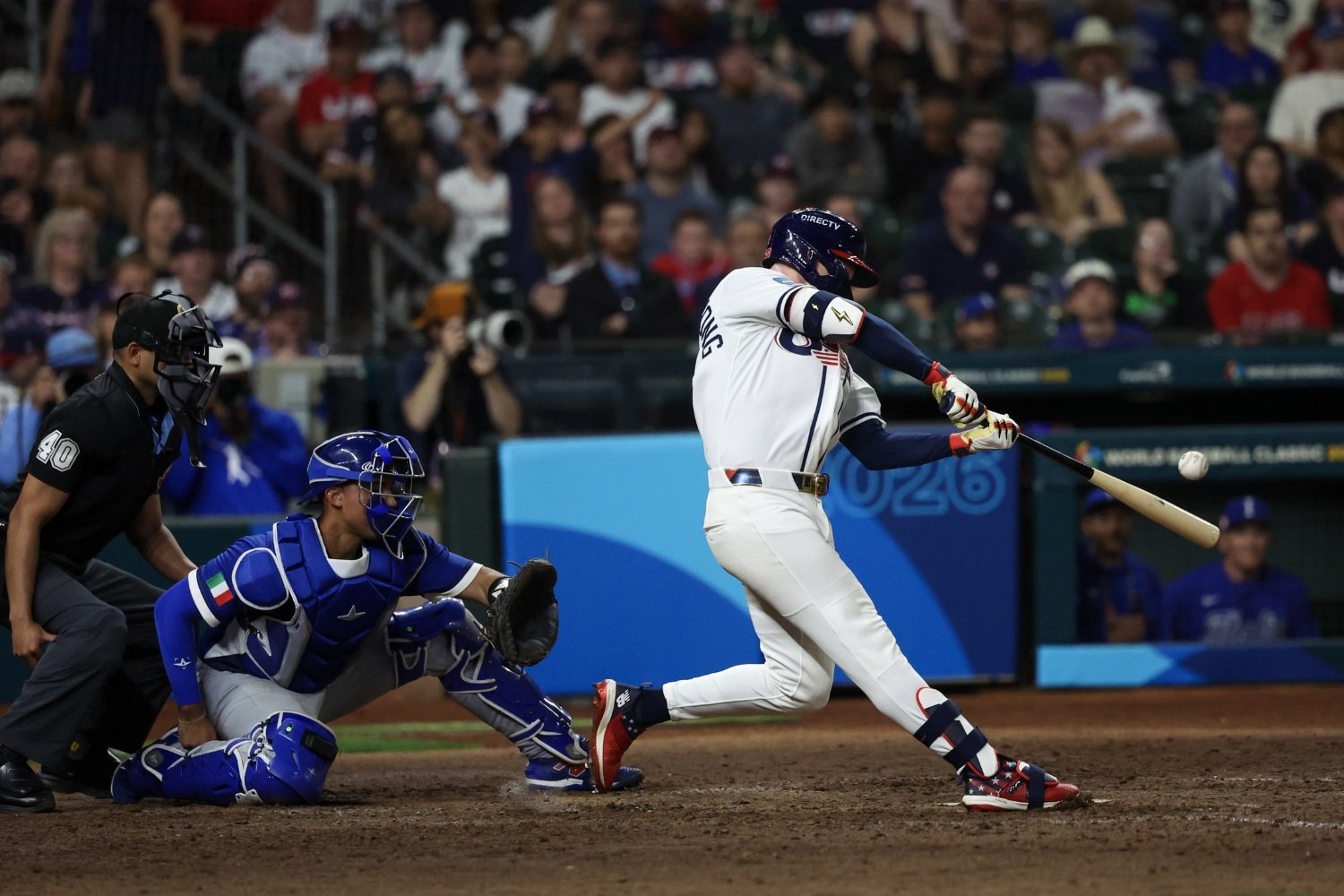
When you watch Pete Crow-Armstrong hit, 'optimized' isn't the first word that springs to mind. Because he swings at practically everything, the Cubs' young center fielder is forever displaying his warts. He often looks like a mess up there, because when we think about players who are exceptionally efficient at the plate, we think first about swing decisions. That's the internet's shared inheritance, having witnessed Moneyball and the change it wrought throughout professional baseball. Crow-Armstrong is an extremely aggressive hitter; his approach has plenty of rough edges.
Break down his actual swing, though, and you're forced to admit that there's a method beneath the madness. Far from flailing at the ball the way many free swingers do, Crow-Armstrong spent 2025 drawing a bead on the ball and attacking it in a very calculated way—without the restraint of a Juan Soto or a Kyle Schwarber, but very much with their level of lethal barrel accuracy and timing. Only six qualifying hitters pulled the ball in the air on a higher percentage of their batted balls than Crow-Armstrong did in 2025, and every name makes it a bit clearer how important that skill is:
- Isaac Paredes - 38.5%
- Cal Raleigh - 38.4%
- Spencer Torkelson - 31.8%
- Max Muncy - 31.5%
- Kyle Schwarber - 31.1%
- José Ramírez - 30.9%
- Pete Crow-Armstrong - 30.2%
Raleigh and Schwarber, of course, led their leagues in homers last season. Of these seven players, only Paredes and Muncy failed to crack 30 homers, and then only because each of them missed a substantial portion of the season. Though lithe and speedy, Crow-Armstrong's swing is as geared for power as the game's elite sluggers—and that was no accident.
Crow-Armstrong entered last season knowing he needed to tap into more of his power. He'll never be a Schwarberesque home-run hitter, because Schwarber is much stronger and has about two grades better raw power than Crow-Armstrong does. However, Crow-Armstrong knew that he could produce at least average pop, as measured by 90th-percentile exit velocity. That number is a better indicator of power than a player's average EV, and the league's median EV90 last year was 105.1 miles per hour. In a limited stint at Triple-A iowa in 2024, Crow-Armstrong had put up an EV90 of 105.7 MPH, but in an uneven year in the majors, that number was just 101.2. Worse, the percentage of his plate appearances that ended in a pulled fly ball was a robust 17.9% in the minors, but an unimposing 10.9% in the majors.
Thus, he came to camp in 2025 ready to attack the ball more ferociously, but also to lift it and maximize the damage done by the contact he made. Firstly, he developed a more spread-out stance, but didn't shorten his stride accordingly. Though starting deeper in the batter's box, he began catching the ball farther in front of his body, thanks to the aggressiveness of his lower half.
.png.cb122cad22659ac7f98aa71d9606ce72.png)
Although Crow-Armstrong's swing is steeper, slower and targeted differently than Juan Soto's, it's a bit instructive to compare the way he gets into his lower half to the way Soto does so. With his new stance and stride, Crow-Armstrong—like Soto—stretches the elastic aspects of the body and maximizes the torque he eventually produces. His swing speed increased by nearly 2 MPH in 2025, but it wasn't because of dedicated bat speed training. He just got much more aggressive, forcing his body into a position where it had to fire a harder swing.
Compare his 2024 (left) and 2025 (right) swings at three crucial moments, and you can see the differences. The wider base created more torque right from the beginning of his swing last year. That opened his front side sooner, which allowed (and, indeed, compelled) him to get around the ball more, even as he began to work up through the ball, rather than down into the hitting zone. By the time he made contact, his barrel was almost 4 inches farther in front of his frame, oriented more toward right-center field, and working more steeply uphill.
.png.117dd41a20905f1712c6138e4a21568a.png)
Swinging harder and catching it farther in front meant that Crow-Armstrong's EV90 jumped right back up to the league's average over his first full season in the majors in 2025, at 105.2 MPH. Obviously, though, his power played at much more than an average level. That's because a whopping 18.9% of his plate appearances ended in pulled fly balls. As the leaderboard above hinted, he'd optimized his swing. It unleashed a version of him with plus-plus overall power, including not just the 31 home runs but 72 total extra-base hits.
To visualize this another way, consider the distributions of Crow-Armstrong's batted balls by exit velocity for both 2024 and 2025. Here's the first of those years.

I've colored the chart by expected batting average, based on exit velocity and launch angle. As you can see (and would guess), the best results came when he hit the ball over 100 MPH, but he was more likely to hit it in the upper 70s. This is an interesting distribution—not unique, but unusual. Most players' histograms show something closer to a normal distribution. This one is a reminder that even as a rookie, Crow-Armstrong was prone to either click on a ball or miss fairly badly, leading to those mishit balls with 75-85 MPH exit velocities.
He had a similar distribution in 2025, but note the important differences.

Firstly, this is closer to a distribution curve with a hard rightward skew, rather than a bimodal distribution. Crow-Armstrong got better at missing by smaller margins. He also hit more balls hard, especially above 105 MPH. Just as importantly, though, look at the red glow of those tall bars where the plurality of his batted balls still fall. By pulling it and lifting it more often, he got a lot more mileage out of those balls on which he made middling contact, too. He found many more hits by hitting low fly balls and flared line drives at those exit velocities than he had by hitting them (mostly) on the ground in 2024. He also collected several RBIs on sacrifice flies by operating that way.

Crow-Armstrong has only average raw power, as even he knows. He has below-average feel for contact, and below-average plate discipline. By optimizing his swing path, though, he exploded into being a plus power threat with average hit-tool utility last year. If he can figure out how to better control the strike zone—a somewhat pie-in-the-sky hope, but one of which there was some evidence this spring—he can take a further step toward greatness. For now, though, his swing and his approach have turned him into a sufficiently dynamic offensive weapon to make him worth a long, nine-figure deal with the Cubs. Even amid his breakout, early last summer, his frankness and advanced understanding of his own game were gratifying. Now, that polish—in however unorthodox a form—has borne fruit for him. The Cubs are buying into the ongoing optimization of their elite outfield athlete. It's a big gamble, but one he's already shown them he can make worthwhile.
Do you approve of the job the Cubs front office is doing?

Follow North Side Baseball For Chicago Cubs News & Analysis



-
 1
1



Recommended Comments
There are no comments to display.
Create an account or sign in to comment
You need to be a member in order to leave a comment
Create an account
Sign up for a new account in our community. It's easy!
Register a new accountSign in
Already have an account? Sign in here.
Sign In Now