


.png.04ff7bb424f31a4fbe79a67ea6b5f416.png)
Cubs Video
A decade ago, we were living through the offseason between 2014 and 2015. Statcast data was not yet widely available, but it had been introduced. The system was implemented in select parks in the second half of 2014, and the league began to release (and attempt to contextualize) the incomplete but valuable data yielded by the new technology. At first, though, it took root only imperfectly. Many fans didn't fully understand the data, not because the numbers themselves were overly complicated, but because they couldn't place them in an easily comprehensible context. It's not enough to know that a batted ball was 106 miles per hour off the bat; we need to have a sense of whether or not that's good.
Since then, the evolution and expansion of Statcast data has taken us into more genuinely complex territory. Even once you have the rough scale of spin rate on each pitch type, you have to understand the nuances involved in order to evaluate players using that information. Does their spin axis maximize the utility of the pitch? What constitutes maximizing utility, in the first place? For a given pitcher, is reducing total spin somewhat in order to better manipulate the direction of that spin an option? Could a change in the pitcher's grip beget a valuable increase (or, for changeups and some sinkers, decrease) in spin rate? And what kind of grip do they have anyway? A given center fielder might be doing very well going back on the ball, but are the numbers overstating that because of the nature of their home park—dimensions, wall heights and angles, and so on? For that matter, is he only impressing the system so much because he's playing too shallow to begin with, forcing himself to race back on balls another outfielder might collect easily? Suddenly, we're on context overload. If we try to smooth or ignore any of that context, we lose the value of the numbers themselves.
Good, studious analysts can still extract great insights from the data to which we now enjoy access. In fact, they can bring the public better insights than ever. More is required of both the analyst and the reader, though, and new numbers are pouring forth for our consideration and education all the time. This year, the most momentous of those new data sets was swing speed.
Bat speed has been understood as the key to power hitting almost since the dawn of the game. In fact, it now seems radical only in its self-evidence, but it's only fair to note that many hitters once prized the ability to swing a heavier bat (more mass to apply force) almost as much as the ability to swing fast. To whatever extent they were ever right, though, the steady (then sharp) increase in velocity from pitchers throughout the league has rendered that notion obsolete. The name of the game, in terms of generating power but also to make consistent enough contact to be productive at all, is now bat speed. It's not the whole story, but it's an important piece.
Let's use the available bat-tracking data for one notable Cubs hitter to better grasp the whole concept, though, and to tease out both the context of the numbers and the key interactions at work. Ian Happ offers us a great way to study this, because as a switch-hitter, he offers two different sets of that data for us to study. Over several years, we've all seen Happ evolve and develop as a hitter, so we understand (more or less) who he is from each side of the plate. He's mostly been better from the left side, and there's a distinct stylistic difference: he's more patient as a lefty, more focused on lifting the ball. As a righty, he's often seemed to be fighting for his life. His career numbers from each side speak to that:
- vs. LHP (as RHB): .243/.316/.397, 28.5% K, 8.7% BB
- vs. RHP (as LHB): .249/.352/.469, 26.6% K, 13.1% BB
You might expect to see Happ generating much better bat speed from the left side, then. That's where he not only connects more often, but generates much more power. For his career, he averages a 90.7-MPH exit velocity from the left side and an 87.4-MPH mark from the right. You'd expect to see a big gap in his swing speeds, even, and in a predictable direction.

Welp.
I'm hiding the ball a hair, here, because we only have swing speed data for 2024, and I reported to you at the end of September that Happ had taken an almost reckless, hard-hacking right-handed approach this year. It led to a better isolated power figure than he's posted against lefties (in any meaningful sample) since his rookie campaign in 2017, and to a career-best seven right-handed homers. A year or two ago, we probably really would have seen Happ swinging faster as a lefty than as a righty. Still, it's remarkable to see him swinging faster right-handed, even this year.
As you can see by the tick marks at the bottom of the graphic above, both of Happ's swings are faster than the league's average one, so that's reassuring, in the first place. As we try to understand how he can swing faster but be considerably less powerful from the right side, though, we have to examine the other key variable measured by new bat-tracking data: how squarely you tend to make contact.
Baseball Savant offers a metric they called Squared Up%, which is the percentage of swings on which a hitter realizes at least 80% of the maximum possible exit velocity, given their swing speed and the speed of the incoming pitch. That's a deeply flawed way to measure the skill we really want to assess, though, because it gives each swing a binary rating: squared-up, or not. Instead, to avail ourselves of a graduated measurement of the ability to square the ball up (one that can distinguish partial successes from total ones and set outcomes on a spectrum, the same way we do with swing speed or exit velocity), we should try to use a version of Squared Up% that rates each batted ball's squareness—that gives us that percentage of the optimal exit velocity achieved on every swing, rather than using a brightline test on each.
Happily, Pitcher List analyst Kyle Bland created an app that does just that. When we examine the distribution of Squared Up% for all of Happ's swings from each side, we can learn some things. First, here is left-handed Happ.
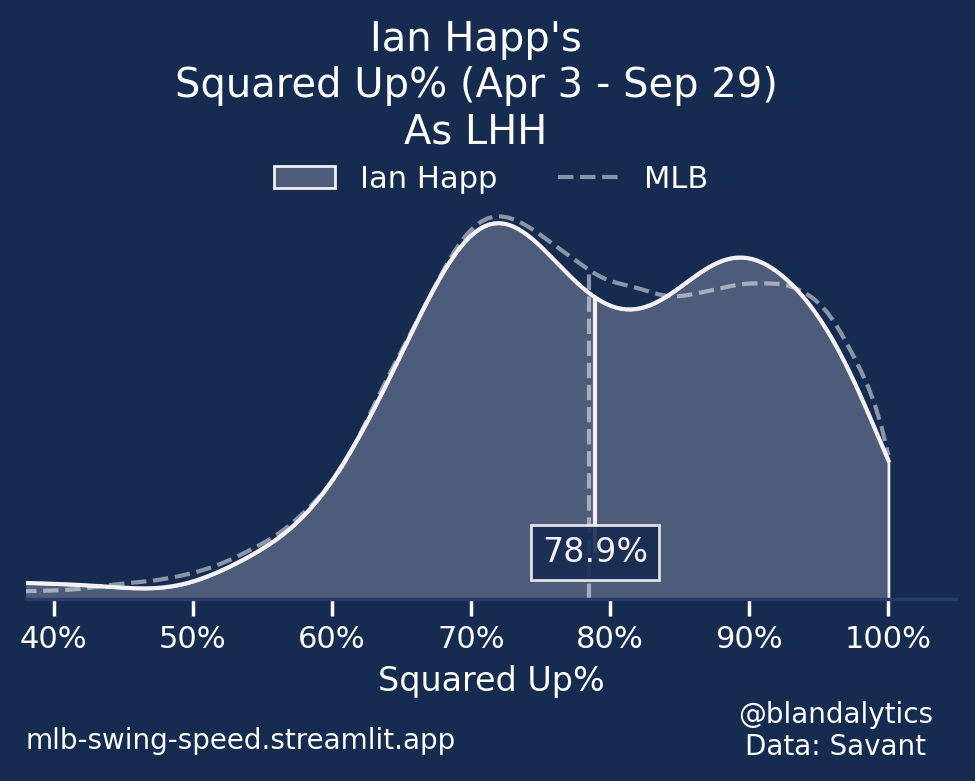
As you can see, Happ's Suqared Up% from the left side maps neatly to the league's average distribution. We should note, and take a moment to synthesize, the fact that that average distribution is somewhat bimodal—in other words, that it has two humps, two points where outcomes tend to cluster most. This is why Savant made the choice (although it's still one I dislike) to give Squared Up% as a simple test: it's meant to ask whether a given instance of contact comes from that bigger hump on the left (lower-quality contact) or the flatter one on the right (balls hit right on the barrel). From this, we can learn something broader about baseball at the highest level: that most swings do result in either a barreled ball or one that's mishit, with a surprisingly large share of the ones mishit falling into a similar bucket in terms of exit velocity efficiency.
Pair a slightly above-average swing speed with this slightly better-than-average Squared Up% profile, and you can see why Happ generates such good power from the left side. He crushes the ball because he can swing fast without sacrificing what the Cubs have long called "barrel accuracy". Here's his right-handed profile.
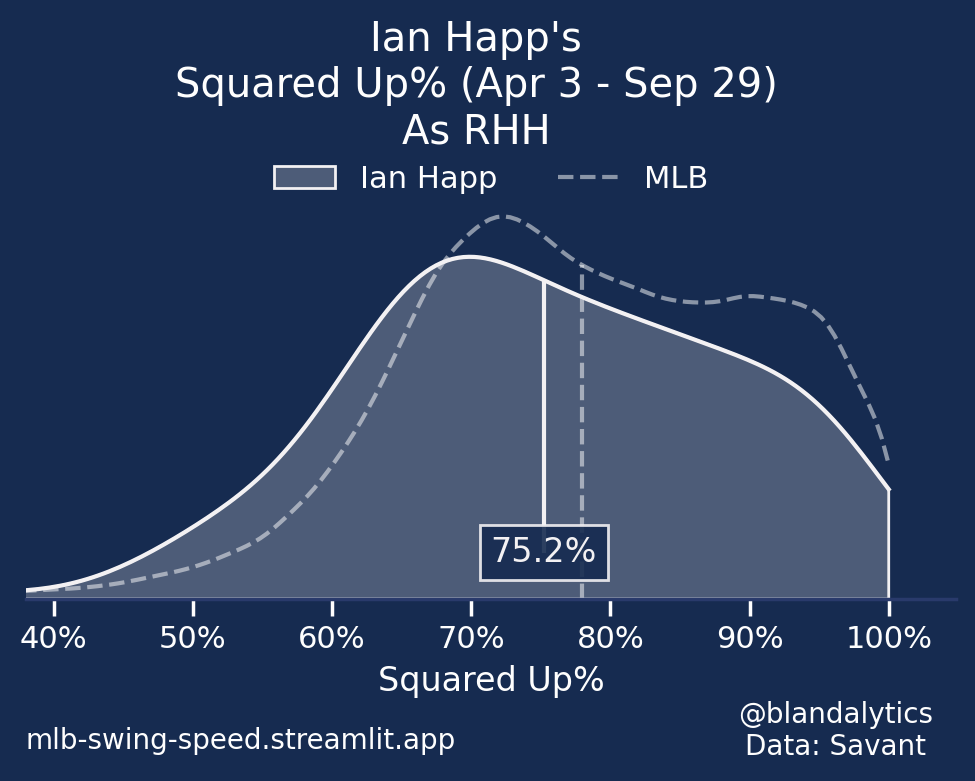
Aha! This explains just about everything. Happ swings faster right-handed, but he really gives up the ability to consistently meet the ball on the barrel by doing so. Fast swings make up for some of the inaccuracy. There were 423 batters who swung at least 200 times against left-handed pitchers in 2024. Happ ranked 361st in the percentage of those that passed Savant's Squared Up%, but because he ranked 126th in the percentage of his swings that were over 75 miles per hour, he still generated a good amount of hard contact against southpaws. It wasn't efficiently generated, but efficiency is not the goal. Hard contact is. Happ's improved results from the right side this year came from having an inefficient, ugly attack—but a dangerous one. By contrast, his left-handed approach blended slightly less raw violence and danger with a much more graceful and efficient address of the ball.
There's another frontier lurking in this arena. Eventually, we'll get publicly available attack angle data for all swings, which will further inform this kind of analysis. That can be thought of as the third dimension, the third variable in this equation. It's already reflected by the Bland version of Squared Up%, though, if only implicitly. For now, we have enough depth of information to do some solid analysis of a player vital to the Cubs' 2025 hopes—and he helps elucidate the different ways we benefit from unfolding this data set to look at it from new angles.






Recommended Comments
Create an account or sign in to comment
You need to be a member in order to leave a comment
Create an account
Sign up for a new account in our community. It's easy!
Register a new accountSign in
Already have an account? Sign in here.
Sign In Now