


Cubs Video
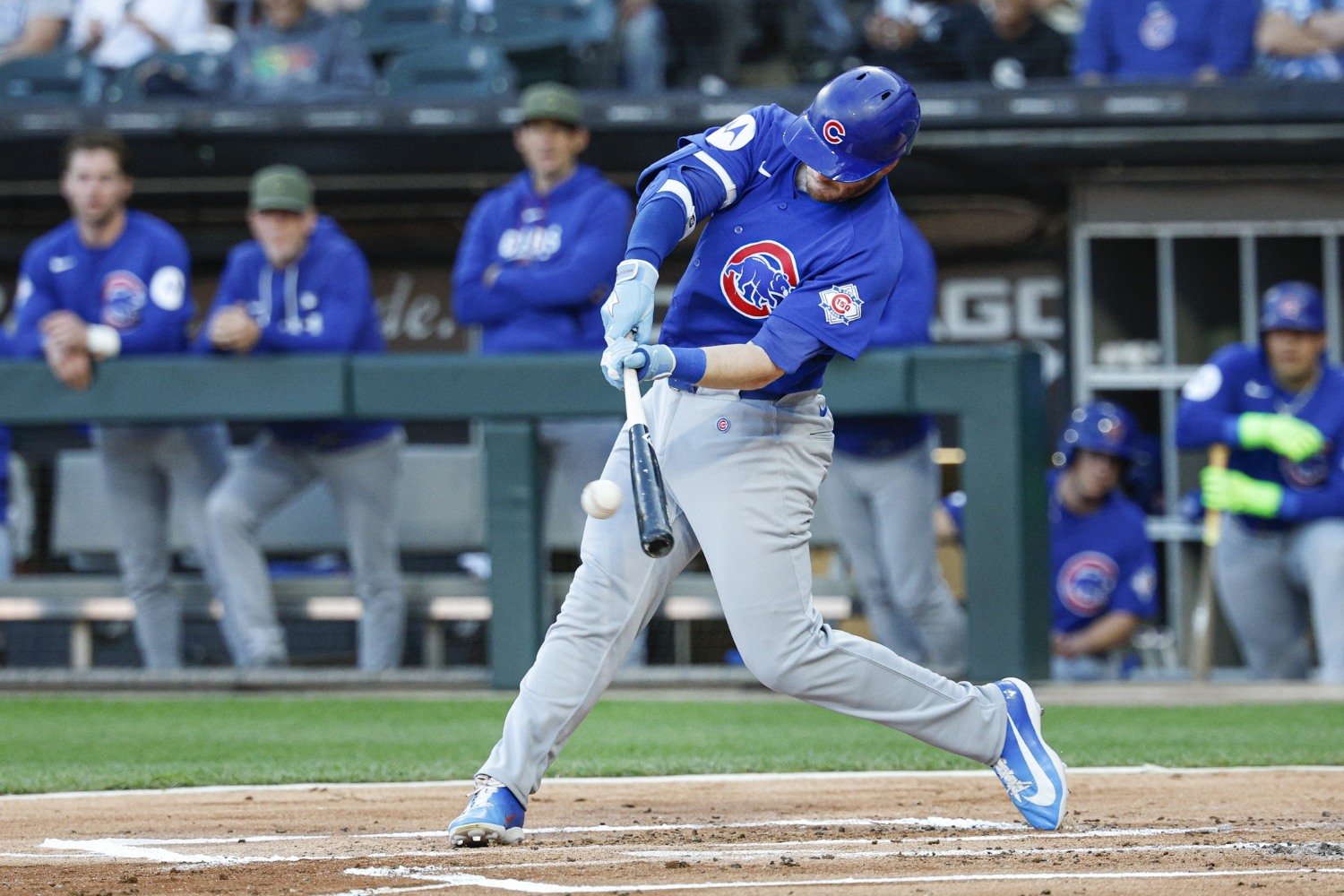
Ian Happ is off to a strange start in 2026. There's more power than we've come to expect, and even more strikeouts. In fact, there's something about this iteration of Happ that looks similar to one we might have seen in 2017 or 2018. Whether or not that's a good thing for the Chicago Cubs, however, is certainly up for debate.
When Happ was a rookie in 2017, he struck out more than 30 percent of the time, with a walk rate that just barely scratched above 9%. He followed that up with an even higher strikeout figure (36.1%) in 2018. The difference was that he was able to drive up the walk rate to what, up until this season, had served as a career-high (15.2%). There was also one other notable element that fluctuated between the two seasons: the power.
In his rookie year, Happ hit 24 home runs. He's since exceeded that number twice, with 25-homer campaigns in 2021 and 2024. But permeating throughout all of those strikeouts, all of those walks, and all of those home runs in 2017 was regular impact contact. He posted a .261 isolated power that he's never come close to replicating over a full season. The next season, his ISO fell to .176. He was able to reach .209 in 2021, but has otherwise sat between a .169 and .199 ISO in the years following that rookie outburst.
More recent years have seen Happ settle into a base where his patience is the pillar. He's exceeded the 20-homer threshold a handful of times, but that ISO has never climbed back to the second-year heights he reached. Instead, he's relied on his discipline. From 2021 to 2025, Happ's 45.3% swing rate ranked 102nd out of 360 qualifying position players. His 27.0% chase rate sat 67th. Each of those elements contributed to a walk rate that came in 23rd out of that whole group (12.1%). He was a remarkably consistent, if unspectacular, player over that stretch.
Happ's line in those five seasons read .247/.343/.433, for a 117 wRC+. His strikeout rate came in at 24.4%, alongside that notable walk rate. His ISO read .187. It's an output that seems wholly appropriate for a player who has been steady more than he's been a star. However, something different is happening in 2026.
His early 2026 line reads .228/.368/.455. In general, that wouldn't seem to represent a stark departure for what we've come to expect from him. However, a number of other areas on the stat sheet have spiked. His walk rate has climbed to over 17%, with a .228 ISO. The former would be the best rate of his career; the latter checks in as the best outside of that 2018 season. His wRC+, at 134, would also sit atop his career outputs. So we have a player who has lingered on the edge of being a "three-true-outcomes" guy diving even further into those waters.
It's not obvious how Happ's doing it. Sometimes, you see a player trying to tap into more power by selling out for it. That might mean an increased swing rate or a harder swing. Happ is doing neither. His 40.9% swing rate is actually the lowest of his career, by a decent margin. His bat speed hasn't changed in any discernible fashion from either side, coming in slightly slower as a left-handed swinger and slightly faster as a righty. Neither has changed in a way that would speak to such a drastic jump in power.
What Happ is doing is taking more chances. His overall swing rate has dropped by about three percentage points from last year, but the chase rate has also risen by about that much. He's making less contact overall, by a significant margin, but he's also making more impactful contact. Happ's barrel rate (17.5% of his balls in play) is not only in the 95th percentile, but sits well above any previous rate he's posted. There isn't any major mechanical shift happening here. It's in Happ making active choices to seek damage.
That type of philosophical shift does have to show up in your body at some point. Rather than being in the swing itself, though, it appears to be in his setup, from the right side. From the left side, he's always had power. His career ISO against right-handed pitchers is .217. It's a bit exaggerated this year, but only a bit. The big difference has come as a righty, where he made over his game and became much more of a contact-oriented, ground-ball guy in 2023 and 2024, but started to find his power again in 2025. This year, he already has three homers from the right side, and his ISO is .212, against a career mark of .154. To get to that pop, he's opened his stance over the last two seasons. Here, from left to right, are pitches Happ saw against lefties in 2024, 2025, and last month.
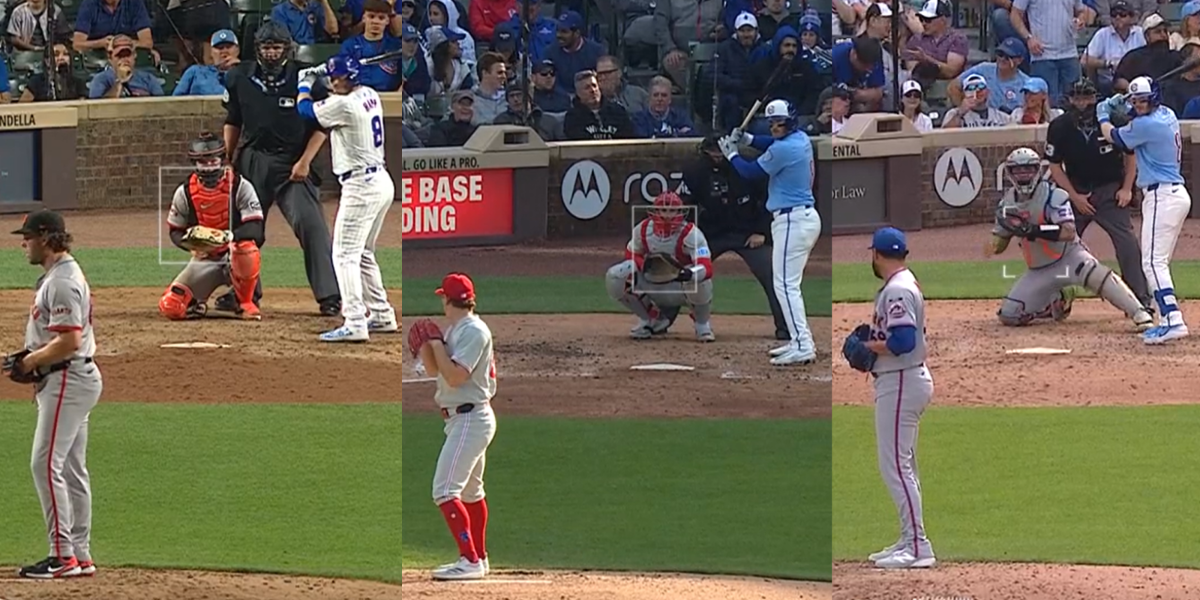
Why does this matter? After all, as hitting coaches love to remark, great hitters all get to fairly similar points by the time they make contact. Here's why: All swings have a certain natural directionality and timing. Barring a full-fledged swing overhaul, hitters will generally find their best contact in the same range and (therefore) with their bat in the same positions and on the same trajectories. One way to tweak that is the stance.
We don't yet have Statcast visualizations of Happ's swing for 2026, because switch-hitting keeps his sample smaller than for batters who only hit from one side. But here, side-by-side, are the moments when his barrel first enters the back of the hitting zone by crossing the back tip of home plate, for 2024 and 2025.
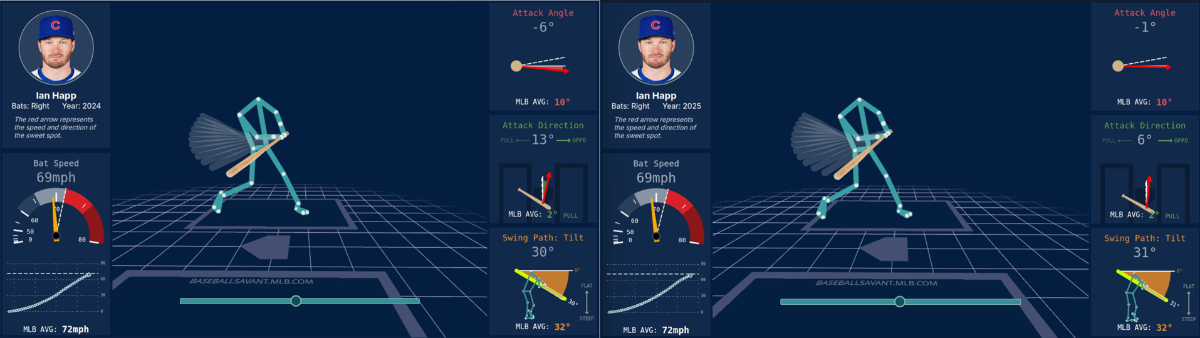
In 2024, his stance was 8° closed from the right side. Last season, it was neutral (0°). Look at the difference that made in where his bat is in its (otherwise little-changed) path when he gets to that same early juncture in the swing. Notice, too, that his front hip is a bit more open in the image on the right, without his hands being materially farther in front of his body or his front shoulder leaking out. He slightly reoriented a swing with which he'd begun to find success (but only on the ground), and unlocked something more. This year, a further tweak in the same direction has exaggerated that—with some costs, as the strategy approaches an extreme, but also with big benefits. Happ's attack angle (the upward angle of the barrel at the instant of contact) was 5° in 2024; it's now 10°. His attack direction (the horizontal angle of the barrel at that same moment) was 3° toward his pull side two years ago; it's now 7°.
Happ has a good command of the strike zone. One could make the argument that he's spent the last handful of years being too patient. This year, he's deploying that patience toward attempting to create power for himself, especially from the right side. It hasn't come at the expense of his ability to draw a walk, just in his ability to make contact as consistently. Are the Cubs better for it, though?
There's an argument to be made that they are.
Under Craig Counsell, the Cubs have been a team that operates with efficiency at the plate. They're approach-oriented, with slower swings that generate quality contact via the barrel more than aggressive ones that maximize power potential. The issue with that ideology is that it doesn't always beget consistent offense. The walks are always there, but the actual output occasionally suffers as players enter periods of bad timing, bad luck, or a temporary deviation from their typical approach. Happ, in his current form, appears to be a benefit for the Cubs, in that he's still generating the on-base presence via the walk but is also creating more in a way that we don't always see from him—or anyone in the lineup.
If the Cubs were a bad team in the OBP department, perhaps one could argue that Happ needs to retreat back into his typical modus operandi. Given their collective ability to do that, though, there's a real case that Happ taking more chances is something that can benefit the Cubs.





Recommended Comments
Create an account or sign in to comment
You need to be a member in order to leave a comment
Create an account
Sign up for a new account in our community. It's easy!
Register a new accountSign in
Already have an account? Sign in here.
Sign In Now