


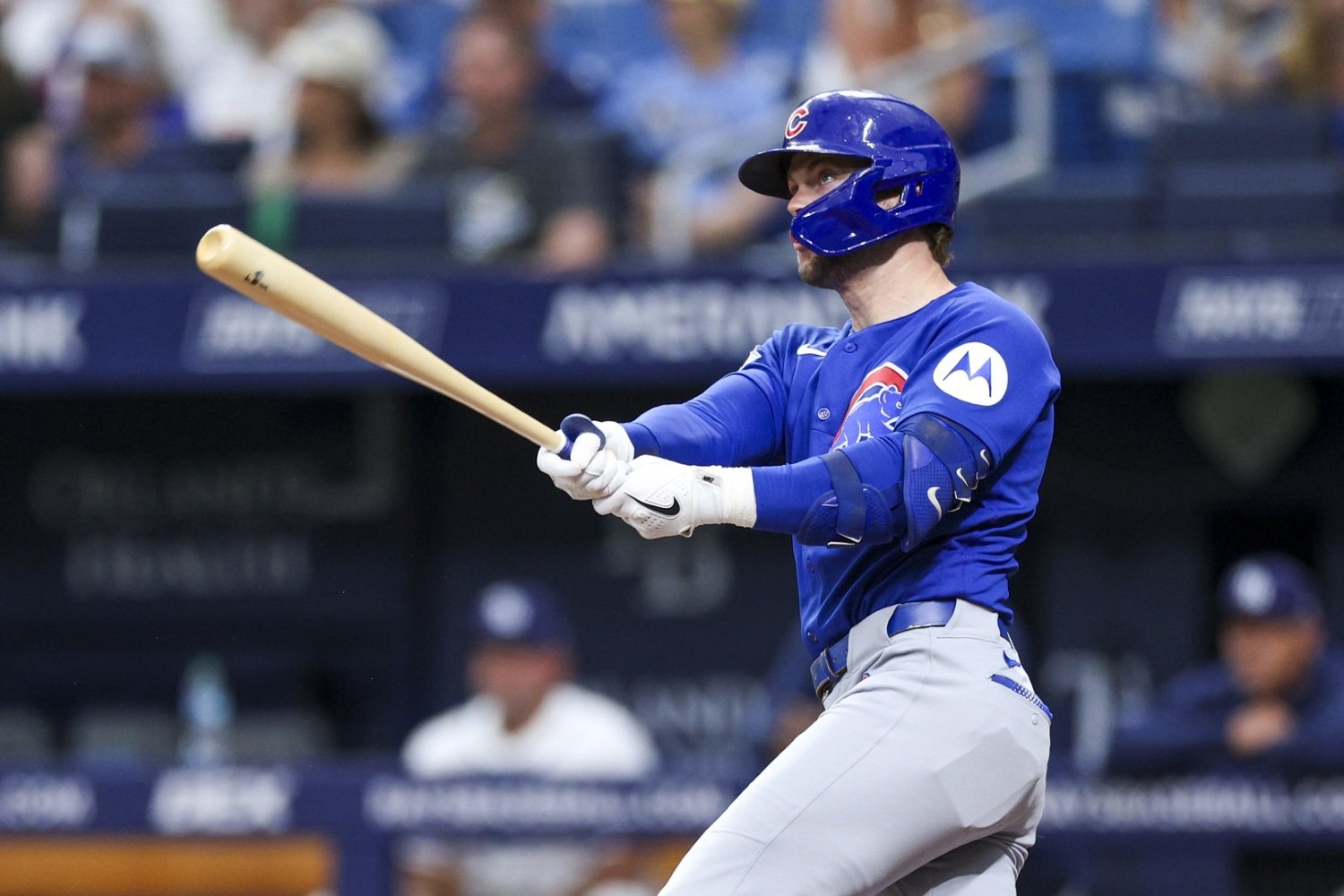
Cubs Video
Back in May 2024, I wrote about Nico Hoerner's potential (or, as I myopically believed back then, lack thereof) to hit more doubles. The issues I noted at the time are still real and salient: that hitting the ball to center and right field, while good for a batter trying to maintain a high contact rate and make good swing decisions, tends to come with limits on sheer exit velocity; and that defenses have gotten better at taking away extra-base hits on balls directed toward the gaps.
Here's a chart from that article that's worth reproducing. It shows the league-wide trends in outcomes on line drives hit to the gaps from 2016-24. Without updating the visual itself, let me assure you: the trends have continued apace.

Hoerner hasn't tapped into some new source of raw power. He has, however, slowly developed a bit more practical power. Without generating more extra-base hits (he had 37 in 2022, 40 in 2023, 43 in 2024 and 40 in 2025), he's maintained his rate of compiling those and increased the rate at which he hits singles. I chronicled the changes to his batted-ball profile that facilitated that increase last fall. In short, he figured out how to start pulling the ball on a line, and while that didn't lead to a sudden surge in isolated power, it augmented his slugging average, because it buoyed his batting average and the slugging rose with it.
This year, he's made a further, subtle change that might just allow him to hit for (a little) more extra-base power without sacrificing his elite contact rate or singles rate. It looks like this.
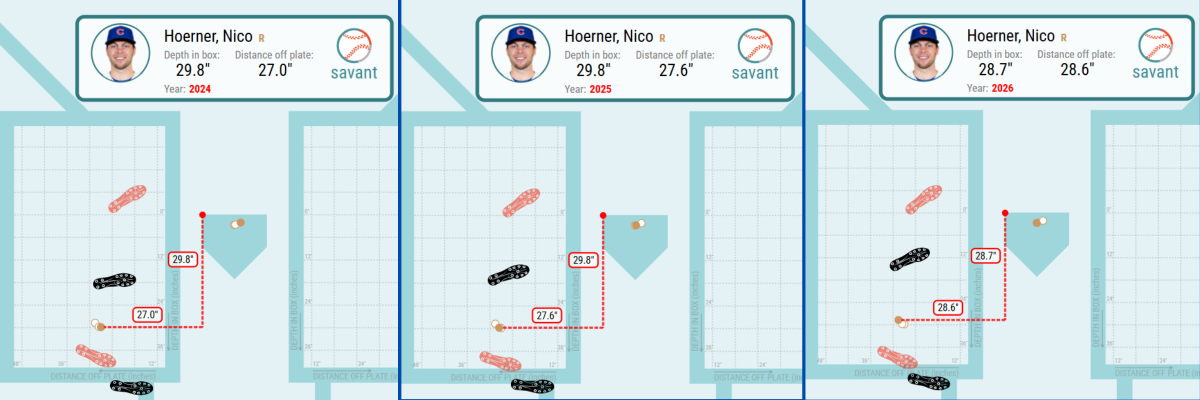
Hoerner has moved slightly off the plate this year. He's also widened his stance slightly. According to Statcast measurements, the distance between his feet in his stance is up to 32.8 inches in 2026, from 28.9 inches in 2025 and 26.7 inches in 2024. That means a shorter stride to what is an almost identical ending position. These numbers are my estimates, because Statcast doesn't report them officially, but Hoerner's stride (the distance his front foot moves from his initial stance to its position at contact) is down from 24.2 inches in 2024 and 19.2 inches last year to 15.5 inches.
A wider stance and shorter stride allow Hoerner to stay slightly more upright, and to flatten his swing more easily when needed. His swing speed is actually down this year, but he's creating more sharp contact down the lines. It comes from this change, because this change lets him hit with a stronger base, so he can let the ball travel or go get it as pitch type and location dictate.
The adjustment that changed everything for Hoerner last year was to catch the ball out front a bit more often. He's always capable of letting it travel deep into the hitting zone, which means contacting the ball when his swing is still leveling out or just beginning to rise. In 2024, 38.0% of his swings had an attack angle of 2° or less, and just 27.8% of them had an attack angle of 10° or more. Last year, he shifted those numbers to 34.6% and 33.9%, respectively, which led to all those line-drive singles to left field—and began to open things up for him to hit more doubles.
He's doing that same thing this year, with one new wrinkle. While his distribution of attack angles is the same as it was in 2025, the results on the balls he hits at very low attack angles have improved dramatically. Already, he's poked four doubles down the right-field line this year, but 'poked' is perhaps the wrong word. More of his opposite-field contact this year looks like this:
From the center-field camera, that looks a lot like the quintessential Hoerner swing, and again, he's not generating better bat speed or anything. However, he's hitting the ball much better when it gets deep on him, because that wider stance and shorter stride mean earlier stability and greater strength in the back half of his hitting zone.
For as long as I can remember, old-school baseball people have repeated the maxim that a good hitter uses the big part of the field to find hits. Maybe so, but to find extra-base hits, a hitter like Hoerner needs to use the small parts. He hit a home run Wednesday night in Tampa on a hanging breaking ball by Joe Boyle. It was a pitch on which he could flatten out and get his arms extended more than in the past, because of his slight stance and stride alteration, but it was also a rare feat. He hit it out on a swing at just 67.8 miles per hour. Since the start of 2025, only 141 home runs have been hit on swings slower than 68 MPH, and only 20 batters have hit more than one such dinger. Hoerner hadn't done it in that span, until Wednesday. The guys who do it even semi-regularly—Wilmer Flores led the way with six of them last year; Isaac Paredes is tied for second—do it by pulling the ball a ton. Hoerner won't and shouldn't lean all the way into that kind of approach, but he does need to be able to shoot the corners for extra-base hits—be they those doubles to right or the occasional homer to left.
Changing the way he sets up in the box has helped him move closer to that goal. There will be more adjustments, of course, as the league tries new ways to pitch to this new version of Hoerner, but for now, he's enjoying the fruits of a cleverly improved style of hitting.





Recommended Comments
There are no comments to display.
Create an account or sign in to comment
You need to be a member in order to leave a comment
Create an account
Sign up for a new account in our community. It's easy!
Register a new accountSign in
Already have an account? Sign in here.
Sign In Now