


Cubs Video
The good news is that, unlike almost anyone else in the sport, Alex Bregman can tell his Cubs teammates firsthand what it's like when a team comes back from a 1-0 deficit to win the best-of-three Wild Card Series. Entering Wednesday, that's only happened once, and Bregman was there. Unfortunately, it was last year, when the Yankees stormed back to take two straight games from Bregman's Red Sox and survive the Wild Card Series, with all the games played at Yankee Stadium.
This situation isn't analogous to that one—at least, not in any way that flatters the Cubs. The 2025 Yankees were pretty clearly better than the Red Sox team they were hosting, with a five-game edge in both actual and Pythagorean record (an estimate of how many games each club should have won, based on their raw numbers of runs scored and allowed). They had home-field advantage, and they had a deep, hard-throwing pitching staff. They still barely eked out a win in Game 2, but once they did so, they were in great shape for Game 3.
In one reading, though, the Cubs are just built in the opposite way. They had the best offense in baseball this season, by runs scored, so why isn't it possible that they'll bounce back from an 8-0 demolition at the hands of the Padres and win a slugfest or two, to make it out of San Diego alive? That's a rhetorical question, of course. It is possible. It just doesn't feel like it, after Game 1.
It's becoming clear what a costly fumble the team committed by losing home-field advantage in this series amid a disappointing September. The Padres lit Petco Park like a powder keg in the postseason opener, and Chicago never recovered. Matthew Boyd's plan wasn't as bad as it looked; he just didn't make good enough pitches to beat a Padres team that had his number. Boyd likes to start his very slow changeup on the plate and let it fade away from righties, but the Padres were sitting on that pitch. If the pitch is well-located, that's not a problem, really. It doesn't earn a whiff, but it's likely to induce weak contact—something off the end of the bat, for a ground ball or a harmless fly. Boyd, though, made five mistakes with the change to righties, leaving it on the outer half but not far enough from the batter, and not low enough. Three of those mistakes went over the wall, accounting for three of the Padres' four early runs.

If he'd been perfect otherwise, and if Craig Counsell hadn't nervously pulled him in favor of a bullpen that had no more answers, it still wouldn't have mattered. Tuesday was a night when the Cubs made many mistakes, from filling out the lineup card (leaving out Michael Conforto, who matched up better against Padres starter Michael King than anyone else on the roster) to not moving runners (Ian Happ) or making plays (Pete Crow-Armstrong, Carson Kelly) when they had rare chances to do so. It's not clear, though, that any of those mistakes really mattered. They were simply overmatched.
King was on his game, and when he's on his game, he's on a level neither Boyd nor any other Cubs starter can match. His fastball was up from its usual 94 miles per hour to almost 96, and he had the ability to stretch the zone both horizontally and vertically. On a night when the Padres didn't even use their highest-octane, highest-leverage relievers, they still dominated Cubs batters with stuff Cubs pitchers couldn't match, and that not even Crow-Armstrong could hit.
There were 46 pitches with an induced vertical break (rising action) of at least 15 inches; the Padres threw 31 of them. There were 37 pitches thrown with at least 17 inches (one home plate's worth) of horizontal break; the Padres threw 22 of them. There were 52 pitches that came in at 95 MPH or faster; the Padres threw 32 of them. King dominated. Even if Conforto had been in the lineup, or if Happ had gotten a runner over when he had a chance in the second inning, not much would have changed; it was just someone else's night.
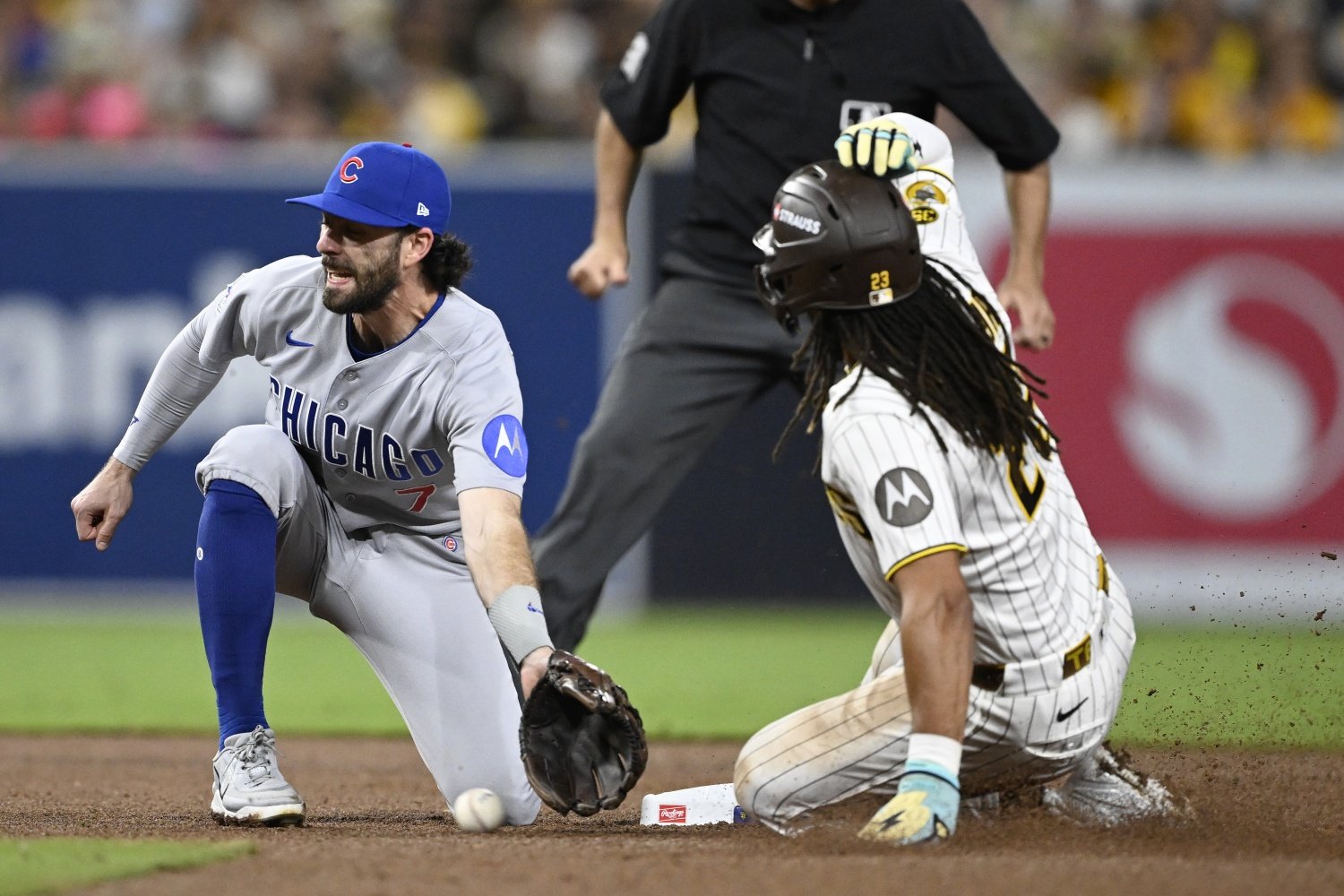
It didn't have to look as bad as it did. The Cubs kept giving up runs by getting sloppy, with free bases galore and a two-base error on a Fernando Tatis Jr. stolen base. The Padres were a better team, though, and they had a good game.
Now, the Cubs will try to remember that they, too, can be that good a team, and try to have that good a game. Kevin Gausman gets the ball, but he probably won't pitch much deeper than Boyd did, even if he's effective. With the season on the line, Counsell will be proactive, and he won't go back to the likes of Javier Assad and Aaron Civale. Daniel Palencia, Ryan Zeferjahn and another member of the starting staff (like David Peterson) will almost surely make appearances.
The truth is that the Cubs looked overmatched, and might actually be so. They can't throw as hard as the Padres, and throwing hard is more important than ever. They score runs mostly when Crow-Armstrong and Bregman produce them; the bottom half of the batting order has been weak for about two months now. Their vaunted defense cracked under pressure from their hosts. But, despite the grim history, a series this short can still flip in a hurry. There's time, yet, for Chicago to show the balance and dynamism that defined them at their best.
It's a good thing every game only counts as one. Tuesday night felt like two or three different losses rolled into one. The Cubs aren't dead yet. They just have to play much better Wednesday night.





Recommended Comments
Create an account or sign in to comment
You need to be a member in order to leave a comment
Create an account
Sign up for a new account in our community. It's easy!
Register a new accountSign in
Already have an account? Sign in here.
Sign In Now