


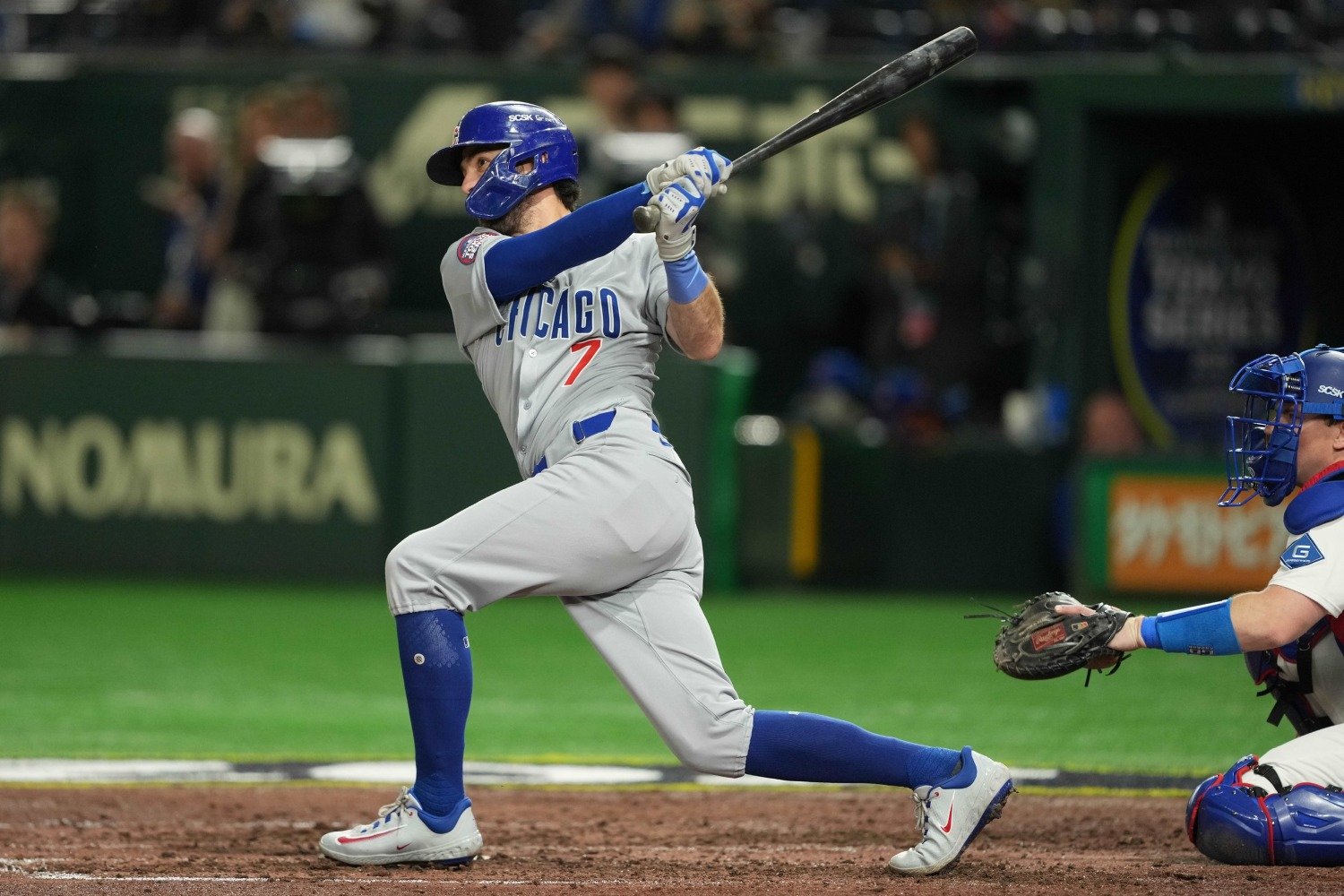
Cubs Video
Dansby Swanson has been smart enough not to let pride prevent him from getting the treatment and rest he needs to maximize his value to the Cubs, even over the first two years of a huge seven-year contract that brings considerable pressure with it. He hadn't spent any time on the injured list since 2019 when he finally landed there in July 2023, with a heel contusion. Last May, a knee sprain sidelined Swanson again, though each time, he was only out for about two weeks. He always wants to be on the field, and when he can't be, he works hard until he's able to come back.
Even for the balance of 2024, though, Swanson was not actually healthy. The stint on the injured list clearly did him some good, because he batted an anemic .209/.285/.341 before that break and a more tenable .252/.321/.405 after it. but there were times when it was evident that he still wasn't swinging or playing the field at full strength. Over the offseason, he underwent surgery to repair a sports hernia—an increasingly common injury in hitters, and one the public often misunderstands because of its name. Essentially, what Swanson was dealing with was a series of torn tissues in his lower abdomen and groin. "Sports hernia" is a catch-all term, because it's often hard to tell exactly what has been damaged—layers of the abdomen wall, muscles, tendons, ligaments, or some mixture thereof—until a surgeon goes in to fix the problem. Unlike other soft-tissue injuries (strained hamstrings, groins, or obliques, for instance), sports herniae tend to require surgery, both because non-muscular tissues are often involved and because that area is tough to target with the same kinds of therapy and non-surgical treatment that work in other places.
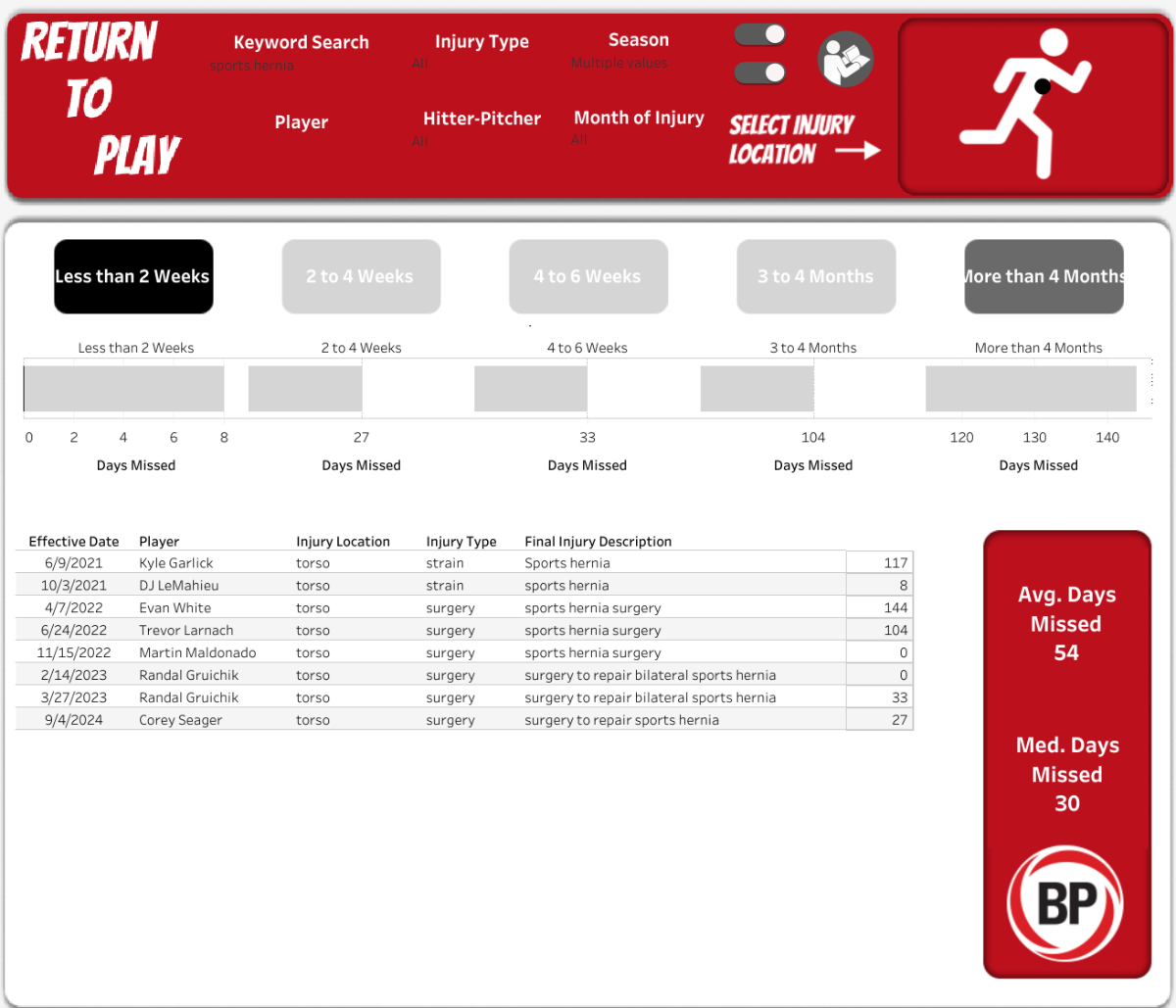
The reason why this injury is becoming pervasive—only two players missed time with it from 2016 to 2019, according to Baseball Prospectus's Recovery Dashboard tool, but seven have done so since 2021, and that number doesn't even include Swanson—is obvious, but rarely discussed: playing baseball requires more explosion, more torque, and much more sheer, shearing athletic force than most players get credit for producing.
Fans tend to be much less understanding of baseball injuries than of those that happen to NBA and NFL stars. Big collisions like the ones that inflict so much damage on football players are vanishingly rare in baseball, and the sport has far less full-speed changing of direction or sudden leaping than basketball. It looks less athletic, to the casual fan, than the other major American team sports—or at least much less dangerous.
Your eyes are lying to you, now more than ever. The game has never been played faster, or by bigger, stronger men. While baseball has always celebrated its embrace of all body types, all that really means is that both very tall and very short people can play it, and that the occasional, highly-skilled fatso can skate by for a moment. Walk through a big-league clubhouse, and one thing becomes immediately clear: even the small guys aren't small. They're short, maybe, but broad backs, thick forearms and sculpted physiques are as common there as in a basketball locker room. In fact, since basketball is more about sheer length, many baseball players are much more compact, explosive raw athletes than their ectomorphic counterparts on the hardwood.
Baseball's biggest athletic demands just look a bit less dramatic, to the naked and untrained eye. By now, no one paying any attention is blind to the dangers of throwing very hard, especially as part of a downhill motion, with gravity applying extra momentum and pressure to everything. Dr. Neal El Attrache has a really, really nice house because throwing is as bad for your arm as blocking is for your brain. It's much easier for fans to miss the sport's other vicious moves, though.
Swinging a bat at the speed required to hit modern pitching pushes the human frame past red lines as reliably as generating competitive big-league velocity does for those pitchers. An exceptionally well-conditioned and coordinated athlete can mostly avoid catastrophic injury, but there are several places in the kinetic chain where any inefficiency (and even phenomenal ballplayers are at least fractionally inefficient, especially when hitting, because hitting requires subliminal, instantaneous reactions and adjustments that can't be perfectly planned, choreographed and repeated) can cause structural failure.
It's not just sports herniae that are becoming more frequent. Hitters are suffering more oblique strains, too. Cubs fans know this all too well, having seen that injury take chunks out of Seiya Suzuki's last two seasons. A fistful of hitters have broken hamates or other bones in their hands over the last five years, not when they were hit by pitches, but from the force of their swing and its follow-through. How you swing can affect which of these injuries you're susceptible to, but it's hard not to expose yourself to the risk of at least one of them, over a long career. You have to create a torrent of force, put into and then drawn from the ground and passed up through your connective tissues, then redirected and applied to the ball by a tornadic rotation of the whole body. Triston Casas of the Red Sox said last year that doctors told him the force of his swing was so great that he was putting his own torso through a "car crash" worth of strain each day; it resulted in cracked cartilage in his ribcage.
Last year, while playing with torn somethings in the very region where Swanson's particular swing is geared to find and transfer its rotational force, he was clearly compromised. To see it in action, let's compare two swings, each on sliders from left-handed pitchers; each breaking in on him, but with enough of the plate to be hittable; and each when he was behind in the count. The camera angles are even fairly similar, so we have a fighting chance of seeing things that are real and not just hallucinations created by altered perspectives. The first is from last Sept. 24:
The second is from Wednesday.
Notice that on the one from last year, Swanson's front hip opens a hair earlier, relative to the landing of his front foot. The rotation that creates his bat speed is earlier, slower, and less explosive. He transfers his weight less aggressively from his back foot to the front one, unwilling to compromise his balance at all. On the second, he's very fast and powerful about pushing off his back side once the front foot comes down, and his hip and shoulder rotations are separated more, creating more tension and more torque. He lets his barrel stay behind his hands a hair longer, but that's just a product of the other movements in his swing—and it means that when his bat does whip through the zone, it does so much faster.
Swanson's swing speed on that pitch last September was 69.2 mph. On the one on which he doubled Wednesday, it was 71.9 mph, and that was in a two-strike count—when nearly all hitters, Swanson included, tend to reduce their swing speed slightly to have a better chance to make contact. He was incapable of the kind of explosion he showed on his RBI double Wednesday for much of 2024. Indeed, he only had nine batted balls that topped the exit velocity on that ball Wednesday (106.4 mph) in the second half.
Hopefully. that's compelling evidence that hitting is a subtly violent and physically demanding act, but that premise invites questions: If Swanson was hurt, and he knew it, why did he keep playing all season? Why don't more players accept proactive rest, and why do so many play through injuries? Isn't hitting at less than 100% health virtually impossible?
For the answer to that, refer back to the numbers we cited at the top of this story. Damaged or not, Swanson put up a .726 OPS after coming back from that early knee issue. Though you could also spot him twisting and firing a bit less fluidly in the field, he played a solid defensive shortstop. He was, in other words, far better than anyone the Cubs could realistically have called up or acquired to replace him. That doesn't dampen the reality of the difficulty of the sport or the severity of the injury; it just illustrates how many different ways there are to compensate for such things and succeed.
At first glance, it seems paradoxical to say that players are doing something hugely difficult and physically dangerous, but also that they can do it at a big-league level even while diminished by a nagging injury. Yet, it's true. That's how good these guys are, and often, it's a good reminder of the width of the gap between the very best and those who make a meager living riding buses with Triple-A teams. Swanson, like other players, learned how to recruit other muscles to make up for some of the lost strength and explosiveness when he couldn't use his typical moves. It didn't make him whole, but he had the versatility to live that way. It changed the composition of his batted balls, but it didn't render him helpless. In the field, he made more plays than most backups could, despite needing to handle the ball in the hole differently because he needed to be a bit ginger after fielding it.
Players hate missing time, even though they understand it's an unavoidable part of life in the long grind of a 162-game season, especially now that the game's athletic standard has risen sharply. They'll do what they can to work around an injury, especially if (as is the case with a sports hernia) it's one that won't heal with time and rest, anyway. Whenever possible, they'll keep taking the field, receive extra treatment to manage pain and maintain flexibility, and try to solve the problems their malady poses on their own.
To some fans, this will seem selfish. To others, it will seem heroic. There's no right answer, because each player (and their margin for error and adjustment, and the alternative their team has available if they go down) is different. For Swanson, it made sense to play through the pain last year. That didn't mean the pain or the inhibition was trivial. Baseball is harder and more violent than it looks, especially if it's already taken a bite out of you. Still, because it's such a full-body sport and contains so many opportunities to gain a mental edge, it's possible to play it at the elite level required in the majors while one is considerably less than fully healthy—if you're good, and versatile, and want it badly enough.
Do you approve of Cubs' ownership?

Follow North Side Baseball For Chicago Cubs News & Analysis



-
 1
1


Recommended Comments
Create an account or sign in to comment
You need to be a member in order to leave a comment
Create an account
Sign up for a new account in our community. It's easy!
Register a new accountSign in
Already have an account? Sign in here.
Sign In Now