


Cubs Video
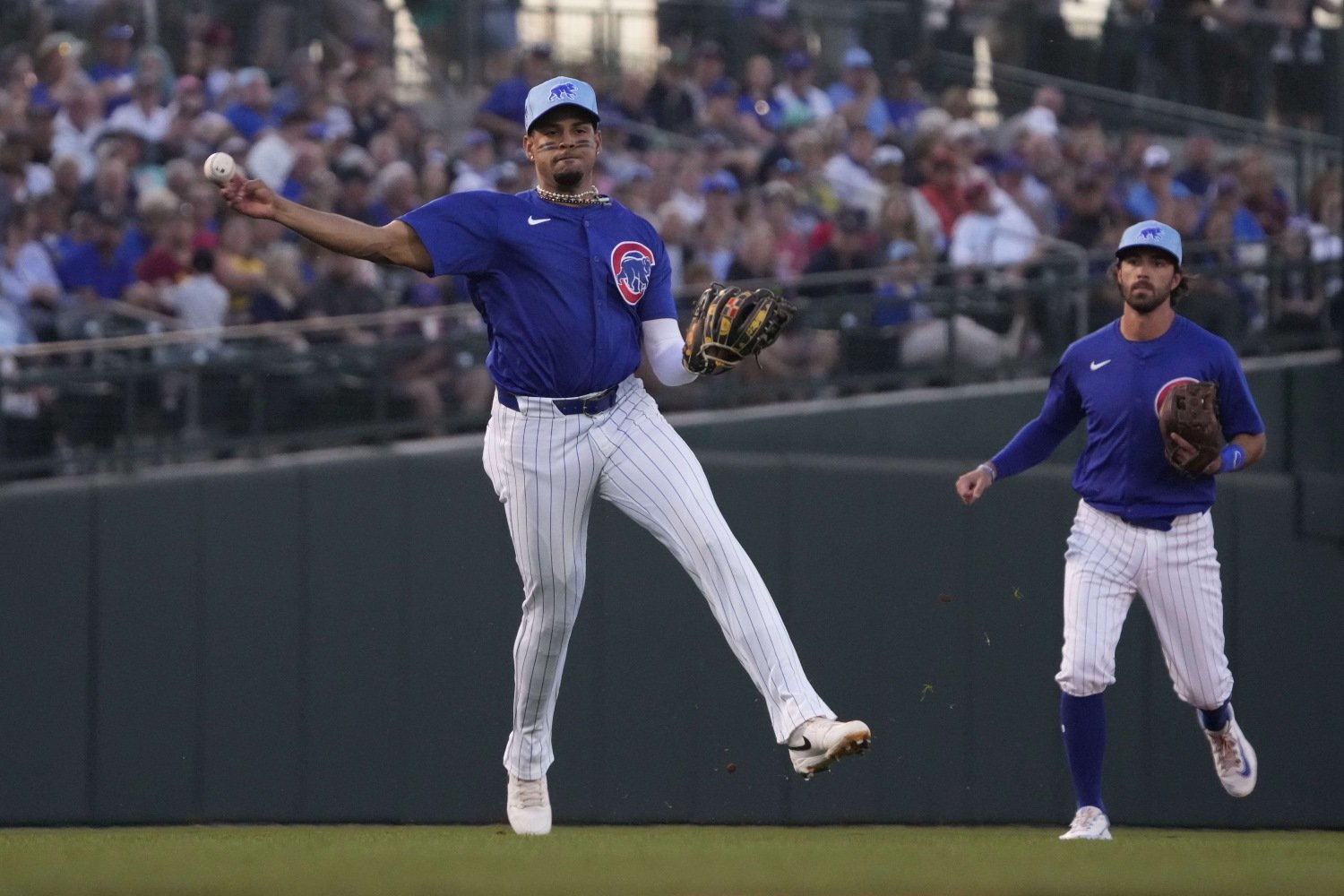
At this point in the timeline, it appears that Christopher Morel will be the Chicago Cubs Opening Day starter at third base. The previously nomadic defender should have a permanent spot, at least from the jump. It’s a logical way for things to play out, given a couple of factors.
The most obvious is that Morel becoming a mainstay there would present the additional benefit of circulating other players in the designated hitter slot, which could ultimately wind up a boon for the offense. The more crucial one, though, is Morel’s skill set in comparison with other options.
We’ve discussed the team’s options at the position extensively. Patrick Wisdom offers a decent offensive profile for the spot, but is very much a below-average defender. Nick Madrigal gives you defensive efficiency but is nowhere close to the bat you’d want at the hot corner. The player health variable clarifies this further. Wisdom was limited early in the spring with a quad issue. Madrigal remains out with the latest in what seem to be perpetual hamstring issues. By the time we reach the end of March, Morel will likely be the only candidate to get a full spring's worth of preparation.
Even beyond that, though, it stands to reason that Morel merely has to be average in order to maintain his grip on the spot. His offensive upside is such that he can compensate for a lot, especially given some of his comps on that side of the ball in a defensive context. So he’s the guy, basically, until he’s not--even if a couple of early spring errors give us the slightest bit of apprehension.
With that, though, we need to consider an important shift in the line of questioning. Not necessarily “Can he hang at third base?” but rather “Can he keep up enough to hang at third base?” Can he grow into the position efficiently enough, even if the early returns aren’t terrific? The distinction lies in the broader context of the position itself. It’s insufficiently specific to say that Morel can start and remain at third base with simply passable defense. What classifies as passable defense at third base is continually evolving. This adds another layer to Morel’s specific situation.
Defense – as a whole – has improved across Major League Baseball over the parade of decades. There are a few theories as to why, none of which I have the space to explore right now (but stay tuned). Twenty years ago, teams were committing 0.66 errors per game. Ten years ago, that figure was at 0.60. Last season, errors were committed at a 0.52-per-game clip. Average fielding percentage has gone .983, .984, and .986 over those same leaps in time. Now, obviously, it’s oversimplified in the face of positional context, in addition to the fact that neither represents an effective measure of a player’s defensive skill. Nonetheless, they do provide a snapshot to showcase the simple idea that defense has improved.
Among qualifiers at third base specifically, the average Outs Above Average (OAA) figure was 1.1 in 2016 (the earliest point at which we have that data) but rose to 1.7 in 2023. Defensive Runs Saved (DRS) in 2016 was 1.6. In 2023, that figure was 2.8. Fielding Run Value (FRV) – a more comprehensive metric than either of the other two – rose from 1.6 in 2016 to 2.8 in 2023. It’s an imperfect science. The “average” alone takes into account the entire range of defenders, and the individual years do feature some fluctuation. The leaders at the position from 2023 also aren’t on the other side of a massive gap from the leaders in 2016 (OAA leaders went for 18, 12, and 11, respectively in 2016 and were at 17, 13, and 11 in 2023). But the big picture does speak to the idea that defense has steadily gotten better.
With expansion more than a quarter-century in our rearview, teams don't have to choose between players who can hit and those who can field as often. It's much easier to find players who can do both, which makes every weakness more glaring than it would have been 20, 30, or 40 years ago. With better positioning and better coaching, too, the conversion rate on balls a fielder reaches just keep rising. In the 1960s, or even in the early 1990s, it might have been possible to get by with a mistake-prone hot corner defender who uses good range to make up for mishaps. In 2024, that's not a viable strategy. The other team's not going to make the mistake that evens the scales. You have to find ways to minimize them in an absolute sense, because the relative cost of each has sharply risen.
This question of Morel’s ability to keep up with defensive growth around the league feeds directly into another query. How are we measuring his growth? Should we be looking at fielding percentage and errors while the sample remains small? It would, at least, be indicative of Morel’s individual ability to keep traffic off the basepath, even if we’re not measuring his true skill at the position. We can also look to DRS in examining Morel’s ability to prevent runs as a defender. Ultimately, that’s what it’s about for him at this stage. It’s not so much about converting outs as it is preventing runs. It's a philosophical and complex idea, but also makes Morel’s adjustment far more fascinating as a result. Defensive metrics, on their own, measure different things. That nuance could be essential in evaluating Morel’s first legitimate entry into the defensive world.
And maybe that’s where we look for his growth as the season progresses. Is he making the plays he needs to make and preventing runs? Yes? Then the Cubs are fine to keep rolling with him there. The defensive stature of the position itself hasn’t grown by leaps and bounds in a year-to-year context. The growth is essential, but it doesn’t have to be exponential. As the sample grows, the measurement can change.
The purpose of this isn’t to oppose or undermine my previous notion that Morel doesn’t have to be great on defense in order to be effective. That still rings true. While the Cubs have built themselves in such a way that success on the margins is essential, they are solidified elsewhere to the point where they can compensate for the occasional third-base flub. For Morel, it’s about the growth. Defense has improved quite steadily over the last few decades. But it hasn’t experienced any sizable jump between years that proved to be permanent. So for now, Morel’s aim should be preventing runs. Maybe later on, we can worry about converting outs.





.thumb.JPG.19c99ddd60a76edf810c77d321439828.JPG)


Recommended Comments
Create an account or sign in to comment
You need to be a member in order to leave a comment
Create an account
Sign up for a new account in our community. It's easy!
Register a new accountSign in
Already have an account? Sign in here.
Sign In Now