


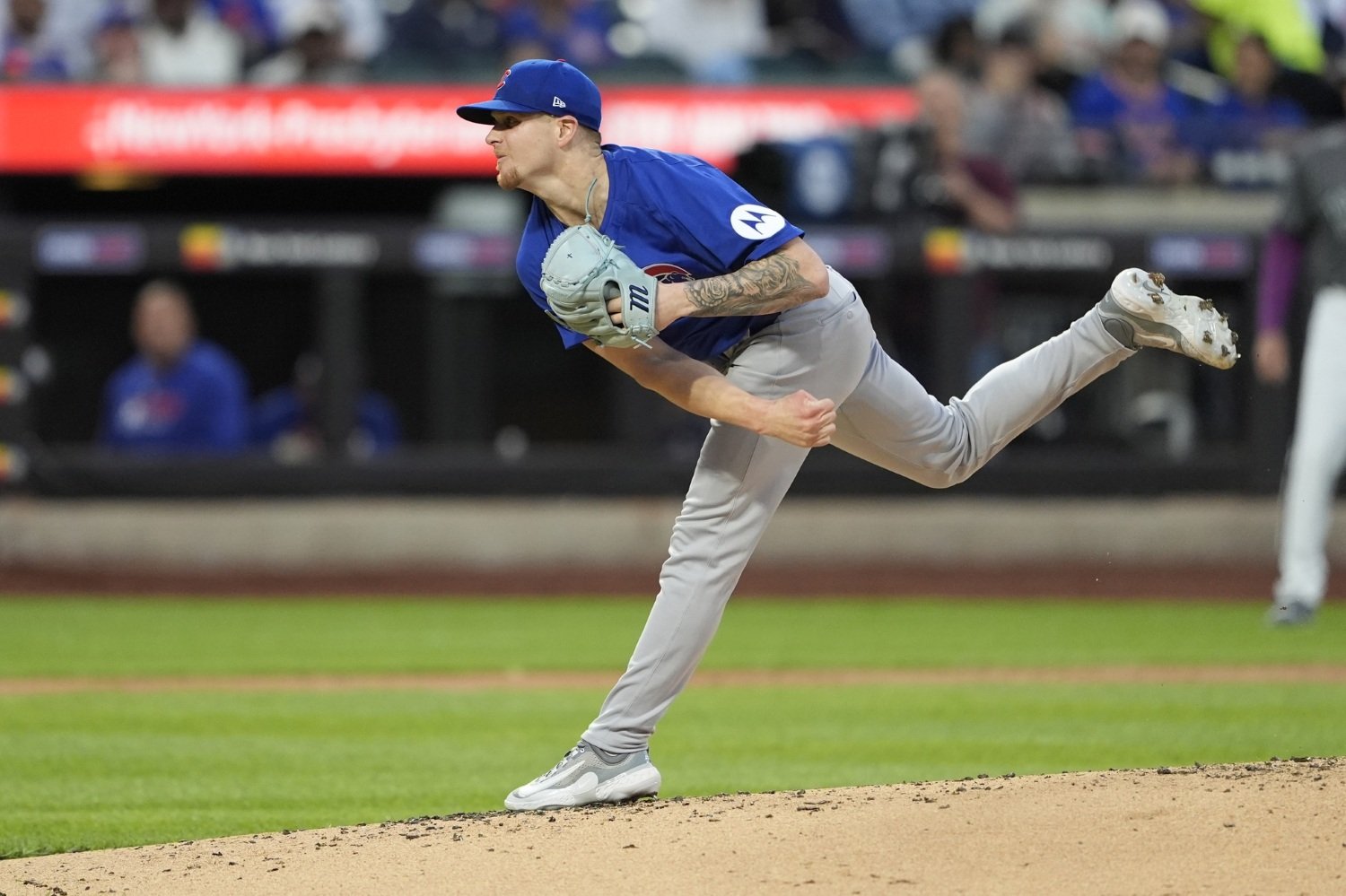
Cubs Video
Now that he's matriculated to the majors, Cade Horton can be studied a bit more completely than he was at Triple-A Iowa. With cleaner spin data and his arm angle to study, it's clear that Horton's primary pitch—what has been called a four-seam fastball, until now—is really a hard cutter. It's very similar to the offering Justin Steele used to become a frontline starter for the team three years ago.
Unlike Steele's version of the pitch, though, Horton's hums in at 95.8 mph. That's harder than any starting pitcher's cutter, this year, and is only topped by four relievers: Emmanuel Clase, Brad Keller (oh, hey!), Graham Ashcraft, and Porter Hodge (wait; whoa!). It's fair to say that the extreme cut-ride fastball the team began to emphasize years ago has become the signature of their organizational pitching philosophy. Horton is, in that way, the quintessential post-pandemic Cubs pitching prospect. He has a deep arsenal and plus overall stuff, but he also has the quirks that have made such success stories of Steele and Hodge.

Horton's secondary pitch does behave so much like a sweeper that it almost has to be labeled that way, but he uses it more like a true slider. The pitch labeled above as a slider, meanwhile, is more of a curve. His high arm slot makes taxonomizing a pitch with as much sweep as his slider has somewhat difficult. The only pitchers who use a higher average arm angle on sweepers than Horton showed on his in his first appearance are Nick Pivetta, Yuki Matsui, and Danny Coulombe. Either way, the story is the same: that main breaking ball—we'll just go along with calling it the sweeper—is a plus pitch on which much of his success will hinge.
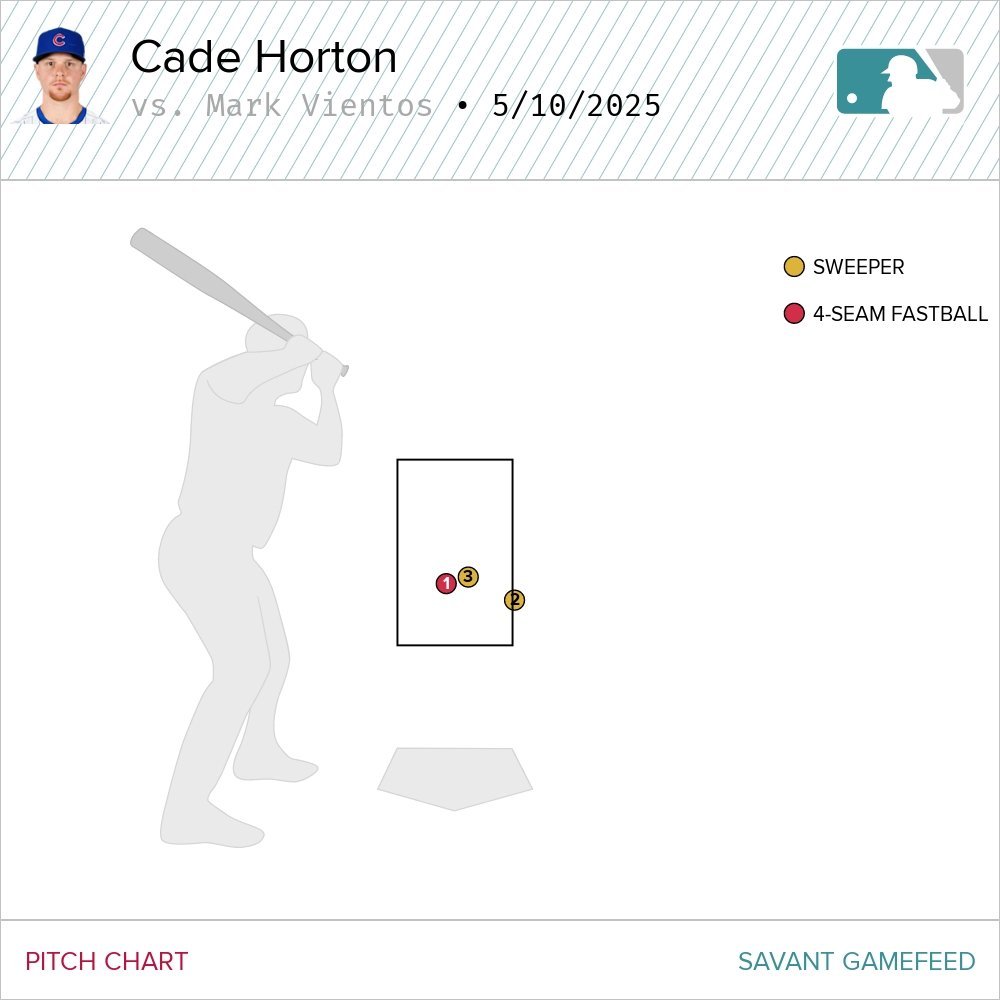
Last time out, Horton mislocated two key sweepers. One went for a single by Mark Vientos:
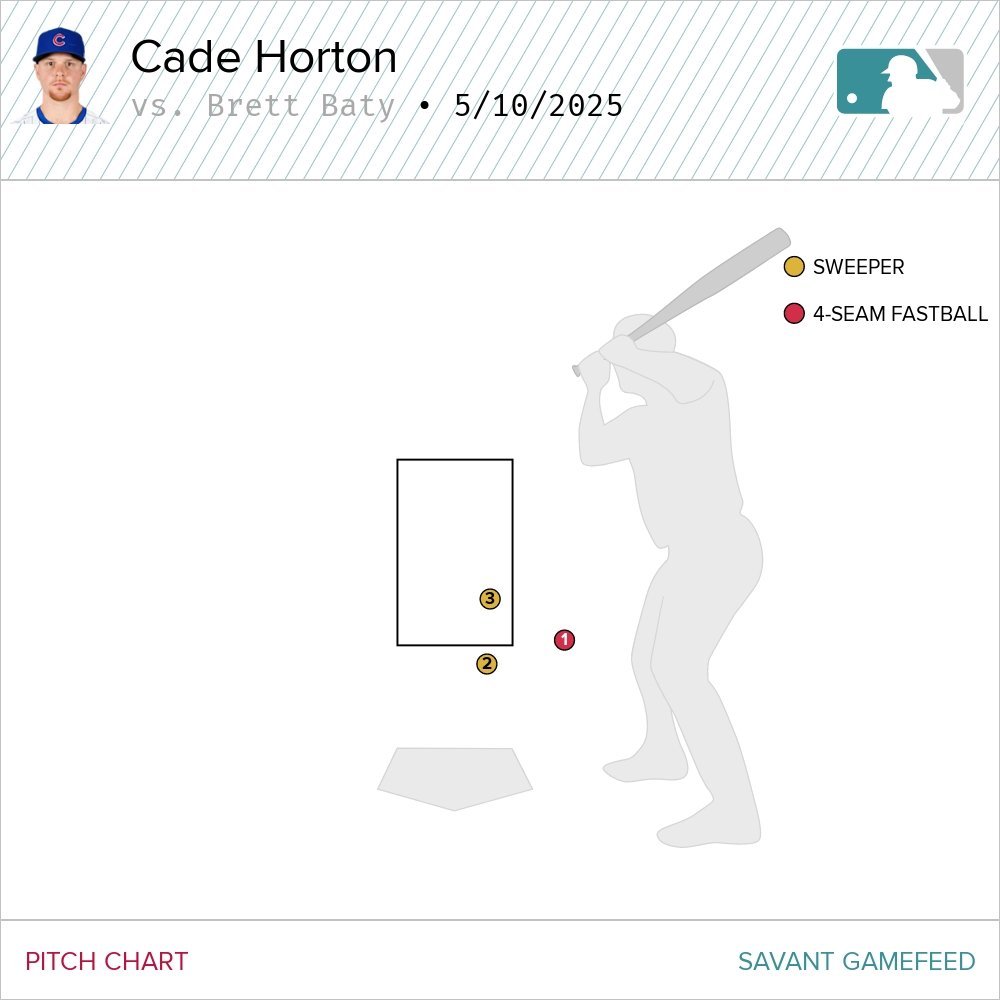
The other, far more costly, went over the wall, for a three-run home run by Brett Baty.
The Mets didn't provide much margin for error, though. They're a good lineup. On Friday, against the White Sox at Wrigley Field, Horton will get to pitch against a team that offers much more of a cushion. He still must learn to execute more efficiently, but as he hones that feel, he'll get a chance to dominate a weaker batting order—and do it with a huge, roaring crowd at his back.
Horton's importance to this team swells with each passing day. They probably intend to shield him from high pitch counts within games or innings totals over the full season, but with Justin Steele gone, Shota Imanaga temporarily shelved, Javier Assad struggling to get back from oblique trouble and Jameson Taillon regressing a bit, Horton needs to step up. Friday will be his first chance to prove he can handle that responsibility, as he certainly showed the potential to do last weekend in New York.





Recommended Comments
There are no comments to display.
Create an account or sign in to comment
You need to be a member in order to leave a comment
Create an account
Sign up for a new account in our community. It's easy!
Register a new accountSign in
Already have an account? Sign in here.
Sign In Now