


Cubs Video
Whether it was at the point of his signing with the Chicago Cubs or the games that have been played since, no shortage of internet ink has been spilled about the skill set and performance of Alex Bregman. A hitter with only moderate power, the plate discipline component recognized as a pillar of his offensive game was expected to be a boon for his own performance and for the collective. His patience at bat has been as expected, but it's come without some of the benefits that one might typically expect. Arguably, his vaunted approach has become a detriment, instead of a source of value, to the team.
In general, patience is an undeniably positive trait to possess as a hitter. However, therein lies a tipping point. There is a threshold where patience erodes production, because a player either won't or can't actually hit the ball consistently well enough to generate hits or power. It's a spiral in which Bregman currently finds himself mired.
On the surface, Bregman's reluctance to chase is doing its job. He's in the 88th percentile in chase rate, the 83rd in whiff rate, and the 73rd in strikeout rate. The strikeout number itself stands at 17.1%, which trails only Nico Hoerner among Cubs regulars. His 9.9% walk rate is above average, but reads as very similar to the 10.3% mark he posted with Boston last year. At this point, it should be noted that Bregman's bag isn't parlaying discipline into walks. His career walk rate sits at 11.7% against a 13.6% career strikeout rate. So it's not necessarily a concern that his strikeout rate is up a touch while the walk rate is lower than his peak years in Houston. He was never trying to take pitches just to draw walks.
Instead, the much larger concern lies in what that discipline is designed to do, but is no longer doing. Bregman's aim in being so selective is to generate hard, aerial contact. Since he broke into the league in 2016, his 86.4% contact rate ranks 36th among nearly 600 qualifying players. His 5.5% swinging strike rate ranks 20th among that same group. While he was never a masher—his 38.4 Hard-Hit% sits 291st—there's been a real and substantial loss of thump when he makes contact, which forces us to ask: is his approach starting to work against him? Is it part of his power outage?
In terms of the actual plate discipline numbers, Bregman's 40.6% swing rate isn't that unusual. It's identical to the number he posted with the Red Sox in 2025, and almost perfectly in line with his 40.2% career mark. What's unusual, though, is his swing rate inside of the strike zone. Bregman is swinging in the zone 57.4% of the time, which would be tied with 2019 for the lowest in his career. As a result, he's sitting at a 22.3% called strike rate—currently the highest mark of his career, and about three percentage points above his career average.
For the visual learners, here's what that looks like. This is Bregman's swing rate from 2016 to 2025:

With any zone visual such as this, you expect there to be heavy red over the heart of the zone and then progressively fade the farther it gets. If we could see the percentages, we'd see the middle-middle portions read at or around 70 percent and the other more favorable parts of the zone in the 60s. That stands in heavy contrast to the chart we see in 2026:

That up-and-in spot is a concerning element of its own. But over the heart of the zone, there's much less action overall. Percentages here are topping out in the mid-60s in the heart before quickly fading into the 50s—not that that should read as a surprise, when the cumulative rate has come down. In Bregman's case, it's not even that he needs to be more adventurous in expanding the zone to create more opportunities. He's simply missing those that already exist in the most obvious part of the zone in which he could be creating impact.
That's further reflected in Statcast's zone-designated run value. Run value is divided into four areas of the zone: heart, shadow, chase, and waste. In chase and waste, Bregman is working with a positive run value. Even in the shadow of the zone, he's at a -5 run value that is actually his best mark since 2019. In the heart of the zone, however, he's working with a -15. That's the worst value of his career in that area (and not particularly close to any of its predecessors). Further, Bregman's swing percentage on pitches designated "meatballs" is at 63.3%, also representing a career low.
A hitter who is too patient looks like one whose swing trends look good on the surface—as in, this guy restrains himself from hacking wildly—but with a waning contact rate. Bregman's 83.1 Contact% is his lowest since 2016 (as is his 88.7% contact rate on pitches inside the zone). Someone who's too patient is unable to parlay that contact into anything impactful. Bregman's hard-hit rate is down to its lowest mark in four years, while his .101 isolated power is more than 100 points lower than his career average.
We also (gulp) have to acknowledge that it's possible Bregman is swinging less because he knows his swing is worse. The Cubs made a big bet on his loss of bat speed after a quad strain last year being temporary. They might have already lost that bet. Here's a chart showing his rolling swing speed over 100-plate appearance windows since the start of Statcast bat-tracking. The red line is the point at which he hurt his leg and missed almost two months last year:
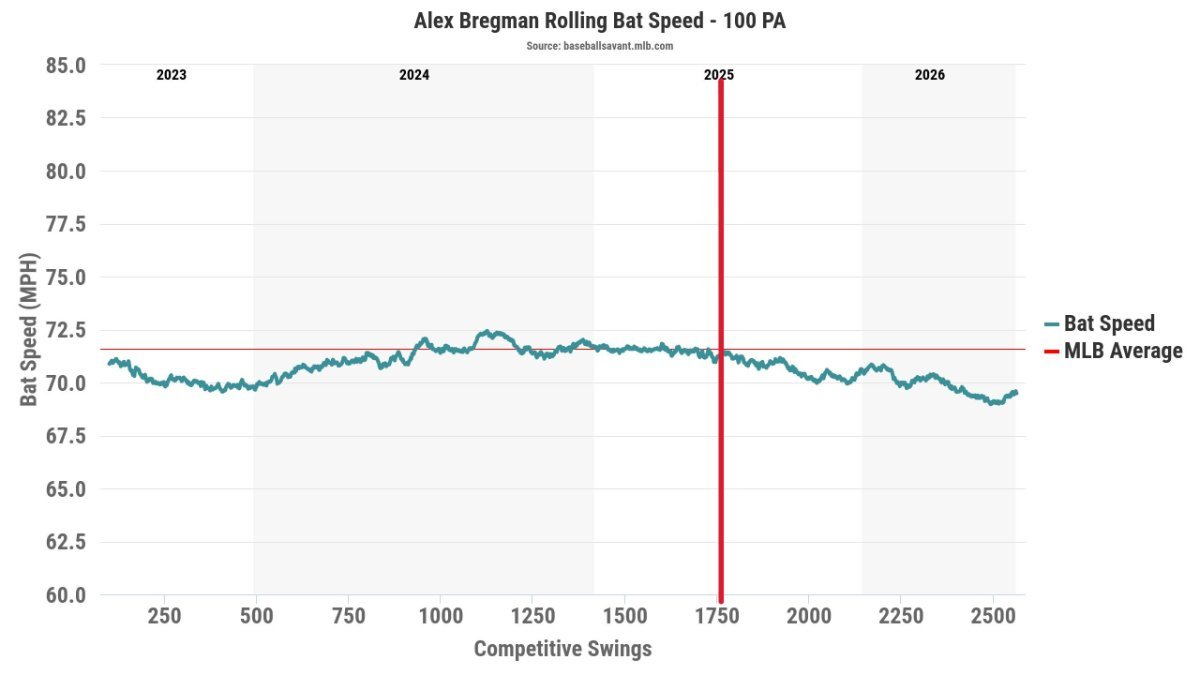
Uh-oh.
Again, this isn't a player who is set in his ways and unwilling to take risks. Bregman would probably have made a larger adjustment to his approach by now, if he felt that he could. He needs to start swinging more, especially at pitches in the heart of the strike zone—but maybe he can't, at least the way he's always been able to. That would be terrible news for the Cubs.





Recommended Comments
Create an account or sign in to comment
You need to be a member in order to leave a comment
Create an account
Sign up for a new account in our community. It's easy!
Register a new accountSign in
Already have an account? Sign in here.
Sign In Now