


Cubs Video
Let's go way, way, way back in time for a moment. To a time when average temperatures were hovering in the 30's, a time before the Cubs first home game at Wrigley, and a time before PCA became an MVP front-runner... let's go all the way back to March 18 in Tokyo, Japan. It is the second inning of Opening Day, as the Cubs face off against the Dodgers. Matt Shaw is hitting against stud pitcher Yoshinobu Yamamoto, no easy task for your first official MLB at-bat. The count is 1-2, and Matt Shaw is about to swing. I'll let the video do the talking.
Yeesh. You can insert your favorite superlative for whatever this was yourself. For me, I'll call a spade a spade—that's the pre-pitch set-up equivalent of "a face only a mother can love". Shaw is hunched over, he has the big leg kick, he's in a different area code than the plate is. Yuck. This was Matt Shaw's first ever swing in an MLB game and it was hideous. I'll also admit that I had probably become desensitized to his swing over the years, and as I look back, I can admit how brutally odd that set-up is. Farmers go nose-blind to the smell of animals the same way I had gone swing-blind to Matt Shaw's stance.
This swing was always a yellow flag. The Cubs' diminutive third baseman had never struggled at a particular level, but how his swing would hold up against the best of the best was yet unseen. Again, looking back, I probably should have been more skeptical, and those who were... were proven correct. As the season trucked along, Matt Shaw struggled at the plate pretty badly, eventually being sent to Iowa to work on things once again. There was some obvious things to work on to help the hitter get his timing down against the best collection of throwers in the world, namely, the leg-kick.
When he returned, changes were (clearly) afoot. Not only was the leg kick toned down, Shaw was much more upright and closer to the plate. This wasn't an entire overhaul, but small tweaks with meaningful impact. He instantly showed an ability to go the other way, hitting the ball hard to the right side when he returned. Things were certainly looking better. Upon returning on May 19, Shaw would immediately start hitting the ball with authority the other way. See for yourself on this double in his first game back with the parent club and notice how different the leg kick is.
Initially, these changes seemed to make a big change for the Cubs' rookie, as Shaw posted a sparkling 148 wRC+ over his next 17 games (62 PAs). This included seven doubles and a home run. Behind these raw numbers, though, the Statcast data painted a strange picture. Up were the barrels, as he connected on four barrels over this run, which is a big improvement over the singular barrel he had previously. However, some issues lingered: a five-degree launch angle, middling exit-velocities, and not a lot of pull were not exactly what you'd like to see. Shortly, these would eventually catch up to him once again.
Over the 15 games that followed, Shaw would struggle, picking up just four hits over his next 48 appearances. The walks dropped off, the exit velocities got worse, and the hard hits dropped too. Now, I think part of this is bad luck. FanGraphs just ran an article looking at some of the players who have had the biggest discrepancies in actual BABIP versus expected BABIP and, lo and behold, Matt Shaw's name appeared. In fact, only six players had a lower differential. Regardless of luck, this was not a good run. Both Matt Shaw and the Cubs seemed to have taken notice and more changes were shortly implemented.
June 15 is our next important date, as Matt Shaw doesn't play. This is a Sunday, heading into an off-day on Monday. Shaw is in the middle of some pretty bad contact over the last stretch of games, and the Cubs gave him a day off. But, coming out of this two-day reset period, Shaw debuts something new: higher hand placement. Up until June 14, Shaw had been using the same swing as we saw above in Miami: same hand placement, same leg-kick. But, on June 17, this happened:
That is, unquestionably, our next evolution in the swing; higher hand placement. And the result was good! A nice double! His hardest hit baseball of the season (to this date), Shaw shoots a double between center and right field. That's a good swing, taking the ball on the outer-third and driving it the other way, Sadly, over the next few days, the results remained poor, and the contact quality got worse. That doesn't bring us to the end of the story, though, as there was one more change to be implemented (as of writing this article).
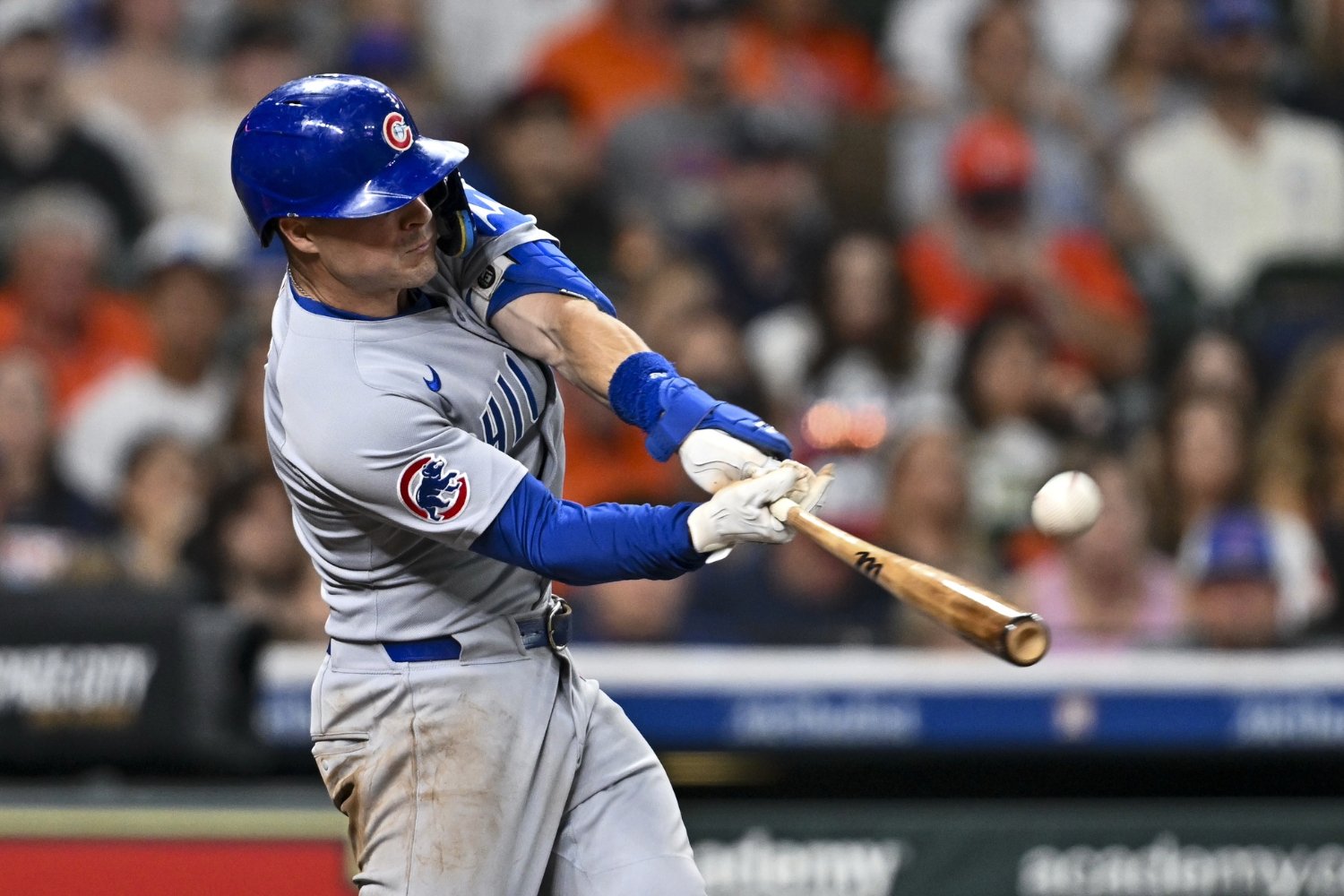
That brings us to now and the next iteration of his swing, and it won't take an eagle eye to pinpoint the difference: the leg kick is gone. Shaw has, over the past few weeks, begun replacing the leg kick with a toe-tapping mechanism. I started to notice it intermittently back on June 19 (after yet again another off-day), but it seems to have really kicked in over the course of his last handful of games. Below is a swing from the game on July 1. While Shaw's outcome of a fly out to right-center field is less than ideal, Shaw's exit velocity of 97mph is pretty good and he had an xBA of .300 on the swing. This is much better than weak contact, and helps to highlight the new timing mechanism he's been displaying over the last handful of games.
While these changes are notable, this only matters if we can pinpoint a difference in the data. It's great to make tweaks and changes, but they need to be meaningful. The good news is that, yes, it appears to be making a difference. Since June 17, Matt Shaw has increased his average exit velocity from 83 mph to (over than span) 84.7 mph. He's had his two hardest hit balls of the season, increased his launch angle to 12 degrees, increased his hard-hit% from 26.6% to 37.9%, and cut his ground ball rate under 40%. If you'd like reason to pause, this data is over just 29 swing-events and none of this is stabilized; this could be a blip still.
However, there also seems to be a better approach. The walk rate has jumped to over 11% of that span, the strikeout rate is at a pretty excellent 16.7%, while he's progressed positively in chase rate, zone-swing rate, zone contact and general contact. I don't think any of this is an accident. He's also swinging a bit less, an important step in learning what a major league strike zone really is.
I also find the timing important. It coincides with actual change and when I see change coupled with data, I start to get excited. You may not have noticed the change yourself, as despite the increase in batted-ball-data, his wRC+ over that span is just 82 wRC+. However, this is where that BABIP luck piece from FanGraphs should be singing in your ear—his BABIP over this span is just .241. What this means is that Shaw is almost assuredly dealing with the bad-luck monster right now. The processes are getting better, the batted ball data is better... the results should follow.
Keep an eye on these small evolutions as the year goes on. We're around the time last year when Pete Crow-Armstrong made some important mechanical fixes and around the same time when Miguel Amaya made changes to his approach. Both hitters were far better in the second half of the season and have continued hitting into 2025. There has been a decent amount of discourse in how the team may improve their third base situation for 2025, but the Cubs may not need to if Matt Shaw's transformation at the plate is happening before our eyes. He's already progressed greatly on defense (+6 DRS at the position now and the OAA data is improving as well), so getting him to continue these steps at the plate could really be a free boost for the Cubs. And, as Shaw has struggled at times, it's good to remember that since returning from Iowa, he's posted an 89 wRC+ at 3B League third basemen have hit to the tune of a 96 wRC+, so it's not as if he's far off from even being league-average at the position offensively.
So, is this the Shaw breakout we have all hoped for? I can't say for sure—in baseball, so little is ever "sure". Recent data suggests rookies need a few hundred PA's again MLB pitching to begin to adjust, and we're getting to that level for Shaw. As the tweaks keep coming, the data underneath seems to be improving along with it, as well. What I can say, though, is that if the Cubs' rookie was about to breakout, this is what I'd expect to see; better swing decisions coupled with better mechanics and improving batted-ball data under the hood. I won't say anything for sure, but I wouldn't be shocked if this was the spark we had been hoping for since Shaw took that first butt-ugly swing of his career back in March.
What do you think of Matt Shaw's swing? Have you noticed these small evolutions? How would you handle the deadline? Let us know in the comment section below!
Are you optimistic about the Cubs right now?

Follow North Side Baseball For Chicago Cubs News & Analysis



-
 1
1



Recommended Comments
There are no comments to display.
Create an account or sign in to comment
You need to be a member in order to leave a comment
Create an account
Sign up for a new account in our community. It's easy!
Register a new accountSign in
Already have an account? Sign in here.
Sign In Now