


Cubs Video
Let me throw a couple of facts at you. At first, these will seem odd, disparate, and silly, but I promise to build a convincing connection between them.
- Josh Gibson, one of the best handful of players in baseball history, used a bat that was 41 inches long. That's a good five or six inches longer than any current player uses, but the rules still permit bats as long as 42 inches.
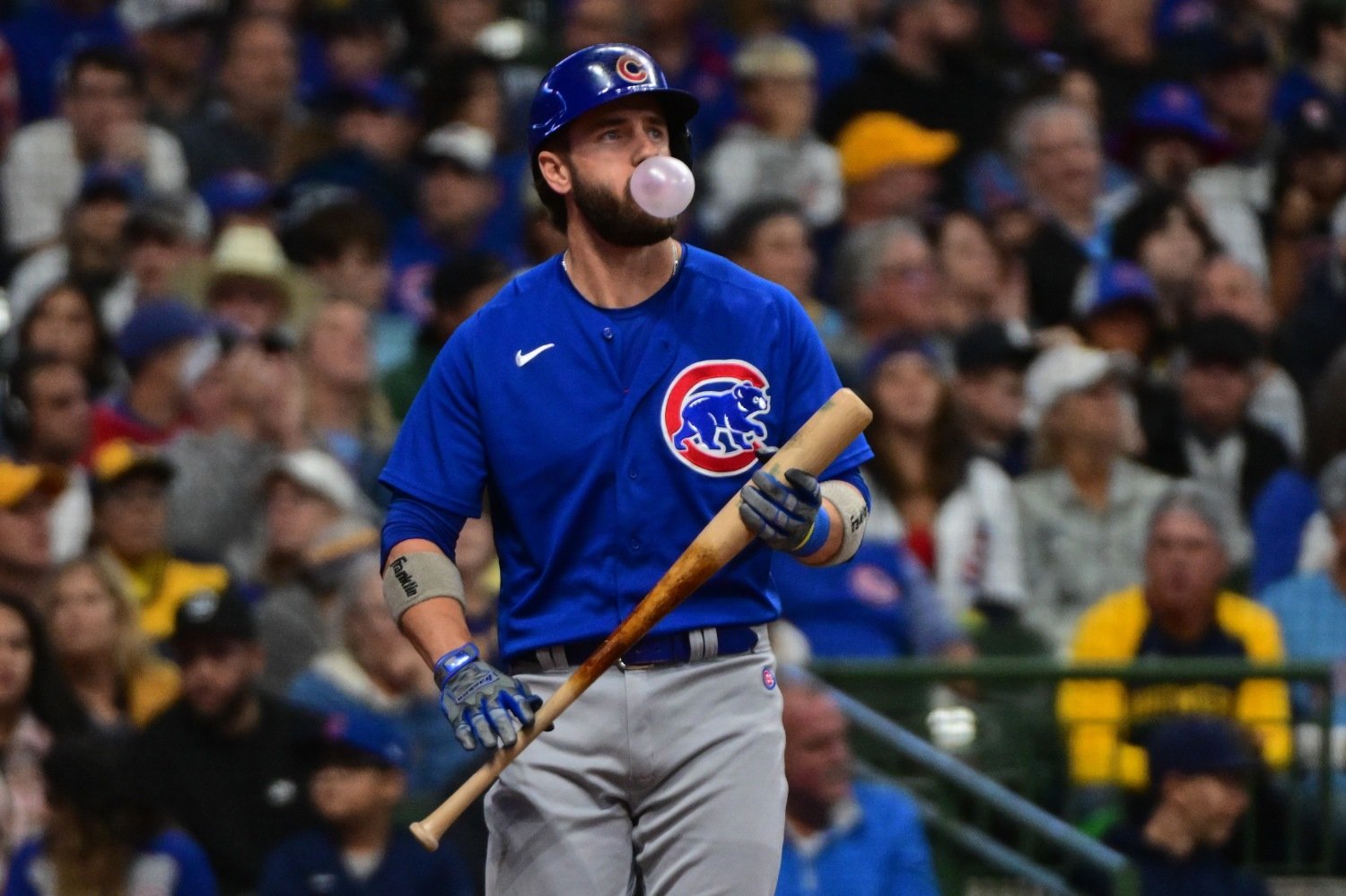
- Patrick Wisdom, one of the best handful of players on the 2022 Chicago Cubs, strikes out anywhere from 30 to 40 percent of the time. He wields bats ranging from 33 1/2 to 35 inches in length.
- In baseball history, there have been 1,763 documented instances of a batter reaching base on catcher interference. Nearly half of those have come in the last 30 years, though.
Famously, Gibson (like his contemporary Babe Ruth) used a bat that mirrored his larger-than-life image among players and fans. Ruth's bats weighed in as heavy as 50 ounces, and were often nearly 40 inches long. That wasn't the norm even at the time, though, and in the modern game (with pitchers throwing much, much harder than they did then and a better understanding of the relative values of bat mass and bat speed in creating power), most hitters use something considerably smaller, even though most hitters are at least as big and strong as were Ruth or Gibson.
Wisdom swings a good-sized stick, by modern standards, but he's six inches shy of Gibson. That's the game now. However, the game has also changed in other ways, including some fueled by equipment evolution. Above, I mentioned the 1,763 catcher interferences we have in the historical MLB record. Let's break it down further:
- Through 1946: 157
- 1947-71: 243
- 1972-81: 221
- 1982-91: 200
- 1992-2001: 191
- 2002-11: 194
- 2012-21: 387
- 2022: 74
- 2023: 96
For the first 60-plus years of well-documented baseball history (those where we can be pretty sure we're not missing a whole bunch of these types of plays), catcher interference was extremely rare. Catchers were sparsely protected, and their mitts were designed for conservative, close-contact catches right in front of the chest. They weren't eager to get hit by a batter attempting a swing, and they had very little reason to even risk it.
In the 1970s, two members of the Cincinnati Reds began to change that. On one hand (literally), Johnny Bench revolutionized catching itself. An exceptional athlete who came along just as catcher equipment was also ready to take a quantum leap, Bench popularized a one-handed catching style and a different type of catcher's mitt, with a more fielder-like hinge and pocket. That, without even many of the involved parties realizing it, invented catcher framing. No longer was a catcher's influence over the umpire confined to politicking and a little bit of subtle leaning from a very inflexible position. Bench and the catchers who came after him began extending their arms forward to receive incoming pitches, and the ability to do that in a fairly fluid motion meant that they could start to sell strikes at the edges of the zone a bit more craftily.
On the other side of the ledger stood Pete Rose, the most ruthless competitor baseball had seen in several decades. Rose realized that, as catchers (better protected by improved safety equipment and learning their new way to receive the ball) crept forward in the catcher's box, he could let his bat drag and seek to hit the ball just before it arrived in the mitt--perhaps making contact with that mitt along the way. By rule, when that happened, he got first base. Few players in baseball history have wanted every 90 feet they could get (by whatever means) worse than Rose, so he took it via catcher interference 30 times in his career, including once in the 1970 World Series.
That probably sounds like a vanishingly small number, but Rose's total was not only the record at the time, but 10 more than anyone else in the history of the game. A couple of times a year, he would nick the mitt and take his base, and that was an extraordinary frequency for the first century and change of baseball history.
Rose played in a different era, though. Back then, opportunities for that kind of collision were virtually non-existent. It was still common for batters to slide up in the batter's box, and still uncommon for catchers to be truly crowding in from behind. That's changed. So has ownership of the all-time record for reaches via catcher interference--to Jacoby Ellsbury, who didn't get there by having one of baseball's longest careers and highest raw totals of plate appearances. Rose and Ellsbury still stand essentially alone atop the career leaderboard, but Josh Reddick had 19 of these. Carl Crawford had 17. Cubs folk hero Tommy La Stella had 16, and another three (the most ever) in postseason play. Memorably, La Stella reached on catcher interference in a two-strike count against Max Scherzer in the Cubs' wild fifth-inning rally in Game 5 of the 2017 NLDS.
The Astros' Kyle Tucker already has 12 of these (the same number accumulated by new Cubs manager Craig Counsell). Given his youth and talent, it's very likely that he'll join Rose and Ellsbury, or surpass them by a substantial margin. As the list above shows, the frequency of catcher interference has exploded in the last 15 years. Of the 36 games in baseball history featuring at least two such plays, 22 have come since 2008. The only one ever to include three came on April 15 of last year.
PITCHf/x gave us a way to (first) quantify and (next) augment pitch framing, and catchers have responded by encroaching on the hitter's space more with each passing campaign. Hitters are standing closer to the plate, because if you want to hit for the power the modern game requires, you have to. They're also standing closer to the back of the batter's box, because if you want to catch up to 103-mile-per-hour fastballs, you have to. The confluence of those trends happens just behind home plate, where it's just much, much more likely (though still very unlikely!) for the bat and the catcher's mitt to run into one another.
On Aug. 1, 2021, just after the fire sale that ended the run for the Cubs' championship core, Wisdom came to the plate in Washington, where the team was tied 5-5 with the Nationals in the top of the ninth. The leadoff man in the inning, he took a strike, fouled off the 0-1 offering, then watched three straight balls. He fouled off the first payoff pitch, and on the next one, his stick caught the side of catcher René Rivera's glove. Wisdom got first base, on what is still the only catcher interference of his career. He was promptly erased on a double play off the bat of Matt Duffy, and the Cubs lost in the bottom of the ninth, but he did start a rally that night.
Wisdom's game is power, and it's important that he swing a stick that allows him to get to it. The big question about his bat, though, is whether he can consistently get on base more often than he has throughout his career so far. His lifetime OBP of .298 won't keep him in the lineup, and when the Cubs need him, they won't get much help from him if that's the rate at which he avoids outs.
He's plenty strong, though. What if you gave Wisdom a bat six inches longer and a few ounces heavier than his current one and told him to cut it loose, just like he's been doing for the last three years? At the bare minimum, you'd force an opposing catcher to back off, and damage their ability to frame pitches against him. If the league were too slow to make that adjustment, he could get on base an extra handful of times in a short span.
This would drive people nuts. It's gimmicky and it's silly. It's also a fun thought exercise, though, because it forces us to confront the fact that baseball's margins have dwindled to zero in one critical zone, and that the impact of that compression is greater than we'd tend to imagine. Wisdom is a good candidate for it because, given his size and his problems with strikeouts and OBP, he's the guy who can make legitimate use of a bat that big and derive the greatest benefits from the stunt.
There's an element of physical intimidation in this ploy. There's an element of cheeky rules manipulation. Still, it's hardly playing dirty. Hitters are under attack, in the modern game, and one of the ways we hardly ever notice in which that's happening is that catchers are closing off the space in which they might try to work, from behind. This might create more space behind the plate for Wisdom's teammates, too. It might take away a pitcher's backdoor slider or their just-hang-on fastball at the knees. Forcing a catcher to adjust his depth more than he's comfortable might alter a few things about the interaction of pitcher, batter, catcher, and umpire, which is becoming the essential one of the game. It's very silly. It's also a serious proposal. Patrick Wisdom should start carrying a bigger club to the plate with him.
Which team do you dislike the most in the NL Central?

Follow North Side Baseball For Chicago Cubs News & Analysis



-
 1
1
-
 1
1


Recommended Comments
Create an account or sign in to comment
You need to be a member in order to leave a comment
Create an account
Sign up for a new account in our community. It's easy!
Register a new accountSign in
Already have an account? Sign in here.
Sign In Now