


Cubs Video
As the offseason looms, there's a veneer of homeostasis around the Cubs' infield. Michael Busch established himself as a strong first baseman in his rookie campaign. Nico Hoerner and Dansby Swanson are signed to multi-year deals with eight-figure annual salaries, and Isaac Paredes is a two-time All-Star acquired just three months ago, who still has team control remaining.
In truth, though, there's a chance the team will seek out significant changes to the infield mix this winter, even if none of them come at the direct expense of any of those presumptive starters. Paredes had a very rocky first month with the club. Swanson and Hoerner were almost invisible until the final two months, by which time the season was lost. Based on his profile, it's easy to envision wanting Busch in a prominent lineup position against right-handed pitchers, but not wanting him in the lineup at all against most lefties.
Each of these promising and talented players has warts, and even if they didn't, reinforcements would be needed. No team gets through a season without incurring injuries to each unit of their roster, and the Cubs' reserve infielders weren't good enough in 2024. With Miles Mastrobuoni, Patrick Wisdom, and others crying out to be replaced by better options, the team needs to head into the winter planning to upgrade their depth on the dirt.
There are players high in the team's farm system who could contribute as the season progresses, but it's important that the team not depend on that outcome. Yet, it's hard to recruit free agents of especially high quality when you don't have a starting job to offer them. Try to fill secondary roles via MLB free agency, and you end up with deals like the Daniel Descalso disaster. So, the creative solution is to look around the trade market and identify players who are good fits for your needs, but who might not be good fits for their own organization--not because they're too deeply flawed, but because those teams have limited spending power and they're due for salary bumps via arbitration that might not be deemed affordable. Here are three lefty-hitting infielders who fit those criteria for the Cubs as the hot stove season draws near.
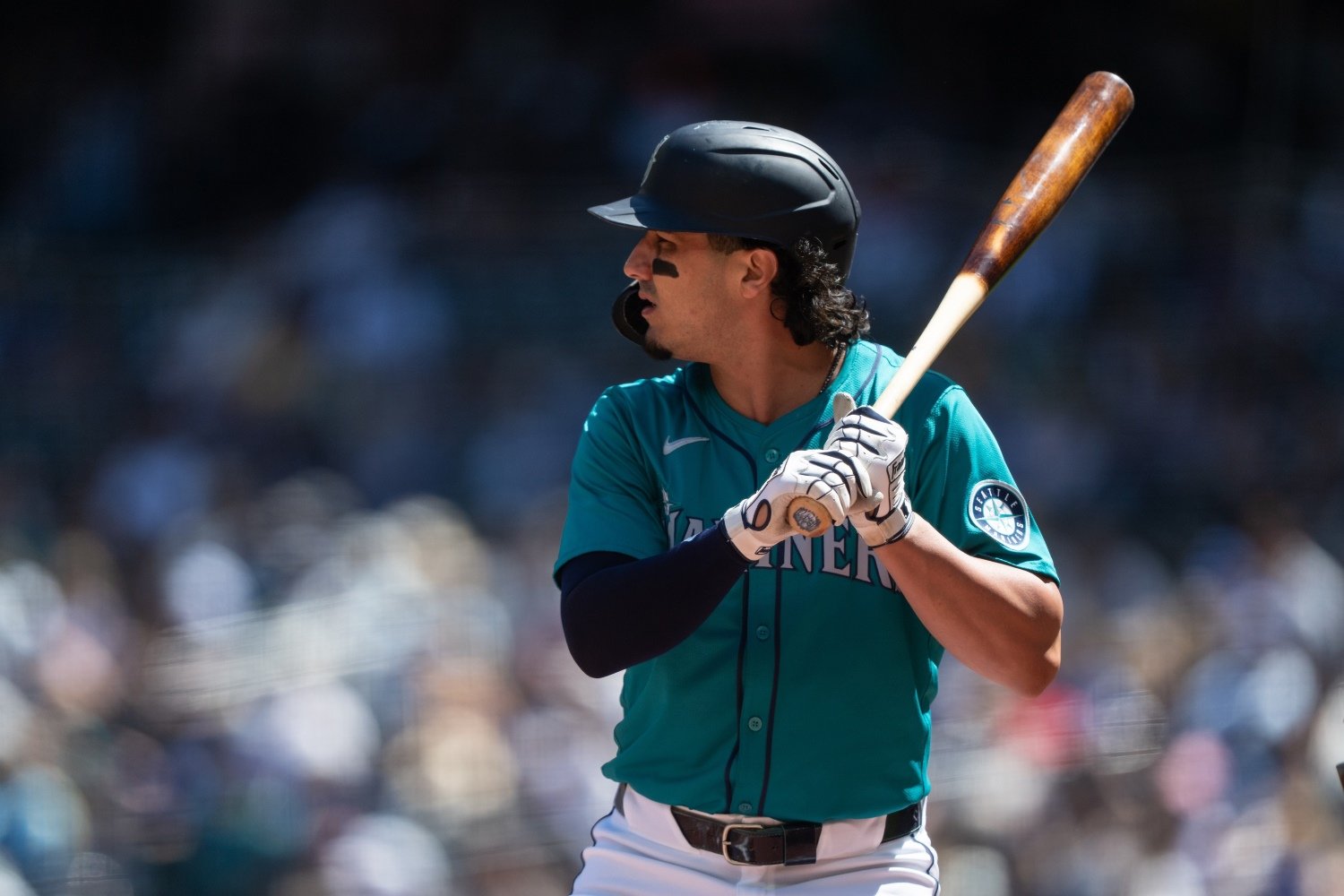
Josh Rojas, 3B, Mariners
Two years of team control remaining, est. 2025 salary: $4.3 million, per MLB Trade Rumors
A late-blooming underdog, Rojas didn't fully establish himself until his age-27 season with Arizona. Dealt to Seattle in the Paul Sewald trade at the 2023 deadline, he's been an underwhelming contributor for the Mariners. However, he just turned 30 at the end of June, and he still has several features to recommend him as a complementary piece for this infield.
A lefty batter, Rojas could be a partial platoon partner to both Hoerner and Paredes, based on matchups and the team's day-to-day defensive needs. He's a fine defender at the hot corner, and a passable one at the keystone. He only batted .240/.318/.370 against righties this season, but that undersells him significantly. Seattle's home park is the only one that played tougher for batters than did Wrigley Field in 2024, but that's just part of the story. Rojas struck out just 20.8% of the time and walked 9.8% of the time against righties, with an above-average hard-hit rate and plenty of line drives and fly balls.
Against righties, he's a balanced, average-plus hitter, with below-average power but above-average ability in all other aspects of offense. Rojas just needs to be sheltered from left-handed pitchers. The Cubs would be in position to make 90 percent of his plate appearances come against right-handed ones, and they can benefit from his defensive flexibility, too. If the Mariners don't want to pay an average salary for a player who can't quite hack it as an everyday option, the Cubs should be first in line to nab him.
Willi Castro, UTIL, Twins
One year of team control remaining, est. 2025 salary: $6.2 million
One of the most unlikely All-Stars of the season, Castro blossomed gorgeously in his second season with the Twins, after he was so raw and frustrating that the Tigers non-tendered him in 2022. He flailed and sputtered down the stretch, playing more often and in a wider variety of places than almost anyone else in the league, but the overall picture is still one of a player who does a lot of things well.
Castro will only turn 28 next April, and in addition to the dynamism of his offensive game, he brings value with his glove and his legs--although the latter has proved somewhat fickle. After stealing 33 bases in 38 tries in 2023, Castro was caught nine times and stole just 14 in 2024. He also made more bad baserunning mistakes this year, but in general, his speed and aggressiveness are still assets. He's also as versatile a defender as almost anyone in the game, having appeared at least 25 times at five different positions last year: second base, third base, shortstop, left field, and center field.
The switch-hitter handles righties better than lefties, but isn't helpless when batting right-handed. He's a slightly better and much more flexible bat than Rojas, and his capability at so many spots makes up for a lack of brilliance at any particular one. The downsides are that he will cost more money, be under team control one fewer year, and perhaps still cost more in a trade than Rojas, but the Cubs can weigh their options and select the superior deal--as long as they're proactive about ascertaining the availability of each. The Twins' payroll has no room to inflate next season, so Castro's waiting payday will be mildly onerous for them, unless they can move him.
Luis García Jr., 2B, Nationals
Three years of team control left, est. 2025 salary: $4.8 million
More so than with Rojas or Castro, getting García might require really ponying up, but he could very well be worth it. A top prospect heading into 2020, García was rushed to the majors rather than have his season wasted, but it's slowed his development into a mature big-league hitter. Just 24 years old even after playing parts of five seasons, he really figured some things out in 2024.
Over 140 games and 528 plate appearances, García hit .282/.318/.444, with 18 home runs and 22 stolen bases. He's a left-handed hitter and a fine baserunner, although a subpar defensive second baseman. His bat is so potent--especially against right-handed pitchers, whom he clubbed to the tune of a .469 slugging average--that he'd be a transformational situational upgrade over Swanson (.361), Hoerner (.359), or Paredes (.360), none of whom slugged within 100 points of him off righties.
Whereas the Mariners don't view Rojas as a core piece and the Twins need to move so much money that Castro is a tough fit, Washington could plausibly hold onto their second baseman. In all likelihood, García would require a trade package rich enough to leave the team feeling an obligation to play him nearly every day. He could find some of that time at designated hitter, some as a bench bat, and some in place of Paredes, but he'd have to heavily cannibalize Hoerner's playing time to rack up 550 or more plate appearances.
These are three distinct player types, but they would all functionally take up the same roster spot for the team next year. Rojas would be a platoon player and defensive specialist. Castro would be a super-sub and chaos creator at the bottom of the lineup, keeping everyone fresh and catalyzing an offense that often lacked that very ingredient last year. García is the one with the star-caliber upside and the power so many fans crave, but he'd also be markedly more costly than the others--with a hefty arbitration-driven price tag over the next three years, plus an acquisition cost much like those of Paredes and Busch.
Maybe none of these three come to fruition, but each represents the kind of upside the team needs to seek as they round out their roster for 2025. Whether or not they successfully upgrade any of their nominal starting positions, they have to be deeper than they were this year, when Craig Counsell increasingly stuck to his trusted nine every day over the final two months--not because they were world-beaters, but because no one on his bench was a credible alternative even when his weaker starters faced bad matchups. Jed Hoyer's job this winter is to make a roster that overflows with talent, and these three trade targets are exemplars of the player type the front office should be pursuing: overqualified role players or perfectly adequate regulars, should the need for that arise. That they're all available as much for financial as for baseball reasons should only make the Cubs more eager to pounce.





Recommended Comments
Create an account or sign in to comment
You need to be a member in order to leave a comment
Create an account
Sign up for a new account in our community. It's easy!
Register a new accountSign in
Already have an account? Sign in here.
Sign In Now